
调仓换股

Search documents
对价值有一个合理的认知,价值并不是持有时间的问题,而是通过操作实现长期收益
Ge Long Hui· 2026-02-26 04:50
Group 1 - The three major indices experienced a collective rise, but the overall market trend remains cautious and conflicted [1] - There is a noticeable divergence in market performance, with a significant pullback in key blue-chip stocks, particularly in the brokerage and banking sectors, leading to index corrections [3] - Increased trading volume indicates potential opportunities, suggesting a shift in stock positions and post-holiday market positioning [3] Group 2 - The market outlook suggests a cautious approach, with recommendations for small purchases during minor declines to strategically position for future gains [3] - A reasonable understanding of value is emphasized, indicating that value is not merely about holding time but achieving long-term returns through active management [3]


多资产周报:恒生科技遭遇倒春寒-20260211
Guoxin Securities· 2026-02-11 02:43
Market Overview - The Hang Seng Tech Index has fallen below the 5400-point mark, indicating a significant pullback after previous gains in sectors like internet platforms and semiconductors[1] - The market is experiencing a "cold spring" with reduced trading volumes and profit-taking behavior observed across various sectors[1] Economic Indicators - Fixed asset investment has decreased by 3.80% year-on-year[5] - Retail sales have shown a modest increase of 0.90% year-on-year[5] - Exports have risen by 6.60% year-on-year[5] - M2 money supply growth stands at 8.54%[5] External Factors - Recent U.S. economic data, including non-farm payrolls and service sector PPI, exceeded expectations, leading to a cooling of interest rate cut expectations from the Federal Reserve[1] - Domestic institutions are showing a strong demand for profit-taking to manage uncertainties post-holiday[1] Asset Allocation Trends - Southbound capital has shifted from high-growth tech stocks to high-dividend assets like telecommunications and banking[1] - The short-term support level for the market is projected to be between 5100-5250 points, coinciding with the 250-day moving average[1] Commodity and Currency Movements - The latest crude oil inventory is reported at 44,684 million tons, an increase of 44,935 million tons from the previous week[3] - The dollar long position has decreased to 16,610 contracts, down by 1,335 contracts[3]
谨慎加仓?
第一财经· 2026-01-20 10:40
Market Overview - The A-share market shows a differentiated adjustment pattern, with the Shanghai Composite Index demonstrating resilience, regaining the 4100-point level, primarily driven by the real estate, banking, and oil sectors [4] - A total of 2231 stocks experienced an increase [5] - The market exhibited a clear divergence, with the real estate sector leading gains, while the TMT (Technology, Media, Telecommunications) sector and power equipment faced significant adjustments [6] Trading Activity - The total trading volume of both markets reached 1 trillion yuan, an increase of 2.56%, indicating a moderate increase in trading activity as funds shifted from previously popular sectors to those with lower valuations or solid fundamentals [7] - Institutional investors are reallocating their portfolios, selling off previously popular sectors like power equipment and telecommunications, and moving towards defensive sectors such as banking, construction, insurance, and real estate [9] Fund Flows - There was a net outflow of 68.4 billion yuan from major funds, while retail investors saw a net inflow [8] - Retail investors are absorbing the selling pressure and speculating on themes, with some funds flowing into short-term overbought stocks, partially offsetting the outflow from popular sectors like semiconductors and commercial aerospace [9] Investor Sentiment - As of January 20, 32.96% of investors increased their positions, while 20.13% reduced their holdings, with 46.91% remaining unchanged [12] - Retail investor sentiment is currently at 75.85% [10]

抄底?
第一财经· 2025-12-03 12:21
Core Viewpoint - The market is experiencing a correction phase, with a notable shift in capital allocation towards low-volatility sectors, while retail investors are engaging in structural bottom-fishing strategies [6][8]. Market Performance - The three major indices have all fallen below the 5-day moving average, indicating a bearish trend, with 1,442 stocks rising and 3,872 stocks declining [4]. - The trading volume in the two markets reached 6.6 trillion, reflecting a 4.80% increase, suggesting a significant adjustment in capital allocation rather than a mass withdrawal [6]. Capital Flow - There was a net outflow of 8.696 billion from institutional funds, while retail investors showed a net inflow [7]. - Institutions are cautiously positioning themselves in low-volatility sectors such as coal and non-ferrous metals, while remaining watchful on growth sectors like lithium batteries and AI applications [8]. Investor Sentiment - Retail investor sentiment stands at 75.85%, indicating a relatively optimistic outlook despite the market's downturn [9]. - The average position held by investors is 70.18%, with 32.31% increasing their positions and 14.53% reducing them [12][18].

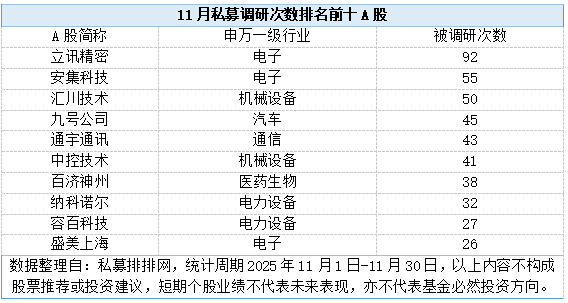
机构:11月私募调研439只个股,立讯精密最受关注
Zhong Guo Jin Rong Xin Xi Wang· 2025-12-03 09:49
Core Insights - In November, a total of 885 private equity firms participated in A-share research activities, covering 439 stocks across 28 industries, with a total of 2,341 research instances [1] - The electronic industry maintained the highest research activity, with 82 stocks receiving attention and a total of 567 research instances, significantly leading other industries [4][5] - Major private equity firms are focusing on key sectors for in-depth research, while smaller firms are seeking excess returns through broader coverage [1] Company-Level Summary - Luxshare Precision was the most researched stock in November, with 92 instances, attracting attention from 19 major private equity firms [2][3] - Anji Technology followed with 55 research instances, primarily from smaller private equity firms [2] - Other notable companies included Huichuan Technology and Zhongkong Technology, with 50 and 41 research instances respectively [2] Industry-Level Summary - The mechanical equipment industry saw a significant increase in research activity, with 411 instances and 67 stocks being researched, ranking second overall [4][5] - The pharmaceutical and electric equipment industries ranked third and fourth, with 30 and 27 stocks researched respectively [4][5] - Other industries such as automotive, computer, basic chemicals, and communication also had over 100 research instances, indicating strong interest [4] Institution-Level Summary - Zhengyuan Investment was the most active in November, conducting 55 research instances, focusing on electronic, mechanical equipment, and electric equipment sectors [6] - Qingli Investment and Shenzhen Shangcheng Asset followed with 36 and 30 research instances, respectively, with a focus on mechanical equipment and pharmaceutical stocks [6] - Half of the top ten research firms were major private equity firms, indicating a strong presence in the research activities [6]

巴菲特,调仓大动作!
Zhong Guo Ji Jin Bao· 2025-11-15 02:36
Core Insights - Berkshire Hathaway has made significant changes to its investment portfolio in the third quarter, including a new position in Alphabet and further reductions in Apple holdings [1][3]. Group 1: New Investments - Berkshire initiated a position in Alphabet, purchasing approximately 17.85 million shares, valued at around $4.34 billion, making it the tenth largest holding in the portfolio, accounting for 1.62% of total holdings [3][2]. - The investment in Alphabet is believed to have been influenced by investment managers Todd Combs or Ted Weschler, who have previously shown interest in technology stocks [3]. Group 2: Increased Holdings - Berkshire increased its stake in Chubb Limited (formerly known as ACE Limited) by approximately 4.3 million shares, raising its investment by $1.21 billion, with the holding percentage increasing from 3.04% to 3.31% [3]. Group 3: Reduced Holdings - Berkshire further reduced its stake in Apple by approximately 41.79 million shares, a decrease of over 14.92% from the previous quarter, although it still holds over 238 million shares valued at approximately $60.66 billion, making Apple the largest holding [5]. - The company also reduced its position in Bank of America by about 37.2 million shares, with the holding percentage dropping from 11.12% to 10.96% [5]. - Berkshire completely exited its position in D.R. Horton, selling all 1.4854 million shares, which is significant as the company is considered a barometer for the U.S. housing market [5].

观望调整?
第一财经· 2025-11-04 11:14
Market Overview - The market is experiencing a broad decline, with 1,627 stocks rising and 3,646 stocks falling, indicating a poor profit-making environment and a clear tendency for capital to seek safety [6][11]. - The total trading volume in both markets has decreased by 9.08% to 9.2 trillion yuan, reflecting a strong sense of caution among investors and concerns about resistance above the 4,000-point level [7]. Capital Flow - There is a net outflow of 39.647 billion yuan from institutional funds, while retail investors are showing a net inflow [8]. - Institutions are exhibiting a cautious defensive strategy, reallocating funds away from previously high-performing sectors like batteries and semiconductors, and moving towards defensive sectors such as banking and insurance [9]. Investor Sentiment - Retail investor sentiment is characterized by anxiety and a passive response, with many adopting a "wait-and-see" approach as market hotspots rapidly rotate, making it difficult for some to keep pace [9]. - As of November 4, 30.38% of investors are increasing their positions, while 16.88% are reducing their holdings, with a significant portion choosing to remain inactive [14].

截至三季度末,“国家队”资金重仓持有超800只A股股票
Xin Lang Cai Jing· 2025-11-03 07:01
Core Insights - As of the end of the third quarter, "national team" funds, which include various state-owned investment entities, held over 800 A-share stocks, with significant investments in Agricultural Bank of China, Bank of China, and Industrial and Commercial Bank of China, each exceeding a market value of 1 trillion yuan [1] Group 1: Investment Trends - The "national team" increased holdings in sectors such as insurance, resources, consumer goods, electronics, and telecommunications, with some stocks in these sectors experiencing price increases of over 100% during the third quarter [1] - Conversely, the "national team" reduced its positions in the top ten shareholders of sectors including securities, banking, electricity, real estate, and pharmaceuticals [1]



帮主郑重收评:沪指跌0.73%、4100股下跌!明日这么做更稳
Sou Hu Cai Jing· 2025-10-30 19:14
Market Overview - The Shanghai Composite Index fell by 0.73%, while the ChiNext Index dropped by 1.84%, with 4,100 stocks declining in the market [1][3] - The trading volume in the Shanghai, Shenzhen, and Beijing markets reached 24,643 billion, an increase of 1,736 billion from the previous day, indicating active fund reallocation despite the market decline [3] Sector Performance - Energy metals and steel sectors showed resilience, with companies like Tianqi Lithium and Yongxing Materials hitting the daily limit up, while Ganfeng Lithium also saw gains [3] - Quantum technology stocks such as Guodun Quantum and Hexin Instruments experienced price increases, and steel companies like Anyang Iron & Steel and Ordos also reached the daily limit up [3] - Conversely, sectors like CPO, coal, gaming, lithography machines, and securities faced significant declines, with companies like Hezhu Intelligent and Antai Group hitting the daily limit down [3] Investment Strategy - Investors are advised not to panic sell if their holdings are fundamentally sound but have declined due to market fluctuations, as selling at this point may result in losses [4] - Caution is recommended against chasing high-performing stocks without prior positioning, particularly in lithium and steel sectors [4] - Monitoring trading volume is crucial; if the volume remains high without further index declines, it may indicate that funds are stepping in to stabilize the market [4]

侃股:三季报是精选个股好时机
Bei Jing Shang Bao· 2025-10-19 13:09
Group 1 - The core viewpoint emphasizes the importance of Q3 reports for investors to optimize their portfolios by buying potential stocks and selling underperforming ones [1] - The recent market volatility reflects differing expectations for various industries, leading to a polarized market where strong stocks continue to perform well while weak stocks lag [1] - The value of Q3 reports lies not only in validating previous performance expectations but also in identifying opportunities for stock replacement before the annual reports [1] Group 2 - Investors should pay special attention to cash flow indicators when interpreting Q3 reports, as they are crucial for assessing a company's true intrinsic value [2] - Comparing companies within the same industry and analyzing historical data can help identify firms with competitive advantages and determine their growth cycle stages [2] - Monitoring a company's market value management measures, such as share buybacks or major shareholder increases, can significantly impact future stock performance [2] Group 3 - Investors are advised to adopt a gradual approach when buying potential stocks, especially during market fluctuations, to mitigate investment risks [3] - Strict adherence to stop-loss discipline is essential for achieving stable returns in the future [3]