
证券

Search documents
湘财证券晨会纪要-20260211
Xiangcai Securities· 2026-02-11 00:50
Group 1: ETF Market Overview - As of February 6, 2026, there are 1,439 ETFs in the Shanghai and Shenzhen markets, with a total asset management scale of 53,280.88 billion [2] - The breakdown includes 1,116 stock ETFs (31,401.67 billion), 53 bond ETFs (7,213.28 billion), 27 money market ETFs (1,615.16 billion), 17 commodity ETFs (3,225.87 billion), 211 cross-border ETFs (9,760.39 billion), and 15 unlisted ETFs (64.51 billion) [2] - In the week from February 2 to February 6, 2026, 10 new stock ETFs were listed, including two photovoltaic ETFs and eight others, with a total issuance scale of 36.04 billion [3] Group 2: ETF Performance Analysis - The median weekly return for stock ETFs was -1.63%, with the Sci-Tech Innovation Board New Energy ETF showing the highest increase of 4.09%, while the Gold Stock ETF had the largest decline of 13.25% [4] - The median weekly return for bond ETFs was 0.06%, with the 30-year Treasury ETF increasing by 0.93% and the convertible bond ETF decreasing by 0.30% [4] - The median weekly return for cross-border ETFs was -2.39%, with the Hang Seng Consumer ETF showing the highest increase of 4.81%, while the Brazil ETF had the largest decline of 11.63% [4] Group 3: PB-ROE Framework and Strategy - The PB-ROE framework categorizes industries into six quadrants, focusing on high PB high ROE industries and low PB medium ROE industries for investment opportunities [5] - Backtesting from 2017 to February 2024 shows that only the third and fifth quadrants achieved excess returns, with annualized excess returns of 4.27% and 1.55%, respectively [5] - A combined strategy from both quadrants resulted in an annualized return of 11.93% and an annualized excess return of 13.22% [6] Group 4: Investment Recommendations - The report recommends focusing on the industries of non-ferrous metals, transportation, and public utilities, with corresponding ETFs for each sector [8] - Additionally, it suggests monitoring non-ferrous metals ETF, chemical ETF, software ETF, food and beverage ETF, and photovoltaic 50 ETF for the upcoming week [8]

IIF:新兴市场投资组合吸引990亿美元外资流入,创下1月单月资金流入纪录
Jin Rong Jie· 2026-02-11 00:50
Core Insights - In January, foreign investors injected $99 billion into emerging markets, setting a record for monthly inflows and marking the largest single-month net inflow since 2020 [1] Group 1: Investment Trends - The inflow included $71.4 billion into debt securities, the highest recorded amount [1] - Equity inflows reached $27.4 billion, ranking fifth in the data tracked by IIF since 2005 [1]
券商晨会精华 | 储能、SOFC将有效弥补美国用电负荷缺口
智通财经网· 2026-02-11 00:46
Market Overview - The market experienced narrow fluctuations with mixed performance across the three major indices, while the STAR 50 Index rose nearly 1% [1] - The total trading volume in the Shanghai and Shenzhen markets was 2.11 trillion yuan, a decrease of 143.9 billion yuan compared to the previous trading day [1] - Over 3,100 stocks in the market declined, with the media sector leading gains, while the commercial aerospace sector saw a decline [1] Energy Sector Insights - Tianfeng Securities suggests that energy storage and Solid Oxide Fuel Cells (SOFC) will effectively address the electricity load gap in the U.S. [2] - The EIA forecasts that from 2026 to 2030, the U.S. will add 7, 7, 16, 8, and 7 GW of gas-fired power generation, while stable power sources will see minimal additions [2] - By mid-October 2025, the planned capacity for data center reserve projects in the U.S. will reach 245 GW, indicating a significant load demand that stable power sources alone cannot meet [2] Aerospace Sector Developments - CITIC Construction Investment emphasizes that the commercial aerospace sector is focusing on technology leadership, frequency track superiority, and clear commercialization paths [3] - The core engine for industrialization in reusable rockets is being continuously optimized, with companies like Deep Blue Aerospace and Tianbing Technology validating recovery technologies [3] - The integration of satellite internet and reusable rockets is seen as a high-certainty mainline for the industry [3] Real Estate Market Analysis - CICC indicates that the real estate market's performance may primarily be driven by beta factors in 2026, with January's second-hand housing transaction volume stabilizing month-on-month and showing a narrowing year-on-year decline [4] - The transaction volume index for second-hand residential properties in 80 cities decreased by 3% month-on-month and also by 3% year-on-year [4] - Recent policy changes and improvements in supply-side conditions are expected to create investment opportunities in the real estate and property management sectors [4]



中信证券:本轮人民币升值不同于历史上的任何一轮
Xin Lang Cai Jing· 2026-02-11 00:40
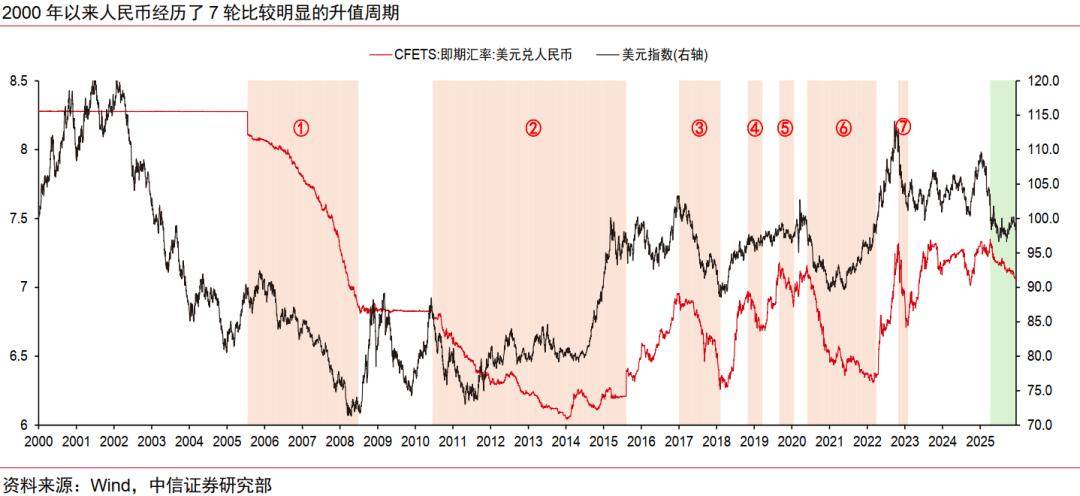
Core Viewpoint - The current appreciation of the RMB is fundamentally different from previous cycles, driven by factors such as improved overseas earning capabilities of Chinese companies, global distrust in the US dollar, and policy shifts aimed at supporting domestic demand through "taxation" on foreign trade [2][3][14]. Group 1: Factors Driving RMB Appreciation - Chinese companies' ability to earn overseas has increased, leading to a significant demand for currency conversion, with a record trade surplus of $118.89 billion in 2025, up 19.78% year-on-year [6]. - Global speculative funds are increasingly seeking physical assets, reflecting concerns over the credibility of the US dollar, with rising interest in tangible assets like gold and shipping vessels [10]. - China's trade policy is shifting from merely expanding scale to stabilizing supply chains and controlling risks, enhancing the profitability of outbound enterprises and increasing the real demand for RMB [12]. Group 2: Market Dynamics and Historical Context - The current RMB appreciation cycle, starting in Q2 2025, shows unique signs such as underperformance in Hong Kong stocks and a lack of strong expectations for the US-China economic dynamics, which historically correlated with RMB appreciation [3]. - Historical analysis indicates that the exchange rate is not the decisive factor in industry allocation, as various industries benefit differently from RMB appreciation based on their cost structures and market conditions [25]. Group 3: Industry Impact and Profitability - Approximately 19% of industries are expected to benefit from RMB appreciation, particularly those with high import dependency for raw materials and low export dependency for finished goods, such as steel, petrochemicals, and consumer goods [28][29]. - Industries like aviation, gas, and paper are likely to experience significant stock price elasticity due to their historical performance during RMB appreciation phases, driven by cost savings [39]. Group 4: Policy Responses and Future Outlook - To mitigate rapid appreciation, potential policy responses may include monetary easing and relaxing restrictions on foreign financial investments, which could enhance the growth prospects for sectors like brokerage and insurance [34][39]. - The ongoing trend of Chinese manufacturing companies expanding production overseas indicates that these firms are less negatively impacted by RMB appreciation, as they have established competitive advantages [36].


华鑫证券党委书记、董事长俞洋:以数智之力书写“十五五”高质量发展新篇章
Zhong Guo Zheng Quan Bao· 2026-02-11 00:38
Core Viewpoint - The article emphasizes the strategic role of Huaxin Securities in supporting China's modernization and financial strength during the "14th Five-Year Plan" and the upcoming "15th Five-Year Plan" [1][9]. Group 1: Strategic Focus - Huaxin Securities aims to leverage its unique position as a service provider in direct financing, capital market oversight, and wealth management to fulfill its historical mission [1]. - The company is committed to a differentiated development path, focusing on supporting the real economy, promoting technological innovation, and optimizing resource allocation [1][2]. Group 2: Financial Innovation and Services - The company has positioned bond financing and asset securitization as key areas to address financing challenges for enterprises, utilizing financial innovation and digital technology [2]. - Huaxin Securities successfully issued its first technology innovation corporate bond during the "14th Five-Year Plan," with a steady increase in underwriting scale [2][3]. - The company plans to expand its green bonds and technology innovation bonds, establishing a collaborative mechanism for comprehensive financing services in high-end manufacturing and new energy sectors [2][3]. Group 3: Digital Transformation - Since establishing its financial technology strategy in 2017, Huaxin Securities has focused on technological innovation to enhance its service capabilities [4]. - The company has developed a unique "AI + Finance" service ecosystem, achieving a transition from "tool empowerment" to "system support" during the "14th Five-Year Plan" [4][5]. - Huaxin Securities has created a smart investment research platform, "Xin i," which supports investment research personnel with intelligent processes and extensive data assets [5]. Group 4: Risk Management and Compliance - The company emphasizes the importance of compliance and risk management as foundational elements for high-quality development [6]. - Huaxin Securities has established a comprehensive risk control system, integrating AI and big data technologies to enhance its risk monitoring capabilities [6]. - The company aims to balance risk prevention with business development through a dynamic risk management model [6]. Group 5: Cultural Development - Huaxin Securities integrates cultural development with its operational strategies, emphasizing the importance of industry culture for high-quality growth [7]. - The company promotes a "customer-first" philosophy and actively engages in social responsibility initiatives, including rural revitalization and charitable efforts [7][8]. - The integration of party-building and cultural initiatives is seen as essential for enhancing the company's soft power and supporting its development goals [8]. Group 6: Future Outlook - The company is poised to navigate new opportunities and challenges in the evolving global economic landscape during the "15th Five-Year Plan" [9]. - Huaxin Securities will continue to focus on data asset ABS and technology innovation bonds while enhancing its intelligent investment research capabilities [9].
中银证券党委书记、董事长周权:践行金融报国使命 走好特色发展之路
Zhong Guo Zheng Quan Bao· 2026-02-11 00:33
"证券公司学习宣传贯彻党的二十届四中全会精神"系列报道 "党的二十届四中全会为中国式现代化建设擘画了宏伟蓝图,为新时代新征程的金融改革发展指明了前 进方向。"中银国际证券股份有限公司党委书记、董事长周权日前在接受中国证券报记者专访时作出上 述表示。 长风破浪,正当扬帆远航。在他看来,"十五五"是推进中国式现代化、加快建设金融强国的关键时期, 证券行业作为直接融资的主要"服务商"、资本市场的重要"看门人"、社会财富的专业"管理者",肩负着 服务实体经济、守护投资者利益、助力国家战略落地的时代使命。 "十四五",中银证券始终以党建为引领,以实干笃行促进稳健发展。展望"十五五"时期,中银证券将立 足中银集团综合金融服务平台的定位,探索差异化特色化发展新路径,奋力在建设金融强国的新征程上 贡献力量。 党建引领强根基 实干笃行促发展 周权表示,"十四五"以来,中银证券始终坚持党的领导,践行金融工作的政治性和人民性,坚持统筹发 展与安全,推动各项事业实现稳健发展,为"十五五"高质量发展奠定了坚实基础。 "中银证券始终把党的领导贯穿治理全过程,将党建写入公司章程,厘清党委、董事会等治理主体权责 边界,构建'权责法定、透明协 ...

渤海证券研究所晨会纪要(2026.02.11)-20260211
BOHAI SECURITIES· 2026-02-11 00:30
证券分析师 崔健 022-28451618 SAC NO:S1150511010016 cuijian@bhzq.com 渤海证券研究所晨会纪要(2026.02.11) 固定收益研究 净融资额继续增加,信用利差整体走阔——信用债周报 行业研究 春节假期临近,关注节后需求——金属行业周报 证 券 研 究 报 告 晨 会 纪 要 请务必阅读正文之后的声明 渤海证券股份有限公司具备证券投资咨询业务资格 1 of 5 晨会纪要(2026/02/11) 晨会纪要(2026/02/11) 固定收益研究 净融资额继续增加,信用利差整体走阔——信用债周报 李济安(证券分析师,SAC NO:S1150522060001) 王哲语(证券分析师,SAC NO:S1150524070001) 1、核心观点 本期(2 月 2 日至 2 月 8 日)交易商协会公布的发行指导利率多数上行,整体变化幅度为-1 BP 至 4 BP。本 期信用债发行规模环比增长,企业债保持零发行,公司债、中期票据、定向工具发行金额增加,短期融资 券发行金额减少;信用债净融资额环比增加,短期融资券净融资额减少,其余品种净融资额增加,企业债 净融资额为负,其余品种 ...
人民币升值十问十答:为何本轮不一样?
Sou Hu Cai Jing· 2026-02-11 00:24
Core Viewpoint - The current appreciation of the RMB is driven by unique factors that differ from historical trends, including improved overseas profitability of Chinese companies, global distrust of the US dollar, and policy shifts aimed at supporting domestic demand through "taxation" on foreign trade [1][15]. Group 1: Unique Indicators of Current RMB Appreciation - The current RMB appreciation cycle, starting in Q2 2025, shows distinct signs such as underperformance of Hong Kong stocks, low expectations for US-China economic dynamics, and continued foreign capital outflow from A-shares [2]. - Historical patterns indicate that the simultaneous occurrence of these signs makes it difficult to associate them with sustained RMB appreciation [2]. Group 2: Factors Driving Current RMB Appreciation - Chinese companies' increasing ability to generate profits overseas has led to significant demand for currency conversion, with a record trade surplus of $118.89 billion in 2025, up 19.78% year-on-year [7]. - The demand for physical assets by global speculative funds is rising, reflecting concerns over the credibility of the US dollar [11]. - China's ability and willingness to "export inflation" through trade policy shifts from merely expanding scale to stabilizing supply chains and controlling risks enhances the attractiveness of quality Chinese assets to global investors [13]. Group 3: Impact of RMB Appreciation on Industries - Approximately 19% of industries are expected to benefit from RMB appreciation, particularly those with high import dependency for raw materials and low export dependency for finished goods [30]. - Beneficial industries include upstream resource products (steel, non-ferrous metals), domestic consumer goods (agriculture, light manufacturing), service-related sectors (transportation, retail), and manufacturing equipment [30]. Group 4: Policy Responses to Manage RMB Appreciation - To mitigate rapid unilateral appreciation, potential policy responses may include moderate monetary easing and relaxing restrictions on foreign financial investments, which could enhance asset allocation and returns [35]. - Specific industries may benefit from policies aimed at stimulating domestic demand and supporting overseas production bases, particularly in sectors like electric vehicles and textiles [36]. Group 5: Investment Strategies in the Context of RMB Appreciation - Investment strategies should focus on three key drivers: short-term muscle memory, profit margin changes, and policy shifts [38]. - Industries with historical price elasticity during RMB appreciation, such as aviation and utilities, should be prioritized [38]. - Sectors with high import dependency and low export reliance are likely to see profit margin improvements, including upstream resources and domestic consumer goods [38].
新春走基层丨券商营业部转型探微:让居民“闲钱”托举稳稳的幸福
Zhong Guo Zheng Quan Bao· 2026-02-11 00:03
Group 1 - The core viewpoint of the articles highlights a significant shift in investor behavior towards more stable and diversified asset management strategies, moving away from high-risk, short-term trading approaches [1][2][3] - Investors are increasingly seeking personalized financial planning and investment advice, indicating a growing reliance on professional wealth management services [3] - The trend shows that experienced investors are focusing on long-term financial products, such as pension funds, reflecting a broader change in financial awareness among residents [3][4] Group 2 - There is a noticeable increase in inquiries about stable investment directions and robust portfolio construction among investors, suggesting a demand for more structured financial guidance [2][3] - The transformation of brokerage services is evident, as firms are shifting from traditional product sales to comprehensive wealth management services that include personalized adjustments and ongoing support [3] - The role of investment advisors is evolving, requiring them to be more professional and knowledgeable to meet the increasing sophistication of investors [3]

美股收盘:纳指尾盘跳水,道指刷新历史新高!中概股逆势四连涨,黄金白银高位震荡
Jin Rong Jie· 2026-02-10 23:57
当地时间2月10日,美股市场呈现出显著的分化格局。在道琼斯工业平均指数盘中刷新历史新高的同 时,纳斯达克指数与标普500指数却由涨转跌,回吐早盘涨幅。与此同时,国际大宗商品市场维持弱势 震荡,地缘政治风险因特朗普的最新表态而再度升温。 在国际贵金属市场,金价与银价延续弱势震荡态势。截至北京时间2月11日5:50,COMEX黄金期货与伦 敦金现货价格分别报5048.8美元/盎司和5022.85美元/盎司,微跌0.6%和0.71%;白银价格波动更甚, COMEX白银期货跌超2%,伦敦银现货跌超3%,分别徘徊在80.475美元/盎司和80.711美元/盎司附近。 中信期货研判认为,在金价维持高位运行的背景下,白银仍具备相对收益空间,但需警惕高波动环境下 的阶段性回撤风险。 原油方面,NYMEX原油期货与ICE布油期货主力合约微跌,分别报64.19美元/桶和69.01美元/桶。信达 期货分析指出,原油市场逻辑已从事件驱动溢价切换至基本面交易,中期来看,"供应过剩"压力是更可 持续的定价锚,空头主导格局明确,油价趋势性承压概率较大。 消息面上,地缘政治不确定性为市场增添变数。据央视新闻报道,美国总统特朗普当地时间2月1 ...