可再生能源

Search documents
对话全球市长|温得和克市长:期待与上海合作发展可再生能源,建设更加绿色的城市
Di Yi Cai Jing· 2025-05-29 08:14
Core Viewpoint - The dialogue between cities, particularly focusing on sustainable development and youth engagement, is essential for future cooperation and innovation [1][3]. Group 1: Event Overview - The "World Mayors Dialogue: Shanghai and 2025 Shanghai International Friendly Cities Cooperation Forum" took place in Shanghai from May 28 to 31, organized by various governmental and academic institutions [3]. - The forum's theme was "Green, Low Carbon, Development," with discussions centered on "Green Low Carbon Empowering Urban Sustainable Development" and "Youth Vitality Inspiring Urban Innovative Future" [3]. Group 2: City Relations - Windhoek, the capital of Namibia, has a population of approximately 500,000 and is a notable tourist city. This year marks the 30th anniversary of the friendship between Windhoek and Shanghai [3]. - Over the past 30 years, Windhoek has benefited significantly from its relationship with Shanghai, including the donation of nearly 2,000 books, particularly in early education [3][4]. Group 3: Renewable Energy and Sustainability - Namibia, heavily reliant on non-renewable energy, faces urgent challenges in developing renewable energy sources, particularly solar energy [4]. - Windhoek aims to become a sustainable city by establishing solid waste recycling centers and promoting green technologies through parks and green spaces [5]. - The city seeks further collaboration with Shanghai to enhance its renewable energy development and sustainable urban initiatives [4][5]. Group 4: Youth Engagement - There is a strong emphasis on increasing youth participation in bilateral exchanges and cooperation, particularly in technology, planning, and innovation [5]. - Various projects have been initiated to encourage youth involvement between China and Namibia, aiming to foster deeper collaboration [5].

越南“违约”降电价?130亿美元新能源项目面临危机
Hua Er Jie Jian Wen· 2025-05-29 06:55
Group 1 - The Vietnamese government has altered its renewable energy subsidy policy, reducing the feed-in tariff (FiT) from 7.09 to 9.35 cents per kilowatt-hour to only 4.7 cents when paid in local currency, representing a cut of 34% to 50% [1] - The changes primarily affect solar energy projects, with many investors reporting delays or reductions in payments from the Vietnam Electricity (EVN) [1] - Investors are expressing concerns over cash flow issues and increased default risks due to EVN's alleged violations of loan agreements, which threaten project sustainability and overall business operations [4] Group 2 - Over 40 foreign and local investors, including companies from Japan, Thailand, the Philippines, Portugal, and the Netherlands, signed a joint letter urging the Vietnamese government to maintain contract integrity and regulatory consistency [4] - The letter highlights that the ongoing dispute poses serious risks to investor confidence, financial stability, and Vietnam's long-term energy and climate goals [4] - Vietnam's economy, heavily reliant on foreign capital and competitive energy prices, is projected to grow by 8% this year, but faces increasing energy demand and power shortages in the northern region [4] Group 3 - EVN reported a loss of nearly $1 billion last year, following an $800 million loss in 2022, and is expected to remain in deficit in the first half of 2024 despite a planned price increase [5] - Government officials maintain that only projects meeting all formal requirements are eligible for the preferential electricity prices, contributing to the ongoing tensions [5] - The lack of clarity in the government's stance has damaged investor confidence and the stability of existing projects, with calls for constructive actions to resolve the disputes [6]
韩国:2025年总统选举前的阿尔法策略思路及政策影响
Goldman Sachs· 2025-05-29 06:00
Political Landscape - The emergency presidential election in South Korea is scheduled for June 3, 2025, following political uncertainty due to the declaration of martial law and the impeachment of President Yoon Suk-yeol[6]. - Recent polls indicate that opposition candidates are leading, reflecting a favorable trend for the opposition party amid high public support for changing the current government[7][8]. Economic Policy Outlook - Key economic policy platforms focus on improving corporate governance and addressing the "Korea discount," with retail investors representing nearly 30% of the population[19]. - Major candidates propose four main categories of capital market policies: corporate governance reform, tax incentives, enhanced accessibility for capital markets, and establishing a fair market order[20]. Market Projections - The KOSPI 12-month target has been raised to 2900, indicating a 9% upside potential, driven by the elimination of political risks and advancements in capital market reforms[3][64]. - The potential reclassification of South Korea's MSCI status could attract approximately $20-30 billion in foreign investment, improving market accessibility[48][51]. Corporate Governance Reforms - Both leading candidates emphasize the importance of corporate governance reforms, which could play a crucial role in narrowing the Korea discount[22][23]. - Despite previous efforts, the valuation of the Korean stock market remains significantly discounted compared to regional and global peers, with a price-to-book ratio discount of 48% compared to developed markets[28]. Tax Incentives - Proposed reforms include changes to dividend and inheritance tax policies to encourage higher dividend payouts, which previously saw significant increases when similar policies were implemented in 2014[37][40]. - The inheritance tax reform aims to address undervaluation issues of listed company stocks, particularly for those with a price-to-book ratio below 0.8[38]. Market Order and Transparency - Candidates commit to strengthening penalties for illegal trading practices, such as insider trading, to enhance protection for minority shareholders and improve market transparency[52][53]. - The overall number of unfair trading cases has decreased, but there has been a rise in cases related to interest disclosures in 2024[53]. Sector-Specific Policies - Both candidates support strategic industries such as AI, renewable energy, and defense, with commitments to establish investment funds and incentives for domestic production[59][60]. - The focus on enhancing the competitiveness of the shipbuilding industry and advancing defense technology is also highlighted in their platforms[60].
中国“双碳”转型勾勒绿色消费新图景
Xiao Fei Ri Bao Wang· 2025-05-29 02:55
□ 本报记者 张丽娜 北京的环京可再生能源圈点亮万家灯火,成都街头每三辆汽车就有一辆"喝电不喝油",深圳近七成电力 来自清洁能源……这些悄然改变生活的绿色细节,勾勒出中国城市"双碳"转型的鲜活图景。中国环境科 学研究院与公众环境研究中心近日发布的《中国城市双碳指数》第三期报告(以下简称"报告"),从气 候雄心、低碳状态和排放趋势三个维度对110个重点城市的"双碳"进展态势开展了系统评价。北京以突 出的气候雄心与低碳状态表现排名榜首,成都、宁波、深圳分列第二至四位,昆明、上海、广州等城市 跻身前十。海口、上海、常州等城市在新能源消费、充电基建等领域崭露头角,一场关乎你我日常的绿 色变革正加速落地。 绿色消费场景加速落地 能源转型支撑消费升级 本期指数评价期内,我国能源转型又迈上新的台阶,可再生能源装机继续领跑全球。截至2024年底,我 国可再生能源装机达到18.89亿千瓦,同比增长25%,约占我国总装机的56%,再次超越火电装机,为居 民绿色用电提供充足保障。消费侧同步呈现爆发式增长:全球超半数电动车行驶在中国,充电桩数量 较"十三五"增长60倍。深圳电网清洁能源占比近七成,成都通过"以电代煤、代油"行动推动居 ...
去年我国可再生能源新增装机占全球近64%
Ke Ji Ri Bao· 2025-05-29 01:44
Core Insights - The "China Renewable Energy Development Report 2024" indicates that China's renewable energy generation capacity is set to grow significantly, with an addition of 37.4 million kilowatts in 2024, representing a 22% year-on-year increase, and accounting for 86.3% of the country's new power generation capacity [1][2] - China's total renewable energy installed capacity is projected to reach 1.89 billion kilowatts in 2024, making up 56.4% of the total power generation capacity [1][2] - The report highlights that China's renewable energy generation is expected to reach 3.47 trillion kilowatt-hours in 2024, a 17.3% increase year-on-year, which will constitute approximately 35% of the national total power generation [2] Industry Developments - The report emphasizes that China's renewable energy installed capacity growth will account for nearly 64% of the global increase, showcasing the country's leadership in the renewable energy transition [2] - Technological advancements in the industry are notable, with "super-large" wind turbine technology leading globally, featuring onshore units with a maximum capacity of 15 megawatts and offshore units reaching 26 megawatts [2] - The solar photovoltaic sector is entering a phase of larger, higher-power components, with over 80% of installations being string inverters [2] Policy and Market Trends - The National Energy Administration stresses the importance of high-quality development in the renewable energy sector, encouraging the industry to adapt to market-oriented developments and focus on integrated growth [3] - The report indicates a trend towards centralized and large-scale new energy storage stations, with lithium-ion battery storage dominating the market at approximately 96% [2]

5月29日证券之星早间消息汇总:DeepSeek宣布 R1模型已完成小版本试升级
Zheng Quan Zhi Xing· 2025-05-29 01:03
1.据新华社消息,中共中央政治局委员、国务院副总理何立峰在人民大会堂会见美国摩根士丹利联席总 裁丹.辛克维兹。何立峰表示,中国坚持以高水平开放推动高质量发展,将为中国和全球经济激发活 力、增添动力,欢迎摩根士丹利在内的更多美资金融机构和长期资本持续深化对华互利合作,积极参与 中国资本市场建设发展。 2.外交部发言人在答记者问时表示,为了进一步便利中外人员往来,中方决定扩大免签国家范围,自 2025年6月9日至2026年6月8日,对沙特、阿曼、科威特、巴林持普通护照人员试行免签政策,上述四国 持普通护照人员来华经商、旅游观光、探亲访友、交流、访问、过境不超过30天可以免办签证入境。加 上2018年全面互免签证的海合会成员国阿联酋和卡塔尔,中方已经实现对海合会国家免签全覆盖。 3.证券时报网:保险资金长期投资改革试点出现"新力量"。与前两批试点多为大型险企不同,第三批试 点参与机构有望新增多家中小保险公司。参与试点的险资机构在数量和类型上实现新突破的同时,险资 参与试点的模式也将有所创新。金融监管总局局长李云泽日前表示,将进一步扩大保险资金长期投资的 试点范围,近期拟批复600亿元,为市场注入更多的增量资金。这宣 ...

今年风电光伏发电装机预计新增2.8亿千瓦
news flash· 2025-05-28 23:08
Core Insights - The "China Renewable Energy Development Report 2024" indicates that China's renewable energy generation capacity will reach a historic high in 2024, accounting for over 60% of the global increase in renewable energy capacity [1] - It is projected that an additional 280 million kilowatts of wind and solar power generation capacity will be added this year [1] - Technological innovation is identified as the core driving force behind the rapid development of renewable energy in China [1] Industry Developments - In 2024, breakthroughs in multiple key areas of renewable energy technology are expected to provide strong support for the industry's growth [1]
从“黑金”到“绿能” 中国资源型城市重塑发展路径
Zhong Guo Xin Wen Wang· 2025-05-28 07:28
Group 1 - The core viewpoint of the articles highlights the transformation of resource-based cities in China, particularly Shanxi's Lüliang, from coal dependency to green energy, driven by the "dual carbon" goals [1][2][8] - Lüliang is transitioning from a coal-dominated economy to a diversified energy landscape, integrating renewable energy sources and innovative technologies [3][6] - The shift from coal to hydrogen energy is emphasized, with Lüliang aiming to become a significant hydrogen production base, leveraging its coal resources and existing industrial capabilities [7][8] Group 2 - The global trend of energy digitalization is noted, with Lüliang's coal mines adopting 5G technology to enhance operational efficiency and safety [4][6] - The integration of digital, clean, and material technologies is reshaping the coal industry, moving away from traditional practices towards more sustainable and efficient operations [6][8] - Other resource-based cities in China are also exploring similar green transitions, indicating a broader movement towards sustainable energy systems across the country [8]
专访睿咨得能源CEO:美国政策转向无法阻挡减排大势,中国技术正在发挥重要作用丨跨国公司看中国
2 1 Shi Ji Jing Ji Bao Dao· 2025-05-27 13:37
Group 1: China's Role in Global Energy Transition - China plays a crucial role in the global energy transition as a leading provider of solar panels and battery technologies, holding the largest market share in these technologies [1][19] - The country has consistently exceeded its renewable energy targets, achieving a 1,200 GW installed capacity goal originally set for 2030 by 2024, showcasing rapid progress in clean energy deployment [1][17] - If current emission reduction momentum is maintained, China may achieve its carbon peak target 3-5 years ahead of schedule [1][18] Group 2: Global Climate Goals and Technological Advancements - Despite potential impacts from U.S. policy changes, global deployment of solar and wind energy continues to accelerate, with significant cost reductions in renewable energy technologies [2][3] - Achieving the Paris Agreement's goal of limiting global warming to 1.5°C remains feasible, contingent on rapid advancements in energy transition technologies [4][5] - Key tasks in the energy transition include decarbonizing the power system, electrification, and addressing residual emissions, with the power system decarbonization being critical [2][4] Group 3: Investment and Market Dynamics - Global investments in solar, wind, and battery technologies remain robust, with nearly $1 trillion still flowing into these sectors despite some slowdown [6][7] - The oil demand is expected to peak in the early 2030s, driven by the acceleration of vehicle electrification and declining oil consumption in power generation and residential heating [10][13] - Natural gas, particularly LNG, is positioned to play a key transitional role in the energy structure, especially as a cleaner alternative to coal [14] Group 4: Belt and Road Initiative and Energy Cooperation - The Belt and Road Initiative is expected to prioritize solar and battery storage projects, providing transformative opportunities for regions like Africa to bypass traditional fossil fuel infrastructure [2][20] - Distributed "photovoltaic + storage" systems can offer sustainable and cost-effective energy solutions for areas lacking local fossil fuel resources, reinforcing China's position as a leading supplier of clean energy technology [20]
长江流域首个实现规模化可再生能源供电的“零碳岛”正式投运
Yang Shi Xin Wen Ke Hu Duan· 2025-05-27 13:11
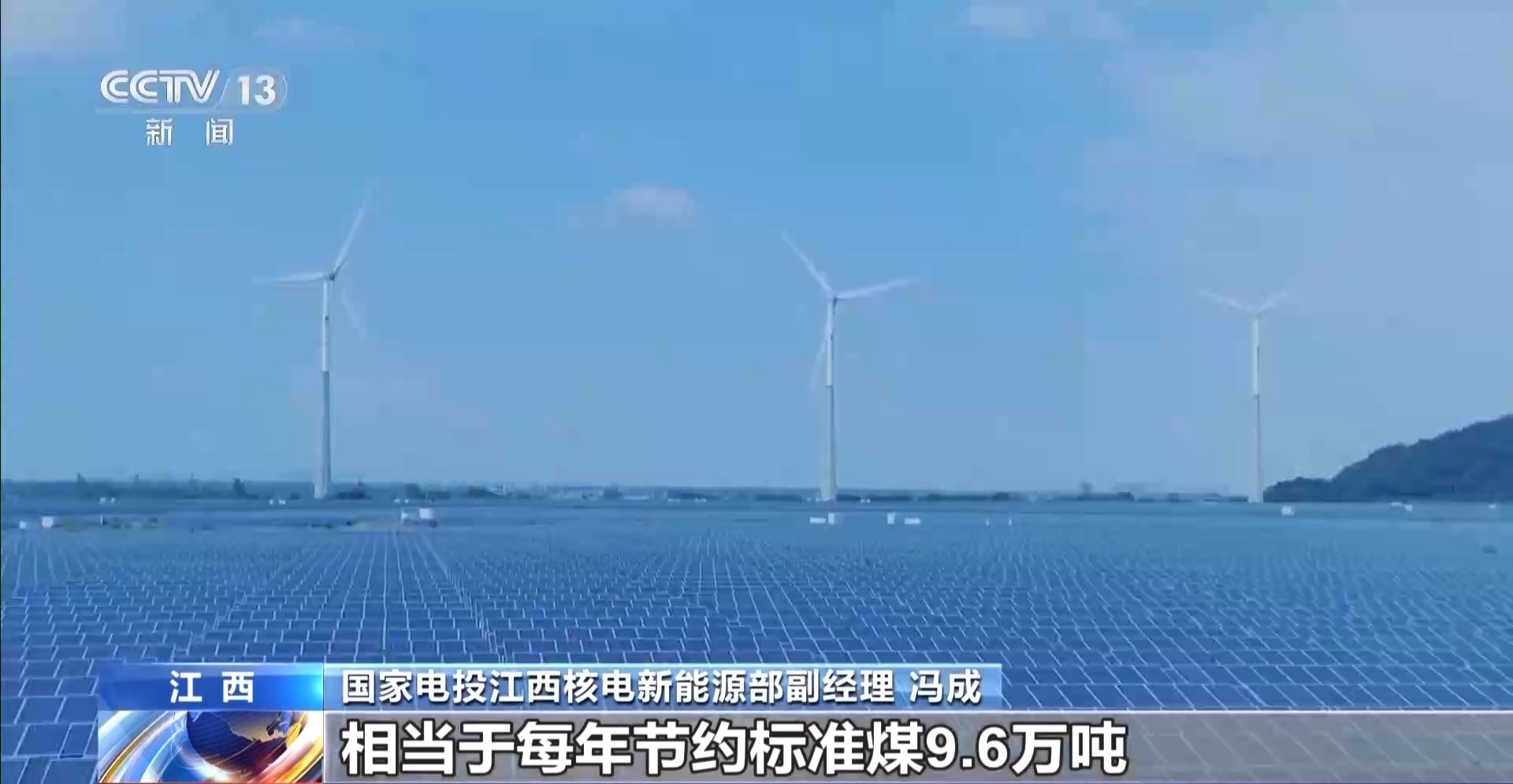
原标题:万里长江首个"零碳岛"投运 记者实地探访如何实现"零碳"→ 国家电投集团今天(27日)发布消息,位于江西彭泽的棉船岛风电项目全容量并网发电,标志着长江流域首个实现规模化可再生能源供电的"零碳岛"正式投 运。 此次并网的风电项目,是棉船镇"零碳岛"建设的核心项目。数千名建设者历时一年半,在棉船岛建设了18台风力发电机组,以及相关配套储能系统。加上前 期建设的光伏项目,目前已基本建成自给自足的清洁能源供应体系,成为长江流域首个实现规模化可再生能源供电的"零碳岛"。为棉船镇及周边居民生产生 活及发展提供清洁能源供应,助力长江经济带绿色发展。 国家电投江西核电新能源部副经理 冯成:项目投产后,年发电量达2.4亿多千瓦时,相当于每年节约标准煤9.6万吨,减少二氧化碳排放24万吨,同时也彻底 地解决了棉船镇孤岛单电源供电的问题。 "零碳岛"投运后,不仅岛上3.2万居民生产生活能源能够实现自给,还能将大量清洁绿电上网外送出岛。 接下来,棉船"零碳岛"将全面推进"风、光、储、氢、农、渔、旅"等多种资源有机结合,构建风电、光伏等清洁能源矩阵,打造长江流域新型电力系统,推 进长江经济带绿色低碳发展。 记者探访:棉船岛如何 ...