商用车

Search documents
又一家车企宣布停售燃油车
第一财经· 2026-01-21 09:51
Core Viewpoint - The heavy truck market in China has rebounded significantly, with sales reaching 1.145 million units in 2025, a 27% increase year-on-year, driven by the rise of new energy heavy trucks [2] Group 1: Market Performance - In 2025, the sales of new energy heavy trucks reached 231,100 units, a staggering increase of 182% year-on-year, with a penetration rate exceeding 28% [2] - Diesel heavy trucks' market share fell below 50% for the first time, dropping 8 percentage points from 2024 [2] Group 2: Company Developments - Hanma Technology (600375.SH) announced it will cease production and sales of traditional fuel vehicles in China starting in 2026, focusing entirely on new energy vehicles [2] - In 2025, Hanma Technology sold 14,005 trucks, with electric medium and heavy trucks accounting for 11,449 units, a 153.46% increase year-on-year, representing over 80% of its truck sales [2] Group 3: Financial Outlook - Hanma Technology expects a revenue of 6.6 billion yuan in 2025, a 56% increase year-on-year, while the net profit attributable to shareholders is projected to be approximately -66 million yuan, reducing losses by about 1.012 billion yuan [3] Group 4: Cost and Policy Support - The cost of operating new energy heavy trucks is significantly lower, with an estimated cost of 1 yuan per kilometer compared to 2.5 yuan for diesel trucks, leading to potential annual savings of 300,000 yuan [3] - New policies provide substantial financial support for the replacement of old heavy trucks, with subsidies up to 140,000 yuan per vehicle, effectively reducing the price of new energy heavy trucks by 6.5% to 8.5% [3] Group 5: Regulatory Environment - New fuel consumption standards for heavy commercial vehicles will reduce oil consumption limits by approximately 15% starting July 1, 2025, imposing stricter requirements on heavy trucks [4] - Cities like Shanghai and Guangzhou are offering operational subsidies and incentives for new energy heavy trucks, promoting their adoption in short-distance transport scenarios [4] Group 6: Industry Trends - The transition to new energy heavy trucks is gaining momentum, with projections indicating a penetration rate of 35% by 2026 and potentially exceeding 50% by 2027 [5]


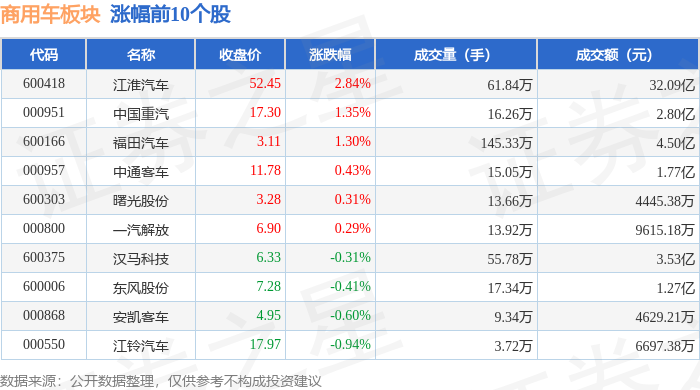
商用车板块1月21日涨0.74%,江淮汽车领涨,主力资金净流入4.17亿元
Zheng Xing Xing Ye Ri Bao· 2026-01-21 08:53
Core Viewpoint - The commercial vehicle sector experienced a slight increase of 0.74% on January 21, with Jianghuai Automobile leading the gains. The Shanghai Composite Index rose by 0.08%, while the Shenzhen Component Index increased by 0.7 [1]. Group 1: Stock Performance - Jianghuai Automobile (600418) closed at 52.45, up by 2.84%, with a trading volume of 618,400 shares and a transaction value of 3.209 billion [1]. - China National Heavy Duty Truck (000951) closed at 17.30, up by 1.35%, with a trading volume of 162,600 shares and a transaction value of 280 million [1]. - Foton Motor (600166) closed at 3.11, up by 1.30%, with a trading volume of 1,453,300 shares and a transaction value of 450 million [1]. - Other notable performances include Zhongtong Bus (000957) at 11.78, up by 0.43%, and Shuguang Co. (600303) at 3.28, up by 0.31% [1]. Group 2: Capital Flow - The commercial vehicle sector saw a net inflow of 417 million from institutional investors, while retail investors experienced a net outflow of 249 million [2]. - Major stocks like Jianghuai Automobile had a net inflow of 274 million from institutional investors, indicating strong institutional interest [3]. - Conversely, stocks like King Long Motor (600686) and China National Heavy Duty Truck (000951) faced significant net outflows from retail investors, suggesting a shift in investor sentiment [3].





汽车视点丨甲醇技术路线重构商用车绿色发展版图,加速进入主流市场
Xin Hua Cai Jing· 2026-01-21 03:53
Core Viewpoint - The methanol-based alcohol-hydrogen electric technology route is accelerating towards mainstream commercial vehicle markets due to its unique advantages, providing a new solution for overcoming the application bottlenecks of pure electric and hydrogen fuel cell technologies [1]. Group 1: Market Overview - China is the largest commercial vehicle market globally, with rapid development expected in electric, hydrogen fuel cell, and methanol technologies, driven by policies and both domestic and export demands [2]. - By 2025, domestic sales of commercial vehicles are projected to reach 3.237 million units, with 871,000 units being new energy commercial vehicles, resulting in a penetration rate of 26.9% [2]. - The penetration rate of new energy in commercial vehicles remains low compared to passenger vehicles, which have surpassed 50% [2]. Group 2: Challenges and Opportunities - The slow development of new energy in commercial vehicles is attributed to the limitations of existing technologies, which do not meet the specific needs of commercial vehicle usage scenarios [3]. - The alcohol-hydrogen electric technology route, centered on methanol, has shown practical and economic advantages in various regions, making it a viable solution for commercial vehicles [3][4]. Group 3: Technological Advantages - Alcohol-hydrogen electric vehicles combine methanol fuel engines with battery technology, allowing for operation across diverse conditions, from extreme cold to high temperatures [4]. - Compared to pure electric vehicles, alcohol-hydrogen electric vehicles offer stronger endurance, less impact from climate, efficient refueling, and lower infrastructure costs [5]. - The latest generation of alcohol-hydrogen power systems has achieved a thermal efficiency of 50.3%, with comprehensive energy costs reduced by 32%-52% compared to diesel vehicles [5]. Group 4: Infrastructure and Policy Support - Existing oil and gas infrastructure can be utilized for the low-cost transportation of liquid methanol, with conversion costs for existing gas stations to methanol refueling stations being significantly lower than building new hydrogen stations [6]. - The Chinese government has introduced over 70 policy documents to support the promotion of alcohol-hydrogen vehicles, indicating strong institutional backing for the methanol energy sector [8][9]. Group 5: Global Trends and Future Outlook - European car manufacturers are increasingly developing methanol as a vehicle fuel, with models expected to enter the market post-2035 [7]. - The global methanol industry is projected to expand significantly, with 414 ships confirmed to adopt methanol fuel by the end of 2025 [7]. - The integration of green hydrogen, ammonia, and methanol is becoming a crucial path for clean energy consumption and industrial innovation [10].
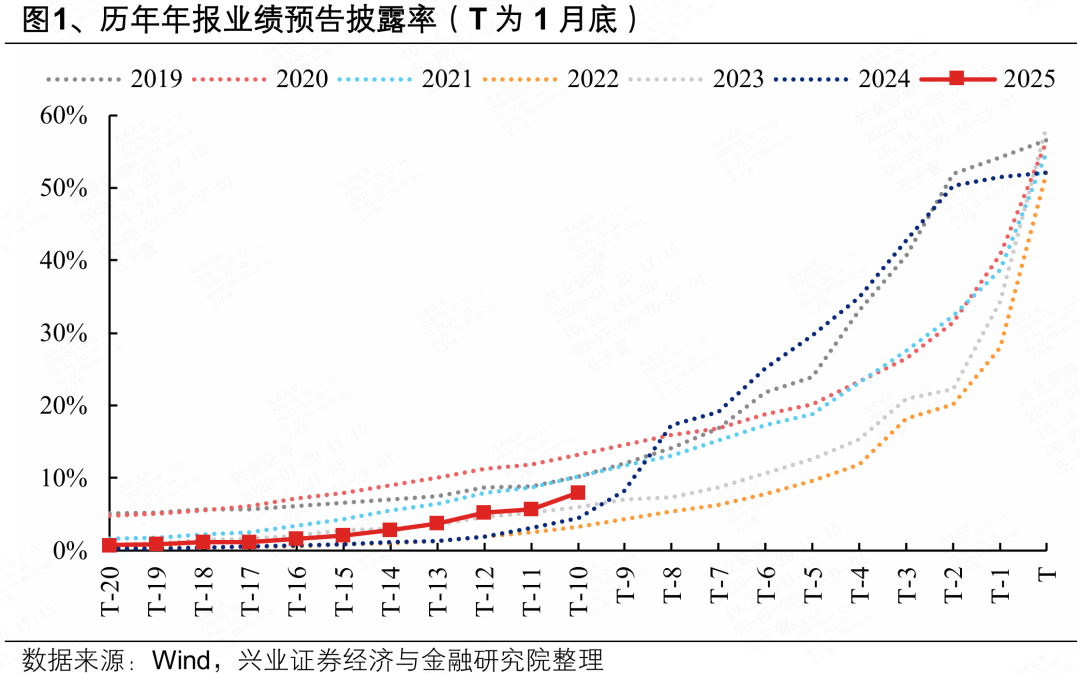
兴业证券:A股业绩预告即将进入披露高峰 关注哪些方向?
智通财经网· 2026-01-20 10:56
Core Viewpoint - As of January 19, the disclosure rate of annual performance forecasts for A-shares is 7.98%, with a peak expected in late January, where the final disclosure rate may reach around 55% [2][5]. Group 1: Performance Forecasts - The performance forecasts indicate that companies with significant net profit growth are primarily in sectors such as computing power, new energy, chemicals, pharmaceuticals, non-ferrous metals, and computers [6][10]. - By January 19, 447 A-share companies have released annual performance forecasts, with 144 companies expecting net profit growth exceeding 50%, mainly in computing power (semiconductors, communication equipment), new energy (batteries, photovoltaics), and chemicals [6][10]. Group 2: Market Reactions - As the performance forecasts enter their peak disclosure period, the correlation between stock prices and performance is expected to increase significantly in the latter half of January, with market sentiment returning to rationality [5]. - The market is likely to undergo a structural adjustment based on fundamentals, with previous hot sectors facing performance validation, while some low-performing but high-quality sectors may attract new capital inflows [5]. Group 3: Industry Insights - The sectors with upward revisions in profit forecasts since November include technology (especially in upstream computing hardware and downstream applications like consumer electronics and software), advanced manufacturing (new energy, military, automotive), and cyclical industries (building materials, non-ferrous metals, coal, steel) [12][13]. - The industries with lower performance growth since the last market rally include AI computing power, new energy, pharmaceuticals, and cyclical sectors like steel and glass fiber [14].

商用车板块1月20日涨0.07%,汉马科技领涨,主力资金净流出2.35亿元
Zheng Xing Xing Ye Ri Bao· 2026-01-20 08:51
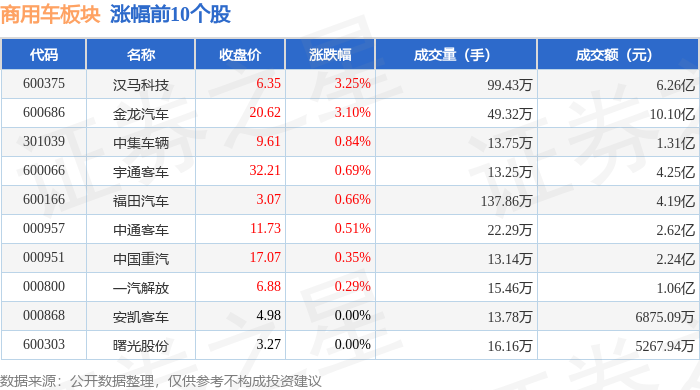
Group 1: Market Overview - The commercial vehicle sector increased by 0.07% on January 20, with Hanma Technology leading the gains [1] - The Shanghai Composite Index closed at 4113.65, down 0.01%, while the Shenzhen Component Index closed at 14155.63, down 0.97% [1] Group 2: Stock Performance - Hanma Technology (600375) closed at 6.35, up 3.25% with a trading volume of 994,300 shares and a transaction value of 626 million [1] - King Long Automobile (600686) closed at 20.62, up 3.10% with a trading volume of 493,200 shares and a transaction value of 1.01 billion [1] - Other notable performers include CIMC Vehicles (301039) at 9.61, up 0.84%, and Yutong Bus (600066) at 32.21, up 0.69% [1] Group 3: Fund Flow Analysis - The commercial vehicle sector experienced a net outflow of 235 million from institutional investors, while retail investors saw a net inflow of 331 million [2] - The detailed fund flow indicates that King Long Automobile had a net inflow of 709.24 million from institutional investors, while Hanma Technology had a net inflow of 35.31 million [3] - Other companies like Yutong Bus and Foton Motor showed mixed fund flows, with Yutong Bus having a net inflow of 977.17 million from institutional investors [3]


全年销2.8万辆增15%!2026力争3.8万辆 四大新品赋能 陕汽商用车要怎么干?| 头条
第一商用车网· 2026-01-20 08:29
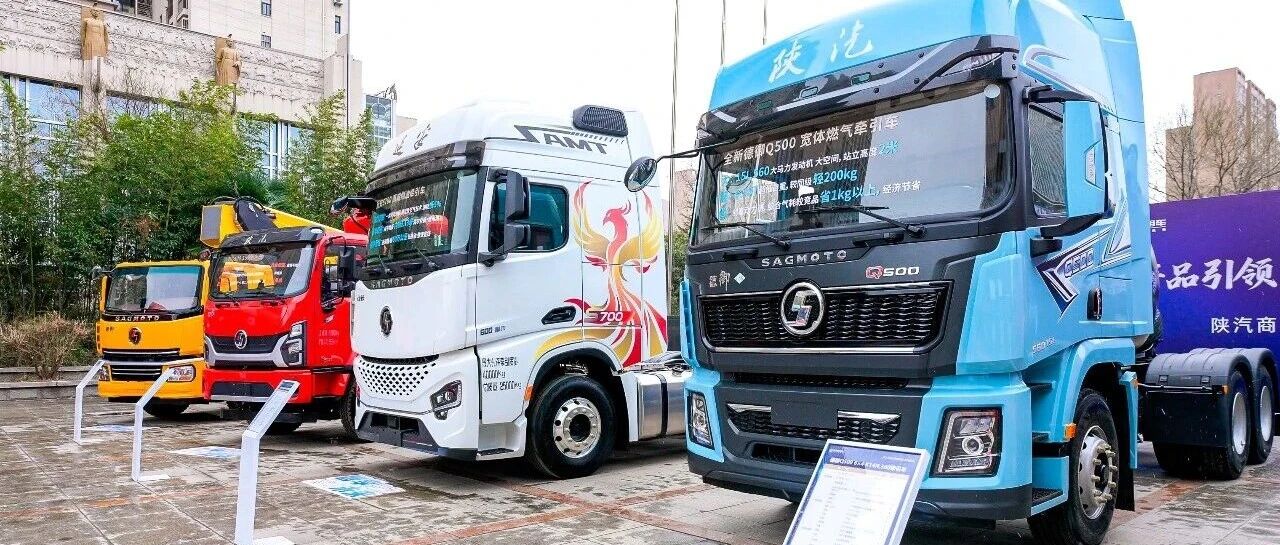
Core Viewpoint - Shaanxi Automobile Commercial Vehicle aims for a breakthrough in the commercial vehicle industry by focusing on high-quality development amidst fierce competition, with a sales target of 38,000 units for 2026 and over 50,000 units by the end of the 14th Five-Year Plan [1][5]. Group 1: Sales Performance and Goals - In 2025, Shaanxi Automobile Commercial Vehicle achieved sales of 28,000 units, a 15% increase year-on-year, with heavy trucks accounting for 90% of new vehicle sales and orders exceeding 30,000 units, a growth of over 20% [2][3]. - The company aims to reach a sales target of 38,000 units in 2026 and over 50 billion yuan in output value by the end of the 14th Five-Year Plan [5][30]. Group 2: Strategic Focus Areas - The company will enhance its product layout by solidifying its competitive advantage in heavy trucks and improving sales of light trucks through high-cost performance models [7]. - Shaanxi Automobile will build an efficient industrial chain ecosystem by sharing resources and reducing production costs, particularly in the fields of new energy and intelligent technology [7][9]. - The focus on new energy business will leverage core technological advantages to optimize energy consumption and operational costs, aiming for higher market penetration [9]. - A precise marketing ecosystem will be established to enhance user experience through digital services and customized financial solutions, expanding its presence in key markets [11][12]. Group 3: Product Development and Innovation - The company has launched four strategic new products, including the S300 Express electric light truck and G300 Pro fuel light truck, designed to meet diverse market needs [18][24]. - The S300 Express features advanced energy management and high-efficiency components, achieving energy consumption reductions of 3.1%-3.5% and overall efficiency exceeding 95.8% [19][20]. - The G300 Pro light truck offers significant improvements in comfort, power response, and load capacity, with enhancements in chassis strength and suspension capabilities [24][26]. - The Q500 LNG heavy truck is equipped with a powerful engine and optimized structure, reducing weight and enhancing operational efficiency [28]. Group 4: Market Positioning and Future Outlook - The commercial vehicle industry is entering a new era of competition, with Shaanxi Automobile committed to understanding user needs and market changes to drive innovation and quality [30]. - The company emphasizes a long-term development philosophy focused on creating value for users and aims to become a leading provider of green transportation solutions [30].
【快讯】每日快讯(2026年1月19日)
乘联分会· 2026-01-19 09:07
Domestic News - Canada will import 49,000 electric vehicles from China, reducing tariffs from 100% to 6.1%, with a long-term goal of having over 50% of imported vehicles priced below 35,000 CAD (approximately 180,000 RMB) within five years [3] - In December, China's total retail sales of consumer goods reached 45,136 billion RMB, a year-on-year increase of 0.9%, with retail sales excluding automobiles growing by 1.7% [4] - Shanghai's 14th Five-Year Plan emphasizes the development of smart connected new energy vehicles through soft-hard collaboration and digital intelligence [5] - Hebei province plans to enhance electric vehicle charging infrastructure, aiming to build 1,200 high-power charging stations by 2027 [6] - Chery held its 2026 AI conference, showcasing advancements in AI technology across various vehicle models [7] - Li Auto's 2025 driving assistance report indicates a user base of 1.505 million, with a total mileage of 6 billion kilometers [8] - Lynk & Co's 30,000th vehicle rolled off the production line, with plans to expand into Latin America and the Middle East [9] - BYD opened its first brand center in Tanzania, introducing multiple electric vehicle models [10] International News - Indonesia's new car sales increased by nearly 18% year-on-year in December 2025, reaching 94,100 units, driven by incentives for electric vehicle imports [12] - Israel approved a ride-hailing bill allowing Uber and Lyft to operate, aimed at reducing taxi fares [13] - Germany plans to introduce subsidies of up to $7,000 for electric vehicle purchases to boost the market [14] - Maruti Suzuki will invest $3.9 billion to build a new factory in Gujarat, India, increasing production capacity by up to 1 million vehicles annually [15] Commercial Vehicles - Times Qi Ji and Ping An Leasing signed a strategic cooperation agreement to promote 5,000 electric heavy trucks [17] - The UK government announced a substantial subsidy program for electric trucks, with a total budget of £318 million [18] - Iveco and PlusAI are testing autonomous trucks in Spain, equipping them with SAE Level 4 technology [19] - A proposal was made in Jinan to establish regulations for the operation of unmanned delivery vehicles [20]

商用车板块1月19日涨2.73%,金龙汽车领涨,主力资金净流入661.01万元
Zheng Xing Xing Ye Ri Bao· 2026-01-19 08:52
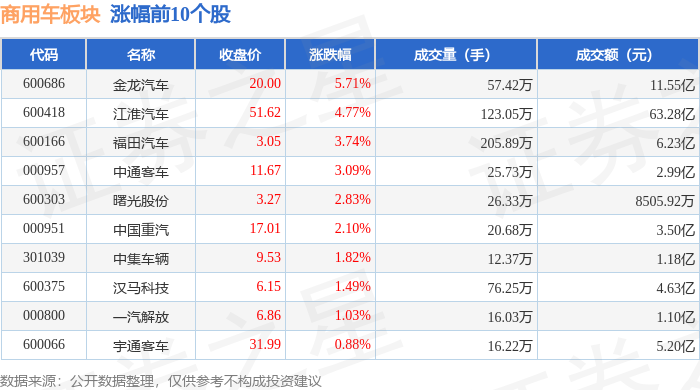
Market Performance - The commercial vehicle sector increased by 2.73% on January 19, with Jinlong Automobile leading the gains [1] - The Shanghai Composite Index closed at 4114.0, up 0.29%, while the Shenzhen Component Index closed at 14294.05, up 0.09% [1] Individual Stock Performance - Jinlong Automobile (600686) closed at 20.00, up 5.71% with a trading volume of 574,200 shares and a transaction value of 1.155 billion yuan [1] - Jianghuai Automobile (600418) closed at 51.62, up 4.77% with a trading volume of 1,230,500 shares and a transaction value of 6.328 billion yuan [1] - Foton Motor (600166) closed at 3.05, up 3.74% with a trading volume of 2,058,900 shares and a transaction value of 623 million yuan [1] - Other notable performers include Zhongtong Bus (000957) up 3.09% and Shuguang Co. (600303) up 2.83% [1] Capital Flow Analysis - The commercial vehicle sector saw a net inflow of 6.6101 million yuan from institutional investors, while retail investors contributed a net inflow of 27 million yuan [1] - However, there was a net outflow of 276 million yuan from speculative funds [1] Detailed Capital Flow for Selected Stocks - Jinlong Automobile had a net inflow of 51.9386 million yuan from institutional investors, but a net outflow of 11.8010 million yuan from speculative funds [2] - China National Heavy Duty Truck (000951) experienced a net inflow of 34.9853 million yuan from institutional investors, with a significant outflow from speculative funds [2] - Foton Motor (600166) also saw a net inflow of 28.1570 million yuan from institutional investors, while speculative funds had a net outflow [2]
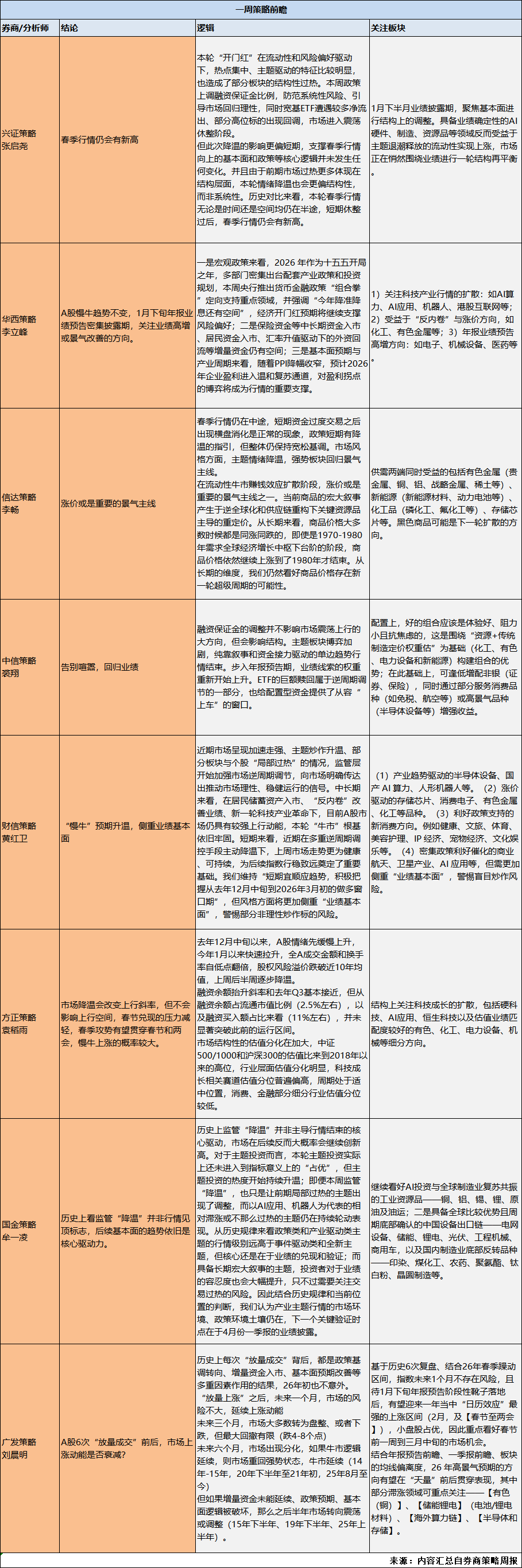
十大券商一周策略:历次“降温”后反而大概率创新高,围绕业绩博弈情绪升温,长牛慢牛基础进一步夯实
Sou Hu Cai Jing· 2026-01-19 00:00
Group 1 - The A-share market is transitioning from an "emotion-driven" phase to one anchored by performance, indicating a shift towards a more stable upward trend [1][2] - As the annual report preview period approaches, the focus of investment logic is shifting from narrative-driven speculation to performance verification [1][2] - A robust investment strategy should combine high-growth sectors like AI computing with cyclical sectors such as resources and manufacturing to create a balanced portfolio [1][2] Group 2 - The adjustment of financing margins does not alter the overall upward trend of the market but will impact its structure, leading to increased competition among thematic sectors [2][4] - The current market environment suggests that the next key verification point will be the performance disclosures in April, with a focus on sectors like AI applications and robotics [3][4] - The market is expected to experience short-term fluctuations, with a focus on sectors benefiting from supply-demand improvements, such as new energy and consumer goods [4][5] Group 3 - The policy environment remains supportive, with indications of potential interest rate cuts, which could bolster market confidence and support a long-term bullish trend [6][7] - The current market structure is likely to see a rotation towards sectors with strong fundamentals, such as industrial resources and consumer recovery channels [3][7] - The investment focus should remain on sectors with high growth potential, including AI, semiconductor equipment, and traditional manufacturing [3][5][10] Group 4 - The "spring rally" is facing short-term pressures due to complex macroeconomic conditions and regulatory measures aimed at stabilizing the market [8][9] - Despite recent market corrections, the underlying logic for AI applications remains intact, suggesting continued investment opportunities in this area [8][12] - The overall market sentiment is expected to stabilize, with a focus on sectors like electronics, power equipment, and non-bank financials as potential investment areas [9][10]
A股分析师前瞻:后市指数行情依旧值得期待,结构上更关注业绩线
Xuan Gu Bao· 2026-01-18 14:42
Core Viewpoint - The current market sentiment is driven by liquidity and risk appetite, leading to a concentration of hot sectors and thematic investments, which has resulted in structural overheating in some areas [1][2] Group 1: Market Trends - The recent "opening red" market rally is characterized by significant liquidity and heightened risk preferences, with a clear focus on thematic investments [1][2] - The adjustment of financing margin ratios aims to prevent systemic risks and guide the market back to rationality, while broad-based ETFs have experienced significant net outflows, indicating a market entering a phase of consolidation [1][2] - Historical comparisons suggest that the current spring market rally is still in its early stages, with potential for new highs following a short-term correction [1][2] Group 2: Sector Focus - Analysts emphasize that the upcoming earnings reporting period will shift focus back to performance indicators, particularly in sectors expected to show high growth or improved conditions, such as electronics, machinery, and pharmaceuticals [1][2] - The adjustment in financing margins is not expected to impact the overall upward trend of the market but will affect sector dynamics, with increased competition among thematic sectors [2][3] - The focus on sectors benefiting from the "anti-involution" trend and price increases includes chemicals and non-ferrous metals, with a particular emphasis on high-growth areas in the upcoming earnings forecasts [2][3] Group 3: Investment Strategies - The market is expected to maintain a "slow bull" trend, with a focus on performance fundamentals as the primary driver of investment decisions, while cautioning against irrational speculative activities [2][3] - The anticipated earnings reports in late January are expected to catalyze significant market movements, particularly in sectors with strong performance indicators [2][3] - The overall market sentiment remains positive, with expectations of continued upward momentum despite short-term fluctuations, driven by fundamental improvements and policy support [2][3]