商超

Search documents
新疆首家胖东来指导调改店开业:汇嘉时代的“美好革新”
Zheng Quan Shi Bao Wang· 2025-08-18 02:42
Core Viewpoint - The opening of the first "Pang Donglai" guided reform store in Xinjiang signifies a comprehensive transformation of Hui Jia Times' supermarket model, focusing on product quality, employee welfare, and customer experience [1][5]. Group 1: Store Transformation - The new store has undergone significant changes, including the removal of over 60% of lower-tier products and the introduction of high-quality brands and local specialties [1][3]. - The store features a "day fresh" bakery section and a redesigned shopping environment that enhances customer experience, likened to shopping in an exhibition hall [3][5]. - The introduction of a new product selection standard emphasizes quality over variety, aligning with the operational philosophy of Pang Donglai [5][6]. Group 2: Employee Welfare - Employee conditions have improved significantly, with wages exceeding local living cost benchmarks and work hours limited to a maximum of 8 hours per day [2][3]. - The company aims to create a positive feedback loop where employee satisfaction leads to better service quality and customer satisfaction [2][3]. Group 3: Financial Performance - Hui Jia Times reported a net profit of 67.0481 million yuan, with a growth rate exceeding 62% in the first half of the year, indicating strong financial health [5]. - The company's strategy aims to provide a shopping experience comparable to first-tier cities, addressing the urgent demand for quality retail in Xinjiang [5][6]. Group 4: Strategic Initiatives - The company is also exploring low-altitude economic opportunities to enhance its logistics capabilities, leveraging Xinjiang's favorable airspace conditions [6]. - The reform aligns with national policies aimed at stimulating economic growth in the region, suggesting a strategic fit with broader economic objectives [6].

零售业“胖改”风潮持续 麦德龙全国首家调改店将启幕
Zheng Quan Ri Bao Wang· 2025-08-14 11:46
Core Viewpoint - The retail industry is increasingly adopting the "Fat Donglai" model and transforming stores to enhance competitiveness and attract consumers through improved product structure, service quality, and shopping environment [1] Group 1: Human Element - Enhancing employee treatment and professional skills is crucial for traditional retail enterprises [2] - The Beijing Siqiqu store has reduced employee working hours and improved benefits such as paid annual leave and rest areas to boost employee satisfaction and service quality [2] Group 2: Product Structure - The store is adopting a "wide category, narrow product" strategy, offering a broader range of product categories while selectively reducing the number of items within each category [2] - The product renewal rate for the Beijing Siqiqu store is 55%, with a focus on maintaining existing advantageous categories while introducing new ones that appeal to younger consumers [3] Group 3: Store Environment - The store has significantly expanded its baking and deli product offerings, increasing the number of items in these categories by nearly six times compared to before the transformation [3] - The store has upgraded its shopping environment by widening aisles, lowering shelf heights, and adding customer service areas, dining zones, and in-store dining options [3] Group 4: Future Plans - The Beijing Siqiqu store will solidify its foundational changes before planning further transformations [4]
2025年商超自有品牌洞察报告-春雷启序,循势增长-尼尔森IQ
Sou Hu Cai Jing· 2025-08-14 10:17
Core Insights - The NielsenIQ report indicates that private labels in supermarkets are entering a critical development phase, transitioning from a low-price strategy to a focus on quality and differentiation [1][2]. Industry Trends - 68% of retailers prioritize optimizing product assortments, including private labels, as their main resource investment for 2025, highlighting its strategic importance [1]. - 56% of Chinese consumers are willing to purchase more private labels, surpassing the global average of 53% [1][11]. - Private label sales in modern channels are projected to grow by 12.9% by 2025, significantly outpacing manufacturer brands at 4.8%, while still being priced 16% lower than manufacturer brands, showcasing a clear value advantage [1][19]. - Despite this growth, 77% of consumers still prefer familiar branded products, and 50% believe manufacturer brands are worth a premium, indicating challenges for private labels in overcoming quality trust and brand loyalty barriers [1][12][16]. Category Performance - Categories showing growth for private labels include yogurt, flavored milk, and packaged water, which leverage "big item" strategies and quality upgrades to attract consumers [1]. - Innovative categories like ready-to-drink tea are exploring differentiation through technological advancements [1]. - Categories experiencing declines, such as soap and skincare products, reflect high brand dependency among consumers, indicating insufficient competitiveness for private labels [1]. - Freshly baked goods and ready-to-eat meals are emerging growth areas, with short-shelf-life baked bread sales increasing significantly and ready-to-eat meal counts growing by 3.5 times, demonstrating consumer attraction to "real ingredients" [1]. Strategic Recommendations - Successful development of private labels requires a multi-faceted approach, including careful category selection based on supply chain capabilities and overcoming procurement barriers for imported goods [2]. - Retailers should enhance product development, supply chain management, and brand building to transition from a low-margin, high-volume model to a high-margin, focused sales strategy [2]. - Collaborative marketing between manufacturer brands and private labels can enhance category flow and avoid direct competition, fulfilling different consumer needs for mutual benefit [2].


苏宁拟支付2.2亿元与家乐福达成债务和解
21世纪经济报道· 2025-08-12 23:56
Core Viewpoint - The long-standing equity tug-of-war between Suning and Carrefour has concluded with a settlement agreement, allowing Suning to fully control Carrefour China while alleviating significant debt burdens [1][7]. Group 1: Settlement Agreement - Suning International has agreed to pay 220 million yuan to Carrefour Group to settle outstanding equity payments, intellectual property fees, and arbitration claims, resulting in 100% ownership of Carrefour China [1][7]. - The settlement will clear all debt issues between the two parties, including the cancellation of ongoing arbitration and lawsuits, and the cessation of Carrefour's brand usage in China [7]. Group 2: Historical Context - The conflict originated from a 2019 agreement where Suning acquired 80% of Carrefour China for 4.8 billion yuan, with an option to buy the remaining 20% two years later [3]. - Carrefour China, once a strong player with nearly 30 billion yuan in revenue in 2018, has faced declining performance and increasing operational challenges, leading to the eventual settlement [3][8]. Group 3: Financial Implications - The settlement is expected to provide Suning with a debt restructuring gain of approximately 1.11 billion yuan, significantly improving its financial statements [7]. - Suning has been divesting non-core assets, including selling four unprofitable Carrefour subsidiaries for a nominal price of 4 yuan, further reducing its debt burden [5][6]. Group 4: Market Dynamics - The decline of Carrefour in China is attributed to a shift in consumer preferences away from traditional hypermarkets, leading to increased losses and operational difficulties [8][9]. - Despite attempts to innovate through new store formats, Carrefour struggled to compete effectively in the evolving retail landscape, ultimately resulting in its exit from the market [9]. Group 5: Future Outlook - Following the settlement, Carrefour's remaining stores will undergo rebranding, marking the end of its operations in China [9]. - Suning plans to focus on its core home appliance business while exploring potential asset repurposing strategies to enhance cash flow [9].


胖东来又“孤独了”
3 6 Ke· 2025-08-12 12:34
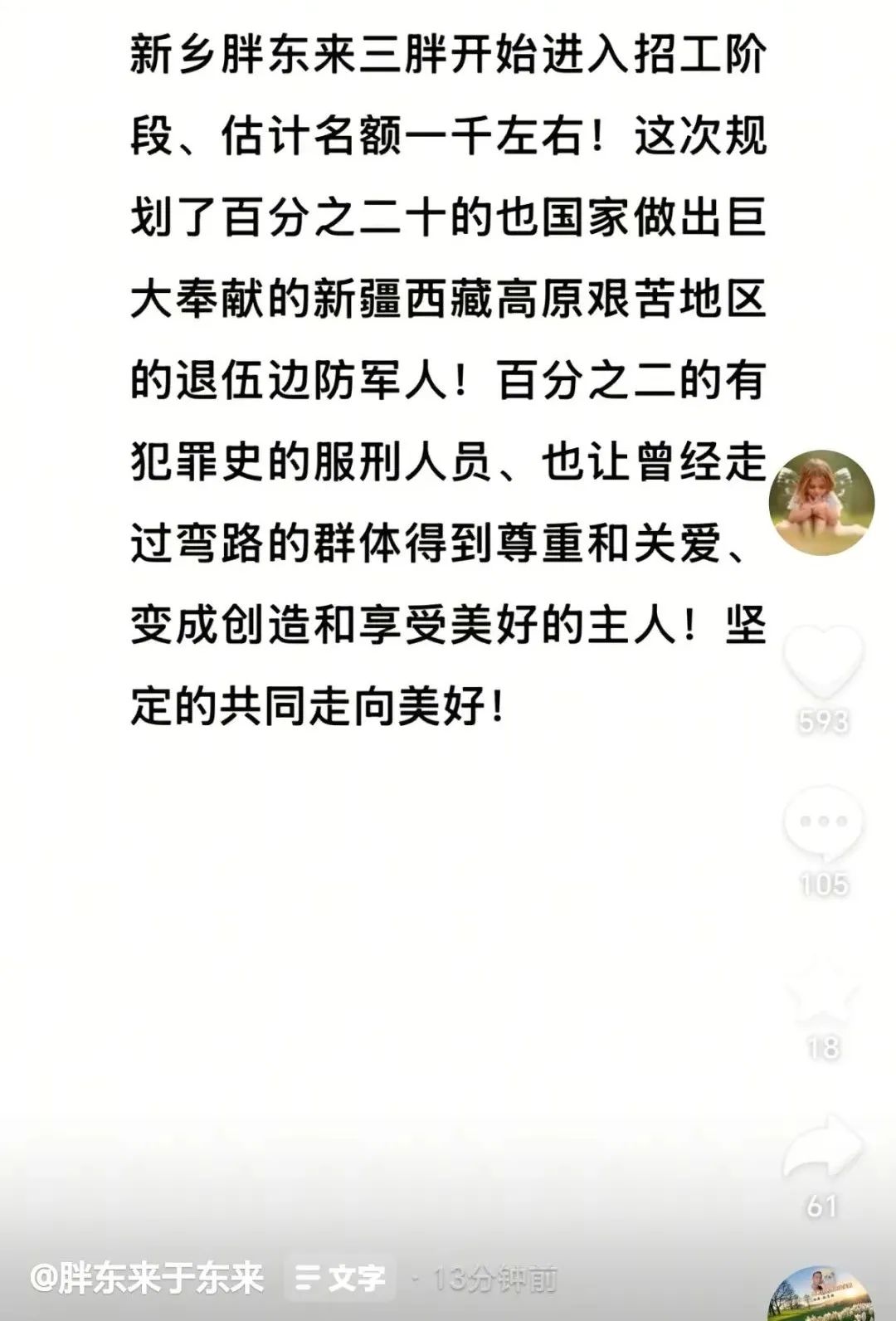
Core Viewpoint - The company "胖东来" (Pang Dong Lai) is attempting to address societal issues by offering job opportunities to ex-offenders, which has sparked both interest and controversy in the public sphere [1][2][11]. Group 1: Recruitment Initiative - Pang Dong Lai plans to recruit approximately 20 positions (2% of new job openings) specifically for ex-offenders, aiming to promote social acceptance and reduce discrimination against this group [1][5]. - The recruitment initiative aligns with the company's brand philosophy of love and freedom, reflecting a commitment to humane management practices [5][7]. Group 2: Public Reaction and Safety Concerns - The public response has been mixed, with concerns about safety and the stigma associated with hiring ex-offenders dominating discussions on social media [4][10]. - There is a prevalent societal anxiety regarding the safety of hiring individuals with criminal backgrounds, which has led to a significant portion of ex-offenders being rejected in the job market [13][15]. Group 3: Employment Statistics and Social Issues - Statistics indicate that 70% of ex-offenders face employment rejection due to their criminal records, with less than 40% finding jobs within three years of release [13][14]. - The employment challenges faced by ex-offenders not only represent a loss of human resources but also pose risks to social stability [15][16]. Group 4: Broader Implications and Call for Action - Pang Dong Lai's initiative serves as a case study for other companies, highlighting the need for a collective effort to address the employment challenges faced by ex-offenders [19][22]. - The company advocates for a collaborative approach involving government support and societal engagement to create a sustainable employment framework for ex-offenders [21][22].
每经热评︱让刑满释放者获得彻底“释放” 呼唤更多“胖东来”
Mei Ri Jing Ji Xin Wen· 2025-08-12 02:45
Core Viewpoint - The company "胖东来" (Pang Dong Lai) is taking a unique approach by offering job opportunities to ex-offenders, which has sparked significant public discussion and controversy. This initiative reflects its brand philosophy of love and freedom, aiming to promote social acceptance and reduce discrimination against this group [1][4][5]. Group 1: Company Philosophy and Strategy - The recruitment of ex-offenders aligns with the company's long-standing brand values of love and freedom, aiming to create a more inclusive workplace [4][5]. - The company has implemented a humane management approach, including compensation for employees who face unjust treatment, which has resulted in a remarkably low employee turnover rate of 0.94% [4][5]. - The company's strategy demonstrates that treating employees well can lead to increased business success and customer traffic, creating a positive feedback loop [4][5]. Group 2: Social Implications and Challenges - The initiative highlights the broader societal issue of employment for ex-offenders, with statistics showing that 70% of them face job rejections due to their criminal records, and less than 40% find employment within three years of release [8][9]. - The company's actions serve as a litmus test for societal acceptance of ex-offenders, challenging the prevalent safety anxieties and stigma associated with this group [8][9]. - The recruitment of ex-offenders is not just a business decision but a response to systemic gaps in the employment landscape for this demographic, aiming to reduce societal risks [9][11]. Group 3: Call for Broader Action - The company’s efforts alone are insufficient to address the employment challenges faced by ex-offenders; a collaborative approach involving more businesses and government support is necessary [11][12]. - There is a need for a comprehensive system that includes incentives for companies hiring ex-offenders, as well as psychological support and skills training for the individuals themselves [12][13]. - The establishment of a supportive environment for ex-offenders requires a dual approach of institutional safeguards and community engagement to alleviate public safety concerns [13][14].
社服零售行业周报:百胜中国Q2同店转正,泡泡玛特泰国最大旗舰店落地湄南河畔-20250810
HUAXI Securities· 2025-08-10 15:32
Investment Rating - The industry rating is "Recommended" [4] Core Insights - In Q2 2025, the company achieved revenue of $2.787 billion, a 4% increase year-on-year, with operating profit of $304 million, up 14%, and net profit of $215 million, up 1% [1][24] - Same-store sales turned positive, with a continuous increase in franchise ratio. The overall system sales for KFC and Pizza Hut increased by 5% and 3% respectively, while same-store sales rose by 1% for both KFC and Pizza Hut [1][24] - The company added 336 new stores in Q2 2025, with a franchise ratio of 26%, including 295 new KFC stores (40% franchise) and 95 new Pizza Hut stores (22% franchise) [1][24] Summary by Sections Industry & Company Dynamics - The company reported a Q2 2025 operating profit margin of 10.9%, an increase of 1.0 percentage points, with restaurant profit margins at 16.1%, up 0.6 percentage points [2][25] - The increase in delivery sales, which accounted for 45% of total sales, led to a rise in rider costs [2] Investment Suggestions - Five investment themes are suggested: 1. Continuous upgrades in AI technology benefiting companies like Keri International and Focus Technology 2. Increased consumer willingness to pay for emotional value, benefiting new retail players like Pop Mart and Miniso 3. Recovery in cyclical sectors under domestic demand, benefiting companies like Haidilao and Yum China 4. Expanding overseas consumption opportunities, with a focus on brands like Pop Mart and Miniso 5. Revitalization of traditional business formats as offline traffic returns, benefiting companies like Yonghui Supermarket and China Resources [6][49][52] Macro & Industry Data - In June, the total retail sales of consumer goods reached 4.23 trillion yuan, a year-on-year increase of 4.8% [26][28] - The online retail sales of physical goods accounted for 24.9% of total retail sales, with a year-on-year growth of 6.0% [27][33] Key Company Announcements - The company returned $274 million to shareholders in Q2 2025, including $184 million in stock buybacks and $90 million in cash dividends [24] - The flagship store of Pop Mart in Thailand opened on August 8, showcasing local cultural elements and interactive areas for consumers [3][22]
新零售业时代,山东商超如何成为顾客心头爱
Da Zhong Ri Bao· 2025-08-10 00:30
Core Insights - The article discusses the transformation of retail in Shandong, focusing on how supermarkets like "胖东来" (Pang Donglai) have become customer favorites through quality and service improvements [2][3]. Group 1: Retail Transformation Strategies - The retail industry is shifting from traditional models to a quality-centric approach, emphasizing user and product focus [2]. - 永辉超市 (Yonghui Supermarket) has implemented a "胖改" strategy, resulting in over 400% sales growth and a 170% increase in customer traffic at its newly opened store [2]. - The strategy includes enhancing product quality, improving store layout, and providing over 30 customer-friendly services [2][3]. Group 2: Private Label Development - "胖东来" has successfully established its own brand products across various categories, driven by a robust supply chain, leading to high market demand [3]. - 银座集团 (Yingzuo Group) is also developing private labels like "InZone" and "银座优鲜" to control product quality and costs while enhancing value for customers [3]. Group 3: Customer Experience and Store Layout - Supermarkets are redesigning layouts to place fresh and baked goods at the entrance to stimulate customer interest and enhance shopping experience [4]. - 家家悦集团 (Jiajia Yue Group) has seen a 20%-30% increase in sales after store renovations, utilizing data analytics to tailor offerings to local demographics [5]. Group 4: Market Adaptation and Innovation - The retail sector is evolving from mere product providers to "lifestyle designers," focusing on health-conscious products and interactive shopping experiences [7]. - New projects like 银座·新辰天地 (Yingzuo New Century) are being developed to cater to younger consumers, featuring trendy designs and a mix of shopping and entertainment [7]. Group 5: Policy and Industry Trends - The Shandong government is promoting retail innovation, aiming to renovate over 50 commercial facilities this year to create new consumer hubs [8].

品牌“互嘲”背后:挑战者的营销“拉踩”
Zhong Guo Jing Ying Bao· 2025-08-08 20:52
Core Insights - The article discusses the recent surge in interactive marketing strategies among brands in the consumer sector, highlighting a competitive landscape driven by attention economy dynamics [1][4][6] Group 1: Interactive Marketing Trends - Interactive marketing has seen a significant rise in July, with brands like Lafang and Duyuan engaging in direct competition through provocative advertising [1][4] - Lafang's marketing campaign for its hair mask product directly references Pantene's "3-minute miracle" controversy, showcasing a trend of brands targeting competitors in their promotions [2][4] - Retailer Duyuan has also employed similar tactics, using signage that indirectly critiques Sam's Club membership fees and product offerings [2][3] Group 2: Industry Dynamics - The competitive strategies reflect a broader issue in the consumer market, where brands are increasingly resorting to controversial marketing to capture consumer attention amid rising customer acquisition costs [4][5] - The current market environment is characterized by saturation, leading brands to adopt more aggressive marketing tactics as traditional methods become less effective [5][6] - Brands like Lafang and Duyuan are positioned as challengers in their respective industries, striving to enhance their market presence against established leaders [6][7] Group 3: Marketing Risks and Considerations - While interactive marketing can generate immediate consumer interest, it carries potential risks, including damage to brand reputation and possible legal issues [9][10] - Companies are advised to carefully evaluate the net benefits of such marketing strategies, balancing short-term sales boosts against potential long-term brand damage [10]



山姆和开市客加速拓店,盒马为何学不来会员制商超模式?
Nan Fang Du Shi Bao· 2025-08-07 23:10
Core Insights - Hema has decided to abandon its membership store format, with the last Hema X membership store in Shanghai set to close on August 31, 2024, following the closure of seven other membership stores this year [4][5][6] - In contrast, Sam's Club and Costco are rapidly expanding their membership store presence in China, with Sam's Club reporting a 40% increase in membership revenue in the latest quarter [4][10] - Hema's shift away from the membership model reflects a strategic focus on its fresh food and discount store formats, aiming for profitability and resource concentration [7][8] Hema's Membership Store Closure - Hema's last X membership store will cease operations, marking the end of its high-end membership store format [6] - The closure of Hema X membership stores has been ongoing, with three stores closed earlier this year and additional closures in June and July [5][6] - Hema's decision to close these stores is part of a broader strategy to focus on Hema Fresh and Hema NB formats, with plans to open nearly 100 new Hema Fresh stores in the coming fiscal year [4][7] Comparison with Competitors - Sam's Club has significantly increased its store count in China, reaching 53 locations by 2024, and has seen strong performance in membership revenue [4][9] - Costco, which opened its first store in mainland China in 2019, is also expanding its footprint, with plans to continue opening new locations [9] - Hema's membership model faced challenges due to insufficient supply chain capabilities and a lack of unique products, leading to its decision to pivot away from this format [8] Financial Performance - Walmart reported a 22.5% year-on-year increase in net sales in China, with Sam's Club contributing to this growth through strong membership performance [10] - The membership fee for Sam's Club is comparable to Hema's, with ordinary and premium memberships priced at 260 yuan and 680 yuan respectively [9] - Hema's membership fees were 258 yuan for gold members and 658 yuan for diamond members, but the value proposition did not meet consumer expectations [7][9]