公用事业

Search documents
中叶私募:如何评估加息对股市的具体影响
Sou Hu Cai Jing· 2025-07-30 06:41
Group 1: Capital Flow and Market Liquidity - After the Federal Reserve raises interest rates, the attractiveness of U.S. assets increases, leading to a significant capital inflow into the U.S. This results in reduced capital supply in other countries, particularly emerging markets, which experience a decline in stock market purchasing power and suppressed stock prices [1][3] - The tightening of liquidity due to interest rate hikes makes financing more difficult, causing funds to shift from the stock market to fixed-income assets like bonds, which increases their appeal to investors. This shift directly impacts the supply-demand relationship in the stock market, putting pressure on stock prices [3] Group 2: Corporate Costs and Profitability - Interest rate hikes increase corporate financing costs, whether through bank loans or bond issuance, leading to higher interest payments. This compresses profit margins, especially for companies with high debt levels, such as those in the real estate sector, which face significant operational pressure in a rising interest rate environment [4] - A decrease in corporate profits leads to lowered future earnings expectations from investors, resulting in stock price declines. However, companies that can offset rising costs through efficiency improvements or revenue growth may not see significant stock price impacts [4] Group 3: Industry Performance Differentiation - Financial stocks typically benefit from interest rate hikes, as banks can earn more interest income from higher loan rates. For instance, during the 2022-2023 rate hike cycle, U.S. bank stocks performed strongly, becoming a crucial support for the market [5] - Growth sectors such as technology and pharmaceuticals often face pressure during rate hikes due to their reliance on substantial funding for R&D and market expansion. Increased financing costs can hinder their growth prospects and valuation potential, as evidenced by the poor performance of U.S. tech stocks during the 2022 rate hike environment [6] - Defensive sectors like consumer staples and utilities tend to exhibit relative stability due to their steady cash flows and lower sensitivity to interest rates. For example, during the 2015-2018 rate hike cycle, the consumer staples sector remained relatively stable, serving as a safe haven for investors [7] Group 4: Market Sentiment and Investor Preferences - Interest rate hikes are perceived as signals of tightening monetary policy, leading to cautious economic growth expectations among investors and a decline in market risk appetite. Investors tend to allocate funds to safer assets like bonds, reducing stock investments, which can lead to overall market valuation declines and stock price pressures [8] - Rate hikes can trigger panic in the market, especially when combined with other uncertainties such as economic concerns or policy adjustments. For instance, during the aggressive rate hikes by the Federal Reserve in 2022, global stock markets experienced significant volatility, with investor sentiment becoming extremely cautious [9] Group 5: Macroeconomic and Policy Environment - Interest rate hikes generally indicate a relatively strong economic state, which can positively impact corporate revenues and profits, benefiting the stock market. However, rapid or excessive rate increases may slow economic growth, negatively affecting the stock market, as seen during the aggressive rate hikes in 2022 that led to declining growth expectations [10] - Domestic policy environments play a crucial role in mitigating the impacts of rate hikes. For example, during the Federal Reserve's rate hikes in 2018, China's implementation of proactive fiscal and monetary policies helped cushion the impact, resulting in relatively stable performance in the A-share market [10] Group 6: Exchange Rate Factors - Interest rate hikes typically lead to a stronger U.S. dollar, which can adversely affect export-oriented companies while benefiting importers. A stronger dollar also diminishes foreign investment interest in RMB-denominated assets, exerting pressure on the A-share market, as observed during the dollar's strength in 2022 [11] - The strengthening of the dollar creates depreciation pressure on the RMB, which supports the profitability of export-oriented companies but overall reduces foreign investment interest in RMB assets. Investors need to closely monitor the impact of exchange rate fluctuations on the stock market [11] Group 7: Historical Case Studies - During the 2015-2018 rate hike cycle, the A-share market exhibited structural trends, with large-cap stocks in finance and consumer sectors performing well, while growth stocks like technology faced relative weakness. The capital inflow into the U.S. led to reduced capital supply in the A-share market, putting pressure on high-valuation sectors [13] - In the 2022-2023 rate hike cycle, the A-share market faced multiple challenges, including geopolitical conflicts and domestic pandemic fluctuations, leading to a significant decline in market risk appetite. The CSI 300 index displayed characteristics of "oscillating bottoming," with technology and growth stocks underperforming while defensive sectors remained stable [14]

申万宏源杨成长:以产业新特征为锚 重塑上市公司产业投资价值
申万宏源证券上海北京西路营业部· 2025-07-30 02:13
Core Viewpoint - The article emphasizes the importance of industrial investment value as a comprehensive measure of a company's collaborative ability, technological potential, and long-term development prospects within the industrial chain ecosystem, highlighting the need for companies to redefine their roles and strategic positioning in the evolving landscape of the digital economy and technological revolution [1][2][3]. Group 1: Industrial Investment Value - Industrial investment value is a key basis for evaluating and making decisions by industrial investors, focusing on sustainable technological evolution and the ability to integrate into the industrial ecosystem [3]. - The evaluation of industrial investment value has shifted from a static classification to a dynamic consideration, influenced by technological innovation and the deep integration of the digital economy [4]. - Many traditional industry companies have not received reasonable valuations due to a simplistic categorization that labels them as low-growth sectors, despite their continuous innovation and excellence in their fields [3][4]. Group 2: Opportunities in Evolving Industrial Landscape - Companies, especially those in traditional industries, must seize four major opportunities arising from the deep evolution of industrial patterns: leveraging digital economy opportunities, understanding new demand characteristics, utilizing network hub advantages, and recognizing the characteristics of the industrial era [5][6]. - The digital economy is reshaping industrial relationships, creating new organizational forms and collaborative logics, allowing traditional companies to embed themselves into the digital economy [6][7]. Group 3: New Demand Characteristics - The traditional linear logic of "demand leads supply" is evolving into a dynamic interplay where supply also creates demand, necessitating companies to redefine their products and services to meet and lead new consumer trends [10][11]. - Companies should actively engage with end-user demands and broaden their growth space by embedding themselves in end-driven industrial chains, enhancing their product technology levels to gain market recognition [10][11]. Group 4: Network Hub Advantages - In the information age, flow (people, logistics, capital, information, energy) is a core representation of the connection between enterprises and markets, and those who master flow can create network hub effects and scale effects [14][15]. - Traditional companies must leverage their network hub positions to transition towards digital value heights, integrating various flows to gain a competitive edge in resource allocation and industrial upgrades [14][15]. Group 5: Traditional and Emerging Industry Dynamics - The boundaries between traditional and emerging industries are increasingly blurred, and companies must redefine themselves and explore collaborative potential between traditional and new industries to enhance their investment value [17][18]. - Emerging industry companies must maintain their innovation momentum to avoid falling into the trap of becoming "new traditional industries" as they mature, emphasizing the importance of long-term investment in core technologies [19][20].

222只港股获南向资金大比例持有
Zheng Quan Shi Bao Wang· 2025-07-30 01:25
Summary of Key Points Core Viewpoint - Southbound funds have become significant participants in the Hong Kong stock market, holding 18.24% of the total shares of Hong Kong Stock Connect stocks, with a total market value of 55,994.41 billion HKD [1]. Group 1: Southbound Fund Holdings - As of July 29, southbound funds held a total of 4,563.87 million shares in Hong Kong Stock Connect stocks, representing 18.24% of the total share capital [1]. - The market value of shares held by southbound funds accounts for 13.77% of the total market capitalization of the stocks [1]. - There are 222 stocks where southbound funds hold over 20% of the total share capital, while 135 stocks have a holding ratio between 10% and 20% [1]. Group 2: Industry Distribution - The stocks with over 20% holdings by southbound funds are primarily concentrated in the healthcare, industrial, and financial sectors, with 43, 35, and 32 stocks respectively [2]. - Among the stocks with the highest southbound fund holdings, China Telecom leads with 74.69%, followed by Green Power Environmental and China Shenhua with 69.97% and 66.91% respectively [2]. Group 3: Characteristics of High Holdings - A majority of the stocks with high southbound fund holdings are AH concept stocks, with 125 out of 222 stocks (56.31%) having over 20% holdings being AH shares [1]. - The distribution of holdings shows that 14.81% of stocks with 10% to 20% holdings are also AH shares [1].

A股定增暖流涌动
2 1 Shi Ji Jing Ji Bao Dao· 2025-07-30 00:00
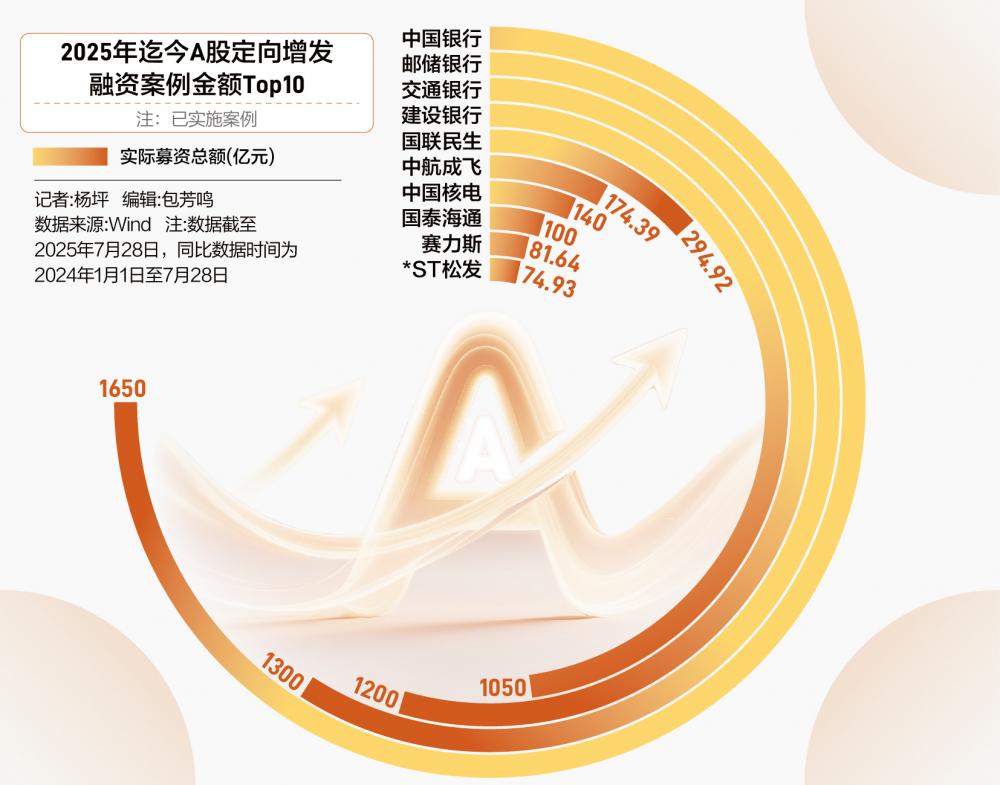
Group 1 - The A-share market has seen a significant increase in equity financing, with 172 companies raising a total of 823.51 billion yuan, a year-on-year increase of 371.52% [1] - Among these, 90 companies completed private placements, raising 722.30 billion yuan, up 543.73% year-on-year, while 25 companies issued convertible bonds, raising 40.56 billion yuan, a 53.53% increase [1] - Major state-owned banks, including Bank of China, Postal Savings Bank, and others, have raised over 1 trillion yuan each for capital replenishment, with Bank of China leading at 165 billion yuan [1][4] Group 2 - The surge in private placements is supported by regulatory measures aimed at increasing long-term capital inflows into the market, including a joint policy issued by six departments [3] - The proportion of financing for mergers and acquisitions has risen significantly, with 16 out of 90 private placements being used for asset acquisitions [3] - The manufacturing and high-tech industries are the primary drivers of private placements, with significant participation from sectors such as chemicals, hardware, and machinery [3] Group 3 - Financial institutions have raised a total of 520 billion yuan, with government support for state-owned banks to issue special bonds for capital replenishment [4] - Securities firms have also engaged in private placements to strengthen their capital, with notable fundraising efforts from Tianfeng Securities and Guotai Junan [5] - The simplified procedures for small and medium enterprises have gained popularity, allowing quicker access to funds, with 11 out of 90 private placements utilizing this method [6] Group 4 - Numerous companies are planning new private placements, with 352 companies updating their refinancing plans this year, a 162.69% increase from last year [7] - The Shenzhen Stock Exchange has introduced guidelines to enhance financing flexibility for companies meeting "light asset" and "high R&D" criteria, benefiting over 200 companies in strategic emerging industries [8] - The overall private placement fundraising scale is expected to exceed 1 trillion yuan this year, driven by improved market conditions and corporate profitability [9]
【策略】市场或继续震荡上行——2025年8月A股及港股月度金股组合(张宇生/王国兴)
光大证券研究· 2025-07-29 23:08
Group 1 - The A-share market showed a general recovery in July, with major indices rising, particularly the ChiNext Index, influenced by improved market sentiment and policy catalysts [2] - The Hong Kong stock market experienced a volatile upward trend in July, with the Hang Seng Technology Index and Hang Seng Composite Index increasing by 7.1% and 6.7% respectively, due to easing overseas disturbances and a recovery in domestic risk appetite [2] Group 2 - The market is expected to reach new highs in the second half of the year, transitioning from policy-driven to fundamental and liquidity-driven dynamics, with potential for a breakout above the 2024 mid-year peak [3] - Focus on sectors benefiting from anti-involution policies and potential rebound opportunities, particularly in coal, steel, photovoltaic, and building materials, with a rotational rebound characteristic anticipated [3] - Key industries to watch include electronics and machinery, with specific attention to chemical fibers, engineering machinery, military electronics, aerospace equipment, and automation equipment [3] Group 3 - The Hang Seng Index has surpassed previous highs and is expected to continue its upward trend, supported by strong overall profitability and relatively low valuations in sectors like internet, new consumption, and innovative pharmaceuticals [5] - The "dumbbell" strategy is recommended, focusing on sectors benefiting from domestic supportive policies in the context of US-China competition, as well as independent internet technology companies [5] - High dividend and low volatility strategies are also advised, particularly in telecommunications, public utilities, and banking sectors, providing stable income as a foundational investment [5]

A股活水来:定增金额大增544%,简易程序成企业“及时雨”
2 1 Shi Ji Jing Ji Bao Dao· 2025-07-29 22:48
Group 1 - The A-share market has seen a significant increase in equity financing, with 172 companies raising a total of 823.51 billion yuan, a year-on-year increase of 371.52% [1] - Among these, 90 companies completed private placements, raising 722.30 billion yuan, up 543.73% year-on-year, while 25 companies issued convertible bonds, raising 40.56 billion yuan, a 53.53% increase [1] - Major state-owned banks, including Bank of China and Postal Savings Bank, have raised over 1 trillion yuan each for capital replenishment, with Bank of China leading at 165 billion yuan [1][4] Group 2 - The surge in private placements is supported by regulatory measures aimed at increasing long-term capital market participation, with policies introduced in 2025 to enhance financing capabilities [3][9] - The manufacturing and high-tech sectors are the primary drivers of private placements, with significant participation from industries such as chemicals, hardware, and machinery [3] - Financial institutions have raised a total of 520 billion yuan, bolstered by government support for capital replenishment [4] Group 3 - Securities firms have also engaged in private placements to strengthen capital, with firms like Tianfeng Securities raising 45.49 billion yuan [5] - A simplified procedure for small-scale private placements has gained popularity, allowing companies to raise funds more quickly and efficiently [6] - Recent announcements indicate a growing trend of companies disclosing plans for targeted stock issuances, with 352 companies updating refinancing plans, a 162.69% increase from last year [7] Group 4 - The Shenzhen Stock Exchange has introduced guidelines to enhance financing flexibility for companies with "light assets" and high R&D investments, allowing them to bypass certain restrictions [8] - Over 200 companies are expected to meet the new criteria, primarily in strategic emerging industries such as information technology and biomedicine [8] - The overall fundraising scale for private placements is projected to exceed 1 trillion yuan this year, driven by improved market conditions and corporate profitability [9]



A股活水来!定增金额大增544%,简易程序成企业“及时雨”
2 1 Shi Ji Jing Ji Bao Dao· 2025-07-29 12:27
Group 1 - The A-share market has seen a significant increase in equity financing, with 172 companies raising a total of 823.51 billion yuan, a year-on-year increase of 371.52% [1] - Among these, 90 companies completed private placements, raising 722.30 billion yuan, up 543.73% year-on-year, while 25 companies issued convertible bonds, raising 40.56 billion yuan, a 53.53% increase [1] - Major state-owned banks, including Bank of China, Postal Savings Bank, and others, have raised over 1 trillion yuan each for capital replenishment, with Bank of China leading at 165 billion yuan [1][3] Group 2 - The surge in private placements is supported by regulatory measures aimed at increasing long-term capital inflows into the market [2] - The "merger and acquisition" policy has led to a significant rise in financing for mergers and acquisitions, with 16 out of 90 private placements being used for asset acquisitions [3] - The financial sector has dominated the fundraising landscape, with major banks collectively raising 520 billion yuan, supported by government initiatives to issue special bonds [3] Group 3 - Several securities firms have also engaged in private placements to enhance their capital strength, with a total of 45.49 billion yuan raised this year [4] - The simplified procedures for small and medium enterprises have gained popularity, allowing quicker access to necessary funds [4][5] - A total of 352 companies updated their refinancing plans this year, a 162.69% increase from last year, with a significant portion being technology firms seeking to bolster working capital [6] Group 4 - The Shenzhen Stock Exchange has introduced guidelines to enhance financing flexibility for companies classified as "light asset" and "high R&D input," allowing them to bypass certain restrictions [7] - Over 200 companies are expected to meet these new standards, primarily in strategic emerging industries such as information technology and biomedicine [7] - The overall fundraising scale for private placements is projected to exceed 1 trillion yuan this year, driven by improved market conditions and corporate profitability [8]
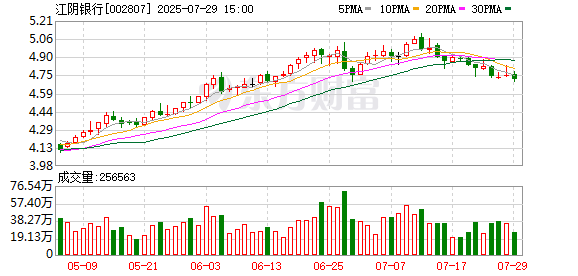
江阴银行:江南水务与新国联不构成一致行动人
Zheng Quan Ri Bao· 2025-07-29 11:39
(文章来源:证券日报) 证券日报网讯江阴银行7月29日在互动平台回答投资者提问时表示,江南水务与新国联不构成一致行动 人。 ...


专题研究 | 2025年2季度哪些企业实现债券市场首发——中西部地区产投类(城投转型)首发案例篇
Xin Lang Cai Jing· 2025-07-29 08:42
Core Viewpoint - The issuance scale of urban investment bonds continues to decline in the first half of 2025, with a slight narrowing of the decline compared to the first quarter, influenced by stricter regulations and policies aimed at mitigating local debt risks [1][3][4]. Group 1: Issuance Trends - In the first half of 2025, the issuance scale of urban investment bonds decreased by approximately 13.5% year-on-year, with the decline in eastern regions remaining significant at 18.7%, while the central and western regions saw slight improvements [4]. - The number of newly issued enterprises in the second quarter of 2025 increased significantly, with a growth rate of 114% compared to the first quarter, indicating a more balanced regional distribution [9]. - The financing net outflow for urban investment bonds in the first half of 2025 reached 214.1 billion, a substantial decrease from the net inflow of 109 billion in the first quarter [7]. Group 2: Enterprise Characteristics - The majority of newly issued enterprises in the second quarter of 2025 were in the production and investment category, accounting for about 64.2% of the total, with a notable increase in diversity among industries such as public utilities and transportation [11]. - In the central region, 76.5% of newly issued enterprises were urban investment types, with a significant proportion being AA+ rated or above, and the majority of funds raised were for new projects [14]. - In the western region, 45.45% of newly issued enterprises were urban investment types, with a focus on new funding purposes, accounting for 92% of the total [16]. Group 3: Transformation and Policy Impact - The series of debt resolution policies initiated in 2023 has led to a tightening of financing policies for urban investment enterprises, resulting in a significant reduction in net financing scale for urban investment bonds in 2024 [3][4]. - Urban investment enterprises are gradually advancing their transformation processes, relying on regional resource endowments and existing business advantages to open up new financing channels in the bond market [3]. - Typical cases of urban investment transformation in the central and western regions include the integration of operational assets and the development of industrial parks, showcasing a shift towards more diversified business models [14][18].

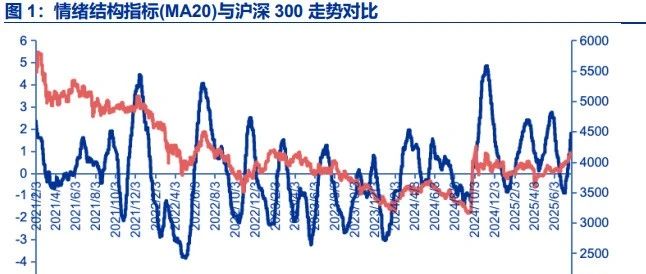
市场情绪持续上升,模型提示行业间交易活跃度上升——量化择时周报20250725
申万宏源金工· 2025-07-29 08:00
Core Viewpoint - The market sentiment score has increased, indicating a bullish outlook for the market as of July 25, with a score of 1.8, up from 0.65 the previous week [1]. Group 1: Market Sentiment Indicators - The sentiment structure indicator is calculated using a scoring method based on the direction of each sub-indicator and its position within the Bollinger Bands, resulting in a 20-day moving average score [1]. - The trading volatility between industries has shown a positive signal, suggesting increased capital activity and reduced uncertainty in short-term sentiment [4][14]. - The financing ratio has decreased, indicating a decline in the heat of margin trading, which requires further observation [4]. Group 2: Trading Activity and Volume - The overall trading volume in the A-share market has maintained an upward trend, with a peak daily trading volume of 19,286.45 billion RMB on July 25 [9]. - The consistency of price and volume remains high, indicating active participation and capital engagement in the market [6]. Group 3: Industry Performance - Industries such as basic chemicals, non-ferrous metals, and electric equipment have shown strong performance, while sectors like public utilities, media, and banking have lagged behind [16]. - The short-term trend scores for industries like coal, food and beverage, and beauty care have significantly increased, with coal showing a remarkable rise of 109.09% [19][20]. Group 4: Style and Trend Analysis - The small-cap growth style is currently favored, with the relative strength index (RSI) indicating a strong preference for growth stocks over value stocks [21][22]. - The trend scoring model shows that industries like coal, food and beverage, and construction materials have strong short-term trend scores, suggesting potential investment opportunities [19][20].