化妆品

Search documents
10月以旧换新相关商品销售保持较快增长
Qi Huo Ri Bao· 2025-11-19 16:07
Core Viewpoint - The domestic consumption market in China has shown steady growth in October, driven by the National Day and Mid-Autumn Festival holidays, with continuous release of consumption potential [1] Summary by Categories Overall Consumption Performance - In October, the total retail sales of consumer goods reached 4.63 trillion yuan, representing a year-on-year growth of 2.9% [1] - From January to October, the total retail sales of consumer goods amounted to 41.2 trillion yuan, with a growth rate of 4.3%, which is 0.8 percentage points higher than the same period last year [1] Retail Sales Breakdown - In October, the retail sales of goods increased by 2.8%, with significant growth in sales of products related to trade-in programs [1] - Retail sales for communication equipment, cultural and office supplies, and furniture increased by 23.2%, 13.5%, and 9.6% respectively [1] Basic and Upgraded Goods Consumption - Basic living goods saw rapid growth, with retail sales of grain and oil foods increasing by 9.1% and clothing and footwear by 6.3% [1] - Demand for upgraded goods remained strong, with retail sales of gold and silver jewelry, sports and entertainment products, and cosmetics increasing by 37.6%, 10.1%, and 9.6% respectively [1]
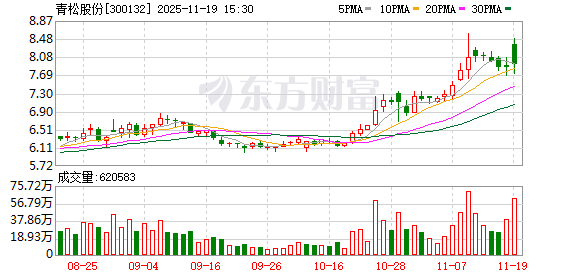
青松股份:公司目前主营业务为化妆品ODM业务
Zheng Quan Ri Bao· 2025-11-19 13:38
Group 1 - The company, Qingsong Co., is primarily engaged in the ODM (Original Design Manufacturer) business for cosmetics [2] - The company's registered location is in Jianyang District, Nanping City, Fujian Province, China [2] - The main operational area of the company is in Zhongshan City, Guangdong Province [2]


福瑞达(600223):调整期业绩仍承压 关注Q4调整节奏
Xin Lang Cai Jing· 2025-11-19 12:31
Core Insights - The company has shown steady growth in its cosmetics business, with specific brands like Yilian and Kemi demonstrating varying performance levels, while Aier Bozhi has seen a reduction in revenue decline [1][2] Group 1: Revenue Performance - For the first three quarters of 2025, the company's total revenue from cosmetics reached 1.569 billion yuan, a decrease of 8.17%, with Q3 revenue at 475 million yuan, down 9.1% [1] - Yilian's revenue for the first three quarters was 786 million yuan, an increase of 19.5%, with Q3 revenue at 232 million yuan, up 10% [1] - Aier Bozhi's revenue for the first three quarters was 646 million yuan, down 29%, with Q3 revenue at 195 million yuan, down 26%, although the decline has narrowed [1] - Kemi's revenue for the first three quarters was 77.19 million yuan, with a significant Q3 growth rate of 138% [1] Group 2: Profitability and Margins - In Q3 2025, the company reported revenue of 807 million yuan, a decrease of 7.97%, and a net profit attributable to shareholders of 34 million yuan, down 23.07% [2] - The gross profit margin for Q3 was 49.5%, a decline of 2.3 percentage points, primarily due to the drop in cosmetics business margins [2] - The net profit margin attributable to shareholders for Q3 was 4.18%, down 0.83 percentage points, while the adjusted net profit margin was 3.17%, down 1.31 percentage points [2] Group 3: Strategic Focus and Future Outlook - The company is undergoing a business adjustment that is expected to impact short-term profitability, with a focus on the recovery of Yilian and the promising growth of Kemi driven by new technology [2] - Aier Bozhi's revenue decline is expected to stabilize with the introduction of new products, and the management's return to frontline operations is anticipated to enhance the adjustment and recovery of the cosmetics business [2]

贾乃亮直播带货娇兰复原蜜被疑是假货,回应:官方旗舰店发货
Nan Fang Du Shi Bao· 2025-11-19 11:12
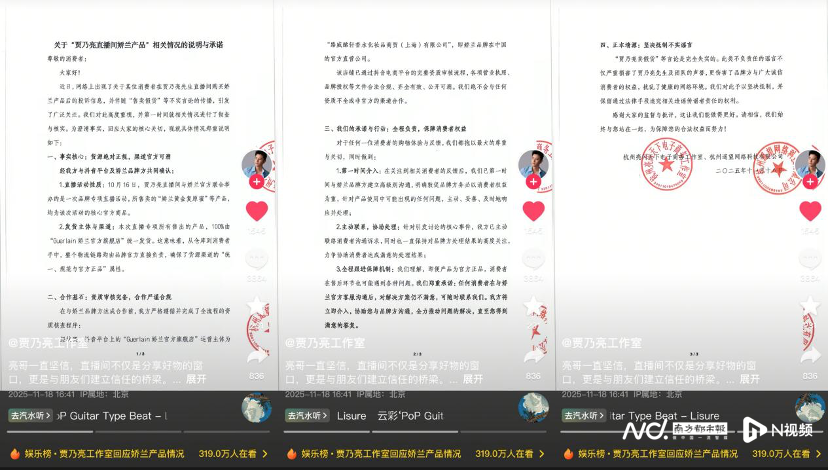
Core Viewpoint - The controversy surrounding the authenticity of "Guerlain Golden Recovery Honey" purchased through a live stream hosted by celebrity 贾乃亮 has raised significant concerns among consumers, leading to claims of counterfeit products despite assurances from the brand's official channels [1][3][5]. Group 1: Consumer Claims - A consumer reported purchasing approximately 7000 yuan worth of "Guerlain Golden Recovery Honey" from 贾乃亮's live stream, suspecting it to be counterfeit based on differences in packaging and texture compared to products from physical stores [3]. - The consumer's claims were supported by a third-party testing agency, which confirmed the product as counterfeit, leading to further questions about the brand's quality control [4][3]. Group 2: Brand and Seller Response - 贾乃亮's studio and the MCN company, 遥望科技, stated that all products sold during the live stream were shipped directly from the "Guerlain Official Flagship Store," ensuring authenticity [5][7]. - The official response emphasized that the logistics chain was managed by the brand itself, aiming to reassure consumers about the product's legitimacy [5][7]. Group 3: Company Background - The operational entity behind the "Guerlain Official Flagship Store" is 路威酩轩香化, a subsidiary of LVMH Group, which oversees the sales of several luxury brands in China [7]. - LVMH Group has not yet provided a public response to the allegations as of the latest updates [8]. Group 4: Sales Performance - During the live stream event on October 16, 贾乃亮's sales reached over 100 million yuan, with "Guerlain Golden Recovery Honey" being one of the top-selling products, accounting for sales between 5 million to 7.5 million yuan [5].

中国游客对日本贡献究竟有多大?
3 6 Ke· 2025-11-19 10:49
Core Viewpoint - The recent travel warning for citizens to postpone trips to Japan has led to a significant decline in travel bookings and a potential economic impact on Japan's tourism sector, which is heavily reliant on Chinese tourists [1][3][10]. Group 1: Impact on Travel Bookings - After the travel warning, bookings for flights from China to Tokyo's Narita Airport dropped by 65% in a single day [3]. - The cancellation of tickets to Japan reached 491,000, which is 32% of the total bookings, with a notable increase in cancellations from Beijing compared to other Chinese cities [3]. - The hotel occupancy rates in tourist-dependent areas like Kyoto and Nara surged to 70% due to the drop in Chinese tourists [3]. Group 2: Stock Market Reaction - The Nikkei 225 index fell over 1% and dropped below 50,000 points on November 17, reflecting immediate market reactions to the travel warning [4]. - Airline stocks, including All Nippon Airways and Japan Airlines, saw declines of over 3% to 4%, while railway, retail, and hotel operators like Hankyu Hanshin Holdings fell more than 2% [5]. Group 3: Economic Significance of Chinese Tourists - The tourism industry contributes 7.5% to Japan's GDP, making it a crucial sector for economic growth and employment [7]. - In 2024, Japan welcomed 36.87 million foreign tourists, a 53.4% increase from 2023, with Chinese tourists accounting for 18.9% of this total [7][8]. - Chinese tourists spent 1.7335 trillion yen, representing 21.3% of total foreign tourist spending in Japan, highlighting their significant economic impact [8]. Group 4: Broader Economic Implications - A significant drop in Chinese tourists could lead to a 0.36% reduction in Japan's GDP, which would erase more than half of the revised GDP growth forecast for the fiscal year 2025 [9]. - The Japanese Cabinet Office recently lowered its GDP growth forecast from 1.2% to 0.7%, indicating a challenging economic environment [9]. Group 5: Global Context of Chinese Tourists - The influence of Chinese tourists extends beyond Japan, as their absence during the pandemic severely impacted global tourism, with Japan losing 4.8 trillion yen [13]. - The spending power of Chinese tourists is unmatched, as evidenced by their higher per capita spending compared to tourists from other countries [14][18]. - The anticipated outbound travel from China is expected to exceed 155 million by 2025, underscoring the growing importance of Chinese tourists in the global tourism landscape [18][19].

叶国富:名创优品,是我在日本逛街逛出来的
创业家· 2025-11-19 10:13
Core Insights - The article emphasizes the importance of focusing on product quality in retail, regardless of whether the sales channel is online or offline [6][7][14] - It highlights the unique shopping experience that physical stores can provide, which often leads to impulse purchases that online platforms cannot replicate [6][14] Group 1: Retail Strategy - The company believes that the core of future offline retail lies in creating an enjoyable shopping experience, where consumers discover products they like while browsing [6][14] - The article suggests that successful retail strategies should follow consumer behavior and learn from successful models, such as Japanese stores [6][14] - It mentions that many retail brands still rely heavily on offline sales, with online sales accounting for only about 10% of total sales for some brands like Miniso [6][14] Group 2: Learning from Japanese Brands - The article discusses a learning trip to Japan to understand how Japanese brands thrive in low-growth environments, focusing on their operational strategies [10][14] - It highlights that Japanese brands have adapted to low-growth periods by focusing on customer expectations and making small innovations rather than pursuing disruptive changes [14][15] - The article emphasizes the importance of understanding consumer needs through direct engagement and observation, as demonstrated by successful Japanese brands [14][15][17] Group 3: Product Development and Innovation - The article points out that successful companies like FANCL and Suntory focus on product quality and consumer feedback to drive innovation [19][25] - It mentions that companies should not rely solely on data but should also engage with the physical product to ensure quality and consumer satisfaction [18][25] - The article illustrates how brands like Kikkoman and WORKMAN have successfully filled market gaps by understanding specific consumer needs and preferences [17][19]


超万亿化妆品市场 国货品牌占比超一半!
Xin Hua She· 2025-11-19 09:55
Core Insights - The National Medical Products Administration has released opinions to deepen cosmetic regulation reform and promote high-quality industry development, emphasizing increased support for the industry and fostering competitive domestic brands [1][5][6] - The domestic cosmetics market is projected to exceed 1 trillion yuan in transaction volume by 2024, with domestic brands capturing 55.2% market share [1] - The rise of domestic cosmetics is attributed to the integration of traditional Chinese culture and innovative product development, appealing to consumers' cultural values [2][3] Industry Trends - The "Double 11" shopping festival showcased strong performance for domestic cosmetics, with 5 out of the top 10 beauty brands on Douyin being Chinese [2] - Consumers are increasingly seeking products that offer cultural value and emotional resonance beyond basic functionality [2] Innovation and Technology - As of mid-2023, 80 new cosmetic raw materials have been registered, with a year-on-year growth of approximately 80%, indicating strong momentum in local raw material development [3] - Chinese companies dominate the global hyaluronic acid market, accounting for 80% of total sales, with innovative production methods enhancing product efficacy [3] Policy Support - The recent policy opinions aim to stimulate innovation, reduce corporate burdens, and optimize the market environment through scientific regulation [6][7] - Local governments are implementing supportive measures, such as financial incentives for key laboratories and initiatives to promote "Shanghai manufacturing" [7] Future Outlook - The continuous improvement of regulatory frameworks and local policies is expected to support the transition from a "cosmetic manufacturing powerhouse" to a "cosmetic strong nation" [7] - The industry is encouraged to leverage cultural elements and scientific research to enhance competitiveness and expand globally [4][8]
财经聚焦丨超万亿化妆品市场,国货品牌占比超一半!
Xin Hua Wang· 2025-11-19 09:49
Core Insights - The domestic cosmetics market in China is projected to exceed 1 trillion yuan in 2024, with domestic brands capturing 55.2% of the market share [1][7] - The rise of domestic beauty brands is attributed to their incorporation of traditional Chinese culture and innovative product development [1][3] Market Overview - The National Medical Products Administration has released guidelines to enhance the cosmetics industry, focusing on policy support to foster competitive domestic brands [1][7] - The "Double 11" shopping festival saw domestic brands performing well, with 5 out of the top 10 beauty brands on Douyin being Chinese [2] Consumer Trends - Consumers are increasingly valuing cultural significance and emotional resonance in products, moving beyond basic functionality [2][3] - The integration of traditional cultural elements into product design and marketing is appealing to younger consumers [1][2] Innovation and Technology - As of mid-2023, 80 new cosmetic raw materials have been registered, with 70 from local companies, indicating strong domestic innovation [3][4] - Chinese companies are achieving breakthroughs in high-end raw materials, such as hyaluronic acid and ergothioneine, enhancing product efficacy [3][4][6] Policy Support - Recent policies aim to stimulate innovation, reduce corporate burdens, and optimize the market environment for the cosmetics industry [7][8] - Local governments are implementing supportive measures, such as financial incentives for approved laboratories and initiatives to promote brand development [7][8] Industry Outlook - The continuous improvement of regulatory frameworks and local policies is expected to support the transition from a "cosmetics manufacturing country" to a "cosmetics powerhouse" [8] - The emphasis on cultural identity and scientific research is anticipated to drive the growth of domestic beauty brands on a global scale [8]

化妆品板块11月19日涨1.72%,科思股份领涨,主力资金净流入2.01亿元
Zheng Xing Xing Ye Ri Bao· 2025-11-19 08:58
Market Overview - The cosmetics sector increased by 1.72% on November 19, with Keshare leading the gains [1] - The Shanghai Composite Index closed at 3946.74, up 0.18%, while the Shenzhen Component Index closed at 13080.09, unchanged [1] Key Performers - Keshare (300856) closed at 15.29, up 7.98% with a trading volume of 315,500 shares and a turnover of 475 million yuan [1] - Bavi (920123) closed at 19.72, up 4.89% with a trading volume of 118,600 shares and a turnover of 229 million yuan [1] - Lafang (603630) closed at 24.60, up 4.15% with a trading volume of 145,700 shares and a turnover of 353 million yuan [1] - Other notable performers include Shuiyang (300740) and Tian Cai Ya (603605), with increases of 3.28% and 2.55% respectively [1] Fund Flow Analysis - The cosmetics sector saw a net inflow of 201 million yuan from institutional investors, while retail investors experienced a net outflow of 252 million yuan [2] - Keshare had a net inflow of 63.71 million yuan from institutional investors, while retail investors had a net outflow of 47.79 million yuan [3] - Other companies like Shuiyang and Furuida also experienced significant net inflows from institutional investors, indicating strong interest in the sector [3]


东方证券:化妆品行业创新发展 国货品牌有望开辟新路径实现技术跃迁
智通财经网· 2025-11-19 07:12
Core Viewpoint - The cosmetics industry in China is expected to evolve from ingredient accumulation to precise targeting, and from marketing competition to better integration of technology, channels, and brands, with the potential for domestic brands to create globally influential brands in the next decade [1] Industry Summary - The domestic cosmetics market is experiencing continuous growth with ongoing ingredient innovation [2] - The market size is projected to grow from 688.6 billion yuan in 2024 to 973.4 billion yuan in 2029, with a CAGR of 7.2% [2] - The skincare market is expected to reach 698.5 billion yuan by 2029, with a CAGR of 8.6%, while the anti-wrinkle skincare segment is projected to grow to 285.2 billion yuan, with a CAGR of 18.9%, significantly outpacing overall market growth [2] - Active plant ingredients are a hot trend, with domestic brands exploring local plant resources to achieve technological advancements and brand enhancement through "herbal technology" [2] Company Case Study: Lin Qingxuan - Lin Qingxuan, established in 2003, focuses on the anti-wrinkle skincare market and has pioneered the "oil-based skincare" concept [3] - The brand has established a competitive barrier by concentrating on the core ingredient of Camellia oleifera and utilizing proprietary extraction technology to create a product matrix [3] - Lin Qingxuan's core product, Camellia oil, has undergone five iterations from 2014 to 2024 and has maintained the top retail sales position in China for 11 consecutive years [3] - The company enhances its core technology through strategic partnerships and independent research, with plans to upgrade its key ingredient further by 2024 [3] - Lin Qingxuan has built a comprehensive value chain encompassing exclusive raw material supply, patented ingredient extraction, product development, and production [3] Financial Performance of Lin Qingxuan - Lin Qingxuan's revenue is projected to grow from 691 million yuan in 2022 to 1.21 billion yuan in 2024, with a CAGR of 32.3% [4] - Online revenue has increased from 312 million yuan to 714 million yuan, with a CAGR of 51.2% [4] - Adjusted net profit is expected to rise from a loss of 4 million yuan to a profit of 200 million yuan [4] - The company's gross margin has improved from 78% to 82.5%, and adjusted net profit margin has increased to 16.6%, indicating strong brand positioning and growth potential [4] Investment Recommendations - Relevant stocks in the beauty and personal care sector include: Shumei Co., Maogeping, Proya, Shanghai Jahwa, Marubi, Shuiyang, Betaini, and Runben [5] - For the agency operation sector, consider: Ruoyu Chen and Qingmu Technology [6] - Other companies to watch include: Meili Tianyuan Medical Health, Kidswant, as well as Lin Qingxuan, Natural Hall, and Plant Doctor regarding their IPO progress [6]