半导体

Search documents
存储预警:三星员工,酝酿罢工
半导体芯闻· 2026-03-05 09:36
Core Viewpoint - Samsung Electronics is facing a stalemate in negotiations with its labor union regarding salary and labor conditions for 2026, with a primary focus on the cancellation of the performance bonus cap [1][2]. Group 1: Negotiation Dynamics - Intense negotiations took place from October 10 to 19, where both parties engaged in heated discussions about the compensation system [1]. - Samsung management cited cash flow pressures from large-scale equipment investments as a reason for refusing to eliminate the performance bonus cap [1]. - The union argues that the company's salary levels are below those of competitors, leading to a talent retention crisis [2]. Group 2: Performance Evaluation Concerns - The union expressed distrust in the current performance evaluation metric, Economic Value Added (EVA), advocating for a shift to a more transparent, profit-based assessment [2]. - Disputes arose over the justification of performance bonus disparities between departments, particularly regarding losses in the manufacturing and system LSI sectors [2]. Group 3: Proposed Solutions and Reactions - Management proposed an aggressive simulation plan to enhance performance bonuses, suggesting that top employees could earn bonuses up to 210% of their salary based on a hypothetical operating profit of 100 trillion KRW [3]. - A separate retention bonus plan was suggested for the struggling wafer foundry and system LSI departments, but the payment method, which involved stock options with holding periods, became a contentious issue [3]. - The union opposed the stock option conditions, viewing them as restrictive, leading to a breakdown in negotiations and preparations for potential labor disputes [3]. Group 4: Future Implications - The union has transitioned to a joint negotiation and struggle headquarters system and plans to hold a strike vote among its members, which could lead to an unprecedented strike in Samsung's semiconductor history [3]. - Industry insiders warn that escalating labor risks could significantly impact Samsung Electronics' technological competitiveness and productivity [3].

英伟达将推出新推理芯片
半导体芯闻· 2026-03-05 09:36
Core Viewpoint - The recent significant drop in the KOSPI index, attributed to global risk aversion due to geopolitical tensions and concerns over Nvidia's new SRAM-based inference chip, may have been misinterpreted regarding its impact on existing memory technologies [1][2]. Group 1: Market Reaction - The KOSPI index experienced a decline of over 10% in two days, marking the largest drop since 2008, primarily driven by global risk aversion following military actions involving Iran [1]. - A strong rebound was observed in the Korean stock market, with the KOSPI index increasing by 11%, and major tech companies like Samsung Electronics and SK Hynix saw significant gains of 13% and 15%, respectively [1]. Group 2: SRAM Chip Analysis - Reports indicated that Nvidia is developing a new inference chip using Groq's SRAM architecture, which raised concerns about reduced demand for existing memory types like HBM [1]. - KIS analysts clarified that the perception that low-cost SRAM chips would diminish the use of HBM reflects a misunderstanding of memory technologies, as SRAM has a larger unit area and higher cost per bit compared to DRAM [2]. Group 3: Memory Technology Diversification - SRAM architecture is not a replacement for DRAM but offers distinct advantages for specific applications requiring ultra-low latency, such as AI edge applications and certain data center workloads [5]. - The adoption of SRAM-based architectures is expected to diversify memory hierarchies within AI infrastructure, with HBM and DRAM continuing to serve as primary memory for large-scale model training and general inference servers [5][6]. - The overall potential market for the memory industry is anticipated to expand as the memory hierarchy becomes increasingly multi-tiered, incorporating SRAM, HBM, and DRAM [6].

台积电,又建一个晶圆厂
半导体芯闻· 2026-03-05 09:36
Core Viewpoint - TSMC is expanding its capacity to meet the strong global demand for AI chips by constructing a new wafer fab in Tainan Science Park, expected to be completed by 2028 [1][2]. Group 1: Expansion Plans - TSMC plans to build a new wafer fab in Tainan Science Park, with the public consultation period for the environmental impact assessment (EIA) having recently concluded [1]. - The new facility will cover an area of 15.46 hectares, with approximately 8 hectares dedicated to production facilities and related equipment [1]. - Construction of the new fab is expected to begin later this year, with completion and operational permits anticipated by 2028 [1]. Group 2: Job Creation and Economic Impact - The new facility is projected to create around 1,400 direct jobs and provide an additional 500 positions for contractors and supply chain partners [2]. - TSMC's ongoing expansion in Taiwan demonstrates its commitment to the region and strengthens Taiwan's critical position in the global semiconductor supply chain [2]. Group 3: Market Context - The rapid growth in demand for AI chips is driving continuous innovation and upgrades in semiconductor technology [2]. - TSMC's proactive expansion is expected to enhance Taiwan's role in the global AI industry chain [2].

特斯拉“最牛散户”廖凯原1.8亿美元加仓英伟达,坚信AI不是泡沫
Sou Hu Cai Jing· 2026-03-05 09:29
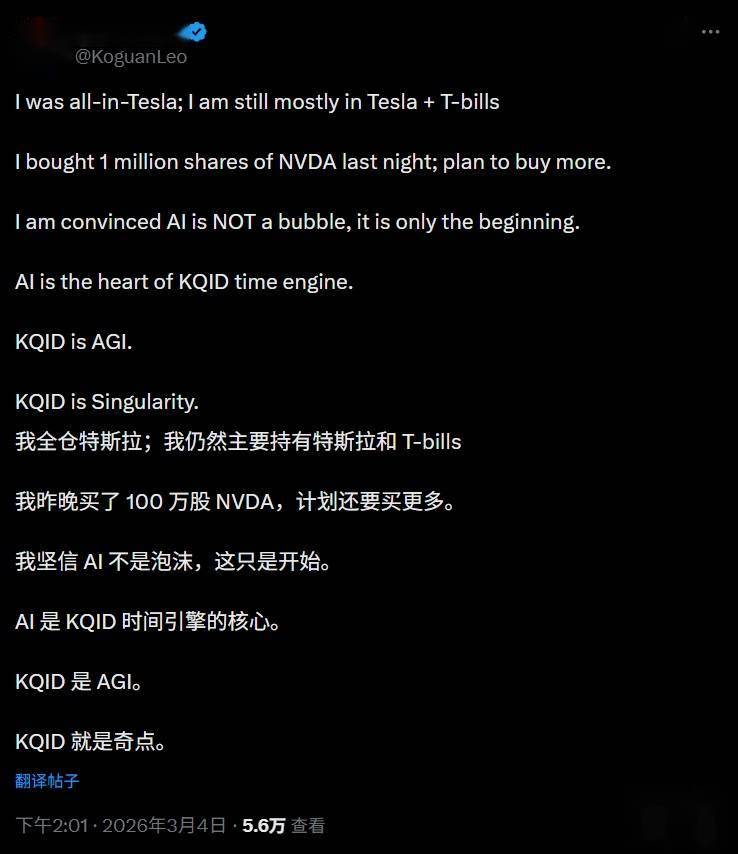
IT之家 3 月 5 日消息,当地时间 3 月 4 日,华裔富豪廖凯原(Leo KoGuan)在社交平台上宣布,已买入 100 万股英伟达股票,并计划买更多。 英伟达周二在纽约收于 180.05 美元,这意味着其耗资约 1.8 亿美元(IT之家注:现汇率约合 12.43 亿元 人民币)。他在其个人账号上写道:"我坚信 AI 不是泡沫,这只是开始。" 据科创板日报,廖凯原在后续接受采访时还说:"计划很快再买入 100 万股英伟达股票,以示对市场的支 持。" 廖凯原被称为特斯拉"最牛散户",是特斯拉最大的个人股东之一。廖凯原在自己的 LinkedIn 个人资料中 自称是特斯拉的第三大个人股东。在其个人账号上,他表示:"我已全部押注特斯拉。" 根据彭博亿万富翁指数,廖凯原的净资产约为 128 亿美元(现汇率约合 883.92 亿元人民币)。 ...
十四届全国人大四次会议开幕、黄仁勋表态对OpenAI的300亿美元投资为最后一次、全球石油运输咽喉霍尔木兹海峡断航
新财富· 2026-03-05 09:25
Key Points - The 14th National People's Congress (NPC) opened on March 5, 2023, with a government work report presented by Premier Li Qiang, outlining key agendas including the review of the 15th Five-Year Plan draft and various legislative proposals [2][3] - The government plans to allocate 250 billion yuan in special long-term bonds to support the "trade-in" program for consumer goods, aiming to enhance consumption [4] - The U.S. military is facing a critical shortage of precision-guided munitions due to ongoing military actions, prompting a meeting with major defense contractors to discuss accelerating production [5] - Ctrip extended the travel order guarantee period for the Middle East amid rising tensions, providing refund and modification options for affected bookings [6] - The closure of the Strait of Hormuz by Iran has led to significant disruptions in global oil transport, with Brent crude prices rising approximately 30% [7] - The application rate of AI technology in China's manufacturing sector has surpassed 30%, with expectations for the core AI industry to exceed 1.2 trillion yuan by 2025 [8][9] - Luckin Coffee's major shareholder, Dazhong Capital, has acquired Blue Bottle Coffee's global store operations for under $400 million, seen as a strategic move to enhance its high-end brand portfolio [10][11][13] - Nvidia's CEO announced that a recent $30 billion investment in OpenAI may be the last before its IPO, with ongoing hardware collaborations [15] - Meta is forming a new AI engineering organization to advance towards "superintelligence," focusing on building a data engine for AI model improvement [16] - OpenAI is preparing to launch a new model, GPT-5.4, which will feature enhanced reasoning capabilities and a larger context window [17] - Xiaomi plans to release a new self-developed processor annually and collaborate with Google Gemini to create an international AI assistant [18][20] - The U.S. military has utilized AI systems for intelligence assessment and target identification in recent operations against Iran, highlighting the deep integration of AI in military decision-making [21][22] - U.S. stock markets rebounded, led by technology stocks, as investor sentiment improved following government measures to ensure Gulf shipping safety [24][25] - A-shares also saw a collective rebound, with significant gains in optical electronics and electric grid equipment sectors [26][27] - Japanese and South Korean stock markets experienced strong rebounds, driven by easing geopolitical concerns and expectations of market stabilization measures [28]
2026胡润全球富豪榜发布:中国10亿美元企业家达1110位超过美国
证券时报· 2026-03-05 09:12
Core Insights - The 2026 Hurun Global Rich List reveals a record high of 4,020 billionaires from 2,914 companies across 73 countries, marking a 17% increase from last year, with total wealth rising by 28% [1][2]. Group 1: Billionaire Rankings - China has surpassed the United States to become the country with the most billionaires, boasting 1,110 billionaires, an increase of 287 from last year, while the U.S. has 1,000 billionaires, up by 130 [2]. - The threshold to enter the top ten of the Hurun Global Rich List has doubled every five years, reaching 1.1 trillion RMB this year, compared to 240 billion RMB ten years ago [3]. - Elon Musk retains his title as the world's richest person for the fifth time in six years, with a wealth increase of 89% to 5.5 trillion RMB, driven by the soaring valuations of SpaceX and Tesla [3]. Group 2: Wealth Growth Drivers - Jeff Bezos ranks second with a wealth of 2.1 trillion RMB, a 13% increase, attributed to Amazon's dominance in AI cloud computing and e-commerce [4]. - Larry Page and Sergey Brin, with wealth of 1.9 trillion RMB and 1.7 trillion RMB respectively, benefit from Alphabet's market capitalization exceeding 4 trillion RMB, fueled by the success of the Gemini 4 AI model and rapid growth in Google Cloud [4]. - The AI wave is identified as the strongest engine for wealth creation, with significant contributions from companies like Nvidia and emerging AI startups [7][8]. Group 3: Chinese Entrepreneurs - Zhang Yiming, founder of ByteDance, becomes China's richest person with a wealth of 550 billion RMB, marking a 32% increase [6]. - The industrial products sector shows remarkable performance, with over 80 new billionaires, while the semiconductor industry adds 18 new billionaires, reflecting China's push for chip self-sufficiency [6]. - Shenzhen leads in new billionaire additions, followed by Shanghai, Hangzhou, and Suzhou [6]. Group 4: Sector-Specific Wealth Increases - The AI sector has seen substantial wealth growth, with figures like Huang Renxun's wealth rising by 34% to 1.2 trillion RMB, and Brett Adcock's wealth skyrocketing over tenfold to 110 billion RMB due to his company's valuation [8]. - The consumer electronics industry also experiences significant wealth increases, driven by AI data center demands, with notable figures like Wang Weixiu's wealth reaching 1.05 trillion RMB [9].

港股电气股、芯片股,普遍上涨
第一财经· 2026-03-05 08:30
Group 1 - The Hong Kong Hang Seng Index rose by 0.28%, while the Hang Seng Tech Index fell by 0.69% [1] - Electric stocks experienced a significant increase, with Northeast Electric rising over 22%, and both Dongfang Electric and Shanghai Electric increasing by over 15% [1] - Semiconductor and chip stocks also saw gains, with InnoCare rising over 8% and Tensun Smart Chip increasing by over 5% [1] Group 2 - Notable stock performances include InnoCare at 8.33% increase, Brainhole Technology at 7.69%, and Tensun Smart Chip at 5.44% [2] - Other semiconductor stocks such as ASMPT, Aixin Yuanzhi, and Lanke Technology also reported positive growth, with increases ranging from 2.63% to 4.07% [2] - Conversely, oil stocks faced significant declines, with Shandong Molong dropping over 15% and Sinopec Oilfield Services falling over 11% [2]
尾盘突袭!一则消息,引发油气板块大跳水!伊朗军方高官称未封锁霍尔木兹海峡...
雪球· 2026-03-05 08:11
Market Overview - The market experienced a high and then a pullback, with the ChiNext Index rising over 3% at one point. By the close, the Shanghai Composite Index increased by 0.64%, the Shenzhen Component Index by 1.23%, and the ChiNext Index by 1.66%. The total trading volume in the Shanghai and Shenzhen markets reached 2.39 trillion, an increase of 243 billion compared to the previous trading day [2][3]. Sector Performance - The MicroLED concept saw a collective surge, with stocks like Longteng Optoelectronics, Huacan Optoelectronics, and Jucan Optoelectronics hitting the 20% daily limit up. The optical and electronic sector rose over 6%, leading the market [4][16]. - The computing power leasing sector also saw rapid gains, with Meili Cloud and Tongniu Information both hitting the daily limit up. The CPO sector continued to strengthen, with Kaige Precision Machinery rising nearly 14% to set a new historical high [5]. Oil Market Reaction - A sudden announcement from Iran's military regarding the non-blockade of the Strait of Hormuz led to a sharp drop in oil futures, which fell from a 14% limit up to a 6.43% increase by the close. The A-share oil and gas sector also declined, with companies like Beiken Energy and Keli Co. dropping over 9% [7][9][10]. - Goldman Sachs' chief oil strategist Daan Struyven projected that oil transport through the Strait of Hormuz would remain at low levels for the next five days, potentially recovering to 70% of normal levels within two weeks and fully normalizing in four weeks. The report highlighted that Middle Eastern oil-producing countries face significant storage pressures due to the disruption [15]. Semiconductor Sector - The semiconductor industry saw a rebound, with stocks like Qiangyi Co. rising over 17%. The entire semiconductor supply chain, including advanced packaging and third-generation semiconductors, experienced price increases, boosting industry sentiment and leading to strong performances from leading companies [20][22]. - Analysts noted that the demand for AI computing power and the semiconductor industry's cyclical recovery are driving growth, with Qiangyi Co. reporting a 157.9% year-on-year increase in revenue for January-February 2026 [22].

罗博特科:董秘称英伟达相关问题涉商业秘密无权答复
Xin Lang Cai Jing· 2026-03-05 08:01
Group 1 - The core point of the article is that NVIDIA's Rubin architecture will feature a highly modular interconnect design, with plans for mass production in 2026 [1] - ficonTEC is a key customer of NVIDIA, and the company is involved in providing technical support for early sampling and trial production of the Rubin architecture [1] - The company has not disclosed specific details regarding the 300mm double-sided wafer testing platform and high-precision coupling equipment due to commercial confidentiality [1]

全市场都在战火里面找 HALO
远川投资评论· 2026-03-05 07:05
Core Viewpoint - The article discusses the emerging investment trend towards HALO assets, which are characterized by heavy assets and low obsolescence, as a response to the rapid advancements in AI and geopolitical tensions affecting supply chains and resource prices [1][2][4]. Group 1: HALO Assets - HALO stands for Heavy Assets and Low Obsolescence, indicating a shift in investment focus towards physical assets that are less likely to be disrupted by AI [1]. - High demand for stable physical assets such as utilities, transportation infrastructure, and long-cycle industrial capacity is highlighted as a key investment opportunity [1][2]. - Goldman Sachs' report indicates that the valuation gap between light asset and heavy asset portfolios is narrowing, with heavy assets experiencing valuation increases [4][7]. Group 2: Market Dynamics - The article notes a significant change in market sentiment, where traditional investment strategies favoring light assets are being challenged by the realities of supply chain disruptions and geopolitical conflicts [3][4]. - The capital expenditure race driven by major tech companies for AI infrastructure is compared to historical investments in telecommunications and railroads, indicating a substantial shift in capital flow towards heavy assets [10][13]. - The ongoing geopolitical tensions, particularly in the Middle East, are causing spikes in resource prices, further validating the investment thesis for HALO assets [13][15]. Group 3: China’s Role - The article emphasizes China's position as a leading manufacturer of physical assets, suggesting that its capabilities should not be undervalued in the context of global supply chain reconfiguration [16]. - The demand for Chinese manufacturing and materials is expected to rise as countries face challenges in rebuilding local supply chains, reinforcing the value of heavy assets [16][17]. - The article posits that the current global economic landscape favors real, productive assets over financial capital, with China being a central player in this transition [16][17]. Group 4: Investment Strategies - The article suggests that institutional investors are increasingly recognizing the importance of physical assets, with a notable shift in portfolio allocations towards sectors like metals and traditional energy [20][21]. - The narrative around supply chain management is evolving from "Just-in-Time" to "Just-in-Case," reflecting a strategic pivot towards securing raw materials and local production capabilities [21]. - The uncertainty in the market is prompting a reevaluation of investment strategies, advocating for a balanced approach that includes maintaining reserves and being prepared for volatility [21].