
娱乐

Search documents
“好邻居金不换!”李在明携韩商业天团访华,呼吁制造业创新合作
2 1 Shi Ji Jing Ji Bao Dao· 2026-01-05 13:48
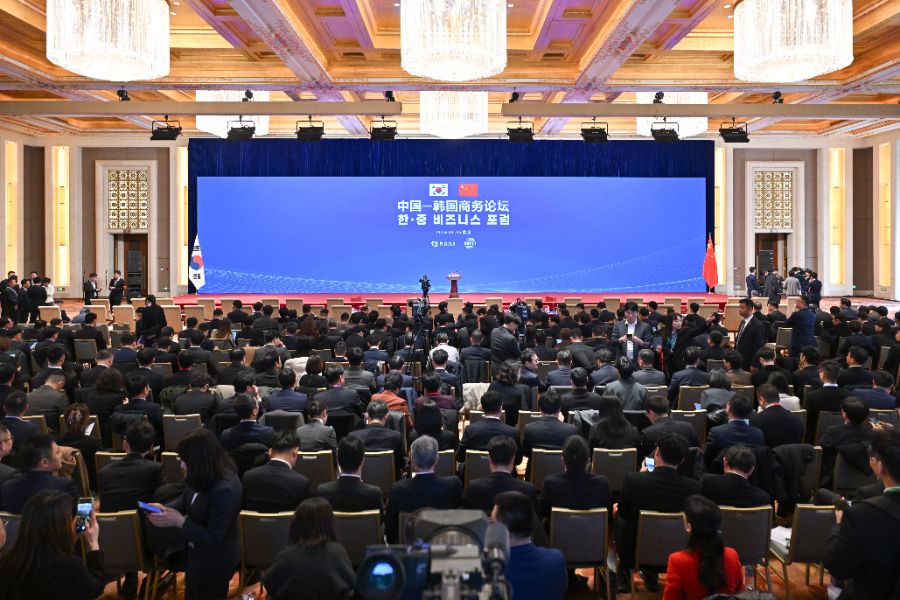
Group 1: Economic Cooperation - The bilateral trade volume between China and South Korea has increased from $6.5 billion at the time of diplomatic relations in 1992 to $272.9 billion in 2024, with China being South Korea's largest trading partner [2] - The forum highlighted three main topics for discussion: manufacturing innovation, supply chain cooperation, and consumer goods market [3] - The two countries aim to deepen cooperation in emerging fields such as artificial intelligence, biopharmaceuticals, green industries, and the silver economy, as part of the ongoing negotiations for the second phase of the China-South Korea Free Trade Agreement [5] Group 2: Cultural and Service Industry Collaboration - There is a growing interest in cultural exchanges, with popular travel experiences like "Seoul Cultural Tours" and "K-Beauty Experiences" among Chinese youth, and "Shanghai Weekend Trips" favored by South Korean youth [6] - The collaboration in content industries, gaming, performances, and cultural platforms is expected to strengthen ties between manufacturing, consumer investment, and new market exploration [6] - Despite rising competition in certain industries, representatives believe that the strategic and mutual benefits of cooperation between the two countries remain unchanged [6] Group 3: Government Support and Future Outlook - The South Korean government is committed to enhancing cooperation with China to provide a favorable environment for businesses and expand cooperation channels [2][6] - The visit of President Yoon signifies a significant diplomatic achievement, aiming to restore comprehensive relations and plan for the future of bilateral ties over the next 30 years [3][4] - The emphasis on mutual respect and understanding in government communications is seen as crucial for the ongoing development of China-South Korea relations [4][5]

下一片出海热土,为什么还是中东?
3 6 Ke· 2026-01-05 08:37
Core Insights - The article highlights the ongoing growth and strategic evolution of Chinese enterprises in the Middle East, transitioning from initial market entry to deeper local integration and sustainable operations [1][2][3]. Group 1: Market Trends and Developments - Chinese companies are increasingly focusing on the Middle East, with nearly 90% of surveyed firms planning to enter or deepen their presence in the region, and 44% having detailed business plans, a 7% increase from 2022 [1]. - The profitability of Chinese enterprises in the Middle East has improved, with 40% reporting profits, up 9% from 2022, while the proportion of loss-making companies has decreased to 15% [1]. - The revenue from Middle Eastern operations for over 30% of companies now accounts for more than 20% of their total income, an increase of 8% from 2022 [1]. Group 2: Strategic Shifts in Operations - Chinese firms are moving from a focus on product exports to establishing regional headquarters, supply chain capabilities, and localized operational systems, indicating a shift towards platform-based and ecosystem-oriented business models [2][9]. - The competitive landscape in the Middle East is evolving, with a focus on long-term local integration rather than merely selling products [2][3]. Group 3: Investment and Economic Diversification - The GCC countries are forming an interconnected hub network, allowing Chinese companies to leverage the strengths of different nations for a complementary business approach [10][11]. - Countries like Bahrain and Oman are actively seeking Chinese investments, with Bahrain positioning itself as a strategic hub due to its geographical advantages [11][13]. Group 4: Capital Market Adjustments - Middle Eastern capital is shifting from aggressive expansion to more cautious, focused investments, particularly in high-potential sectors like entertainment and green energy, while scaling back on longer-term, high-cost projects [21][25]. - The Saudi stock market has faced challenges, with IPO financing dropping over one-third in 2025, marking the lowest level since 2020 [21][25]. Group 5: Consumer Behavior and Market Opportunities - The rise of a new middle class in the Middle East is driving changes in consumer preferences, with a focus on experience, quality, and local products [37][39]. - The demand for local brands is increasing, with 20% of consumers willing to pay the same or higher prices for domestic products compared to international brands [45][46]. Group 6: Tourism and Cultural Shifts - The Middle East is leveraging tourism as a key pillar for economic diversification, with Saudi Arabia and the UAE implementing significant initiatives to attract international visitors [50][52]. - The region is witnessing a cultural shift, with Saudi Arabia relaxing traditional restrictions to enhance its appeal as a tourist destination [52][53].

开门红!元旦假期,威海消费市场“热气腾腾” →
Sou Hu Cai Jing· 2026-01-04 12:29
Core Insights - The overall consumption market in the city during the New Year holiday was stable, with a significant year-on-year increase in sales for key monitored trading enterprises, achieving a total sales volume of 216.15 million yuan, representing a growth of 16.22% [3] Consumption Trends - The festive atmosphere was vibrant, with high consumer enthusiasm and a variety of promotional activities in major shopping areas, including discounts and special offers [5] - Various sectors such as food, beverages, entertainment, and leisure saw strong consumer demand, indicating a continuous release of consumption potential [5] Cultural and Tourism Activities - The cultural and tourism market operated smoothly, with a rich array of activities enhancing visitor engagement and experience [6][8] - Notable events included the "Swan Fairy Tale Festival" at the Na Xiang Sea Scenic Area, featuring activities like swan watching and hot spring experiences, which attracted many visitors [8] - Cultural activities were abundant, with public art exhibitions and community events contributing to a lively cultural atmosphere [10]
李在明开启任后首次访华,200余名韩企高管随行
2 1 Shi Ji Jing Ji Bao Dao· 2026-01-04 11:51
南方财经21世纪经济报道记者郑青亭、实习生陈俊康北京报道 1月4日下午,韩国总统李在明抵达北京首都国际机场,开启为期4天的国事访问。这是李在明就任总统 后首次访华,也是韩国总统时隔6年再次访华。访华前,李在明对媒体表示,韩国和中国在地理、经 济、历史、社会文化上有着不可分割的关系,稳定地管理好韩中关系有着重要意义,两国可以在文化、 经济、民间交流等领域展开合作。 中国社科院亚太与全球战略研究院研究员、中国周边战略研究室主任王俊生在接受21世纪经济报道采访 时表示,李在明选择在这一时间点访华,充分体现其对中韩关系的高度重视。"这是中韩领导人在庆州 会晤后仅两个月再次面对面交流,也是韩国总统时隔9年再次对中国进行国事访问,释放出十分明确的 积极信号。" 中国外交部发言人在答记者问时表示,中韩互为重要近邻和合作伙伴,期待在两国元首战略引领下,此 访为推动中韩战略合作伙伴关系进一步向前发展发挥积极作用。 据环球网报道,韩国国家安保室室长魏圣洛1月2日在新闻发布会上透露了李在明此次访华日程安排—— 李在明预计4日抵达北京,6日前往上海。在上海停留的两天内,他将参观韩国被日本殖民统治时期的大 韩民国临时政府旧址。据悉,2 ...

大外交|韩国各大财团掌门人倾巢出动随总统访华 ,专家:从经济上重新认识中国
Xin Lang Cai Jing· 2026-01-04 08:11
Core Viewpoint - The visit of South Korean President Lee Jae-myung to China marks a significant opportunity for economic dialogue and cooperation between South Korea and China, with a focus on recalibrating perceptions of the Chinese market and enhancing bilateral trade relations [1][3][5]. Group 1: Economic Delegation and Activities - A large economic delegation consisting of over 200 South Korean business leaders, including heads of major corporations like Samsung, SK Group, and Hyundai, will accompany President Lee during his visit to China [1][2]. - The delegation will participate in the Korea-China Business Forum and sign cooperation memorandums, as well as engage in one-on-one business meetings organized by the Korea Trade-Investment Promotion Agency (KOTRA) [1][2]. Group 2: Shifts in Economic Relations - The economic relationship between South Korea and China has evolved from a complementary vertical division of labor to a coexistence of cooperation and competition, necessitating a reassessment of South Korea's approach to the Chinese market [1][3]. - The past six years of limited high-level exchanges due to various factors, including the pandemic and political changes in South Korea, have impacted economic interactions, making this visit particularly significant [2][3]. Group 3: Future Cooperation Areas - Discussions during the visit are expected to cover practical cooperation in supply chain investment, digital economy, environmental issues, cultural exchanges, tourism, and combating transnational crime [2][8]. - Both countries are looking to enhance cooperation in emerging fields such as artificial intelligence, biopharmaceuticals, green industries, and the silver economy, with a focus on mutual benefits and shared growth strategies [5][7]. Group 4: Trade Statistics and Economic Context - China has been South Korea's largest trading partner for many years, with bilateral trade reaching $328.08 billion in 2024, reflecting a 5.6% increase [5][6]. - South Korea remains a key investment destination for China, and the two countries have established a complementary relationship in critical industries such as semiconductors and batteries [6][7]. Group 5: Geopolitical Considerations - The ongoing U.S.-China competition poses challenges for South Korea, which is navigating pressures to decouple from China while maintaining strong economic ties [8][9]. - Despite U.S. pressures, the economic relationship between South Korea and China remains robust, with both countries recognizing the need for closer cooperation to mitigate external uncertainties [9].
新一轮消费品以旧换新政策全面启动 广西消费市场火热
Zhong Guo Xin Wen Wang· 2026-01-04 06:54
Core Insights - Guangxi's new round of consumer goods exchange policy is set to stimulate consumption during the New Year holiday period in 2026, with various promotional activities organized to enhance consumer engagement and sales [1] Group 1: Consumer Activity and Sales Performance - The consumer goods exchange initiative launched on December 31, 2025, has seen over 10,000 applications for subsidies amounting to over 5.87 million RMB, leading to sales exceeding 41.25 million RMB within two days [1] - During the New Year holiday, sales of major appliances and communication equipment in Guangxi increased by 4.2% and 5.0% year-on-year, respectively [1] - Key monitored pedestrian streets and commercial areas in Guangxi experienced a 21% increase in average daily foot traffic and a 16% increase in sales revenue year-on-year [1] Group 2: Online Promotions and Tourism - Over 400 "Guangxi Products Chain ASEAN" live streaming events were organized to promote local and ASEAN products, enhancing online traffic and boosting offline sales [2] - The number of visitors to Guangxi during the New Year holiday increased by 35.2% compared to the previous year, with a significant recovery in dining consumption [2] - Major events such as concerts featuring popular artists have led to a dramatic increase in hotel bookings around the Guangxi Sports Center, with orders surging by several times year-on-year [2] Group 3: Cultural and Entertainment Activities - Guangxi planned over 400 key cultural and tourism activities, including New Year music festivals and parades, with Beihai's Weizhou Island emerging as a top destination for New Year tourism, ranking second nationally in ticket sales [2] - Movie screenings of popular films like "Zootopia 2" and "Avatar 3" have contributed to a vibrant cultural consumption market during the holiday [2] Group 4: Market Stability - Prices of essential goods in Guangxi remained stable during the New Year holiday, with no reports of shortages, price fluctuations, or other abnormal market conditions [2]
百年江汉路变身“年轻的街”
Chang Jiang Ri Bao· 2026-01-04 02:32
1月1日晚,江汉路Happy站台门前,熙来攘往的人群中几乎全是年轻面孔。这里曾是武汉人熟悉的 王府井百货,历经近一年的招商调整后,以"Happy站台C馆"的全新身份正式亮相。6层总面积3.5万平方 米的空间,变身为华中地区规模领先的潮玩超级卖场,成为百年江汉路"潮变新生"的又一新地标。 平安大厦运营方湖北玺普环保科技有限公司(以下简称湖北玺普)首席执行官施超表示,此次改造 并非简单的业态调整,而是基于对传统百货模式的重构。项目以"情绪新主场、潮玩新地标"为核心定 位,精准锁定武汉90余所高校近140万大学生、年轻家庭及日益增长的文旅客群,旨在打造一个集购 物、娱乐、社交、文化体验、商旅于一体的一站式青年消费引力场。 引进4家首店,打造潮玩"首发高地" 试营业首日,涌入"轻语有品"潮玩超市的人流最为汹涌。这个占据一楼和三楼的全球首店,以高达 2万平方米的"仓储式超市"模式运营,施超向长江日报记者介绍,这里是类似潮玩界的"山姆会员店"。 货架上方是成排的黄色集装箱式储货区,下方陈列着超过5万款SKU的潮玩产品,覆盖了市面上80%以 上的常见潮玩品类。价格令人惊喜:热门动漫《盗墓笔记》相关潮玩仅售9.9元,大量商品 ...

95后跨年怎么过?吃火锅烤肉、打台球、美发美甲……
Sou Hu Cai Jing· 2026-01-03 17:11
Core Insights - Urban consumption vitality was fully released during the New Year period, with cities like Shanghai, Nanjing, and Changsha showcasing strong local consumption activity [1][8] - Diverse consumption experiences, including shopping, cross-city travel, and winter activities, saw significant growth, indicating a robust experience economy [1][3] Consumption Trends - Supermarket shopping and cross-city tourism were popular, with supermarket coupon sales on Douyin increasing by 164% year-on-year, and sales of clothing and jewelry rising by 147% and 109% respectively [3] - The pet care sector also saw a notable increase, with pet grooming services growing by 63% [3] Travel and Accommodation - The travel market was vibrant, with hotel and guesthouse sales increasing by 93% and 97% year-on-year, respectively, and attraction ticket sales rising by 46% [3] - The "Heartfelt List" of hotels saw a 71% increase in sales and an 85% increase in order volume from December 19 to January 1 [3] Experience Economy - The offline experience economy became a new highlight, with "Pindou" handcraft experiences seeing a staggering 1461% increase in sales on Douyin [6] - Theme park visits and pottery experiences also gained popularity, with sales increasing by 106% and 99% respectively [6] Food Consumption - Food consumption remained a key focus during the holiday, with hot pot, chicken pot, grilled fish, and other dishes being particularly favored, and buffet sales increasing by 94% year-on-year [4] Regional Highlights - Cities such as Shanghai, Zhengzhou, Fuzhou, Chengdu, Wuhan, Guangzhou, Hangzhou, Beijing, Nanjing, and Changsha demonstrated strong local consumption vitality during the New Year holiday [8] - Hainan experienced a tourism surge, attracting visitors with its unique climate and travel resources, leading to high demand for group purchases of scenic area tickets and travel packages [8]

财政部 商务部 税务总局 关于开展有奖发票试点工作的通知财建〔2025〕484号
蓝色柳林财税室· 2026-01-03 14:06
Core Viewpoint - The article outlines the implementation of a pilot program for prize invoices aimed at stimulating consumer demand and supporting economic growth through increased spending in various sectors such as retail, dining, and tourism [2][5]. Policy Goals - The primary goal is to enhance consumer enthusiasm and unlock spending potential in key sectors, thereby providing robust support for economic stability and growth [2]. - The pilot program will be conducted in approximately 50 cities, focusing on those with large populations and strong economic potential, with a duration of six months [2]. Support Directions - The pilot cities will organize lottery draws for consumers who purchase goods and services above a specified invoice amount, with a minimum threshold set at 100 yuan [2]. - The maximum prize amount for a single invoice is capped at 800 yuan, with cities determining the winning invoice ratio and prize structure [2]. Work Procedures - Local authorities are required to submit applications for the pilot program, detailing their implementation plans and addressing existing challenges in boosting consumption [3][4]. - A competitive evaluation process will be used to select cities for the pilot, with specific criteria including consumer spending rankings [4]. Funding and Performance Evaluation - Central government funding for the pilot cities is tiered based on city size, with allocations of up to 3 billion yuan for super-large cities, 2 billion for large cities, and 1 billion for others [5]. - After the pilot period, cities must conduct self-evaluations and submit performance reports by the end of August 2026 [5]. Work Requirements - Provincial departments are tasked with coordinating efforts and ensuring that pilot cities adhere to the established timelines and objectives [6]. - There is an emphasis on the use of technology for managing the lottery and prize distribution, ensuring transparency and security in the process [6]. Promotion and Supervision - Authorities are encouraged to promote the program widely to engage consumers and create a favorable environment for participation [6]. - A robust supervision mechanism is to be established to prevent fraud and ensure compliance with the program's rules [6].

三部门联合开展有奖发票试点工作
Xin Lang Cai Jing· 2026-01-03 10:58
Core Viewpoint - The Ministry of Finance, Ministry of Commerce, and State Taxation Administration have announced a pilot program for prize invoices to stimulate consumer demand and support economic stability [1] Group 1: Policy Objectives - The policy aims to enhance consumer enthusiasm and stimulate consumption in sectors such as retail, dining, accommodation, cultural arts, entertainment, tourism, sports, and residential services [1] - The pilot program will be implemented in approximately 50 cities, focusing on those with large populations and strong economic potential, with a duration of six months [1] Group 2: Support Directions - Pilot cities will organize a lottery for consumers who purchase goods and services above a certain invoice amount, with a minimum threshold set at 100 yuan [2] - The maximum prize amount for a single invoice will not exceed 800 yuan, with cities determining the winning invoice ratio and prize structure [2] Group 3: Work Procedures - Local authorities must submit applications for pilot programs, ensuring that proposals are clear, logical, and data-driven, while avoiding extravagant materials [3] - A competitive evaluation will be conducted by provincial departments to select cities for the pilot, with specific recommendations based on consumer spending rankings [4] Group 4: Funding and Performance Evaluation - Central government will allocate prize funds based on city size, with a maximum of 3 billion yuan for super-large cities, 2 billion for large cities, and 1 billion for others [5] - After the pilot period, cities will conduct self-evaluations, and a comprehensive performance evaluation will be organized by the central authorities [5] Group 5: Work Requirements - Provincial departments are responsible for coordinating efforts, establishing performance indicators, and ensuring timely execution of the pilot program [6] - Strong oversight and management of funds are required, with a focus on ensuring the integrity of the lottery process and the security of financial transactions [7] - Promotion of the program will be essential, with a requirement for comprehensive communication strategies to engage consumers and report outcomes by the end of August 2026 [7]