
锂离子电池制造

Search documents
经济运行总体平稳稳中有进(锐财经)
Ren Min Ri Bao· 2025-10-20 20:50
Economic Growth - China's GDP grew by 5.2% year-on-year in the first three quarters, ranking among the top major economies [1][2] - The economic increment reached 39,679 billion yuan, an increase of 1,368 billion yuan compared to the previous year [1][2] Employment and Prices - The average urban survey unemployment rate for the first three quarters was 5.2%, unchanged from the first half of the year [2] - The Consumer Price Index (CPI) slightly decreased by 0.1% year-on-year, while the core CPI, excluding food and energy, rose by 0.6% [2] International Trade - China's foreign trade showed strong resilience, with import and export volumes reaching historical highs, and the growth rate rebounding quarter by quarter [2][3] - By the end of September, foreign exchange reserves remained above 3.3 trillion USD, with the RMB exchange rate showing stability and appreciation [2] High-Quality Development - The proportion of added value from equipment manufacturing and high-tech manufacturing reached 35.9% and 16.7%, respectively [3] - Non-fossil energy consumption's share of total energy consumption increased by approximately 1.7 percentage points year-on-year [3] Policy Impact - A series of policies have effectively stabilized the economy and supported long-term development [4] - Final consumption expenditure contributed 53.5% to economic growth, an increase of 9.0 percentage points from the previous year [4] Investment Trends - Investment in equipment and tools increased by 14.0% year-on-year, contributing 2.0 percentage points to overall investment growth [4] - Specific sectors such as computer and office equipment manufacturing, general equipment manufacturing, and transportation equipment manufacturing saw significant investment growth [4] New Growth Drivers - Industries such as lithium-ion battery manufacturing, shipbuilding, and electric motor manufacturing experienced year-on-year value-added growth of 29.8%, 22.9%, and 17.1%, respectively [5] - The production of new energy vehicles and electric bicycles also saw substantial increases [5] Economic Stability - The third quarter GDP growth was 4.8%, reflecting a slight decline from the previous quarter but still higher than most major economies [7] - The total economic output for the third quarter reached 35.5 trillion yuan, surpassing the projected total for the third-largest economy in 2024 [7] Future Outlook - The stable growth in the first three quarters lays a solid foundation for achieving annual targets [8] - Emphasis will be placed on effectively leveraging policies to balance short-term growth with long-term development [8]
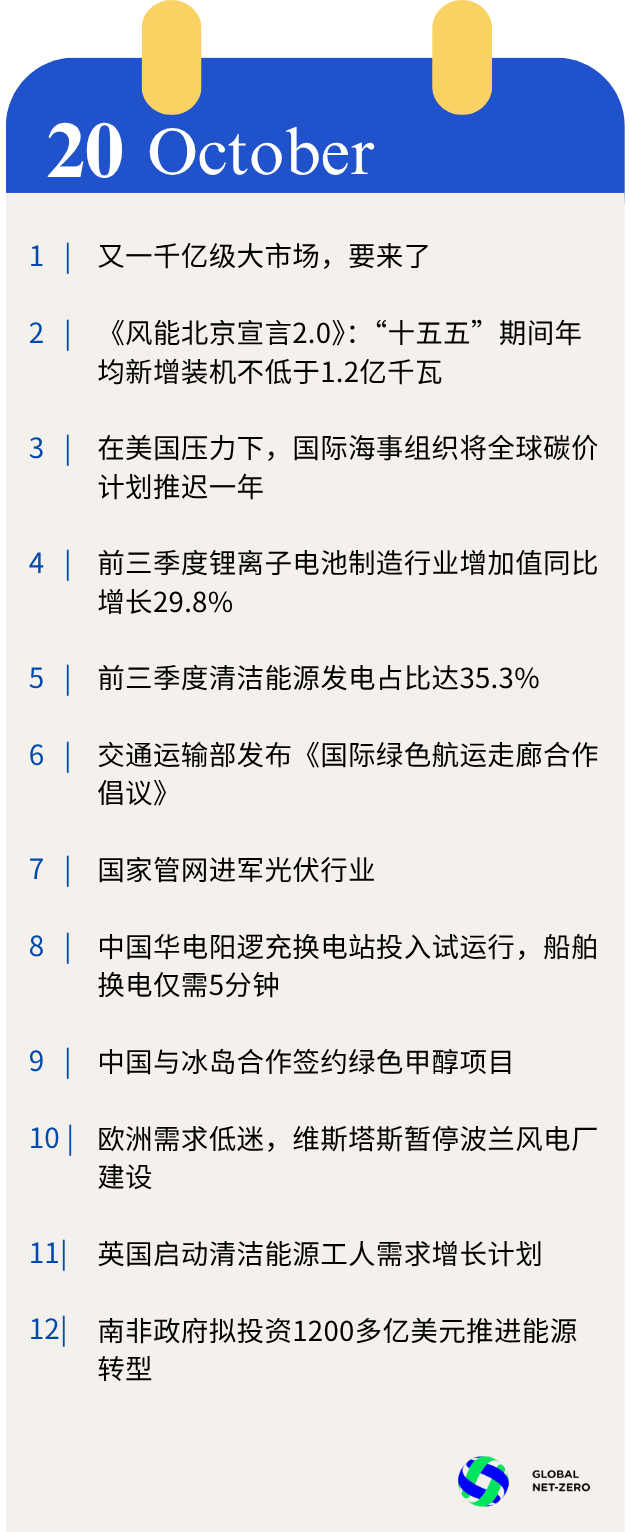
快讯 | 又一千亿级大市场,要来了
Sou Hu Cai Jing· 2025-10-20 17:43
Group 1 - The domestic market for power battery recycling in China is expected to exceed 100 billion yuan by 2030, driven by the large-scale retirement of power batteries [3] - In 2024, the domestic power battery recycling volume is projected to surpass 300,000 tons, corresponding to a market scale of over 48 billion yuan [4] - The State Administration for Market Regulation has released 22 national standards for power battery recycling, covering various aspects to support the industry's high-quality development [4] Group 2 - The "Beijing Wind Energy Declaration 2.0" states that during the 14th Five-Year Plan period, China's annual new installed wind power capacity should not be less than 12 million kilowatts [5] - By 2030, China's cumulative wind power installed capacity is expected to reach 1.3 billion kilowatts, and by 2035, it should not be less than 2 billion kilowatts [6] Group 3 - The value added of the lithium-ion battery manufacturing industry increased by 29.8% year-on-year in the first three quarters of the year [8] - The production of new energy vehicles, electric bicycles, and tablet computers saw significant growth, with respective increases of 29.7%, 27.1%, and 9.5% [8] Group 4 - Clean energy generation accounted for 35.3% of total energy generation in the first three quarters, an increase of 1.9 percentage points compared to the same period last year [9] - The overall energy consumption in China grew by 3.7% year-on-year, with a continuous optimization of the energy consumption structure [9] Group 5 - The National Pipeline Network Group has launched its first large-scale photovoltaic power generation project, which is expected to significantly promote the green and low-carbon development of the oil and gas industry [11] - The project has a designed annual average power generation capacity of 623 million kilowatt-hours [11] Group 6 - China Huadian's Yangluo charging and swapping station has begun trial operations, marking a significant step in the "green shipping" initiative [12] - The station is equipped with facilities for both electric ships and heavy-duty electric trucks, supported by distributed photovoltaic power generation [12] Group 7 - South Africa's new Integrated Resource Plan (IRP2025) outlines a roadmap for over $120 billion in new power generation investments, aiming to balance energy security, decarbonization, and industrial growth [16] - The plan emphasizes a diversified energy structure, positioning nuclear power as a key component of the country's long-term strategy [16]

国家统计局:前三季度设备工器具购置投资同比增长14.0%
Sou Hu Cai Jing· 2025-10-20 05:39
Group 1 - The core viewpoint of the articles highlights the effective implementation of proactive macro policies that support economic stability and long-term growth [1][2] - Investment in equipment and tools has seen a year-on-year increase of 14.0% in the first three quarters, contributing 2.0 percentage points to overall investment growth [1] - Key sectors such as computer and office equipment manufacturing, general equipment manufacturing, and transportation equipment manufacturing have reported investment growth rates of 7.4%, 11.8%, and 22.3% respectively [1] Group 2 - New growth drivers are steadily emerging, with industries like lithium-ion battery manufacturing, shipbuilding, and motor manufacturing showing value-added growth rates of 29.8%, 22.9%, and 17.1% respectively [1] - The production of updated products such as CNC forging equipment and packaging equipment has increased by 11.7% and 26.0% respectively, while new energy vehicles and electric bicycles have seen production growth of 29.7% and 27.1% [1] - The market competition order has improved, leading to accelerated flow of goods, personnel, and capital, with a year-on-year increase in cargo and passenger turnover of 4.8% and 4.4% respectively [2]
重要经济数据出炉!国家统计局详解
天天基金网· 2025-10-20 05:27
Economic Growth - The GDP for the first three quarters reached 10,150.36 billion yuan, with a year-on-year growth of 5.2%, accelerating by 0.2 and 0.4 percentage points compared to the full year of 2024 and the same period in 2024 respectively [3] - The quarterly GDP growth rates were 5.4% in Q1, 5.2% in Q2, and 4.8% in Q3, with the decline in Q3 attributed to complex external environments and domestic structural adjustment pressures [3] Industrial Production - The industrial added value for large-scale enterprises grew by 6.2% year-on-year, with the equipment manufacturing sector increasing by 9.7% and high-tech manufacturing by 9.6%, outpacing the overall industrial growth by 3.5 and 3.4 percentage points respectively [5] - The share of equipment manufacturing in total industrial output reached 35.9%, maintaining above 30% for 31 consecutive months [5] - Industrial exports showed resilience, with a year-on-year growth of 3.3% in the first three quarters [5] Service Sector - The service sector's added value increased by 5.4% year-on-year, with significant growth in information transmission, software, and IT services (11.2%), leasing and business services (9.2%), and transportation and warehousing (5.8%) [6] Consumer Spending - The total retail sales of consumer goods grew by 4.5% year-on-year, with the growth rate accelerating by 1.2 and 1.0 percentage points compared to the same period last year and the full year respectively [8] - Final consumption expenditure contributed 53.5% to economic growth, highlighting its role as a primary growth engine [9] Investment Trends - Fixed asset investment decreased by 0.5% year-on-year, with infrastructure investment growing by 1.1% and manufacturing investment increasing by 4.0%, while real estate development investment fell by 13.9% [9] - Excluding real estate, project investment grew by 3.0% year-on-year [9] Future Outlook - The internal logic for stable economic development remains unchanged, with favorable conditions for achieving annual targets [11] - Continued macroeconomic policy effectiveness is expected to support stable economic operations, with a focus on enhancing confidence and expectations for the fourth quarter [11][12]

国家统计局:宏观政策主动作为和精准发力 主要宏观经济指标总体平稳
Sou Hu Cai Jing· 2025-10-20 05:06
Group 1 - The core viewpoint of the article emphasizes that China's economy has shown resilience and steady progress in 2023, supported by proactive macroeconomic policies and effective implementation of various initiatives aimed at expanding domestic demand and revitalizing the capital market [1][2][3][4] Group 2 - The release of consumption potential is being facilitated through the issuance of 300 billion yuan in special long-term bonds to support consumer goods replacement, contributing to a 53.5% growth in final consumption expenditure's contribution to economic growth, an increase of 9.0 percentage points from the previous year [2] - The optimization and upgrading of industries are being promoted through a combination of fiscal and financial policies, resulting in a 14.0% year-on-year increase in investment in equipment and tools, which has significantly driven overall investment growth [2] - New growth drivers are steadily emerging, with significant increases in the value added of industries such as lithium-ion battery manufacturing (29.8%), shipbuilding (22.9%), and electric motor manufacturing (17.1%) in the first three quarters [3] - The orderly flow of the economic cycle is being enhanced by focusing on expanding domestic demand and improving market competition, leading to a 106.8% year-on-year increase in stock trading volume in the Shanghai and Shenzhen markets [4]
重要数据出炉!国家统计局详解
Shang Hai Zheng Quan Bao· 2025-10-20 05:03
Economic Overview - The GDP for the first three quarters reached 10,150.36 billion yuan, with a year-on-year growth of 5.2%, accelerating by 0.2 and 0.4 percentage points compared to the full year of 2024 and the same period in 2024 respectively [1] - The quarterly GDP growth rates were 5.4% in Q1, 5.2% in Q2, and 4.8% in Q3, with the decline in Q3 attributed to complex external environments and significant domestic structural adjustment pressures [1] Industrial Production - The industrial added value for large-scale enterprises grew by 6.2% year-on-year, with the equipment manufacturing sector increasing by 9.7% and high-tech manufacturing by 9.6%, outpacing the overall industrial growth by 3.5 and 3.4 percentage points respectively [3] - The share of equipment manufacturing in total industrial output reached 35.9%, maintaining above 30% for 31 consecutive months, indicating its stabilizing role in the economy [3] - Industrial exports showed resilience, with a year-on-year growth of 3.3% in the first three quarters, and the capacity utilization rate for large-scale industrial enterprises rose to 74.6% in Q3, up 0.6 percentage points from Q2 [3] Service Sector - The service sector's added value increased by 5.4% year-on-year, with significant growth in information transmission, software and IT services (11.2%), leasing and business services (9.2%), and transportation, warehousing, and postal services (5.8%) [4] Consumer Spending - The total retail sales of consumer goods grew by 4.5% year-on-year, with the growth rate accelerating by 1.2 and 1.0 percentage points compared to the same period last year and the full year respectively [6] - Final consumption expenditure contributed 53.5% to economic growth, reinforcing its role as a primary growth engine [6] - The retail sales of goods increased by 4.6%, while catering revenue rose by 3.3%, and service retail sales grew by 5.2% [6] Investment Trends - Fixed asset investment (excluding rural households) declined by 0.5% year-on-year, with infrastructure investment increasing by 1.1% and manufacturing investment growing by 4.0%, while real estate development investment fell by 13.9% [6] - Excluding real estate development, project investment increased by 3.0% year-on-year [7] Future Outlook - The internal logic for stable economic development remains unchanged, with favorable conditions for achieving annual targets [9] - Continuous macroeconomic policies are expected to support stable economic operations, with an emphasis on enhancing policy coordination and targeting in Q4 [9] - Early indicators show positive signals, such as a rise in the manufacturing purchasing managers' index and an increase in prices for key industrial products [9]
前三季度核心CPI持续回升,PPI降幅有所收窄
Guo Jia Tong Ji Ju· 2025-10-20 02:18
Group 1: Consumer Price Trends - Consumer prices remained stable in the first three quarters, with CPI decreasing by 0.1% year-on-year, consistent with the first half and the first quarter [2] - Core CPI, excluding food and energy, has shown a continuous recovery since March, rising to 1% in September, the highest in nearly 19 months [4] - Food prices saw a year-on-year decline of 1.8%, with fresh vegetable prices averaging a drop of 7.9% and pork prices shifting from an increase of 3.8% in the first half to a decrease of 2.9% in the first three quarters [2] Group 2: Energy Price Trends - Energy prices decreased by 3.3% year-on-year in the first three quarters, with gasoline prices dropping by 7.3% due to international oil price fluctuations [3] Group 3: Producer Price Trends - PPI decreased by 2.8% year-on-year in the first three quarters, with a narrowing decline of 0.3 percentage points in the third quarter compared to the second quarter [5] - The domestic market's competitive order has improved, leading to a recovery in prices for certain industries, such as coal processing and black metal smelting, which saw a reduction in year-on-year price declines [5] Group 4: External Influences on Prices - International oil prices have generally trended downward, impacting domestic oil-related industry prices, with a 9.9% decline in the oil and gas extraction industry [6] - Conversely, international non-ferrous metal prices have risen, leading to a 5.6% year-on-year increase in domestic non-ferrous metal smelting and rolling industries [6] Group 5: High-Tech Industry Developments - The development of high-tech industries and effective macro policies have driven price increases in certain sectors, such as integrated circuit packaging and testing, which rose by 3.0% year-on-year [7] - Upgraded consumer demand has also contributed to price increases in sectors like arts and crafts manufacturing, which saw a 12.7% rise [7]
部分领域市场供求关系逐步改善
Jing Ji Ri Bao· 2025-10-16 00:07
Group 1 - The consumer price index (CPI) showed a slight increase in September, with a month-on-month rise of 0.1%, marking a shift from the previous month where it was flat [1][2] - The core CPI, excluding food and energy, rose by 1% year-on-year, the highest increase in 19 months, indicating a steady recovery in consumer prices [1][3] - Food prices increased by 0.7% month-on-month, with seasonal price rises observed in fresh vegetables, eggs, fresh fruits, lamb, and beef, while pork and aquatic product prices decreased due to sufficient supply [1][2] Group 2 - The producer price index (PPI) remained flat month-on-month for two consecutive months, with a year-on-year decline of 2.3%, but the rate of decline has narrowed by 0.6 percentage points compared to the previous month [3][4] - Improvements in supply-demand structure have led to price stabilization in certain industries, such as coal processing and black metal smelting, with some prices showing an upward trend [3][4] - The construction of a unified national market has contributed to a reduction in the year-on-year decline of prices in various sectors, with notable improvements in industries like coal mining and photovoltaic equipment manufacturing [4]
9月份核心CPI同比涨幅近19个月以来首次回到1%——部分领域市场供求关系逐步改善
Jing Ji Ri Bao· 2025-10-15 22:11
Core Insights - The consumer price index (CPI) showed a slight increase in September, with a month-on-month rise of 0.1%, marking a shift from the previous month where it was flat. The core CPI, excluding food and energy, rose by 1% year-on-year, the highest increase in 19 months, indicating a recovery in consumer prices [1][2][3] CPI Analysis - The year-on-year CPI decreased by 0.3%, but the decline was less severe than the previous month, narrowing by 0.1 percentage points. The drop was primarily due to the "carryover effect" from previous price changes, with food prices falling by 4.4% [2][3] - Food prices saw a month-on-month increase of 0.7%, driven by seasonal rises in fresh vegetables, eggs, fruits, lamb, and beef, while pork and aquatic product prices decreased due to sufficient supply [1][2] PPI Insights - The producer price index (PPI) remained flat month-on-month for two consecutive months, with a year-on-year decline of 2.3%, which is a reduction of 0.6 percentage points from the previous month. This decline is attributed to a low comparison base from the previous year and the positive effects of macroeconomic policies [3][4] - Certain industries, such as coal processing and black metal smelting, have shown price stabilization, with some experiencing price increases for two consecutive months [3][4] Market Dynamics - The ongoing construction of a unified national market has contributed to a narrowing of year-on-year price declines in various sectors. Improved market competition and capacity management have led to better price stability in industries like coal and photovoltaic equipment [4] - The upgrading of industrial structures and the release of consumer potential have driven price increases in specific sectors, such as aircraft manufacturing and specialized electronic materials, reflecting a shift towards higher-quality and upgraded consumption [4]
9月物价数据解读:CPI边际改善,PPI延续回升
Yin He Zheng Quan· 2025-10-15 09:46
Group 1: CPI Analysis - In September, CPI increased by 0.1% month-on-month, with a year-on-year decline narrowing from 0.4% to 0.3%[1] - Food prices rose by 0.7% month-on-month, while year-on-year they decreased by 4.4%, contributing approximately 0.83 percentage points to the CPI decline[1] - Core CPI remained flat month-on-month and increased by 1.0% year-on-year, marking the fifth consecutive month of growth[1] Group 2: PPI Analysis - In September, PPI remained flat month-on-month and the year-on-year decline narrowed to -2.3% from -2.9%[2] - Production demand improved, supporting price increases in some energy and raw material sectors[2] - The coal processing price rose by 3.8% month-on-month, while the prices for coal mining and washing increased by 2.5%[2] Group 3: Market Outlook - The improvement in CPI may continue into October due to tailwind factors, with a focus on the progress of pig production capacity reduction[2] - The real estate market remains weak, with property sales area and sales value down 4.7% and 7.3% year-on-year, respectively[2] - M1 growth has been rising, which is expected to support PPI improvement, although the overall PPI is unlikely to turn positive this year[2]