
ETF基金

Search documents
越跌越买?超700亿资金,借道ETF逆势加仓
券商中国· 2025-11-23 09:58
Core Viewpoint - The recent market correction is primarily driven by external factors, including declining expectations for a Federal Reserve rate cut and rising concerns over AI bubbles, which have transmitted pessimistic sentiments from overseas to the domestic market [2][6][8]. Market Performance - On November 21, A-shares experienced a significant drop, with the Shanghai Composite Index falling by 2.45% to close at 3834.89 points, while the Shenzhen Component and ChiNext Index dropped by 3.41% and 4.02%, respectively [2]. - Over the past week (November 17 to November 21), the Shanghai Composite Index declined by 3.9%, and the Shenzhen Component fell by 5.03%, with several high-growth sectors, including AI, chips, and lithium batteries, leading the market decline [3][4]. Fund Flows - Despite the market downturn, over 700 billion yuan flowed into stock ETFs, indicating a trend of buying on dips. Notable ETFs such as the Southern CSI 500 ETF and E Fund ChiNext ETF saw net inflows exceeding 30 billion yuan each [4][5]. - On the day of the market drop (November 21), more than 400 billion yuan was invested in ETFs, with the Huatai-PB CSI 300 ETF alone receiving approximately 40 billion yuan in net inflows [4]. External Influences - Fund companies attribute the market correction to external disturbances, particularly the unclear direction of the Federal Reserve's monetary policy and concerns over the sustainability of AI investments. The recent U.S. employment data showed a paradox where job growth was strong, but the unemployment rate reached a four-year high, complicating the Fed's decision-making [6][8][9]. - The sentiment in the U.S. tech sector has also negatively impacted the A-share market, as strong earnings reports from major tech companies did not prevent stock price declines, reflecting a tightening liquidity environment [9]. Future Outlook - Despite the current market volatility, several fund companies maintain a positive long-term outlook for Chinese assets, suggesting a "slow bull" market trend. They believe that the market will continue to attract new capital, particularly in the technology sector, supported by favorable policies [10][11]. - The long-term fundamentals, including stabilizing real estate prices and the effectiveness of "anti-involution" policies, are expected to support a sustained upward trend in the A-share market [10][11].


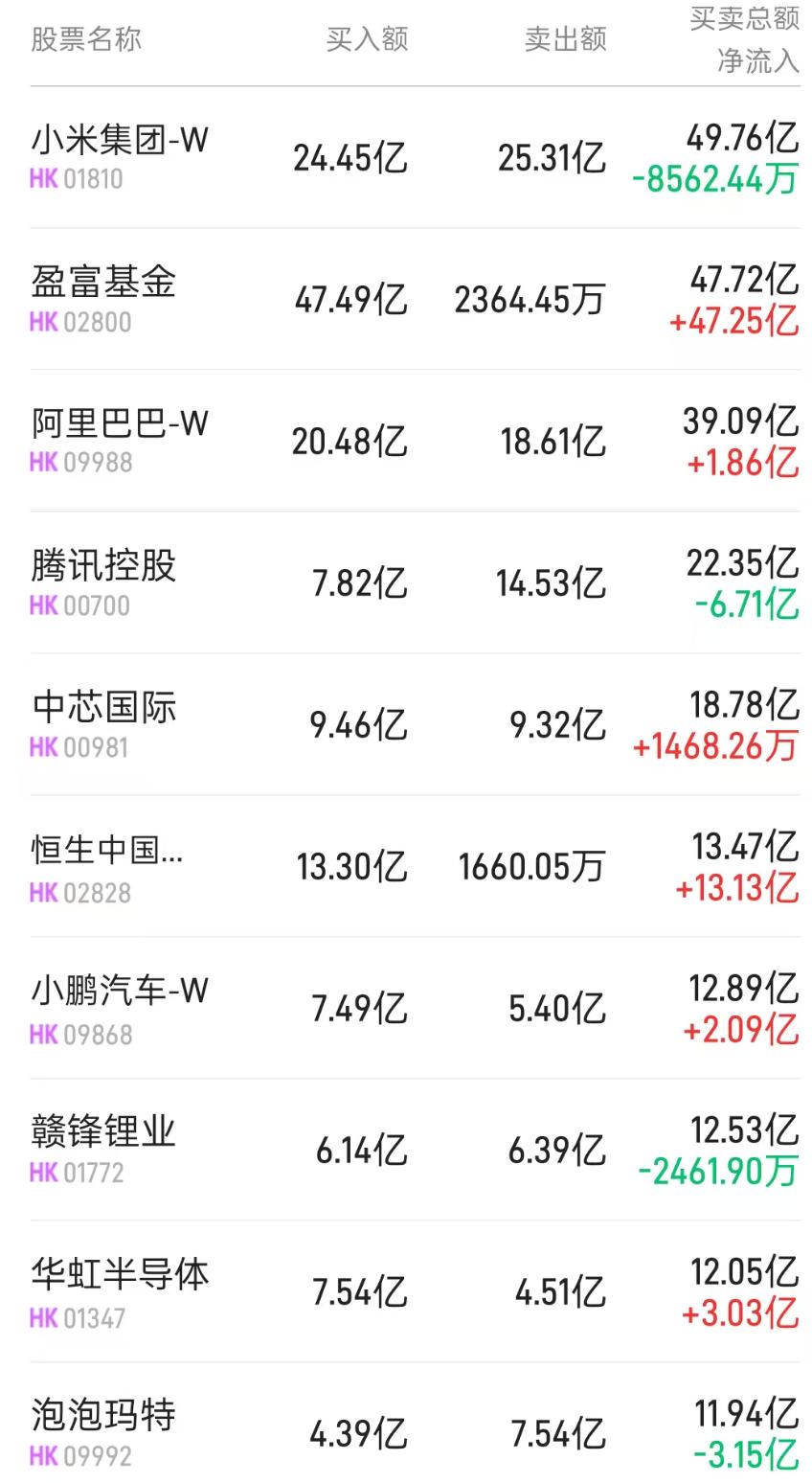
北水成交净买入159.92亿 北水大举加仓港股ETF 全天抢筹盈富基金超74亿港元
Zhi Tong Cai Jing· 2025-11-21 17:33
Group 1: Market Overview - On November 20, the Hong Kong stock market saw a net inflow of capital from Northbound trading amounting to HKD 159.92 billion, with HK Stock Connect (Shanghai) contributing HKD 78.08 billion and HK Stock Connect (Shenzhen) contributing HKD 81.84 billion [2] - The most net bought stocks included the Tracker Fund of Hong Kong (02800), Hang Seng China Enterprises (02828), and Alibaba-W (09988), while the most net sold stocks were Ganfeng Lithium (01772) and SMIC (00981) [2] Group 2: Stock Performance - Xiaomi Group-W (01810) experienced a net outflow of HKD 85.62 million, while the Tracker Fund of Hong Kong (02800) had a net inflow of HKD 47.25 billion [3] - Alibaba-W (09988) saw a net inflow of HKD 1.86 billion, and Tencent Holdings (00700) had a net outflow of HKD 671 million [3] Group 3: Sector Insights - Northbound funds showed strong interest in Hong Kong ETFs, with the Tracker Fund of Hong Kong (02800) and Hang Seng China Enterprises (02828) receiving significant net inflows of HKD 74.19 billion and HKD 19.13 billion respectively [6] - Ganfeng Lithium (01772) faced a net outflow of HKD 25.87 million, while SMIC (00981) had a net outflow of HKD 33.64 million [5][8] Group 4: Company-Specific Developments - Alibaba-W (09988) launched its official AI assistant, Qianwen APP, which is expected to enhance its AI application capabilities and drive revenue growth [6] - Xpeng Motors-W (09868) is projected to see a 40% revenue growth in 2026, with expectations of achieving breakeven for the first time [7] - Ganfeng Lithium (01772) is expected to face a global lithium supply surplus of 76,000 tons and 54,000 tons in the next two years, with prices stabilizing between RMB 75,000 to 90,000 per ton [8]



3 Mega-Cap Growth Stocks To Buy Now
247Wallst· 2025-11-21 14:56
Core Insights - Mega-cap growth stocks have been among the top performers in the stock market [1] - The Roundhill Magnificent Seven ETF (BATS:MAGS) includes the seven largest publicly traded corporations [1] - This ETF has consistently outperformed the S&P 500 since its inception [1]

每日市场观-20251121
Caida Securities· 2025-11-21 06:28
Market Overview - The market experienced a decline on November 20, with the Shanghai Composite Index falling by 0.4%, the Shenzhen Component down by 0.76%, and the ChiNext Index decreasing by 1.12%[2] - The total trading volume was 1.72 trillion, a decrease of approximately 20 billion compared to the previous trading day[1] Sector Performance - Most sectors declined, with notable increases in construction materials and comprehensive banking, while coal, oil, chemicals, and power equipment sectors faced significant declines[1] - The technology sector, particularly semiconductor and communication equipment, saw major capital outflows, indicating a shift in investor sentiment[3] Technical Indicators - The market is showing signs of short-term weakness, with the ChiNext Index breaking below the 60-day moving average, and the Shenzhen and Shanghai indices also facing similar tests[1] - A five-day consecutive decline in the daily K-line pattern suggests a bearish trend, necessitating caution in trading strategies[1] Fund Flows - On November 20, net outflows from the Shanghai Stock Exchange amounted to 4.557 billion, while the Shenzhen Stock Exchange saw net outflows of 6.478 billion[3] - The top three sectors for capital inflows were IT services, energy metals, and joint-stock banks, while the semiconductor, communication equipment, and photovoltaic equipment sectors experienced the largest outflows[3] Economic Indicators - The October consumption market showed stable growth, with new energy vehicle retail sales increasing by 7.3%[4] - The November Loan Prime Rate (LPR) remained unchanged at 3.5% for five years and 3% for one year, indicating a stable monetary policy environment[5] Industry Trends - The Chinese chip design industry is projected to achieve sales of 835.73 billion in 2025, reflecting a year-on-year growth of 29.4%[8] - The smart glasses market is expected to reach a significant turning point in 2026, with global shipments projected to exceed 23.687 million units, and China's market expected to surpass 4.915 million units[7]
黄金早参|失业数据超预期,12月降息升温,金价震荡加剧
Sou Hu Cai Jing· 2025-11-21 01:32
Group 1 - Gold prices experienced increased volatility, reaching $4,100 during the day but later falling to $4,045 before closing at $4,076.7, a decrease of 0.15% [1] - The market anticipates no interest rate cuts in December, with the probability of a rate cut dropping to 27%, which negatively impacts precious metals [1] - The U.S. added 119,000 jobs in September, significantly above expectations, while the unemployment rate unexpectedly rose to 4.4%, the highest since October 2021 [1] Group 2 - Initial jobless claims in the U.S. decreased by 8,000 to 220,000, while continuing claims reached a four-year high [1] - The Federal Reserve's October meeting minutes revealed significant divisions among members, with a lack of data guidance contributing to uncertainty [1] - The U.S. Bureau of Labor Statistics will not release the October non-farm payroll report, incorporating the data into the November report set for release on December 16, after the Fed's final meeting of the year [1]
新兴亚洲ETF(520580)创上市以来最高收盘价,高“印度含量”助力全球化配置
Sou Hu Cai Jing· 2025-11-20 13:40
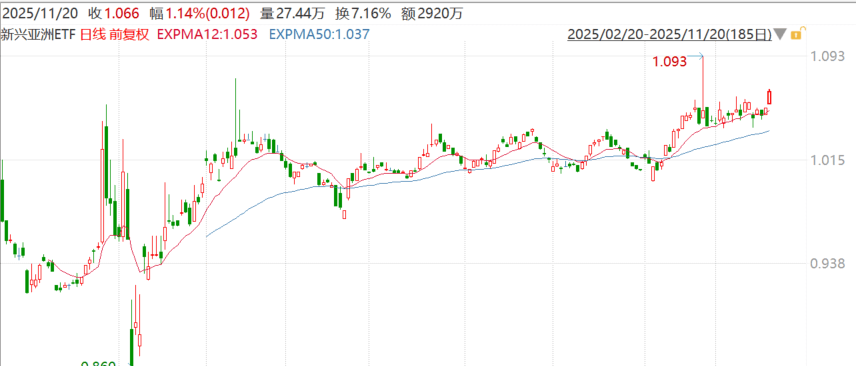
Core Insights - The Indian SENSEX30 index rose by 0.33% on November 20, reaching a new high since September 2024, and is close to its historical peak [1] - Moody's has indicated that consumer demand and infrastructure spending will drive India's economic growth, with an expected growth rate of 7% for this year [3] - Morgan Stanley forecasts strong performance for the Indian stock market over the next 12 months, driven by robust domestic growth and stable oil prices, with a projected 13% increase in the BSE Sensex index by December 2026 [3] Market Performance - The SENSEX30 index saw significant gains from major companies such as Reliance Industries, Mahindra & Mahindra, and the State Grid of India, each rising over 1% [1] - The Emerging Asia ETF (520580) closed up 1.14% at 1.066 yuan, marking its highest closing price since its listing on February 20 of this year [1] Investment Insights - The Emerging Asia ETF (520580) tracks the Singapore Exchange Emerging Asia Select 50 Index, with approximately 48% of its investments in the Indian market, making it the highest "India content" ETF listed in the A-share market [3] - The correlation coefficient between the Emerging Asia Select 50 Index and the Indian SENSEX30 index is 0.69 over the past three years, indicating a strong relationship, compared to lower correlations with other major indices [4]
港股科技ETF天弘(159128)、港股通央企红利ETF天弘(159281)资金连续净流入天数均居同标的第一,机构:港股配置上重回哑铃策略
2 1 Shi Ji Jing Ji Bao Dao· 2025-11-18 02:05
Group 1 - The Hong Kong stock market indices opened lower, with both technology and dividend sectors declining [1] - The Hong Kong Stock Connect Technology Index fell over 1%, while stocks like Kingsoft Cloud rose over 6% [1] - The Tianhong Hong Kong Stock Connect Technology ETF (159128) saw a net inflow of 39.8 million yuan over two days, reaching historical highs in both shares and scale [1] Group 2 - The Hong Kong Stock Connect Central State-Owned Enterprises Dividend Index dropped over 0.7%, with companies like Sinopec and China National Offshore Oil Corporation showing gains [1] - The Tianhong Hong Kong Stock Connect Central State-Owned Enterprises Dividend ETF (159281) recorded a net inflow of 40.5 million yuan over five days, also achieving historical highs in net inflow days [1] - Tianhong Fund highlighted that the Central State-Owned Enterprises Dividend Index includes high dividend yield companies, benefiting from policy advantages and market characteristics [2] Group 3 - Recent fluctuations in the Hong Kong stock market are attributed to external volatility and investor profit-taking behavior [2] - Despite the market's current state, there are expectations for upward adjustments in external liquidity, suggesting potential investment opportunities [2] - A "barbell strategy" is recommended for asset allocation, focusing on technology and non-ferrous metals for growth, while emphasizing dividends and turnaround stocks for defense [2]

ETF龙虎榜 | 抄底!资金逆势流入这一方向
Zhong Guo Zheng Quan Bao· 2025-11-17 13:57
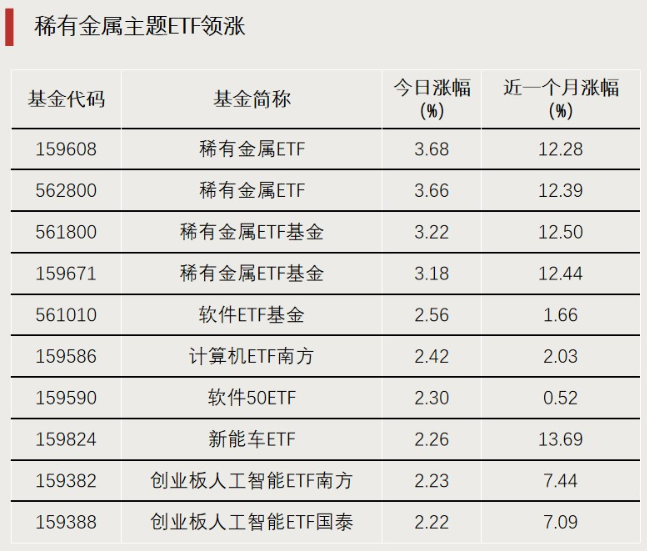
Group 1: Rare Metals ETF Performance - On November 17, rare metals ETFs led the market with four ETFs rising over 3%, including the rare metals ETF (159608) which increased by 3.68% [2][3] - The rise in the rare metals sector was driven by a significant increase in lithium carbonate futures, with expectations of improved supply-demand fundamentals in the lithium industry from 2026 to 2027 [2][10] - The overall performance of rare metals ETFs over the past month shows substantial gains, with the rare metals ETF (159608) up 12.28% [3] Group 2: AI Application ETFs - AI application-related ETFs also saw positive performance, with software ETFs and the Southern China AI ETF rising over 2% on November 17 [2] - The Southern China AI ETF (159382) recorded a net inflow of 8.99 billion yuan on November 14, indicating strong investor interest despite a general decline in tech stocks [8][9] Group 3: Bond ETFs Activity - Bond ETFs were notably active, with eight out of the top ten ETFs by trading volume being bond ETFs, including several from the Sci-Tech bond category [6] - The trading volume for the Sci-Tech bond ETF from Guotai reached 9.384 billion yuan, up from 7.215 billion yuan the previous day, reflecting increased investor activity [7] Group 4: Decline in Gold ETFs - Gold-themed ETFs experienced a collective decline, with several gold-related ETFs dropping over 2% [4][5] - The gold stock ETF saw a decrease of 2.57%, while other gold ETFs also reported significant losses over the past month [5] Group 5: Market Outlook - The outlook for the A-share market remains positive, with expectations of continued upward trends driven by structural economic improvements and declining risk-free rates [10] - Long-term prospects for the rare metals sector are bolstered by supply constraints and expanding demand, particularly from the new energy vehicle market and emerging industries [10]
指数化投资周报20251117:黄金ETF涨幅领先,科创板块逆市净申购-20251117
Shenwan Hongyuan Securities· 2025-11-17 12:20
Group 1: Report Industry Investment Rating - No information provided regarding the industry investment rating Group 2: Core Viewpoints of the Report - In the recent week, most A - share ETFs declined, while gold ETFs led the gains with a 3.26% increase, and the technology sector mostly fell. Funds were deployed in the science - innovation sector against the trend, and the ETFs targeting SGE Gold 9999 had the largest net inflow of funds [2][9] Group 3: Summary by Directory 1. Index Product Establishment, Raising, and Application - **Product Establishment and Listing**: Five products were listed, with a concentration on Hong Kong Stock Connect products. Eight products were established, including index - enhanced products such as Zhongjia Beizheng 50 Component Index Enhanced A and Huatai Baorui Shanghai Stock Exchange Science and Technology Innovation Board Comprehensive Index Enhanced A [1][4] - **Product Issuance Information**: Two index products ended their fundraising in the coming week, and no index products were set to start fundraising [6] - **Product Application Information**: A total of 28 index products were applied for in the recent week, maintaining the diversified characteristics of industry themes, including 18 theme funds and 6 linked funds [7] 2. ETF Market Review - **Overall ETF Performance**: Most A - share ETFs declined, with the declines of Kechuang 50ETF, ChiNext 50ETF, and CSI 500ETF being - 3.83%, - 3.67%, and - 1.24% respectively. Among Hong Kong - stock ETFs, only the Hang Seng ETF rose by 1.30%, and among US - stock ETFs, the S&P 500ETF rose by 2.68%. In commodity ETFs, the non - ferrous ETF rose by 1.26%, and gold rebounded strongly by 3.26% [2][9] - **Industry - based A - share ETF Performance**: The medical category rose significantly, with the Chinese medicine ETF having the highest increase of 3.61%. The chemical ETF also had a relatively high increase of 3.38%. The technology category declined significantly, with the communication ETF, electronic ETF, and chip ETF having declines of - 6.99%, - 5.62%, and - 4.81% respectively [2][13] - **Cross - border ETF Performance**: In the recent week, the major broad - based indices of cross - border markets had mixed performance. The France CAC40 had the highest increase of 2.77%. Among corresponding ETFs, Boshi Hang Seng Healthcare ETF and Hua'an France CAC40ETF rose significantly, while Huatai Baorui CSI Korea Exchange Sino - Korean Semiconductor ETF declined by 4.20% [16] 3. ETF Fund Flow - **Overall ETF Scale**: As of November 14, 2025, there were 1304 ETFs in the entire market, with a total scale of 563.3719 billion yuan, a decrease of 3.914 billion yuan from the previous week. A - share and cross - border ETFs ranked first and second in scale [22] - **Non - monetary ETF Fund Inflow and Outflow**: Among non - monetary ETFs, the ETFs targeting SGE Gold 9999 had the largest net inflow of 5.567 billion yuan, while the ETFs of CSI A500 had the largest net outflow of 4.04 billion yuan [24] - **High - Inflow and High - Liquidity ETFs**: Huaxia Shanghai Stock Exchange Science and Technology Innovation Board 50ETF and Southern ChiNext Artificial Intelligence ETF had high fund inflows of 2.495 billion yuan and 2.028 billion yuan respectively. Haifutong CSI Short - term Financing ETF and E Fund CSI Hong Kong Securities Investment Theme ETF had high liquidity [26]
ETF业绩跟踪及资金流动周报-20251117
SINOLINK SECURITIES· 2025-11-17 12:18
- The report tracks the weekly performance and fund flows of broad-based ETFs, including average returns and fund inflows/outflows[1][2] - The top ten broad-based ETFs by fund inflows and outflows are listed, with specific details on fund size, weekly returns, and trading volume[3][4] - The report also covers the weekly performance and fund flows of sector-themed ETFs, Smart Beta ETFs, and Hong Kong Stock Connect ETFs[5][6] - The report provides a detailed breakdown of the number, size, and trading statistics of equity ETFs, categorized by index and sector[9][10] - Overseas ETFs experienced a net outflow of 34.23 billion yuan over the past week, with significant outflows from large-cap value styles and specific sectors like banking[11][12][13] - The report lists the top ten individual stocks by net fund outflows, including companies like Kweichow Moutai and CATL[15][16][17]