
水泥

Search documents
基建景气或正修复:每周高频跟踪20250927-20250927
Huachuang Securities· 2025-09-27 14:43
Group 1: Report Industry Investment Rating - No relevant content provided Group 2: Core Views of the Report - In the fourth week of September, the peak-season effect on the demand side was gradually released, especially the investment-related indicators showed a month-on-month recovery. Inflation-wise, food prices stopped falling and rebounded. In terms of exports, both the CCFI and SCFI indices continued to decline month-on-month, while port freight volume remained high and volatile. Industrially, industrial electricity consumption decreased before the holiday, coal consumption entered the off-season, and the increase in the operating rate slowed down. In investment, the price increases of cement and rebar expanded, and the operating rate of asphalt accelerated, indicating that the infrastructure investment climate may be improving. In the real estate sector, the sales of new homes further soared while second-hand homes remained stable month-on-month. Overall, the "Golden September" was mediocre, and the year-on-year growth of new homes remained negative [2][32]. - For the bond market, production weakened marginally before the holiday, but the signs of investment stabilization became more prominent this week. The release of peak-season investment demand, the expectation of supply contraction, and the increase in costs may boost the prices of midstream investment products. Attention should be paid to the month-on-month improvement of PPI. Although the "Golden September" was mediocre in terms of real estate sales and investment indicators, demand began to improve in the last week of September. After the holiday, attention should be paid to its sustainability. Especially in October, the weather is conducive to construction, and policy-based financial tools are expected to be implemented, so the fourth quarter may be the period when the "broad credit" effect is realized. Short-term macro expectations may still disturb the bond market sentiment [2][32]. Group 3: Summary by Relevant Catalogs Inflation-related - Food prices stopped falling and rebounded. This week (September 22 - 26), the average wholesale price of pork in the country decreased by 0.94% month-on-month and continued to fall. Vegetable and fruit prices rose. The 200-index of agricultural product wholesale prices and the wholesale price index of basket products increased by 0.41% and 0.48% month-on-month, respectively, ending the decline [7]. Import and Export-related - The CCFI and SCFI indices continued to decline. This week, the CCFI index decreased by 2.93% month-on-month, and the SCFI decreased by 6.98% month-on-month, continuing the downward trend. The demand for China's export container transportation weakened, and the freight rates in the ocean shipping market continued to adjust. Among them, the demand on the North American route had not improved, and the spot booking prices continued to fall. The freight rates on the West and East Coast routes of the United States decreased by 10.8% and 6.7% month-on-month, respectively. In terms of port freight volume, from September 15 to September 21, the container throughput and cargo throughput of ports increased by 0.18% and 0.14% month-on-month, respectively, and the year-on-year increases were 12.95% and 18.76%, respectively, with a significant expansion of the increase, indicating that the export boom remained high [9]. - The BDI index continued to rise, but the increase narrowed. This week, the BDI and CDFI indices increased by 2.2% and 1.7% month-on-month, respectively, continuing the upward trend. Before the holiday, the coal cargo volume increased, and the typhoon affected the ship turnover, driving up the bulk shipping rental prices [9]. Industry-related - The price of thermal coal continued to rise. This week, the price of thermal coal (Q5500) at Qinhuangdao Port increased by 1.6% month-on-month (2.6% the previous week). In terms of demand, this week, the typhoon brought heavy rainfall to the South China coast, effectively alleviating the high temperature in the south. Coupled with the maintenance of power plant units, the civilian electricity load significantly decreased, and coal consumption entered the off-season. As the National Day holiday approached, downstream industrial enterprises would enter a centralized shutdown period, and industrial electricity demand would also weaken accordingly [13][15]. - The price of rebar increased slightly, and the inventory reduction accelerated. The spot price of rebar (HRB400 20mm) increased by 0.2% month-on-month (0.6% the previous week). The rebar inventory decreased by 2.8% month-on-month, with an accelerated reduction. This week, both the factory and social inventories of rebar decreased, and the apparent demand rebounded. According to Jinlian Chuang statistics, the rebar production has been continuously decreasing since September. In some regions, the profit decreased, and steel mills actively reduced production. The supply side shrank significantly, and the dual-energy control policy fermented in some regions, restricting the release of production capacity. The survey showed that as of the end of September, the terminal procurement volume in East China had only recovered to 92% of the same period last year, and it was still less than 90% in North and Northeast China. The "Golden September" was mediocre. Looking forward to October, as engineering projects enter the year-end sprint stage, attention should be paid to the demand performance of rebar [15]. - The increase in copper prices slightly expanded. This week, the average prices of Yangtze River Nonferrous Copper and LME Copper increased by 0.66% and 0.57% month-on-month, respectively, maintaining an upward trend. This week, the suspension of copper mines in Indonesia led to an expectation of supply contraction, the social inventory of Shanghai copper decreased, and the expectation of interest rate cuts by the Federal Reserve in October and December increased, all of which boosted copper prices [17]. - The increase in glass futures narrowed. At the beginning of the week, the glass trading was mediocre. During the week, boosted by macro expectations, manufacturers generally raised their price expectations significantly, and the downstream procurement rhythm accelerated accordingly, resulting in a significant increase in the market price. However, the actual improvement in the glass demand side was limited [17]. Investment-related - The price increase of cement significantly expanded, supported by both cost and demand. This week, the weekly average of the cement price index increased by 2.0% month-on-month (0.01% the previous week). Recently, the cost of cement raw materials has increased, the demand in the traditional peak season has been gradually released, and environmental protection policies require some regions to implement staggered kiln shutdowns, jointly driving up the general increase in cement prices [21]. - In the fourth week of September, the sales volume of new homes increased at an accelerated pace month-on-month but was lower year-on-year. From last Friday to this Thursday (September 19 - 25), the transaction area of new homes in 30 cities was 1.793 million square meters, a month-on-month increase of 52.4% and a year-on-year decrease of 4.6%. New homes entered the end-of-month sprint stage and improved at an accelerated pace compared with the previous week, but the year-on-year performance was still low, and the overall performance was mediocre. The sales of second-hand homes decreased slightly. This week, the transaction area of second-hand homes in 17 cities was 1.973 million square meters, a month-on-month decrease of 0.5% and a year-on-year increase of 8.3% (61.6% last week), with the upward momentum weakening marginally [23]. Consumption-related - The retail sales of passenger cars turned positive year-on-year in the first three weeks of September. According to the Passenger Car Association, from September 1 to 21, the retail sales of passenger cars increased by 1% year-on-year and 8% month-on-month. The retail growth rate of passenger cars improved in the third week, but to some extent, it was supported by the low base caused by the Mid-Autumn Festival holiday in mid-September last year, and the market trend was generally stable [25]. - The increase in crude oil prices expanded. As of Friday, the prices of Brent crude oil and WTI crude oil increased by 5.2% and 4.9% month-on-month, respectively, turning from a decline to an increase. During the week, the uncertainty of Iraq's crude oil export supply and the month-on-month decrease in US commercial crude oil inventories supported the oil prices [25].
建材行业稳增长工作方案发布,关注水泥、玻璃供给侧变化
GOLDEN SUN SECURITIES· 2025-09-27 13:34
Investment Rating - The report maintains an "Overweight" rating for the construction materials sector [4]. Core Views - The construction materials sector is expected to recover positively in 2025-2026, with improved profitability levels due to strict capacity control measures for cement and glass production [2]. - The report highlights the importance of municipal engineering projects, which are likely to accelerate, benefiting companies like Longquan Co., Qinglong Pipeline, China Liansu, and Zhen'an Technology [2]. - The report emphasizes the ongoing supply-demand imbalance in the float glass market, with a focus on price stability following production cuts in photovoltaic glass [2]. - Consumer building materials are recommended due to favorable conditions from second-hand housing transactions and consumption stimulus policies, with companies like Beixin Building Materials and Weixing New Materials highlighted [2]. - Cement production is expected to see positive changes on the supply side, with a focus on regional demand increases driven by large infrastructure projects [2]. Summary by Sections Cement Industry Tracking - As of September 26, 2025, the national cement price index is 347.22 CNY/ton, up 2.61% week-on-week, while cement output decreased by 5.59% to 2.5905 million tons [3][18]. - The cement industry is facing a "supply price increase, demand not following" contradiction, with infrastructure being the mainstay of demand [18]. Glass Industry Tracking - The average price of float glass is 1224.74 CNY/ton, with a week-on-week increase of 1.39%, while inventory levels have decreased [6]. - The report notes that the market's supply-demand structure has not improved significantly, and the upcoming National Day holiday may exert pressure on supply and demand [6]. Fiberglass Industry Tracking - The report indicates that fiberglass prices are stabilizing, with demand showing slight improvement, particularly for high-end products [7]. - The overall inventory growth rate has slowed, suggesting a potential for price increases in the future [7]. Consumer Building Materials Tracking - The demand for consumer building materials continues to show signs of weak recovery, with upstream raw material prices experiencing fluctuations [8]. Carbon Fiber Industry Tracking - The carbon fiber market remains stable, with production costs reported at 106,800 CNY/ton and a negative gross margin [8]. - The report highlights a slow recovery in downstream demand, particularly in wind energy and hydrogen storage sectors [8].
高频|黑色系商品领跌,“金九”成色如何?
CAITONG SECURITIES· 2025-09-27 06:48
1. Report Industry Investment Rating No information about the industry investment rating is provided in the given reports. 2. Core Views of the Report - This week, the spot price of rebar decreased slightly, terminal demand remained weak, and the willingness to replenish inventory before the holiday was low. The black - series led the decline in the commodity market on Friday, and the coking industry association issued a clarification statement in the afternoon. The double - coke continued to fall at night, indicating significant uncertainties in the fundamentals. The real estate sales declined marginally this week, with first - tier cities providing support. The momentum of travel was strong approaching the holiday [1]. - In terms of real estate sales, the transaction area of new homes in 20 cities tracked by Wind increased by 7.58% week - on - week and decreased by 10.63% year - on - year. The transaction area in first - tier cities was significantly stronger than the same period last year, while that in second - tier cities turned negative year - on - year. The sales area of second - hand homes in Beijing and Shanghai was much higher than last year [1]. - In investment and production, most commodity prices rose. The rebar price decreased slightly, with weak terminal demand and low pre - holiday inventory replenishment willingness. The glass futures price increased due to stable supply and improved demand in the peak season, along with positive policy sentiment. The cement price index rose as the traditional peak season deepened, and the asphalt price increased slightly supported by the rebound in oil prices [1]. - In industrial production, the operating rates showed differentiation. The PTA operating rate declined, while the operating rates of automobile tires, coking enterprises, and polyester filament remained basically flat. The blast furnace operating rate of steel mills increased slightly, and the operating rate of petroleum asphalt increased significantly [1]. - In consumption, the travel momentum was strong. Subway travel exceeded the seasonal level, and automobile consumption, domestic flights, and movie box - office were in line with the season [1]. - In terms of inflation, the pork price declined, vegetable prices rose, and oil prices increased. The increase in vegetable prices was due to some vegetables entering the end of the harvest season and reduced production after the temperature drop in the north. The rise in crude oil prices was mainly driven by the geopolitical disturbances in Russia and Ukraine [1]. - In exports, the SCFI declined, and the BDI increased. The demand in the transportation market remained unchanged, and the spot - market booking prices continued to fall [1]. 3. Summary According to Relevant Catalogs 3.1 Real Estate Sales: First - Tier Cities Provide Support - New home sales: From September 19th to 25th, the transaction area of new homes in 20 cities tracked by Wind increased by 7.58% week - on - week and decreased by 10.63% year - on - year. First - tier cities' transaction area was significantly stronger than last year, second - tier cities' year - on - year sales turned negative, and third - and fourth - tier cities' sales were weaker than last year and the previous period [1][6]. - Second - hand home sales: The sales area of second - hand homes in Beijing and Shanghai was much higher than last year. Overall, the transaction area of second - hand homes in key cities was basically flat week - on - week, with the year - on - year increase showing a decline. Except for Shenzhen, the transaction areas of other key cities were stronger than the previous period [1][20]. 3.2 Investment: Most Commodity Prices Rose - Rebar: The price decreased slightly. Due to weak terminal demand and low pre - holiday inventory replenishment willingness, merchants focused on reducing inventory. The inventory decreased by 2.75% week - on - week, and the apparent consumption increased by 4.96% [1][5]. - Glass: The futures price increased. The supply output was stable, the demand improved marginally in the peak season, and the policy sentiment of the "Building Materials Industry Stable Growth" was positive. The price increased by 3.71% week - on - week [1][5]. - Cement: The price index rose. As the traditional peak season deepened, enterprises generally raised prices, with a 2.51% increase week - on - week [1][5]. - Asphalt: The price increased slightly. The rebound in oil prices provided price support, with a 0.78% increase week - on - week [1][5]. 3.3 Production: Operating Rates Showed Differentiation - PTA: The operating rate declined, dropping from 77.29% to 76.48% [1][5]. - Automobile tires, coking enterprises, and polyester filament: The operating rates remained basically flat [1]. - Steel mills' blast furnaces: The operating rate increased slightly, rising from 84% to 84.47% [1][5]. - Petroleum asphalt: The operating rate increased significantly, rising from 34.4% to 40.1% [1][5]. 3.4 Consumption: Strong Travel Momentum - Subway travel: It was higher than the seasonal level, although it decreased by 2.54% week - on - week [1][5]. - Automobile consumption, domestic flights, and movie box - office: They were in line with the season. Automobile consumption increased by 7.07% week - on - week, domestic flights decreased by 1.37% week - on - week, and movie box - office increased by 17.00% week - on - week [1][5]. 3.5 Exports: SCFI Declined, BDI Increased - SCFI: It decreased by 6.98% week - on - week, indicating that the demand in the transportation market remained unchanged and the spot - market booking prices continued to fall [1][5]. - BDI: It increased by 2.86% week - on - week [1][5]. - CRB spot index: It decreased slightly by 0.75% week - on - week [1][5]. 3.6 Prices: Pork Price Declined, Vegetable and Oil Prices Rose - Pork: The price decreased slightly, dropping from 19.48 yuan/kg to 19.42 yuan/kg [1][5]. - Vegetables: The price increased, rising by 2.01% week - on - week, due to some vegetables entering the end of the harvest season and reduced production after the temperature drop in the north [1][5]. - Oil: The price increased. The Brent crude oil spot price in the UK rose from $67.15/barrel to $72.09/barrel, mainly driven by geopolitical disturbances in Russia and Ukraine [1][5].
广东塔牌:股东徐永寿拟减持1%公司股份
Xin Lang Cai Jing· 2025-09-26 13:03
Core Viewpoint - Shareholder Xu Yongshou, holding 8.02% of Guangdong Tapa Group Co., Ltd., plans to reduce his stake by 11,680,328 shares due to personal financial needs, which represents 1% of the total share capital after excluding repurchased shares [1] Summary by Relevant Sections - **Shareholder Information** - Xu Yongshou holds 93,657,056 shares, representing 8.02% of the company [1] - After the planned reduction, he will still hold over 5% of the shares [1] - **Reduction Details** - The reduction will occur within three months after 15 trading days from the announcement date [1] - The shares will be sold through centralized bidding or block trading at market-determined prices [1] - **Regulatory Compliance** - Xu Yongshou has no outstanding lock-up commitments and there are no regulations preventing the reduction [1] - The reduction is not expected to lead to a change in company control [1]

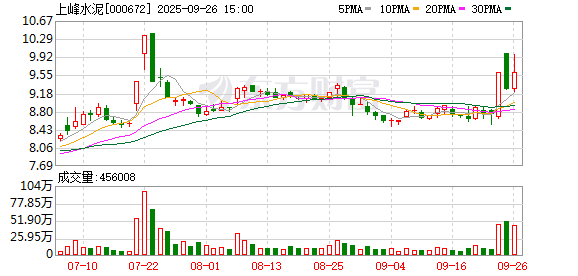
上峰水泥:关于控股股东部分股份质押的公告
Zheng Quan Ri Bao· 2025-09-26 12:13
Group 1 - The company, Shangfeng Cement, announced that its controlling shareholder, Zhejiang Shangfeng Holding Group Co., Ltd., pledged 12,000,000 shares to Ningbo Bank Co., Ltd. Shaoxing Branch [2] - The purpose of the share pledge is to supplement working capital [2]


房地产及建材行业双周报(2025、09、12-2025、09、25):建材稳增长工作方案提出,行业供需矛盾有望进一步改善-20250926
Dongguan Securities· 2025-09-26 09:17
Investment Rating - The report maintains a "Neutral" rating for both the real estate and building materials sectors [2][4]. Core Insights - The real estate market is experiencing a decline, with new residential sales area down 4.7% and sales value down 7.3% year-on-year for the first eight months of 2025. The decline in sales has accelerated, indicating a weakening fundamental outlook [4][25]. - The building materials sector is expected to see improved supply-demand dynamics due to government policies aimed at stabilizing growth, including restrictions on new capacity for cement and flat glass [4][47]. Summary by Sections Real Estate Sector - The real estate sector has seen a significant drop in sales, with August figures showing a year-on-year decrease of 10.98% in sales area and 14.76% in sales value. Prices in first, second, and third-tier cities have also declined [4][25]. - Policy adjustments in Shanghai aim to stimulate the market by exempting certain homebuyers from property tax, indicating a trend towards loosening regulations [4][23]. - Recommended companies for investment include Poly Developments (600048), Binjiang Group (002244), and China Merchants Shekou (001979) due to their stable operations and focus on first and second-tier cities [4][25]. Building Materials Sector - The Ministry of Industry and Information Technology has issued a "Stabilization Growth Work Plan" for the building materials industry, prohibiting new capacity for cement and flat glass, which is expected to alleviate supply-demand conflicts [4][47]. - Cement demand is anticipated to recover due to urban renewal projects and infrastructure construction, with companies like Conch Cement (600585), Taipai Group (002233), and Huaxin Cement (600801) being highlighted for their investment potential [4][47]. - The glass industry is currently facing challenges, but opportunities may arise in the fiberglass sector due to growth in emerging fields such as wind power and electric vehicles, with China Jushi (600176) recommended for investment [4][49].
水泥板块9月26日跌0.12%,三和管桩领跌,主力资金净流出9889.38万元
Zheng Xing Xing Ye Ri Bao· 2025-09-26 08:48
Market Overview - The cement sector experienced a slight decline of 0.12% on September 26, with Sanhe Pile leading the drop [1] - The Shanghai Composite Index closed at 3828.11, down 0.65%, while the Shenzhen Component Index closed at 13209.0, down 1.76% [1] Individual Stock Performance - Sanhe Pile (003037) closed at 7.91, down 4.47% with a trading volume of 168,100 shares and a turnover of 134 million yuan [2] - Qingsong Jianhua (600425) closed at 4.25, down 2.52% with a trading volume of 393,800 shares [2] - Sichuan Jinding (600678) closed at 9.23, down 2.22% with a trading volume of 105,800 shares [2] - Guotong Co. (002205) closed at 13.63, down 1.87% with a trading volume of 94,800 shares [2] - Tianshan Co. (000877) closed at 5.97, down 1.16% with a trading volume of 388,500 shares [2] - Other notable declines include Jianfeng Group (600668) down 1.02% and Xizang Dalu (600326) down 0.81% [2] Capital Flow Analysis - The cement sector saw a net outflow of 98.89 million yuan from institutional investors and 47.41 million yuan from retail investors, while individual investors contributed a net inflow of 146 million yuan [4] - Hainan Ruize (002596) had a net inflow of 47.06 million yuan from institutional investors, while experiencing a net outflow of 10.28 million yuan from retail investors [4] - Fujian Cement (600802) reported a net inflow of 11.08 million yuan from institutional investors, with a slight net outflow from retail investors [4] - Guotong Co. (002205) had a net inflow of 5.80 million yuan from institutional investors, while retail investors showed a net outflow [4]






中国提出全经济减排目标
21世纪经济报道· 2025-09-26 04:42
Core Points - China announced a new round of Nationally Determined Contributions (NDC) at the UN Climate Change Summit, aiming for a 7%-10% reduction in greenhouse gas emissions by 2035, with non-fossil energy consumption exceeding 30% of total energy consumption [1][3] - The national carbon market has been operational for over four years, covering more than 2,200 key emission units in the power sector, making it the largest carbon market globally [3][4] - The carbon market's trading volume reached nearly 700 million tons with a transaction value of approximately 48 billion RMB by the end of August 2024, marking a record high since its inception [4][6] Carbon Market Development - The carbon market has seen significant growth, with a 44% increase in daily average transaction volume in 2024 compared to the previous compliance cycle, and a total transaction value of 18 billion RMB [6][4] - The market aims to expand its coverage to include major industrial sectors by 2027, with a focus on implementing total quota control for stable emission sectors [6][7] - New industries, including steel, cement, and aluminum smelting, will be included in the carbon market by 2025, increasing the controlled greenhouse gas emissions by approximately 3 billion tons [10][9] Future Expectations - The Chinese government plans to enhance the carbon market's mechanisms and expand its coverage to additional sectors such as aviation, petrochemicals, and paper manufacturing [9][10] - There is an emphasis on international cooperation and the establishment of cross-border carbon trading systems, with expectations for the upcoming COP30 to facilitate global climate governance [13][15] - The carbon market is seen as a critical tool for achieving carbon neutrality and is expected to play a significant role in the global carbon pricing landscape [6][14]

2025年7月中国水泥及水泥熟料出口数量和出口金额分别为101万吨和0.45亿美元
Chan Ye Xin Xi Wang· 2025-09-26 03:33
Core Insights - The report by Zhiyan Consulting highlights the significant growth in China's cement and clinker exports, with a notable increase in both quantity and value in July 2025 compared to the previous year [1]. Group 1: Export Data - In July 2025, China's cement and clinker export volume reached 1.01 million tons, representing a year-on-year increase of 117.4% [1]. - The export value for the same period was $4.5 million, showing a year-on-year growth of 71.7% [1]. Group 2: Industry Analysis - Zhiyan Consulting is recognized as a leading industry consulting firm in China, specializing in in-depth industry research and providing comprehensive consulting services [1]. - The firm has been dedicated to the industry research field for over a decade, offering tailored solutions to empower investment decisions [1].

建材行业多部门稳增长方案解读
2025-09-26 02:29
Summary of Key Points from the Conference Call Industry Overview - The conference call primarily discusses the **building materials industry**, focusing on **cement**, **glass**, and **photovoltaic glass** sectors, along with emerging materials and government policies impacting these areas [1][2][3]. Core Insights and Arguments Cement Industry - The Ministry of Industry and Information Technology (MIIT) aims to increase the cement industry's capacity utilization rate from approximately **45% to 70%** by December 31, 2025, through restrictions on overproduction and encouraging off-peak production [1][3][6]. - Challenges include effective supervision and enforcement of these policies, as well as the potential revival of "zombie" capacities that could undermine profitability improvements [6][22]. - Companies like **Sankeshu**, **Hankow Group**, and **Dongfang Yuhong** show significant fundamental improvements, making them noteworthy [3][18]. - The outlook for export-oriented building material companies is optimistic, particularly for leaders like **China Jushi** [3][19]. Glass Industry - The glass sector, particularly float and architectural glass, has reacted positively to the new policies, with significant movements in both futures and stock markets indicating expectations of price increases [5][9]. - The main driver of stock price fluctuations is attributed to pricing strategies of small and medium enterprises during peak seasons, rather than the new growth stabilization policies [9]. - The glass industry faces limited new policy increments, focusing instead on capacity replacement, with market performance influenced by window guidance [15][23]. Photovoltaic Glass Industry - The photovoltaic glass sector has implemented measures to reduce production capacity by approximately **15%**, leading to improved profitability, transitioning from losses to a **10% net profit** for leading companies [10]. - However, the industry faces risks from potential declines in export tax rebates, which may lead to short-term export surges [10][15]. Emerging Materials - New materials such as advanced glass, artificial crystals, and high-performance fibers are gaining attention, with some receiving policy support [11][16]. - The introduction of quality traceability mechanisms is expected to enhance standards in the building materials sector, particularly for non-standard products [17]. Other Important Insights - Government subsidies for building materials have been marginally improved, with categories like tiles and energy-efficient windows included in new subsidy programs, although the overall subsidy intensity has decreased compared to the previous year [12][14]. - Urban renewal projects continue to support demand for building materials, with ongoing high activity levels in renovation and upgrading of old properties [13][14]. - The building materials industry is expected to see structural growth through strict supply controls, demand stimulation, and quality improvements, although execution details and potential risks remain to be clarified [8][14]. Company Performance and Recommendations - Companies with strong fundamentals, such as **Sankeshu**, **Hankow Group**, and **Dongfang Yuhong**, are recommended for their positive performance outlook [18][20]. - Export-oriented companies like **China Jushi** are highlighted for their growth potential, especially in a favorable global demand environment post-Federal Reserve interest rate cuts [19]. - The cement sector's main players, including **Huaxin Cement**, **Keda Manufacturing**, and **Puyang Nanfang**, are expected to show long-term upward trends despite short-term volatility [20]. Conclusion - The building materials industry is undergoing significant changes driven by government policies aimed at stabilizing growth and improving quality standards. Key sectors like cement, glass, and photovoltaic glass are adapting to these changes, presenting both challenges and opportunities for investors and companies alike [1][8][14].
