
矿业

Search documents
金丰来:2026年金银牛市未竟 技术资产或成助燃剂
Xin Lang Cai Jing· 2025-12-24 10:37
Core Viewpoint - The ongoing bull market for gold is expected to continue despite potential short-term corrections in Bitcoin, AI, and the overall tech sector by 2026. The current weakness in crypto assets may actually drive upward momentum for silver [1][4]. Group 1: Gold and Bitcoin Analysis - The BOLD index created by ByteTree provides a framework for rebalancing gold and Bitcoin, two uncorrelated assets, to capture their complementary nature in volatile market conditions [1][4]. - Predictions suggest that gold prices could reach $7,000 per ounce by 2030, a forecast that is gaining credibility given the recent $2,500 increase in gold prices over the past five years [1][4]. - The expansion of the money supply and persistent fiscal deficits are expected to lead to inevitable inflation when these funds flow into the real economy [1][4]. Group 2: Silver Potential - If gold reaches its target price and the gold-silver ratio falls to around 40, silver prices could theoretically reach $175 [5]. - Gold serves as a reserve asset linked to macroeconomic indicators, while Bitcoin acts as a digital reserve tied to technology stocks and internet development, highlighting their distinct roles in asset allocation strategies [5]. Group 3: Market Dynamics - Bitcoin is currently in an oversold condition, while gold and silver show strong signs of being overbought, although historical data indicates that these conditions may extend further [5]. - The AI and internet sectors are showing signs of overvaluation after a prolonged period of enthusiasm, with concerns about capital expenditures and returns on investment [5]. - The current market is experiencing a stock momentum bubble not seen in at least 25 years, and as the internet sector adjusts, capital flows will redefine asset performance [5]. Group 4: Institutional Investment and Sentiment - Mainstream institutions have a very low allocation to Bitcoin, particularly in North America and Europe, indicating significant growth potential for the asset [6]. - Silver, once dismissed as "dirt," is making a comeback as the gold-silver ratio declines, suggesting a shift in investor sentiment [6]. - The absence of large inflows into mining ETFs and prevailing public skepticism about gold as a "barbarous relic" signal that the gold bull market is not yet over [6].


研报掘金丨渤海证券:首予西部矿业“增持”评级,乘铜市景气东风
Ge Long Hui A P P· 2025-12-24 08:57
格隆汇12月24日|渤海证券研报指出,西部矿业背靠西矿集团,主要开发国内西部地区矿产资源,业务 涵盖铜、铅、锌、铁、镁和锂等领域,其中铜类产品为公司主要盈利来源。受益于产能扩张和降本增 效,公司2025年前三季度业绩稳健增长,期间费用率实现下降。26年供给或短缺,铜价有望得到支撑在 全球能源结构深度调整背景下,风电和光伏的发展、相应电力电网的建设、新能源汽车的发展将长期支 撑新能源领域的用铜需求。从可比公司iFinD一致预期看,截至12月22日,可比公司2025年平均PE值为 18.36X,公司2025年PE值低于可比公司对应均值,首次覆盖给予"增持"评级。 ...

普次仁等11人获评第二届“拉萨工匠”
Xin Lang Cai Jing· 2025-12-24 08:31
Core Viewpoint - The second "Lhasa Craftsman" cultivation event aims to enhance the construction of a skilled workforce in Lhasa, promoting high-quality economic and social development through the recognition of outstanding laborers in various industries [1] Group 1: Event Overview - The event announced the selection of 11 "Lhasa Craftsmen" from various fields, including construction materials (1), mining (2), electricity (1), and traditional intangible cultural heritage (7) [1] - The selection process involved qualification review, on-site interviews, expert evaluations, and public announcements, ensuring that the chosen craftsmen have over five years of experience and significant contributions [1] Group 2: Economic Impact - The selected craftsmen have created over 1,000 job opportunities and played a leading role in their respective industries, significantly contributing to economic growth and meeting the increasing material and cultural needs of the people [1] - The craftsman Danzen Quzha from the traditional intangible heritage sector has conducted over 3,000 "intangible heritage into campus" activities and trained 32 inheritors, showcasing the importance of cultural preservation and innovation [1] Group 3: Innovation and Sales - Danzen Quzha has developed over 20 modernized incense products, achieving sales of over 4 million RMB through various offline exhibitions and online live broadcasts, thus expanding the market for traditional incense [1]
铁矿石:供需持续宽松,关注补库需求
Hua Bao Qi Huo· 2025-12-24 05:22
Report Summary of Iron Ore 1. Report Industry Investment Rating - Not provided 2. Core Viewpoint of the Report - Macro drivers are weakening, and the fundamentals of the industrial chain have improved. However, the decline in domestic iron ore demand has exceeded expectations, and the supply side is generally stable with a slight increase. It is expected that the port inventory will tend to accumulate overall. In the short term, the market trading focus has shifted to the reality, and the upside potential of prices is limited. However, restocking demand may support prices, and the market will mainly fluctuate in the short term [3]. 3. Summary by Relevant Catalogs Supply - The weekly shipment of foreign mines has decreased slightly compared to the previous week. Among them, the shipment from Australia has declined slightly, and the shipment from Brazil has remained basically stable. According to seasonal patterns and the shipment targets of major mines this year, major mines will have a phased rush at the end of the year, and the weekly shipment volume will increase month - on - month. In terms of the arrival volume, it remains at a moderately high level in the short term and is higher than the same period last year, and the support from the supply side is weak [3]. Demand - Domestic demand has continued to decline rapidly, and the weakening of demand has exceeded expectations. Based on the current production reduction efforts and restart plans, the molten iron volume may be close to the lowest level. The main reasons are the combined effects of environmental protection restrictions and annual maintenance. The daily average molten iron this period is 226.55 million tons, a decrease of 2.65 million tons compared to the previous period, and the absolute level of molten iron continues to be lower than the same period last year [3]. Inventory - The imported inventory at the steel mill end remains at a low level. The steel mill inventory this period has decreased compared to the previous period and is at the lowest level in the same period in recent years. High prices have suppressed the willingness to restock. Currently, the restocking actions of steel mills are weak. Later, attention will be paid to when the restocking of US - dollar goods by steel mills will be fully launched. Port inventory has continued to accumulate, mainly because the arrival volume has remained at a relatively high level. It is expected that the port inventory will still tend to accumulate in December [3]. Price - The price operates within a range. The main contract of Dalian iron ore is in the range of 770 - 800 yuan/ton, corresponding to the external market (FE01) price of about 102.5 - 105.5 US dollars/ton [4]. Strategy - Operate within a range and use covered call options [4].
碳酸锂回暖引爆锂矿价值重估 大中矿业“铁锂双驱动” 开辟增长新航道
Mei Ri Jing Ji Xin Wen· 2025-12-24 04:04
Core Viewpoint - Lithium carbonate prices have shown a clear recovery, with futures prices returning to 110,000 yuan/ton, benefiting companies like Dazhong Mining, which is transitioning from a traditional iron ore leader to a dual-driven new energy resource enterprise focusing on lithium [1][6]. Group 1: Project Development and Compliance - Dazhong Mining holds two major lithium mining projects in Hunan and Sichuan, which are crucial for its transformation and are compliant with the new Mineral Resources Law set to take effect in July 2025 [2]. - The Hunan Jijia Mountain lithium mine received the first mining license under the new law, with a resource volume of 490 million tons and lithium oxide reserves of 1.31 million tons, equivalent to 3.24 million tons of lithium carbonate [2]. - The Sichuan Gada lithium mine is progressing steadily, with a resource volume of 148.42 thousand tons of lithium carbonate equivalent and initial sales generating revenue of 21.95 million yuan [3]. Group 2: Technological Innovation and Cost Advantages - Dazhong Mining employs innovative technologies to reduce costs, such as using shield tunneling machines for mining, which shortens construction time by 40% and lowers costs by approximately 20 million yuan per kilometer [4]. - The company has implemented a new lithium extraction process that increases resource recovery rates from 75%-80% to 90%, addressing environmental concerns and enhancing project profitability [4]. Group 3: Business Strategy and Market Position - Dazhong Mining's dual-driven strategy combines iron ore and lithium mining, with a projected annual lithium carbonate production capacity of 130,000 tons, representing nearly 30% of China's current annual output [5]. - The iron ore business provides stable cash flow, supporting ongoing investments in lithium projects, while the lithium segment serves as a high-growth engine, enhancing the company's resilience against market cycles [5]. - The company's competitive edge lies in its combination of compliant resource reserves, cost advantages across the supply chain, and a synergistic business model [5]. Group 4: Industry Outlook - The demand for lithium, referred to as the "white oil" of the new energy industry, is expected to grow significantly, with the International Energy Agency predicting a fivefold increase by 2030 [6]. - The tightening of compliance in the domestic lithium mining industry is creating a favorable environment for upstream mining companies, positioning Dazhong Mining for a successful transition and revenue growth [6].
铂金涨势如虹!十连阳首破2300美元/盎司,供需失衡引爆市场
智通财经网· 2025-12-24 03:34
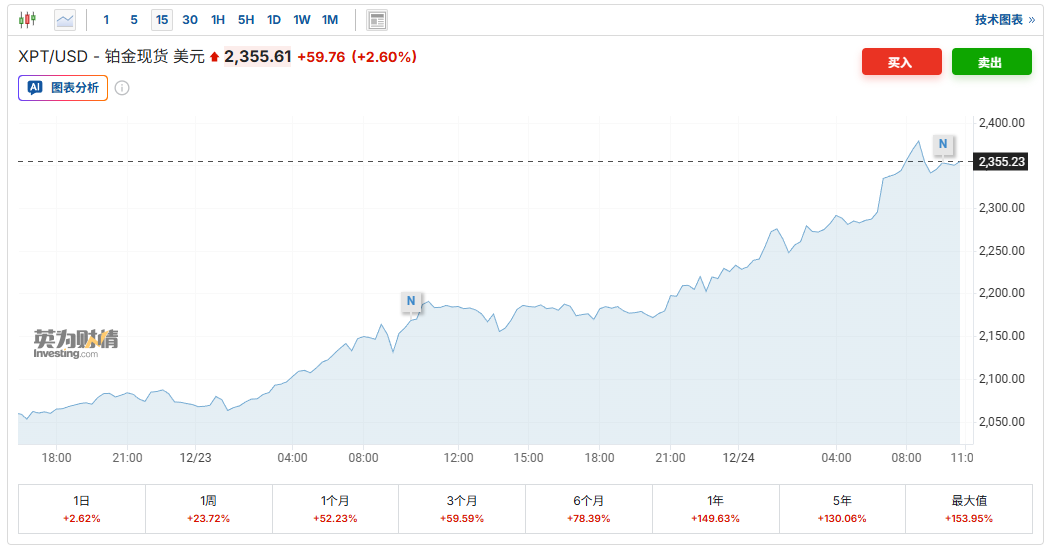
Core Viewpoint - Platinum prices have surged to a historical high due to supply shortages and resilient demand, with spot prices reaching $2,355.61 per ounce, marking a significant increase of over 23% in the past week and nearly 150% year-to-date [1][3]. Supply Factors - South Africa, the main producer of platinum, is facing structural issues such as power shortages and aging infrastructure, leading to a 13% year-on-year decline in platinum group metal production in Q1 2023. It is projected that production will decrease by 6% in 2025 [3]. - The World Platinum Investment Council (WPIC) forecasts a third consecutive year of global platinum market shortages in 2025, with a potential shortfall of 30 tons [3]. Demand Factors - The demand for platinum is being bolstered by increased usage in traditional automotive catalysts and the growth of the hydrogen energy sector. Despite the rise of electric vehicles, the number of existing and newly added fuel vehicles remains substantial, leading to increased platinum usage per vehicle due to stricter emission regulations [3]. - The decision by Europe to relax the 2035 ban on fuel vehicles further strengthens the demand outlook for platinum in the automotive sector [3]. - The hydrogen energy industry is opening new growth avenues for platinum, as it is an essential catalyst in fuel cells and water electrolysis, with significant long-term price support expected [3]. Investment Trends - The rising gold prices have led to a "substitution effect," with platinum becoming a more attractive option for consumers and investors, resulting in a notable increase in demand [4]. - The WPIC projects a 7% year-on-year increase in platinum jewelry demand to 67 tons by 2025, the highest level since 2018, and a 6% increase in investment demand to 23 tons [4]. - China is expected to be a key driver of platinum bar and coin demand, with a projected 47% year-on-year increase to 16 tons by 2025, marking a four-year high [4]. Market Dynamics - The recent rise in platinum leasing rates indicates a tight supply in the spot market, pushing industrial users to buy directly rather than borrow, which contributes to upward pressure on spot prices [4]. - Other precious metals, including gold, silver, and palladium, have also shown strong performance, with gold surpassing $4,500 per ounce and silver reaching historical highs [4]. Macro Factors - The current bull market for precious metals is supported by expectations of macroeconomic easing, tight spot supply, and resilient demand, with a weaker dollar and lower U.S. Treasury yields reducing the holding costs for precious metals [6]. - The ongoing competition for key resources globally is leading to a rebalancing of pricing for money and resources, with platinum and palladium being part of this dynamic [6]. Future Outlook - Analysts believe that the strong momentum for platinum is likely to continue due to persistent supply-demand tightness and the expanding industrial demand from the hydrogen sector [6]. - However, the sustainability of platinum and palladium prices will depend on key variables such as leasing rates, macroeconomic conditions, and the speed of supply recovery [7]. - Despite tight supply, there remains a significant amount of above-ground inventory, which could act as a buffer against potential price declines [7].
黑色建材日报:市场成交偏弱,钢价区间波动-20251224
Hua Tai Qi Huo· 2025-12-24 03:34
黑色建材日报 | 2025-12-24 市场成交偏弱,钢价区间波动 钢材:市场成交偏弱,钢价区间波动 市场分析 期现货方面:昨日钢材期货维持震荡运行,现货方面,钢材现货成交偏弱,环比回落,投机情绪不足,钢材价格 基本持平。 供需与逻辑:目前建材供需基本面持续改善,淡季消费维持韧性,产量小幅回升,库存延续回落,伴随各地持续 降温,建材需求仍有季节性回落预期。板材产量环比回落,消费及出口小幅下滑,但是仍存韧性,去库斜率不及 往年同期,高库存持续压制板材价格表现,卷螺差持续走弱。 策略 单边:震荡 跨期:无 跨品种:无 期现:无 期权:无 风险 宏观政策、成材需求情况、钢材出口、钢厂利润、成本支撑等。 铁矿:市场情绪谨慎,铁矿震荡运行 市场分析 期现货方面:昨日铁矿石期货价格震荡运行,现货方面,唐山港口进口铁矿主流品种价格小幅波动,贸易商报价 多随行就市,钢厂采购以刚需为主。全国主港铁矿累计成交118.7万吨,环比上涨17.64%;远期现货:远期现货累 计成交98.0万吨(6笔),环比下跌12.50%(其中矿山成交量为57万吨)。 供需与逻辑:目前铁矿石供需矛盾仍在持续积累,高估值下非主流发运持续高位,总库存连续攀 ...
中广核矿业再涨近4% 高盛预计铀供应缺口将扩大至32% 铀价仍有20%上涨空间
Zhi Tong Cai Jing· 2025-12-24 01:45
Core Viewpoint - China General Nuclear Power Corporation (CGN) Mining (01164) has seen a nearly 4% increase in stock price, currently trading at 3.3 HKD, with a trading volume of 22.18 million HKD. This rise is supported by positive forecasts regarding uranium prices and changes in sales frameworks that are expected to boost revenue and profits for the company [1]. Group 1: Uranium Market Outlook - Goldman Sachs' latest report predicts that spot uranium prices will rise to approximately 91 USD per pound by the end of 2026, representing at least a 20% increase from the current price of about 76 USD [1]. - The report indicates that both the spot and long-term contract markets for uranium face upward price risks, with long-term contract prices increasing from 80 USD per pound to 86 USD since August [1]. - Goldman Sachs' model forecasts a cumulative supply gap of about 13% for uranium from 2025 to 2035, which is expected to widen to 32% from 2025 to 2045 [1]. Group 2: Company-Specific Developments - Guotou Securities International recently published a report stating that a new trading framework will drive significant increases in both revenue and profits for CGN Mining [1]. - In early June, the company announced a new pricing framework for related transactions with China General Nuclear Group for the years 2026-2028, changing the sales price structure from 40% base price + 60% spot price to 30% base price + 70% spot price [1]. - The base prices have been significantly raised from 61.78 USD/pound, 63.94 USD/pound, and 66.17 USD/pound to 94.22 USD/pound, 98.08 USD/pound, and 102.10 USD/pound, respectively, indicating a substantial increase in expected sales revenue and profit [1].

港股异动 | 中广核矿业(01164)再涨近4% 高盛预计铀供应缺口将扩大至32% 铀价仍有20%上涨空间
智通财经网· 2025-12-24 01:39
Core Viewpoint - China General Nuclear Power Corporation (CGN) Mining (01164) has seen a nearly 4% increase in stock price, currently trading at 3.3 HKD, with a trading volume of 22.18 million HKD. This rise is influenced by positive forecasts regarding uranium prices and a new pricing framework for transactions with its parent company [1]. Group 1: Uranium Market Outlook - Goldman Sachs' latest report predicts that spot uranium prices will rise to approximately 91 USD per pound by the end of 2026, representing at least a 20% increase from the current price of about 76 USD [1]. - The report indicates that both spot and long-term contract markets face upward price risks, with long-term contract prices increasing from 80 USD per pound to 86 USD since August [1]. - A cumulative supply gap of about 13% for uranium is expected from 2025 to 2035, which is projected to widen to 32% from 2025 to 2045 [1]. Group 2: Company-Specific Developments - Guotai Junan Securities International recently released a report stating that a new transaction framework will drive significant revenue and profit growth for CGN Mining [1]. - The new pricing framework for transactions with CGN Group, effective from 2026 to 2028, changes the sales price structure from 40% base price + 60% spot price to 30% base price + 70% spot price, with base prices significantly increased from previous levels [1]. - The base prices have been raised from 61.78 USD/pound, 63.94 USD/pound, and 66.17 USD/pound to 94.22 USD/pound, 98.08 USD/pound, and 102.10 USD/pound, respectively, indicating a substantial expected increase in sales revenue and profit for the company [1].
锚定目标任务 狠抓工作落实
Liao Ning Ri Bao· 2025-12-24 01:25
Economic Development Initiatives - The provincial economic work conference emphasized the need for high-quality completion of eight key tasks to ensure a good start for the "14th Five-Year Plan" [1] - The provincial development and reform commission plans to implement policies that promote high-quality economic development, focusing on effective investment and project planning [1] - The industrial system aims to establish a "2211" industrial structure, integrating traditional industry upgrades with the growth of strategic emerging industries [2] Financial Management and Support - The provincial finance department is committed to enhancing fiscal capacity through improved revenue organization and resource allocation [3] - A focus on optimizing expenditure structures and integrating special funds is planned to support major strategic tasks and basic livelihood needs [3] - The implementation of a long-term risk prevention mechanism is prioritized to ensure stable grassroots financial operations [3] Transportation Infrastructure - The transportation department aims to accelerate the construction of a modern comprehensive transportation system, enhancing infrastructure and digital transformation [4] - Efforts will be made to improve port management and logistics efficiency while promoting green transformation in the transportation sector [4] State-Owned Enterprises and Economic Growth - The conference highlighted the importance of state-owned enterprise reform to enhance operational efficiency and management levels [5] - The focus will be on optimizing the business environment and reducing logistics costs to support economic revitalization [5] Agricultural Development - The agricultural sector is tasked with advancing high-standard farmland construction and implementing black soil protection projects to improve grain yield and quality [8] - Specific initiatives include organic fertilizer application and protective tillage to enhance soil health and agricultural productivity [8]