
银行

Search documents
2月第4周立体投资策略周报:杠杆资金回流推动市场情绪回暖-20260302
Guoxin Securities· 2026-03-02 11:52
Core Conclusions - In the fourth week of February, a total net inflow of 45.3 billion yuan was recorded, reversing the previous week's outflow of 72.8 billion yuan [1][7] - Short-term sentiment indicators are at a mid-high level since 2005, while long-term sentiment indicators are at a mid-low level [1][2] - From an industry perspective, the highest trading volume share in the past week was seen in defense and military, communication, and semiconductor sectors [1][2] Market Trends - The total net inflow of funds amounted to 45.3 billion yuan, with a financing balance increase of 79.5 billion yuan, public fund issuance up by 0.9 billion yuan, ETF net redemption of 18 billion yuan, and an estimated net inflow of 2.1 billion yuan from northbound funds [7] - On the outflow side, IPO financing was 1.7 billion yuan, industrial capital net reduction was 7.8 billion yuan, and transaction fees totaled 9.6 billion yuan [7] Short-term Sentiment Indicators - The recent weekly turnover rate (annualized) was 501%, placing it at the 84th percentile historically [11][14] - The recent weekly financing transaction ratio was 10.04%, currently at the 76th percentile historically [11][14] Long-term Sentiment Indicators - The recent A-share risk premium (the inverse of the overall A-share PE minus the yield of ten-year government bonds) was 2.43%, at the 46th percentile historically [2][13] - The recent dividend yield of the CSI 300 index (excluding financials) compared to the yield of ten-year government bonds was 1.21, at the 6th percentile historically [2][13] Industry Analysis - The top three industries by trading volume share in the past week were defense and military (99%), communication (98%), and semiconductor (98%), while the lowest were food processing (0%), pharmaceutical biology (0%), and banking (1%) [2][13] - The highest financing transaction ratio industries were machinery equipment (92%), electric power equipment (85%), and social services (82%), while the lowest were comprehensive (12%), coal (18%), and oil and petrochemicals (20%) [2][13]
多家交易所,紧急提示!
证券时报· 2026-03-02 11:29
Core Viewpoint - Multiple exchanges have issued notifications regarding market risk control due to the recent complex and volatile situation in the Middle East, urging investors to take precautionary measures and invest rationally to maintain market stability [1][3][5]. Group 1: Notifications from Exchanges - On March 2, several exchanges released notices emphasizing the need for market risk control in light of increased volatility caused by geopolitical factors [1][3][5]. - The Shanghai Futures Exchange and Zhengzhou Commodity Exchange both highlighted the importance of investor education and risk prevention, urging members to remind investors to participate rationally and comply with trading regulations [4][6]. Group 2: Market Performance - On March 2, domestic commodity futures experienced significant gains, with several commodities reaching their daily limit, including shipping European lines up 15%, and fuel oil, crude oil, and methanol also hitting limits [8]. - Precious metals markets have seen increased volatility, prompting banks like Industrial and Commercial Bank of China and Postal Savings Bank to issue warnings about the risks associated with trading in precious metals, advising investors to monitor market changes closely and manage their positions carefully [8].


【招银研究|资本市场快评】伊朗地区冲突对全球主要市场影响分析
招商银行研究· 2026-03-02 11:28
Core Viewpoint - The article discusses the recent military conflict between the US-Israel coalition and Iran, analyzing its implications for global markets and potential scenarios for the future [1]. Group 1: Timeline of the Conflict - The conflict escalated from indirect negotiations in January-February 2026 to a large-scale military confrontation on February 28, 2026, marked by the US-Israel joint strike on Iran [2]. - The timeline is divided into three phases: initial negotiations and stalemate (January to mid-February), parallel negotiations and military preparations (late February), and the official outbreak of war and escalation (from February 28 onwards) [2][3]. Group 2: Scenario Analysis - The baseline scenario suggests a "low-intensity long-term" conflict with sustained risks to shipping in the Strait of Hormuz, as both the US and Iran have entrenched positions [4]. - An optimistic scenario could see a de-escalation if Iran accepts US-Israel negotiation terms, potentially leading to a more secular government [4]. - A risk scenario indicates a possible escalation if hardliners regain power in Iran, leading to significant retaliation against the US-Israel coalition and prolonged disruptions in the Strait of Hormuz [4]. Group 3: Market Impacts - The conflict is expected to elevate investor risk aversion and concerns over shipping disruptions in the Strait of Hormuz, which is crucial for 20% of global oil and LNG transport [6]. - Short-term impacts include rising prices for precious metals, bonds, and the US dollar, while stock markets may face downward pressure due to heightened risk aversion [6]. - Energy prices and inflation expectations are likely to rise, benefiting precious metals and the dollar, but negatively impacting stock markets and US Treasury bonds [6]. Group 4: Currency Market Impact - The US dollar is expected to remain strong due to heightened risk aversion and rising oil prices, which could lead to increased inflation risks in the US [7]. - The dollar's mid-term trajectory will depend on the conflict's duration; a prolonged conflict may support the dollar further [7]. Group 5: Bond Market Impact - Short-term risk aversion and geopolitical tensions may lead to lower US Treasury yields, but rising commodity prices could introduce inflation concerns, potentially reversing this trend [8]. - The 10-year Treasury yield forecast has been adjusted from 4.0% to 4.2% due to inflation risks, with a preference for coupon strategies [8]. Group 6: Equity Market Impact - The conflict is likely to have a negative short-term impact on US stocks, with increased volatility and risk aversion affecting market sentiment [9]. - Sector performance will vary, with energy, defense, and cybersecurity sectors benefiting, while consumer discretionary sectors face pressures from rising costs and declining demand [9]. - The A-share market may also be pressured by rising oil prices, which could squeeze profit margins for downstream companies [9]. Group 7: Commodity Market Impact - Gold is expected to perform strongly as a dual hedge against risk and inflation, with ongoing conflict likely to drive prices higher [12]. - Oil prices have already risen significantly due to concerns over shipping disruptions, with potential for further increases if the conflict escalates [13]. - Copper prices are supported by reduced supply from Iran, although long-term demand remains uncertain [13].

美股暴跌,道指泻700点,英伟达又跌2%,中概股惨淡,油价飙涨
Sou Hu Cai Jing· 2026-03-02 10:36
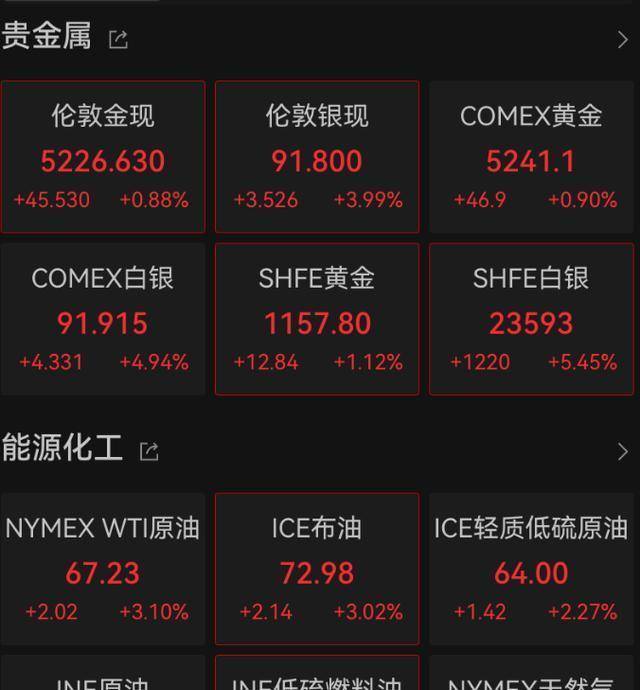
Market Overview - The recent downturn of major tech stocks is not solely the fault of individual companies but reflects a broader market search for "safe havens," leading to a surge in precious metals like gold and silver [1] - The decline in Chinese concept stocks in overseas markets indicates their ongoing vulnerability, influenced by macro liquidity, regulatory expectations, and valuation corrections [1] Precious Metals and Commodities - Gold prices have surpassed $5220 per ounce, with silver rising by 4%, indicating a flight to safety amid stock market declines [1] - Oil prices have also increased, with Brent and WTI crude both rising over 3%, suggesting a concurrent rise in energy prices and inflationary risks [1] Sector Performance - Software, semiconductor, and banking sectors have faced significant declines, revealing structural risks as these sectors rely heavily on expectations, supply chains, and confidence [1] - The simultaneous rise in oil and gold prices suggests a dual strategy of hedging against inflation and risk, highlighting the ongoing interplay between financial markets and the real economy [1] Investor Sentiment and Market Dynamics - The rapid restructuring of funds is attributed to an unstable global liquidity environment and a diminished tolerance for high valuations, indicating a critical moment for market participants [3] - Investors are cautioned against viewing market fluctuations as mere noise, emphasizing the need for rational guidance and education in capital markets [5] Implications for Chinese Investors - The recent U.S. stock market decline serves as a reminder that overseas market risks can directly impact domestic investors, necessitating a careful approach to asset allocation [7] - Policymakers are advised to respond promptly to market signals to avoid exacerbating panic, balancing intervention with allowing market self-correction [7] Global Market Interconnectivity - The current market turmoil illustrates that no market operates in isolation; U.S. market fluctuations can influence global sentiment, affecting oil prices and foreign capital flows [8] - The resilience of institutional frameworks is essential for managing cross-market contagion, rather than relying on temporary fixes [8] Long-term Market Strategies - The market must navigate the balance between necessary corrections and protecting the majority of investors' wealth, emphasizing the importance of transparency, regulatory expectations, and investor education [10][12] - Understanding market volatility as a natural occurrence is crucial for maturity in investment strategies, allowing for corrections to be seen as opportunities rather than threats [12]

首席信息官的新职责:战略、速度和规模智能(英)2026
麦肯锡· 2026-03-02 09:30
Investment Rating - The report indicates a positive investment outlook for companies that effectively integrate AI and data into their operations, positioning technology as a value creator rather than a cost center [4][6]. Core Insights - The role of Chief Information Officers (CIOs) is evolving into that of strategic architects, focusing on leveraging AI and data to drive business growth and innovation [3][5]. - High-performing companies are shifting their technology focus from cost reduction to speed and value creation, with a significant emphasis on AI as a primary investment area [19][33]. - Collaboration between business and technology leaders is becoming essential for driving strategic initiatives, with nearly half of top performers engaging in iterative strategic planning [9][10]. Summary by Sections Strategic Role of CIOs - CIOs are increasingly involved in shaping corporate strategy, with 64% of top performers indicating high engagement in strategic decision-making [12]. - The integration of technology into business strategy is critical for driving bottom-line growth, with a notable increase in the involvement of technology leaders in strategic planning [8][11]. Technology Investment Trends - Over half of the surveyed companies prioritize AI investments over cybersecurity and infrastructure modernization, reflecting a shift towards innovation-driven growth [20][19]. - Top-performing companies plan to increase their technology budgets significantly, with 28% expecting a budget increase of over 10% in 2026 [23][26]. AI and Innovation - AI is recognized as a key driver of innovation, with leading companies focusing on integrating AI into their operational models to enhance efficiency and creativity [44][46]. - The report highlights the necessity for organizations to build internal capabilities and invest in talent to effectively leverage AI technologies [18][27]. Organizational Transformation - High-performing organizations are adopting product and platform operating models, which facilitate faster decision-making and innovation [17][16]. - There is a clear trend towards restructuring technology organizations to align with strategic goals, emphasizing the importance of agility and responsiveness in operations [10][33].
渣打集团2月27日斥资1485.92万英镑回购80.5万股
Zhi Tong Cai Jing· 2026-03-02 09:21
Group 1 - Standard Chartered Group announced a share buyback of 805,000 shares at a cost of £14.8592 million, scheduled for February 27, 2026 [1]
华源晨会精粹20260302-20260302
Hua Yuan Zheng Quan· 2026-03-02 09:19
Fixed Income/Banking - The total bond custody scale increased by 0.76 trillion yuan to 179.3 trillion yuan in January 2026, with a net increase of 0.46 trillion yuan compared to December 2025 [8] - Long-term bonds experienced a pullback at the end of February, primarily due to profit-taking by brokers and funds following the relaxation of real estate policies in Shanghai, presenting a potential opportunity for investors [8][11] - The report anticipates that the 10-year government bond yield may reach a low of 1.75% in Q1 and 1.70% in Q2, with an expected range of 1.6%-1.9% for the year [11] Transportation - The Middle East conflict may significantly increase oil shipping rates, with the potential for a substantial rise in oil transport prices due to geopolitical tensions [12][13] - The express delivery sector in Zhejiang province reported a record high of 56.3 million packages processed in a single day during the Spring Festival, reflecting a 10% year-on-year increase in package volume [16][17] - The civil aviation sector transported 22.05 million passengers during the 2026 Spring Festival, marking a 7.7% increase compared to the previous year [20] Pharmaceutical - The pharmaceutical index rose by 0.50% in late February, with a focus on cyclical sectors like chemicals and non-ferrous metals, while innovative drugs continued to adjust [28] - Eli Lilly's oral weight-loss drug, Orforglipron, is expected to lead the global commercialization of small molecule GLP-1RA drugs in 2026, showing significant advantages in efficacy and convenience over competitors [30] - The report suggests focusing on companies with strong Q1 performance and undervalued innovative drug stocks, as well as those with potential for price increases [28][32] Media - Perfect World’s new game "Yihuan" is set to launch in April 2026, featuring innovative gameplay that differentiates it from mainstream competitors [5] - The release of Nano Banana2 has improved image generation speed and efficiency, with a significant reduction in output costs [5] Real Estate - New housing policies in Shanghai aim to stimulate demand, including increased loan limits for first-time homebuyers and subsidies for multi-child families [6] - In January 2026, new home transactions in 42 key cities totaled 760,000 square meters, a 282.1% increase from the previous month [6] Public Utilities and Environmental Protection - The report emphasizes the importance of "dual carbon" assessments and highlights key hydrogen energy projects as part of the energy sector's transition [6] - The hydrogen industry is expected to move from demonstration to industrial-scale promotion in 2026, supported by favorable policies and capital [6]
为英国产业转型融资(英)
牛津经济研究院· 2026-03-02 09:15
Investment Rating - The report indicates a strong need for private capital to support the UK's industrial strategy and infrastructure pipeline, highlighting the critical role of the financial sector in mobilizing £345 billion over the next decade [16][18]. Core Insights - The UK government aims to achieve its industrial strategy and national infrastructure goals through significant private investment, particularly in high-growth sectors identified in the IS-8 strategy [17][25]. - The report emphasizes the importance of private investment in clean energy, advanced manufacturing, and other key sectors to meet ambitious growth targets and ensure a sustainable economic future [27][89]. - The current market environment is favorable for investment, driven by increased interest in defense, low-carbon transitions, and public infrastructure updates [18][19]. Summary by Sections 1. Executive Summary - The report outlines two focused strategies for UK growth, emphasizing the need for private sector involvement in funding infrastructure projects [22][23]. 2. Infrastructure Pipeline - The national infrastructure pipeline is projected to attract approximately £530 billion in planned investments over the next decade, with nearly half expected to come from the private sector [23][34]. - The report highlights that 68% of projects scheduled for 2025/26 have confirmed funding, indicating a strong short-term funding outlook [45][46]. 3. Clean Energy - The UK government aims for clean energy to generate at least 95% of its electricity by 2030, requiring over £40 billion in annual investments to achieve this target [51][61]. - The clean energy sector is identified as a growth driver, with significant investment needed in technologies such as offshore wind and nuclear energy [62][63]. 4. Exploring IS-8 Areas - The IS-8 sectors, including advanced manufacturing, clean energy, and digital technology, collectively contributed £841 billion to the UK GDP in 2023, representing 31% of total economic output [25][89]. - The report stresses the necessity of scaling up financing to meet the ambitious growth targets set for these sectors [26][27].

宁波银行(002142):2026年度经营情况展望:管理层平稳过渡,市场化底色鲜明
Changjiang Securities· 2026-03-02 08:57
Investment Rating - The investment rating for the company is "Buy" and is maintained [7]. Core Insights - The management transition is smooth, with a clear market-oriented governance structure, which is a core competitive advantage [2][10]. - The bank is expected to benefit from accelerated growth in net interest income and stable growth in non-interest income, leading to a recovery in revenue growth in 2026 [2][10]. - The retail risk indicators have shown a turning point, with expectations for a continued decline in the non-performing loan generation rate [2][10]. - The improvement in fundamental expectations is likely to drive valuation recovery, supported by the established retail risk turning point and stable management transition [2][10]. Summary by Sections Management Transition - The board has elected Zhuang Lingjun as chairman and appointed Feng Peijiong as president, with all vice presidents promoted internally, ensuring a stable governance structure [4][10]. Financial Performance - The bank has maintained a high growth rate in loans, with a 17.4% increase in 2025, primarily driven by corporate loans [10]. - The net interest margin was 1.76% in the first three quarters of 2025, expected to remain stable, with improvements anticipated in 2026 due to a higher proportion of demand deposits and better deposit pricing [10]. - Non-interest income is expected to grow due to a recovery in the capital market, with low base pressure from the previous two years [10]. Risk Management - The non-performing loan generation rate has been declining since Q2 2025, with a stable provision coverage ratio, indicating improved asset quality [10]. - The bank's focus on corporate loans, particularly to state-owned enterprises, is expected to stabilize risk indicators [10]. Investment Outlook - The bank's year-to-date performance ranks among the top in A-share listed banks, with fundamental improvements driving accelerated valuation recovery [10]. - The projected price-to-book ratios for 2025 and 2026 are 0.93x and 0.84x, respectively, indicating a favorable investment opportunity [10].

太平洋岛国代理银行的衰落:知识状况和解决问题的方法(英)
Shi Jie Yin Hang· 2026-03-02 08:50
Investment Rating - The report does not explicitly provide an investment rating for the industry, but it highlights significant concerns regarding the decline of Correspondent Banking Relationships (CBRs) in Pacific Island countries, which may impact investment attractiveness and economic stability in the region [7][40]. Core Insights - The report emphasizes the critical role of CBRs in facilitating cross-border payments, which are essential for trade and remittances in the Pacific Islands. The ongoing withdrawal of these relationships due to de-risking poses a threat to financial inclusion and economic development [8][40]. - De-risking is defined as the withdrawal of banking services in response to anti-money laundering (AML), combating the financing of terrorism (CFT), and proliferation financing (CPF) concerns. This phenomenon has led to a significant decline in the number and quality of CBRs, particularly affecting smaller jurisdictions [11][39]. - The report identifies that the decline in CBRs has adversely impacted export performance and increased remittance costs, with econometric analysis supporting these findings [13][20]. Summary by Sections Background to the Study - The study was initiated following concerns raised at the Pacific Islands Forum Economic Ministers meeting regarding the ongoing withdrawal of CBRs in the region, which is exacerbated by the effects of de-risking [7][9][40]. Introduction and Purpose - The report aims to understand the current state of CBRs in Pacific Island countries, the actions taken to address the issue, and potential solutions to prevent further de-risking [9][10]. De-risking and CBRs - De-risking has led to a significant reduction in CBRs, particularly affecting jurisdictions with limited banking options. The report notes that some countries, like Fiji and the Cook Islands, have experienced more severe losses than others [15][16]. - The report highlights that the profitability and risk/reward considerations are key drivers behind the withdrawal of CBRs, with international banks often finding these services unprofitable [20][72]. Recent Developments - The report discusses various initiatives undertaken by Pacific Island Forum members to strengthen AML/CFT/CPF measures and counter de-risking, including improving local laws and exploring electronic Know Your Customer (eKYC) utilities [27][29]. Recommendations - The report outlines several recommendations to address CBR losses, including the investigation of safe payment corridors, improving national identification systems, and developing a CBR resilience framework [32][34][35].