
债券

Search documents
192万亿债市再迎开放红利 人民币资产吸引力凸显
Jin Rong Shi Bao· 2025-09-25 11:42
Core Insights - The Hong Kong Securities and Futures Commission and the Hong Kong Monetary Authority hosted the first Hong Kong Fixed Income and Currency Forum, where the Deputy Governor of the People's Bank of China, Zou Lan, emphasized the unique advantages of RMB bond assets and the robust development of the Chinese bond market [1] - Zou announced four significant measures aimed at enhancing cross-border investment and financing convenience, promoting high-level financial market openness, and accelerating the development of the offshore RMB market [1][6] Group 1: Chinese Bond Market Development - China's bond market ranks second globally, with a total balance of 192 trillion RMB as of August 2025, and a bond issuance scale exceeding 59 trillion RMB in the first eight months of 2025, reflecting a 14% year-on-year growth [2] - The net financing from bonds accounted for 44.5% of the total social financing increment during the same period, indicating its critical role in financing the real economy [2] - The proportion of net bond financing in total social financing has increased from around 30% five years ago to over 40% currently, showcasing the growing importance of the bond market [2] Group 2: International Investor Interest - Nearly 1,170 foreign institutional investors have entered the Chinese bond market, with a total holding of approximately 3.9 trillion RMB, marking a nearly fourfold increase since the launch of the Bond Connect [3] - The Chinese bond market's stability amid global financial volatility has led to its increased recognition, with its representation in major global indices exceeding initial expectations [3] - The International Monetary Fund has raised China's economic growth forecast, reflecting international confidence in China's economic prospects [3] Group 3: Bond Yield and Investment Value - Chinese bonds offer competitive short-term and long-term yields, with a 70% return on investments in the Bloomberg Barclays Global Aggregate Index over the past decade [4] - The actual yield of RMB bonds remains relatively high, providing a solid value retention and appreciation avenue for global RMB holders [4] - RMB bonds exhibit low correlation with G7 and other emerging market bonds, enhancing their diversification value [4] Group 4: Future Measures and Market Potential - The People's Bank of China plans to support various foreign institutional investors in conducting bond repurchase transactions to improve the efficiency of RMB bond usage [7] - The daily trading limit for the swap market will be increased from 20 billion RMB to 45 billion RMB, facilitating better interest rate risk management for investors [7] - The measures announced reflect a commitment to further integrate Hong Kong into the global financial system and enhance its status as an international financial center [7]
债市阿尔法:RWA 债券全维度分析:运作机制、全球监管与实践路径
Guoxin Securities· 2025-09-25 11:38
1. Report Industry Investment Rating No relevant content provided. 2. Core Viewpoints of the Report - RWA bonds, as a key product integrating "real - asset credit anchoring" and "blockchain technology enabling", are reshaping the operation logic of the traditional debt - financing market. The report comprehensively analyzes RWA bonds from multiple aspects such as core definition, operation mechanism, comparison with traditional bonds and ABS, global policy environment and regulatory framework, typical cases, and investor participation paths [12]. 3. Summary by Directory 3.1 RWA Bond Core Definition - **Concept Definition**: RWA bonds are standardized debt - financing tools that tokenize the creditor's rights of real - world assets with stable cash flows through blockchain technology. They have "dual - anchoring" features, anchoring both the cash flows of underlying assets and the income - distribution rules of smart contracts, and are classified as "security tokens" subject to securities regulations [13][14]. - **Underlying Asset Types and Characteristics**: There are three types of underlying assets. Financial assets, including accounts receivable, corporate loans, and national debts, are the mainstream with stable cash flows and low verification difficulty. Physical assets, such as real estate, infrastructure, and charging piles, have anti - inflation properties but long valuation periods and poor liquidity. Equity assets, like carbon - emission rights and intellectual property rights, are scarce and suitable for long - term allocation [15][16]. 3.2 RWA Bond Operation Mechanism - **Asset Confirmation and Pooling**: For non - standardized assets, asset confirmation uses the multi - node consensus of the alliance chain to generate "on - chain ownership certificates", and then packs the assets into an asset pool. For standardized financial assets, the issuer purchases the underlying assets through a licensed custodian, and the custodian issues a legal holding certificate, which is then uploaded to the chain [19][21]. - **Chain Mapping and Token Generation**: Non - standardized assets need to disassemble the asset - pool rights and interests into "on - chain quantifiable units" and associate them with on - chain ownership certificates, and then issue standardized security tokens. Standardized financial assets can be directly mapped by unit, and the token generation often uses a highly compatible general standard [22][25]. - **Trading, Circulation, and Settlement**: Non - standardized assets can be traded on compliant centralized exchanges or decentralized exchanges (DEX) with a KYC check. The settlement cycle is instant, and the T + 0 arrival is achieved. Standardized financial assets are traded on Layer2 DEX and licensed centralized exchanges, and the smart contract realizes instant "token - funds" transfer [26][30]. - **Income Distribution and Asset Monitoring**: For non - standardized assets, the income is distributed through IoT devices to collect data and smart contracts to execute the distribution rules. Asset monitoring uses IoT devices to collect data and establish an early - warning mechanism. Standardized financial assets have a simpler income - distribution process, and the asset monitoring focuses on price and ownership risks [31][34]. 3.3 Comparison with Traditional Bonds and ABS - **Compared with ABS**: RWA bonds are more efficient and intelligent. They change from an "off - line manual - driven" model to an "on - chain algorithm - driven" model, with a more transparent process, lower participation thresholds, and better risk control [37][38]. - **Multi - Dimensional Comparison**: In terms of technical foundation, asset scope, liquidity, regulatory framework, investor threshold, information transparency, and issuance cost, RWA bonds, traditional bonds, and ABS have significant differences. RWA bonds have a wider asset scope, higher liquidity, and lower investor thresholds [44][45]. 3.4 Global RWA Bond Policy Environment and Regulatory Framework - **United States**: It is the largest RWA bond market globally. After experiencing the technology - exploration period, institutional - trial period, and explosive - growth period, it has achieved significant market - scale growth. The passage of the CLARITY Act has established a dynamic regulatory framework, and technological infrastructure improvements and institutional capital inflows have also promoted market development [48][50]. - **Europe**: It has developed from infrastructure pilots to a unified framework under MiCA. After the phased and full implementation of MiCA, it has eliminated the regulatory differences among countries, and technological improvements have also met institutional requirements [51][54]. - **China**: It features a dual - track pattern of cautious piloting in the Chinese mainland (excluding Hong Kong, Macao, and Taiwan) and international linkage in Hong Kong. Through rule recognition, asset interconnection, and technological interconnection, a cross - border compliance closed - loop has been formed [55][58]. 3.5 RWA Typical Cases - **Shenzhen Futian RWA Digital Bond**: Issued in 2025 with a scale of 500 million yuan and a coupon rate of 2.62%, it is the world's first public - offering RWA bond, listed on both the Macau Stock Exchange and the Shenzhen Stock Exchange, with the underlying assets being the income rights of charging piles and office buildings [60]. - **Langxin Group Charging Pile RWA**: Issued in 2024 with a scale of 100 million yuan, it is the first new - energy RWA in China, anchoring the income rights of 9000 charging piles [63]. - **GCL - New Energy Photovoltaic Power Station RWA**: Issued in 2024 with a scale of 200 million yuan, it anchors the income rights of an 82MW photovoltaic power station and bundles carbon - reduction benefits [64]. 3.6 RWA Bond Investor Participation Paths and Thresholds - **Primary Market Subscription**: Chinese mainland (excluding Hong Kong, Macao, and Taiwan) institutional investors can subscribe through direct connection with overseas licensed underwriting institutions or indirect participation through domestic QDII products [68]. - **Secondary Market Trading**: They can trade through the Hong Kong MOX, the Shenzhen Stock Exchange Cross - border Connect, or licensed digital exchanges, with different trading objects and risk levels for each channel [69][70].
中方连出3招:抛257亿美债,还封杀美芯片,马斯克:美基本没救了
Sou Hu Cai Jing· 2025-09-25 09:23
Group 1 - The core viewpoint highlights the impact of the Trump administration's tariff policies on U.S. soybean prices, leading Chinese buyers to shift towards more cost-effective suppliers like Brazil, while also expanding domestic soybean cultivation in China [1] - The trade pressures not only affect U.S. farmers but also reveal vulnerabilities in the U.S. global supply chain [1] - In the financial sector, China has notably reduced its holdings of U.S. Treasury bonds, decreasing by $25.7 billion in July to a total of $730.7 billion, the lowest level since 2009 [1] Group 2 - This reduction marks the fourth time in 2023 that China has cut its U.S. Treasury bond holdings, with cumulative reductions exceeding $280 billion since April 2022 [1] - In contrast, the UK and Japan have increased their U.S. Treasury bond holdings, with the UK adding $41.3 billion to reach $899.3 billion and Japan increasing to $1.151 trillion [1] - The long-term trend indicates that the U.S. is becoming increasingly reliant on allies to maintain stability in the debt market, while China is actively reducing risk and decreasing its dependence on the dollar [1]
RWA 债券全维度分析:运作机制、全球监管与实践路径
Guoxin Securities· 2025-09-25 08:29
Report Industry Investment Rating The provided content does not mention the report industry investment rating. Core View As blockchain technology integrates deeply with the traditional financial system, tokenization of Real-World Assets (RWA) has become a key path to connect "on-chain value" and "offline entities." RWA bonds, with "real - asset credit anchoring" and "blockchain technology empowerment," are reshaping the operation logic of the traditional debt - financing market. The report comprehensively analyzes RWA bonds, including their definition, operation mechanism, comparison with traditional bonds and ABS, global policy and regulatory frameworks, typical cases, and investor participation paths [12]. Summary by Related Catalogs RWA Bond Core Definition - Concept: RWA bonds tokenize the creditor's rights of real - world assets with stable cash flows into standardized debt - financing tools using blockchain technology. They have "dual - anchoring" features, anchoring both the underlying asset's cash flow and the smart - contract - defined distribution rules, and are classified as "security tokens" subject to securities regulations [13][14]. - Underlying Asset Types: They include financial assets (e.g., accounts receivable, corporate loans, and national debts), physical assets (e.g., real estate, infrastructure, charging piles, and photovoltaic power stations), and equity assets (e.g., carbon emission rights, intellectual property rights, and art revenue rights) [15][16]. RWA Bond Operation Mechanism - Asset Confirmation and Pooling: Non - standardized assets use a consortium chain for multi - node verification to generate "on - chain ownership certificates" and then package them into an asset pool. Standardized financial assets are confirmed through a licensed custodian and directly mapped on - chain [19][21]. - Chain Mapping and Token Generation: Non - standardized assets need to disassemble and map rights and interests, and then issue tokens according to a special standard. Standardized financial assets are directly mapped and use a general - purpose token standard [22][25]. - Trading, Circulation, and Settlement: Non - standardized assets can be traded on compliant centralized or decentralized exchanges, and the settlement is completed through smart contracts. Standardized financial assets are traded on high - frequency platforms, and the settlement is also fast, with a T + 0 arrival [26][30]. - Income Distribution and Asset Monitoring: For non - standardized assets, IoT and oracles are used to collect data and distribute income automatically. For standardized financial assets, the income distribution is more simplified, and the asset monitoring focuses on price and ownership risks [31][34]. Comparison with Traditional Bonds and ABS - Compared with ABS: RWA bonds are more efficient and intelligent, with an automated operation mode, 7×24 - hour second - level settlement, full - chain real - time transparency, and a lower investment threshold [2][38]. - Asset Feature Comparison: RWA bonds have a wider range of underlying assets, a more advanced technological foundation, and higher information transparency than traditional bonds and ABS. However, traditional bonds have a more mature regulatory system, and ABS has a more established approval process [44][45]. Global RWA Bond Policy and Regulatory Framework - US: It has evolved from technology exploration to institutional dominance. The CLARITY Act provides a dynamic regulatory framework, and technological upgrades and institutional capital inflows have driven market growth [48][50]. - Europe: It has moved from infrastructure pilots to a unified MiCA framework. MiCA clarifies the legal attributes of RWA tokens and provides a unified license, while technological improvements meet institutional requirements [51][54]. - China: It features a dual - track approach of cautious pilot projects in regions excluding Hong Kong, Macao, and Taiwan, and international linkage in Hong Kong. Through rule recognition, asset interconnection, and technological interconnection, a unique RWA ecosystem is being built [55][59]. RWA Typical Cases - Shenzhen Futian RWA Digital Bond: Issued in 2025 with a scale of 500 million yuan and a coupon rate of 2.62%, it is the world's first public - offering RWA bond, listed on both the Macau Exchange and the Shenzhen Stock Exchange, with underlying assets of charging piles and office building revenue rights [3][60]. - Langxin Group Charging Pile RWA: In 2024, it was a Hong Kong sandbox project with a scale of 100 million yuan, anchoring the revenue rights of over 9000 charging piles, and was the first domestic new - energy RWA [3][63]. - GCL New Energy Photovoltaic Power Station RWA: In 2024, it issued 200 million digital tokens corresponding to the revenue rights of an 82MW photovoltaic power station, bundling carbon - reduction benefits, and using a "two - chain and one - bridge" architecture [3][64]. RWA Bond Investor Participation Path and Threshold - Primary Market Subscription: Institutions in regions excluding Hong Kong, Macao, and Taiwan can directly connect with overseas licensed underwriters or indirectly subscribe through domestic QDII products [68]. - Secondary Market Trading: They can trade through the Hong Kong MOX, the Shenzhen Stock Exchange Cross - border Connect, or licensed digital exchanges, with different risk - level bond trading requirements [69][70].
政府债周报:四季度地方债发行计划已披露七千三百亿-20250925
Guoxin Securities· 2025-09-25 08:16
Report Industry Investment Rating - Not provided in the given content Core Viewpoints - The report presents data on government bond net financing, including the net financing amounts of government bonds, national bonds, local bonds, etc. in the 38th week (9/15 - 9/21) and the 39th week (9/22 - 9/28), as well as their cumulative amounts and progress compared to the previous year [1][6]. - As of September 24, the planned issuance of local bonds in the fourth quarter is 730 billion yuan, including 40 billion yuan of new general bonds and 390 billion yuan of new special bonds. The remaining quotas for new general bonds and special bonds are 140 billion yuan and 740 billion yuan respectively [2][9]. - The issuance progress of special refinancing bonds is 99%, and the net financing of urban investment bonds is expected to be -7 billion yuan in the 39th week, with a balance of 10.2 trillion yuan as of this week [3][27]. Summary by Related Catalogs Government Bond Net Financing - In the 38th week (9/15 - 9/21), the net financing of government bonds was 317.9 billion yuan, and in the 39th week (9/22 - 9/28), it was -22 billion yuan. As of the 38th week, the cumulative amount was 11.5 trillion yuan, exceeding the same period last year by 5.1 trillion yuan [1][6]. - The net financing of national bonds + new local bond issuance in the 38th week was 405.6 billion yuan, and in the 39th week, it was 10.8 billion yuan. As of the 38th week, the cumulative generalized deficit was 9.7 trillion yuan, with a progress of 81.9% [1][6]. National Bonds - The net financing of national bonds in the 38th week was 287.1 billion yuan, and in the 39th week, it was -144.4 billion yuan. The annual net financing of national bonds is 6.66 trillion yuan. As of the 38th week, the cumulative amount was 5.5 trillion yuan, with a progress of 83.2% [1][7]. Local Bonds - The net financing of local bonds in the 38th week was 30.9 billion yuan, and in the 39th week, it was 122.5 billion yuan. As of the 38th week, the cumulative amount was 6.0 trillion yuan, exceeding the same period last year by 2.7 trillion yuan [1][9]. - As of September 24, the planned issuance of local bonds in the fourth quarter is 730 billion yuan, including 40 billion yuan of new general bonds and 390 billion yuan of new special bonds. The remaining quotas for new general bonds and special bonds are 140 billion yuan and 740 billion yuan respectively [2][9]. New General Bonds - In the 38th week, the issuance of new general bonds was 20.7 billion yuan, and in the 39th week, it was 5.6 billion yuan. As of the 38th week, the cumulative amount was 656.2 billion yuan, with a progress of 82.0%, exceeding the same period last year [2][11]. New Special Bonds - In the 38th week, the issuance of new special bonds was 97.8 billion yuan, and in the 39th week, it was 149.6 billion yuan. The planned issuance of new special bonds in 2025 is 4.4 trillion yuan. As of the 38th week, the cumulative amount was 3.5 trillion yuan, with a progress of 79.8%, exceeding the same period last year [14]. - The special new special bonds issued reached 1201.2 billion yuan, of which 233.3 billion yuan was issued since September. The land reserve special bonds issued were 346.6 billion yuan. As of September 23, 27 provincial - level administrative regions had announced relevant projects, covering 4992 parcels of land, with a capital scale of 553.7 billion yuan [2][14]. Special Refinancing Bonds - In the 38th week, the issuance of special refinancing bonds was 21.4 billion yuan, and in the 39th week, it was 11.4 billion yuan. As of the 38th week, the cumulative amount was 1.98 trillion yuan, with a issuance progress of 99% [3][27]. Urban Investment Bonds - The net financing of urban investment bonds in the 38th week was 15.5 billion yuan, and it is expected to be -7 billion yuan in the 39th week. As of this week, the balance of urban investment bonds was 10.2 trillion yuan [3][27].
经典重温 | 债市的“盲点”?(申万宏观·赵伟团队)
申万宏源宏观· 2025-09-25 05:14
Core Viewpoint - The bond market has entered a phase of adjustment after a prolonged bull market, with increasing market divergence and potential investment blind spots identified for 2025 [2][9]. Recent Changes in the Bond Market - The bond market has shown rapid interest rate declines and a flattening yield curve since the beginning of 2023, with the 10Y government bond yield dropping by 94 basis points and the 1Y yield by 53 basis points [3][10]. - The economic backdrop includes a GDP growth rate decrease from 6.5% to 5.4% and a decline in MLF rates from 2.75% to 2.00% [3][19]. - Significant adjustments have occurred in the bond market, with the 10Y government bond yield rising from 1.60% to 1.83% between January 6 and March 14, 2024 [3][26]. Investment Blind Spots in the Bond Market - Historical data suggests that once long-term interest rates fall below 2%, the market often enters a multi-year consolidation phase, with the average time taken for rates to drop from 3% to 2% being 2 years and from 2% to 1% being 4 years [4][37]. - The market has exhibited extreme positioning since 2022, with the yield spread between the 10Y government bond and the overall A-share dividend yield breaking historical norms, even turning negative at -0.9% in January 2025 [4][65]. Framework Adjustments for the Bond Market - The policy environment has solidified since the "924" policy, with a clearer GDP target of around 5% and a focus on dynamic adjustments [5][69]. - Asset allocation has begun to rebalance, with significant shifts in fund positioning observed, such as a mixed fund stock holding ratio of 70.5%, which is at a low percentile compared to the past three years [5][84]. - The current yield of 1.83% for the 10Y government bond remains significantly lower than the 3.35% dividend yield of high-dividend stocks, indicating a potential return to more normalized market conditions [5][90].


固收周报:四季度债市或呈现震荡格局-20250925
Yong Xing Zheng Quan· 2025-09-25 04:08
Report Industry Investment Rating No relevant content provided. Core Viewpoints - From September 12 to September 19, 2025, most treasury bond yields rose, and the term spread widened. The central bank conducted a total of 22,068.00 billion yuan in reverse repurchase operations, with a net injection of 6,340.00 billion yuan. Inter - bank capital prices increased. The primary issuance of interest - rate bonds was 6,645.39 billion yuan, and the net financing was 4,664.25 billion yuan [1]. - From September 15 to September 21, 2025, the credit bond issuance volume increased month - on - month. The primary market issued 1,231 new credit bonds, with a total issuance scale of 16,911.73 billion yuan. The net financing was 3,938.10 billion yuan. The credit bond yields mostly rose [2]. - From September 12 to September 19, 2025, the three major US stock indexes rose, European stock indexes were divided, most US Treasury yields increased, the US dollar index strengthened, most non - US currencies weakened, crude oil prices fell, and gold prices rose [3]. Summary by Directory 1. Interest - rate Bonds: Most Treasury Bond Yields Rose, and the Term Spread Widened 1.1 Liquidity Observation: Net Liquidity Injection, Rising Capital Prices - From September 12 to September 19, 2025, the central bank conducted 22,068.00 billion yuan in reverse repurchase operations, with a net injection of 6,340.00 billion yuan. Inter - bank and exchange capital prices increased. For example, DR001 rose 9.98BP to 1.4644%, and GC001 rose 5.90BP to 1.4110% [15]. 1.2 Primary Market Issuance: Increased Net Financing, Decreased Local Government Bond Issuance - From September 15 to September 21, 2025, the primary market issuance of interest - rate bonds was 6,645.39 billion yuan, and the net financing was 4,664.25 billion yuan. The issuance of local government bonds decreased compared with the previous period [27]. 1.3 Secondary Market Trading: Most Treasury Bond Yields Rose, and the Term Spread Widened - From September 12 to September 19, 2025, most treasury bond yields rose. The 1 - year yield decreased 1.00BP to 1.3900%, while the 3 - year, 5 - year, 7 - year, and 10 - year yields rose 1.51BP, 0.47BP, 4.89BP, and 1.19BP respectively. The 10Y - 1Y term spread widened from 46.70BP to 48.89BP. The yields of China Development Bank bonds were divided, and the 10Y - 1Y term spread narrowed from 45.04BP to 40.04BP [32]. 2. Credit Bonds: Most Credit Bond Yields Rose 2.1 Primary Market Issuance: Issuance Volume Increased Month - on - Month - From September 15 to September 21, 2025, the primary market issued 1,231 new credit bonds, with a total issuance scale of 16,911.73 billion yuan, a month - on - month increase of 4,522.11 billion yuan. The net financing was 3,938.10 billion yuan. Asset - backed securities had the largest number of issuances, and financial bonds had the highest issuance amount. AAA - rated bonds accounted for 71.79% of the total issuance. The issuance was mainly in the 3 - 5 - year term, and the financial industry had the largest number of issuances [45]. 2.2 Secondary Market Trading: Most Credit Bond Yields Rose - From September 12 to September 19, 2025, most urban investment bond yields rose, with the 7 - year AAA and AA - rated bonds having the largest increase of 4.50BP. Most medium - and short - term note yields rose, with the 5 - year AAA - rated note having the largest increase of 5.01BP [55]. 2.3 One - Week Credit Default Event Review - From September 15 to September 21, 2025, one enterprise's credit bonds defaulted [56]. 3. Weekly Observation of Major Asset Classes 3.1 European and American Stock Indexes Rose - From September 12 to September 19, 2025, the three major US stock indexes rose. The Dow Jones Industrial Average rose 1.05%, the S&P 500 Index rose 1.22%, and the Nasdaq Composite Index rose 2.21%. European stock indexes were divided, with the German DAX Index falling 0.25%, the French CAC40 Index rising 0.36%, and the UK FTSE 100 Index falling 0.72%. Asian - Pacific stock indexes rose and fell unevenly [58]. 3.2 Most US Treasury Yields Rose - From September 12 to September 19, 2025, the yields of 3 - year, 5 - year, 7 - year, and 10 - year US Treasury bonds rose 4.00BP, 5.00BP, 7.00BP, and 8.00BP respectively, while the 1 - year yield decreased 6.00BP. The 10Y - 1Y term spread changed by 14.00BP to 54.00BP [60]. 3.3 The US Dollar Index Strengthened, and Most Non - US Currencies Weakened - From September 12 to September 19, 2025, the US dollar index rose 0.30%. Most non - US currencies weakened. For example, the British pound against the US dollar fell 0.64%, and the US dollar against the Japanese yen rose 0.21% [64]. 3.4 Crude Oil Prices Fell, and Gold Prices Rose - From September 12 to September 19, 2025, COMEX gold futures prices rose 1.09%, and London spot gold prices rose 0.33%. Brent crude oil prices fell 0.46%, and WTI crude oil prices fell 0.02% [66]. 4. Investment Recommendations - As the cross - quarter capital demand increases near the end of the quarter, the central bank adjusts the 14 - day reverse repurchase operations to relieve liquidity pressure. In the short term, it may boost the bond market sentiment and push down interest rates. In the medium and long term, it can enhance the stability of the bond market. It is expected that the bond market will remain volatile in the fourth quarter. Interest - rate bonds should mainly be traded in bands, and credit bonds should focus on urban investment bonds and leading industrial bonds [4][70].
大类资产早报-20250925
Yong An Qi Huo· 2025-09-25 02:13
Report Information - Report Date: September 25, 2025 [1] - Report Author: Research Center Macro Team of Guanyi Futures [1] Global Asset Market Performance 10-Year Treasury Yields of Major Economies - On September 24, 2025, the 10-year Treasury yields in the US, UK, France, etc., were 4.148%, 4.668%, 3.568% respectively. There were various changes in the latest, weekly, monthly, and yearly periods. For example, the latest change in the US was 0.041, and the one-year change was 0.443 [2]. 2-Year Treasury Yields of Major Economies - On September 24, 2025, the 2-year Treasury yields in the US, UK, Germany, etc., were 3.610%, 3.948%, 2.020 respectively. There were also different changes in different time periods. For instance, the latest change in the US was 0.040, and the one-year change was -0.030 [2]. US Dollar Exchange Rates Against Major Emerging Economies' Currencies - On September 24, 2025, the exchange rates of the US dollar against the Brazilian real, South African rand, South Korean won, etc., were 5.331, 17.347, 1404.300 respectively. There were percentage changes in the latest, weekly, monthly, and yearly periods. For example, the latest change in the US dollar against the Brazilian real was 0.93%, and the one-year change was -2.37% [2]. Stock Indices of Major Economies - On September 24, 2025, the closing prices of the S&P 500, Dow Jones Industrial Average, NASDAQ, etc., were 6637.970, 46121.280, 22497.860 respectively. There were percentage changes in the latest, weekly, monthly, and yearly periods. For example, the latest change in the S&P 500 was -0.28%, and the one-year change was 18.15% [2]. Credit Bond Indices - There were different changes in the latest, weekly, monthly, and yearly periods for US investment - grade, euro - zone investment - grade, emerging economies' investment - grade credit bond indices, etc. For example, the latest change in the US investment - grade credit bond index was -0.28%, and the one - year change was 3.38% [2][3] Stock Index Futures Trading Data Index Performance - The closing prices of A - shares, CSI 300, SSE 50, etc., were 3853.64, 4566.07, 2939.51 respectively, with corresponding percentage changes. For example, the A - share index had a 0.83% increase [4]. Valuation - The PE(TTM) of CSI 300, SSE 50, CSI 500, etc., were 14.10, 11.69, 34.83 respectively, with corresponding环比 changes [4]. Risk Premium - The risk premiums (1/PE - 10 - year interest rate) of S&P 500 and German DAX were -0.53 and 2.37 respectively, with corresponding环比 changes [4]. Fund Flows - The latest values of fund flows into A - shares, the main board, etc., were 930.68, 373.77 respectively, and there were corresponding 5 - day average values [4]. Trading Volume - The latest trading volumes of the Shanghai and Shenzhen stock markets, CSI 300, SSE 50, etc., were 23267.84, 6291.62, 1571.95 respectively, with corresponding环比 changes [4]. Main Contract Basis - The basis of IF, IH, IC were -36.07, 0.29, -166.71 respectively, with corresponding percentage changes [4] Treasury Futures Trading Data - The closing prices of T00, TF00, T01, TF01 were 107.650, 105.565, 107.305, 105.445 respectively, with corresponding percentage changes. The R001, R007, SHIBOR - 3M in the money market had daily changes in basis points [5]
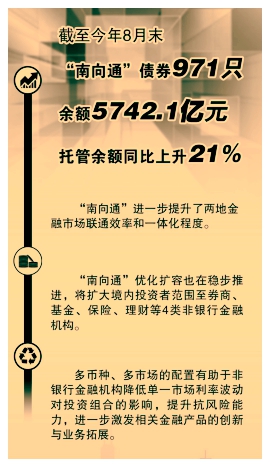
债券通“南向通”迎来上线四周年
Jin Rong Shi Bao· 2025-09-25 01:00
Core Insights - The "Southbound Bond Connect" has marked its fourth anniversary, enhancing the connectivity and integration of financial markets between mainland China and Hong Kong, while providing new opportunities for mainland investors to access global markets [1][4] - The launch of "Southbound Bond Connect" is seen as a significant milestone in achieving mutual access between the north and south of China's bond markets, solidifying Hong Kong's position in bond financing [1][4] Market Performance - As of the end of August 2023, there are 971 bonds under the "Southbound Bond Connect" with a total balance of 574.21 billion yuan, reflecting a year-on-year increase of 21% in custodial balance [4] - The continuous policy support from the People's Bank of China and the Hong Kong Monetary Authority has been crucial for the growth of the "Southbound Bond Connect" [4] Investment Opportunities - The "Southbound Bond Connect" allows mainland investors to diversify their portfolios by investing in various currencies, including Hong Kong dollars, Renminbi, and other foreign currencies [5] - The expansion of the "Southbound Bond Connect" to include more non-bank financial institutions is expected to enhance liquidity and activity in the Hong Kong bond market [7] Institutional Development - Participation in the "Southbound Bond Connect" is viewed as a way for domestic institutions to enhance their international operational capabilities and improve investment decision-making and risk management [6] - The recent optimization measures announced by the People's Bank of China aim to facilitate easier access for mainland investors to multi-currency bonds and extend settlement times [7] Future Outlook - The offshore Renminbi bond market is expected to continue to grow, with the cost of "dim sum bonds" remaining lower than that of US dollar bonds, making them more attractive for issuers [8] - The increasing demand from domestic investors for overseas asset allocation, combined with supportive policies and improved infrastructure, is gradually revealing the market potential of the "Southbound Bond Connect" [8]
欧债收益率涨跌不一,英国10年期国债收益率跌1个基点
Mei Ri Jing Ji Xin Wen· 2025-09-24 22:03
Group 1 - The core viewpoint of the article highlights the mixed movements in European bond yields as of September 24, with varying changes across different countries' 10-year government bonds [1][2] Group 2 - The UK 10-year government bond yield decreased by 1 basis point to 4.667% [1] - The French 10-year government bond yield increased by 0.5 basis points to 3.567% [1] - The German 10-year government bond yield fell by 0.1 basis points to 2.746% [1] - The Italian 10-year government bond yield rose by 2.1 basis points to 3.562% [1] - The Spanish 10-year government bond yield increased by 0.4 basis points to 3.297% [1]