
智能手机

Search documents
存储芯片价格飙升,手机厂商集体承压
Mei Ri Jing Ji Xin Wen· 2025-11-18 13:16
Core Viewpoint - The global memory chip industry is experiencing a significant price surge, particularly in the DDR5 and DDR4 segments, driven by increased demand from the AI sector and supply chain constraints [1][2][3]. Group 1: Price Surge and Market Impact - The price of DDR5 16Gb chips rose from $7.68 to $15.5 in just one month, marking a 102% increase, while DDR4 16Gb saw a rise of over 92% [1]. - Major manufacturers like Samsung, SK Hynix, and Micron have paused quotes due to rapid price increases, impacting the consumer electronics sector, particularly smartphone manufacturers [1][2]. - Tier 1 smartphone manufacturers have long-term supply agreements, preventing stockouts, but face pressure from the steep price increases, with LP4X/5X contract prices rising by 40% and UFS prices by 25% to 30% in Q4 [1][2]. Group 2: Supply Chain Dynamics - The demand for memory chips is being reshaped by AI, with AI servers requiring 8 times the DRAM and 3 times the NAND compared to regular servers [2]. - North American cloud service providers have significantly increased their stocking demands, leading to a projected supply shortage for memory chips throughout the next year [2]. Group 3: Cost Implications for Manufacturers - DRAM contract prices in Q4 2025 are expected to rise over 75% year-on-year, increasing the BOM cost for devices by 8% to 10% [3]. - Xiaomi's president acknowledged that the rising costs of memory chips are beyond expectations and will continue to escalate [3]. Group 4: Manufacturer Strategies - Smartphone manufacturers are adopting a strategy of slight price increases combined with a reduction in memory configurations to mitigate the impact of rising costs [4]. - For example, some manufacturers are downgrading RAM configurations from 16GB to 12GB without significantly affecting user experience [4]. Group 5: Challenges for Lower-End Market - The low-end smartphone market is facing more severe impacts from rising memory chip prices, leading to potential production bottlenecks and increased pressure on hardware profit margins [5]. - Smaller smartphone brands may struggle to secure resources, potentially leading to a market reshuffle favoring larger brands [5]. Group 6: Financial Performance of Companies - Transsion Holdings reported a revenue of 49.543 billion yuan for the first three quarters of 2025, a slight decline of 3.3%, with net profit down by 44.97% due to increased supply chain costs [6]. - The company is adjusting its pricing and product structure in response to rising memory chip costs [6]. Group 7: Future Outlook - TrendForce has revised its 2026 global smartphone production forecast from a 0.1% increase to a 2% decrease, indicating potential further downgrades if supply-demand imbalances worsen [7]. - The industry is expected to endure high-pressure conditions for at least another couple of quarters [7].



小米前三季度经调净利已超去年总额 汽车业务首季盈利
Xin Jing Bao· 2025-11-18 12:57
Core Insights - Xiaomi Group reported Q3 revenue of 113.1 billion yuan, a year-on-year increase of 22.3%, marking the fourth consecutive quarter of exceeding 100 billion yuan [2] - Adjusted net profit reached 11.3 billion yuan, up 80.9% year-on-year, setting a new historical high [2] - The smart electric vehicle and AI innovation business segment generated revenue of 29 billion yuan, with a year-on-year increase of over 199% [2] Financial Performance - For the first three quarters, total revenue reached 340.4 billion yuan, nearing last year's total, with adjusted net profit of 32.8 billion yuan, surpassing last year's total [3] - Smartphone business showed steady growth with global shipments of 43.3 million units, achieving year-on-year growth for nine consecutive quarters [3] - Internet services revenue in Q3 was 9.4 billion yuan, a year-on-year increase of 10.8%, with a gross margin of 76.9% [5] Business Segments - The smartphone and AIoT segment generated revenue of 84.1 billion yuan, with smartphone revenue at 46 billion yuan [3] - The IoT and lifestyle consumer products segment grew steadily, with Q3 revenue of 27.6 billion yuan, a year-on-year increase of 5.6% [3] - Xiaomi's AIoT platform connected over 1 billion IoT devices, with users having five or more connected devices reaching 21.6 million, a year-on-year increase of 26.1% [3] Electric Vehicle Development - Xiaomi's electric vehicle segment achieved significant breakthroughs, with Q3 revenue reaching 29 billion yuan [6] - The first SUV model, Xiaomi YU7, launched on June 26, received over 200,000 pre-orders within three minutes [6] - In Q3, Xiaomi delivered over 100,000 vehicles, setting a new quarterly record, with total deliveries exceeding 260,000 units for the year [7] R&D Investment - Xiaomi's R&D investment for the first three quarters reached 23.5 billion yuan, with Q3 investment at 9.1 billion yuan, a year-on-year increase of 52.1% [8] - The company aims to invest over 30 billion yuan in R&D this year, focusing on core technologies such as chips and systems to build competitive barriers [8]

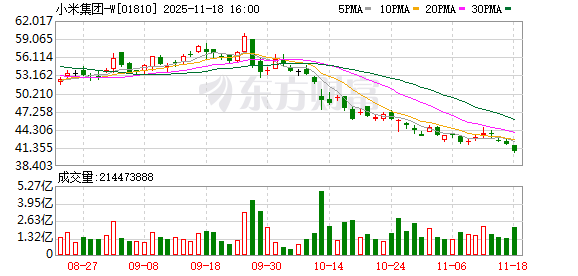
小米总裁卢伟冰回应存储成本上涨:一部分要通过涨价消化,更重要的是优化产品结构
Mei Ri Jing Ji Xin Wen· 2025-11-18 12:37
Core Viewpoint - The recent increase in memory chip prices is attributed to strong demand driven by AI, marking a shift from previous cycles that were primarily influenced by fluctuations in the smartphone industry [1] Group 1: Memory Chip Market Dynamics - The price low for memory chips was observed in 2023, with expectations that new production will not emerge until 2027, indicating a prolonged period of high demand and limited supply [1] - The current memory price increase is expected to be a longer cycle compared to past trends, primarily due to the robust demand for high-performance mixed signal chips (HPM) driven by AI [1] Group 2: Company's Strategy - The company aims to ensure supply continuity, stating that despite predictions of ongoing shortages, it will have no supply issues for the entire year of 2026 [1] - To address rising memory costs, the company plans to implement price increases, but acknowledges that this alone will not fully offset the cost increases, emphasizing the need for product structure improvements and optimizations [1]
三大股指期货齐跌 标普、纳指失守50日均线拉响技术面崩盘警报
Zhi Tong Cai Jing· 2025-11-18 12:36
Market Overview - US stock index futures are all down ahead of the market opening on November 18, with Dow futures down 0.68%, S&P 500 futures down 0.57%, and Nasdaq futures down 0.72% [1] - European indices also show declines, with Germany's DAX down 1.40%, UK's FTSE 100 down 1.37%, France's CAC40 down 1.42%, and the Euro Stoxx 50 down 1.46% [2][3] - WTI crude oil is up 0.02% at $59.87 per barrel, while Brent crude oil is down 0.05% at $64.17 per barrel [4] Market Sentiment - Analysts warn of a potential market correction as the S&P 500 index closes below its 50-day moving average for the first time in 139 trading days, breaking a record for the second-longest period above this trend line in the 21st century [5] - The Nasdaq also falls below its 50-day moving average, ending a record streak of 187 trading days above this level, with more stocks hitting 52-week lows than highs, indicating weak market internals [5] - Bitcoin briefly drops below $90,000, further increasing market risk aversion [5] Federal Reserve Insights - Federal Reserve Vice Chairman Jefferson indicates that a soft labor market alters the risk balance, suggesting a cautious approach to further rate cuts [6] - The upcoming changes in the Federal Reserve's committee members may influence the direction of monetary policy, with potential shifts towards a more dovish stance if a hawkish member retires [6] Economic Data - UBS predicts that the Federal Reserve is likely to cut rates in December, despite internal disagreements among committee members [7] - Initial jobless claims in the US total 232,000, with continuing claims at 1.957 million, slightly above the previous week [7] Oil Market Forecast - Goldman Sachs warns of a continued decline in oil prices until 2026 due to a supply surplus of approximately 2 million barrels per day, predicting Brent crude to average $56 per barrel and WTI at $52 per barrel by 2026 [8][9] Company Performance - Apple's iPhone 17 series sees a 37% increase in sales in China, regaining a 20% market share, indicating strong momentum in a key market [10] - Home Depot reports Q3 sales of $41.35 billion, with same-store sales growth of only 0.2%, below expectations [11] - Axalta announces a merger with AkzoNobel to create a $25 billion global coatings company, expected to complete by late 2026 or early 2027 [11] - Baidu reports Q3 total revenue of 31.2 billion yuan, with AI new business revenue growing over 50% [12] - Futu Holdings sees Q3 revenue increase of 86.3% year-on-year, with net profit rising by 136.9% [13] - Weibo reports a net profit of $221 million for Q3, a 69.33% increase year-on-year, despite a slight decline in total revenue [14]

美股前瞻 | 三大股指期货齐跌 标普、纳指失守50日均线拉响技术面崩盘警报
智通财经网· 2025-11-18 12:31
Market Overview - US stock index futures are all down ahead of the market opening, with Dow futures down 0.68%, S&P 500 futures down 0.57%, and Nasdaq futures down 0.72% [1] - European indices also show declines, with Germany's DAX down 1.40%, UK's FTSE 100 down 1.37%, France's CAC40 down 1.42%, and the Euro Stoxx 50 down 1.46% [2][3] - WTI crude oil is up 0.02% at $59.87 per barrel, while Brent crude oil is down 0.05% at $64.17 per barrel [4] Economic and Monetary Policy Insights - Analysts warn of a potential market correction as the S&P 500 index closes below its 50-day moving average for the first time in 139 trading days, breaking a record for the second-longest period above this trend line in the century [4] - The Nasdaq also falls below its 50-day moving average, ending the longest streak since October 1995, with more stocks hitting 52-week lows than highs, indicating weak market internals [4] - Federal Reserve Vice Chair Jefferson emphasizes a cautious approach to further rate cuts, citing a softening job market and recent easing inflation risks [5] - UBS predicts a strong likelihood of a rate cut in December, despite internal disagreements within the Federal Reserve [6] Oil Market Forecast - Goldman Sachs warns of a continued decline in oil prices until 2026 due to a supply surplus of approximately 2 million barrels per day, forecasting Brent crude at $56 per barrel and WTI at $52 per barrel by 2026 [7][8] Company-Specific Developments - Apple (AAPL.US) sees a 37% increase in iPhone 17 sales in China, regaining a 20% market share, indicating strong consumer response to new models [9] - Google (GOOGL.US) CEO warns of irrational factors in the current AI market, suggesting that no company, including Google, is immune to potential market corrections [9] - Arm (ARM.US) partners with Nvidia (NVDA.US) to integrate NVLink technology into its Neoverse platform, enhancing collaboration in AI data center chips [9] - Home Depot (HD.US) reports Q3 sales of $41.35 billion, with same-store sales growth of only 0.2%, below expectations [10] - Axalta (AXTA.US) announces a merger with AkzoNobel to create a $25 billion global coatings company, expected to complete by late 2026 or early 2027 [10] - Baidu (BIDU.US) reports Q3 revenue of 31.2 billion yuan, with AI-related business revenue growing over 50% [11] - Futu Holdings (FUTU.US) shows a significant increase in Q3 revenue by 86.3% year-on-year, with net profit up 136.9% [12] - Weibo (WB.US) reports a net profit of $454 million for Q3, a 55.43% increase year-on-year, despite a slight decline in total revenue [13]






小米第三季营收1131亿:汽车收入290亿,实现季度盈利,将提前完成全年交付目标
3 6 Ke· 2025-11-18 12:25
Core Viewpoint - Xiaomi Group reported significant growth in revenue and profit for the first nine months of 2025, indicating strong operational performance and strategic investments in AI and IoT sectors [2][19]. Financial Performance - For the first nine months of 2025, Xiaomi's revenue reached 340.37 billion RMB, a 32.5% increase from 256.9 billion RMB in the same period last year [2]. - Operating profit for the same period was 41.672 billion RMB, up 166.9% from 15.613 billion RMB year-on-year [2]. - Adjusted net profit was 32.817 billion RMB, reflecting a 73.5% increase compared to 18.918 billion RMB in the previous year [2]. Quarterly Performance - In Q3 2025, Xiaomi's revenue was 1131.21 billion RMB, a 22.3% increase from 925 billion RMB year-on-year, but a slight decline of 2.4% from the previous quarter [4]. - Gross profit for Q3 2025 was 25.936 billion RMB, up 37.4% from 18.881 billion RMB year-on-year [4]. - The operating profit for Q3 2025 was 15.110 billion RMB, a 150.1% increase from 6.041 billion RMB year-on-year [6]. R&D and Innovation - Xiaomi's R&D expenditure reached 91 billion RMB in Q3 2025, a 52.1% increase year-on-year, with total R&D spending for the first nine months at 235 billion RMB [7][11]. - The number of R&D personnel reached a record high of 24,871 [7]. Business Segments - The smartphone and AIoT segment generated 841 billion RMB in Q3 2025, with smartphone revenue at 460 billion RMB and global smartphone shipments of 43.3 million units, a 0.5% increase year-on-year [12]. - IoT and lifestyle products revenue was 276 billion RMB in Q3 2025, a 5.6% increase year-on-year, with a gross margin of 23.9% [13]. - Internet services revenue for Q3 2025 was 94 billion RMB, up 10.8% year-on-year, with advertising revenue at 72 billion RMB, a 17.4% increase [16]. Automotive and AI Innovations - The smart electric vehicle and AI segment reported revenue of 290 billion RMB in Q3 2025, with a significant year-on-year growth of over 199% [19]. - Xiaomi's automotive division delivered over 100,000 vehicles in Q3 2025, with total deliveries exceeding 260,000 units for the year [19].

小米汽车业务首次单季盈利 预计本周可完成全年交付目标
Zheng Quan Shi Bao Wang· 2025-11-18 12:05
Core Insights - Xiaomi's automotive division achieved its first quarterly profit of approximately 700 million yuan, marking a significant milestone for the company [1] - The company reported a third-quarter revenue of 113.1 billion yuan, a year-on-year increase of 22.3%, and a record net profit of 11.3 billion yuan, up 80.9% year-on-year [1] - Xiaomi's total revenue for the first three quarters reached 340.4 billion yuan, nearing last year's total, with adjusted net profit exceeding last year's total at 32.8 billion yuan [1] Automotive Business - The automotive and AI innovation segment generated revenue of 29 billion yuan, a year-on-year increase of over 199%, with smart electric vehicle revenue accounting for 28.3 billion yuan [1] - In the third quarter, Xiaomi delivered over 100,000 new vehicles, bringing total deliveries for the first three quarters to over 260,000 units [2] - Xiaomi's automotive division is on track to meet its annual delivery target of 350,000 units [1] Smartphone and IoT Business - The smartphone and AIoT segment generated revenue of 84.1 billion yuan, with smartphone revenue at 46 billion yuan, showing growth for nine consecutive quarters [2] - Xiaomi's global smartphone shipments reached 43.3 million units in the third quarter, maintaining a strong position in both domestic and international markets [2] - The IoT and lifestyle products segment reported revenue of 27.6 billion yuan, a year-on-year increase of 5.6%, with over 1 billion connected IoT devices [3] High-End Market Strategy - Xiaomi is accelerating its high-end strategy across various product categories, achieving a significant increase in market share in the high-price segment of smartphones [3] - In the high-end smartphone segment (priced between 4,000 and 6,000 yuan), Xiaomi's market share reached 18.9%, an increase of 5.6 percentage points year-on-year [3] - The company is also establishing a high-end product matrix in the electric vehicle sector, with its models SU7 and YU7 leading sales in their respective categories [3] Research and Development - Xiaomi's R&D investment for the first three quarters reached 23.5 billion yuan, nearing the total planned investment for 2024, with expectations to exceed 30 billion yuan for the year [3] - The third quarter saw a record R&D expenditure of 9.1 billion yuan, a year-on-year increase of 52.1%, reflecting the company's commitment to transitioning from an "internet company" to a "hardcore technology company" [3]
卢伟冰:预计明年小米汽车毛利率可能较今年有所下滑
Feng Huang Wang· 2025-11-18 11:58
Core Viewpoint - Xiaomi's recent performance shows significant growth in smartphone sales and IoT revenue, while also highlighting challenges in the automotive sector due to market competition and policy changes [1] Smartphone Sales - Xiaomi's 17 series achieved over 1 million units sold within 5 days of launch, with cumulative sales exceeding 2 million by early November, indicating a faster sales pace compared to the previous generation [1] - During the Double Eleven shopping festival, the Xiaomi 17 Pro Max became the best-selling smartphone in both sales volume and revenue in the price segment above 6000 yuan, being the only domestic model competing with the iPhone [1] IoT Business - In Q3, Xiaomi's IoT revenue reached 27.6 billion yuan, marking a year-on-year growth of 5.6%, with a gross margin increase to 23.9%, maintaining growth for seven consecutive quarters [1] - The gross margin and average selling price of the home appliance segment have both improved, with the company focusing on innovation rather than price wars to drive demand [1] - Xiaomi's home appliance business has significant overseas potential, having entered Southeast Asia and Europe this year, with plans for further expansion next year [1] AI Initiatives - Over the past year, Xiaomi has released various AI models, including language, multimodal, and voice models, and has open-sourced the smart home exploration project Xiaomi Miloco in November [1] - The total R&D investment for the year has reached 23.5 billion yuan, with one-quarter allocated to AI, exceeding initial expectations [1] Automotive Business - Xiaomi's automotive business is expected to maintain stability in Q4, with a projected annual delivery target of 350,000 vehicles [1] - However, challenges are anticipated in 2026 due to changes in vehicle purchase tax policies and increased market competition, with expectations of a decline in automotive gross margins next year compared to this year [1]
小米集团(01810) - 2025 Q3 - 电话会议演示
2025-11-18 11:30
Financial Performance - Group revenue reached RMB 113.1 billion, a YoY increase of 22.3%[11] - Gross profit margin increased to 22.9%, up 2.5 percentage points YoY[11] - Adjusted net profit reached RMB 11.3 billion, a significant YoY increase of 80.9%[11] - Smart EV, AI and other new initiatives revenue reached RMB 29.0 billion, a substantial YoY increase of 199.2%[11] Smartphone and AIoT Business - Global smartphone shipments ranked among the top 3 for 21 consecutive quarters, with a market share of 13.6%[14] - Premium smartphone sales in Chinese Mainland increased to 24.1% of total smartphone units sold, a YoY increase of 4.1 percentage points[14] - IoT and lifestyle products revenue reached RMB 27.6 billion, up 5.6% YoY[85] Smart EV Initiatives - Delivered 108,796 Smart Electric Vehicles, representing a YoY increase of 173.4%[18] - Smart EV sales revenue reached RMB 28.3 billion, up 197.9% YoY[89] User Growth and AI - Global MAU reached 741.7 million[21] - Number of connected devices reached 1,035.5 million[26] R&D Investment - R&D expenses reached RMB 9.1 billion in Q3 2025[31]
全品类高端化战略加速兑现,小米汽车首次实现单季盈利
2 1 Shi Ji Jing Ji Bao Dao· 2025-11-18 11:13
Core Viewpoint - Xiaomi Group has successfully implemented its high-end strategy across various product categories, achieving significant revenue growth and profitability in its automotive segment for the first time in a single quarter [1][3]. Financial Performance - In Q3 2025, Xiaomi reported total revenue of 113.1 billion yuan, a year-on-year increase of 22.3%, and an adjusted net profit of 11.3 billion yuan, up 80.9% [1]. - The company's R&D investment reached 23.5 billion yuan in the first three quarters of the year, nearing the total for the entire year of 2024 [1]. Business Segments - The smartphone segment saw a slight revenue decline from 47.5 billion yuan to 46 billion yuan, a decrease of 3.1%, primarily due to a drop in average selling price (ASP) [2]. - The IoT and lifestyle products segment grew from 26.1 billion yuan to 27.6 billion yuan, a 5.6% increase, driven by global sales of wearable devices [2]. - Internet services revenue increased from 8.5 billion yuan to 9.4 billion yuan, a growth of 10.8%, largely due to strong performance in advertising [3]. - The smart electric vehicle segment experienced a remarkable revenue increase of 197.9%, rising from 9.5 billion yuan to 28.3 billion yuan, with vehicle deliveries increasing by 173.4% [3]. Cost and Investment - Sales and marketing expenses rose to 8.3 billion yuan, a 32.3% increase, reflecting expansion efforts in retail and advertising [3]. - R&D spending in Q3 reached 9.1 billion yuan, a 52.1% increase, with total R&D investment expected to exceed 30 billion yuan for the year [3]. Workforce and Market Position - As of September 30, 2025, Xiaomi's R&D personnel count reached a record high of 24,871 [4]. - Xiaomi's stock price closed at 40.78 HKD per share on November 18, 2025, with a total market capitalization of 1.06 trillion HKD [4].