金融

Search documents
西部证券晨会纪要-20251215
Western Securities· 2025-12-15 01:46
Group 1: Restaurant Industry Insights - The report emphasizes the resilience of the restaurant industry, highlighting key companies such as Yum China, Xiaocaiyuan, Haidilao, and Dashishi as potential investment opportunities due to their operational capabilities and market positioning [2][10] - The restaurant sector is expected to benefit from government policies aimed at boosting service consumption, with specific measures outlined to enhance the sector's growth [7] - Restaurant revenue is projected to account for 12% of total retail sales in 2024, with growth rates of 20% and 5% for 2023 and 2024 respectively, indicating a stronger performance compared to overall retail sales [8] Group 2: Computer Industry Outlook - The computer industry is anticipated to see significant advancements in AI applications, with a focus on increasing computational power and model sophistication [3][12] - The report highlights the emergence of large AI models and their commercial applications, indicating a strong growth trajectory for AI-related technologies [12][14] - The demand for AI capabilities is expected to drive investments in domestic AI chip development, with a focus on enhancing performance and establishing a robust software ecosystem [13] Group 3: Aerospace and Defense Sector - Hangya Technology is positioned as a key player in the aerospace engine components market, leveraging its expertise in precision forging technology to meet rising international demand [4][16] - The company reported a revenue of 530 million yuan and a net profit of 78 million yuan for the first three quarters of 2025, reflecting a year-on-year growth of 1.95% in revenue but a decline of 16.04% in net profit [16][17] - The report forecasts significant revenue growth for Hangya Technology, projecting revenues of 817 million yuan, 1.09 billion yuan, and 1.51 billion yuan for 2025 to 2027, with corresponding net profits increasing substantially [17] Group 4: Macro Economic Context - The macroeconomic environment is characterized by a stable growth outlook, with a projected GDP growth target of around 5% for 2026, supported by proactive fiscal and monetary policies [30] - The report notes a focus on domestic demand as a primary driver of economic growth, with specific measures aimed at stabilizing the real estate market and enhancing employment [30][31] - Financial data indicates a slight decline in loan growth, with a notable drop in household loans, while overall social financing growth is stabilizing [18][19]

日本国债期货小幅走高,投资者消化日本央行短观调查
Jin Rong Jie· 2025-12-15 01:11
Core Viewpoint - Japanese government bond futures rose slightly in early Tokyo trading as investors digested the Bank of Japan's quarterly Tankan survey results, which showed a large manufacturer sentiment index of 15, aligning with market expectations [1] Group 1: Economic Indicators - The large manufacturer sentiment index reported by the Bank of Japan was 15, matching market expectations [1] - Market participants are anticipating the upcoming Bank of Japan meeting, with U.S. employment data set to be released prior to this meeting [1] Group 2: Market Expectations - Citigroup's economist, Masahiko Akiyama, indicated that if the U.S. employment data does not cause significant market turmoil as seen last summer, the Bank of Japan is expected to raise interest rates as scheduled [1] - A key focus for the Bank of Japan will be how much they will hint at future rate hikes amid the ongoing trend of a weakening yen [1] Group 3: Market Movements - The ten-year Japanese government bond futures increased by 0.09 yen, reaching 134.14 yen [1]
统筹推进深层次改革和高水平开放
Zheng Zhou Ri Bao· 2025-12-15 00:46
Core Viewpoint - The article emphasizes the importance of deepening reforms and expanding high-level openness as key strategies for achieving modernization in China, particularly in the context of Zhengzhou's development as a national central city and a hub for domestic and international dual circulation [1][2][4]. Group 1: Reform and Development - The need to deepen reforms to enhance advantages and build a dual circulation hub is highlighted as a strategic choice for Zhengzhou to fulfill its responsibilities as a national central city [2]. - Zhengzhou is one of three cities in China designated as pilot cities for comprehensive market-oriented allocation of factors, indicating its role in leading reform initiatives [2]. Group 2: Open Economy and Market Integration - The article stresses the importance of integrating into the national unified market to leverage the advantages of a large market scale and unlock development potential [2]. - Zhengzhou aims to strengthen its position as a comprehensive international transportation hub and enhance its modern commercial logistics capabilities [2][3]. Group 3: Infrastructure and Connectivity - Zhengzhou is positioned as a critical transportation hub with a high-level international status, featuring a comprehensive high-speed rail network and international air transport capabilities [3]. - The city is recognized for its strategic resources that connect various regions, making it a vital manufacturing base and an inland opening window [3]. Group 4: Systematic Reform and Innovation - The article advocates for a unified approach to reform and openness, suggesting that deeper reforms will necessitate higher levels of openness and vice versa [4]. - It calls for innovative thinking to expand institutional openness and actively participate in the construction of a unified national market [4].
美联储降息牵动全球资本流向,影响国内企业融资与个人理财
Sou Hu Cai Jing· 2025-12-15 00:40
Group 1: Personal Consumption and Living Costs - The Federal Reserve's interest rate cuts lead to a weaker dollar, making studying abroad, shopping, and travel cheaper for Chinese families, potentially saving over 10,000 yuan annually for those studying in the U.S. [2] - The appreciation of the yuan results in lower prices for imported consumer goods, such as electronics and luxury items, but may weaken the competitiveness of export goods, particularly in labor-intensive sectors like textiles and home appliances [2] - The decline in returns on dollar-denominated assets, including U.S. Treasury bonds and dollar-linked investment products, necessitates adjustments in investment strategies for holders [2] Group 2: Corporate and Macroeconomic Impact - Companies reliant on dollar financing, such as those in technology and real estate, benefit from reduced borrowing costs and alleviated pressure from existing dollar-denominated debt [3] - Export-oriented companies facing rising prices for dollar-denominated goods may experience diminished competitiveness, while firms importing raw materials could face increased cost pressures [4] Group 3: Capital Market Fluctuations - Foreign capital may flow back into emerging markets, with sectors like semiconductors and renewable energy in A-shares benefiting from increased liquidity and valuation improvements [5] - Precious metals like gold and silver are driven up by the weaker dollar, although caution is advised as gold prices are at historical highs [6] Group 4: Policy and Long-term Implications - The narrowing of interest rate differentials between China and the U.S. reduces depreciation pressure on the yuan, creating favorable conditions for potential interest rate cuts and reductions in reserve requirements in China, which may lead to lower mortgage rates [7] - Short-term stimulus measures could exacerbate asset bubbles in markets like U.S. stocks and real estate, with risks of market reversals if inflation rebounds or economic conditions weaken [8] - Debt pressures in emerging markets remain unresolved, and rapid capital movements could heighten financial volatility [9] Group 5: Strategies for Individuals - Individuals are advised to reduce holdings in dollar-denominated assets and shift towards high-dividend A-share leaders, gold ETFs, and QDII overseas bond funds [10] - Caution is recommended regarding high-valuation assets, with a preference for industries with stable cash flows, such as utilities and consumer staples [11] - Those needing to exchange for dollars should consider doing so during the depreciation period, but long-term holdings should be approached with caution [12] Group 6: Controversies and Uncertainties - Internal divisions within the Federal Reserve are evident, with a 9:3 vote on December rate cuts, and the pace of rate cuts in 2026 remains uncertain, potentially accelerated by political interventions [13] - The interplay between AI expansion by tech giants, which relies on low interest rates, and the potential for increased unemployment and inflation creates policy dilemmas [13] - The current rate cuts by the Federal Reserve are characterized as "preventive" adjustments, with the core issue being the balance between weak employment and persistent inflation, necessitating attention to potential pauses in rate cuts in January 2026, which will directly influence capital flows and policy space [14]
8点1氪:被罗永浩指责收高价“祸害客人”,涉事酒店回应;全国劳动力人口平均年龄达39.66岁;马斯克或成全球首位万亿美元富豪
36氪· 2025-12-14 23:57
Group 1 - The article discusses a complaint against Hyatt's Yifei Hotel, where a guest reported multiple issues with their room, including air conditioning problems and water leaks, leading to a poor experience [3][5] - The hotel staff acknowledged the complaints and mentioned that management is handling the situation, but specific details on resolutions were not provided [5] - The article highlights the growing trend of consumer complaints in the hospitality industry, particularly regarding transparency and customer service [3][5] Group 2 - Huayi Brothers has reported a cumulative loss of 8.2 billion yuan over the past seven years, with its current market value being less than one-tenth of its peak [4] - The article notes that the average age of the labor force in China has risen to 39.66 years, indicating an aging population and potential implications for the labor market [6] - The article mentions that the global largest automotive safety testing center has been put into operation, which may impact the automotive industry standards and practices [6] Group 3 - The article reports that SpaceX is considering an IPO, with a target valuation of approximately 1.5 trillion dollars, which could make Elon Musk the world's first trillionaire [6][14] - Lululemon's market value has decreased by approximately 25 billion dollars over the past year, with a significant drop in stock price and leadership changes [11] - The article discusses the introduction of a new policy by the National Market Supervision Administration to prevent car manufacturers from selling vehicles below production costs, aiming to enhance market stability [7]


承诺现金分红比例不低于50%!未来三年分红规划,这些公司已提前布局
Zheng Quan Shi Bao· 2025-12-14 23:54
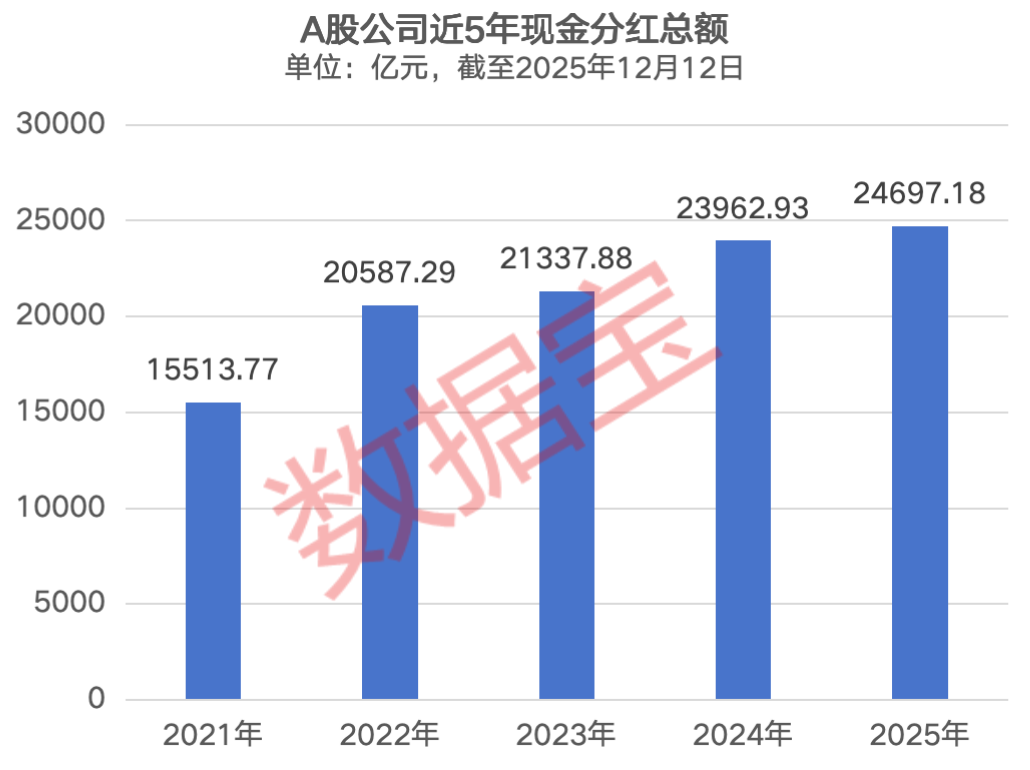
近年来,上市公司分红意愿显著提升,A股市场分红生态持续优化,呈现出分红总额、参与分红公司数量占比以及年内多次分红公司数量逐年递增的趋 势。 按照除权除息日计算(下同),截至12月12日,今年以来,A股上市公司现金分红总额达到2.47万亿元,已超过2024年全年的现金分红总额。 今年以来,上市公司以现金分红等方式积极回馈投资者。 作为回馈投资者的重要方式,近年来,国内资本市场有关现金分红的政策文件相继出炉。 2024年年初,沪深交易所相继发出"提质增效重回报""质量回报双提升"的倡议;同年4月,新"国九条"出台,其中提出强化上市公司现金分红监管,并提 出"推动一年多次分红、预分红、春节前分红"。 2025年12月初,中国证监会主席吴清在人民日报发表署名文章《提高资本市场制度的包容性适应性(学习贯彻党的二十届四中全会精神)》。该文章指 出,督促和引导上市公司强化回报投资者的意识,更加积极开展现金分红、回购注销等。 年内分红总额已超过去年全年 从2025年数据来看,比亚迪、海康威视、紫金矿业等今年实施的现金分红总额首次突破百亿元。 传统"分红大户"今年均加大力度。以2025年以来现金分红超过百亿元的36家公司来看, ...
华尔街见闻早餐|2025年12月15日
Sou Hu Cai Jing· 2025-12-14 23:43
Market Overview - Concerns over AI have led to a significant decline in U.S. stock markets, with the Nasdaq dropping nearly 2% and the S&P 500 falling over 1%, while the Dow Jones, despite a weekly drop, remains up over 1% for three consecutive weeks [1] China Economic Indicators - In November, China reported a new social financing of 2.49 trillion yuan and new RMB loans of 390 billion yuan, with an expanding M2-M1 spread [1] - Multiple Chinese ministries are responding to the central economic work conference, with the central bank indicating a flexible use of various monetary policy tools, including potential rate cuts [1] Corporate Developments - Vanke's "22 Vanke MTN004" medium-term note extension proposals were not approved, but the company has a five-day grace period to negotiate [1] - Kweichow Moutai is reportedly set to implement a quantity control policy, leading to a significant price increase for its Feitian Moutai liquor, which rose to 1,580 yuan per bottle in a single day [1] Technology Sector - Oracle has faced concerns as reports emerged of delays in the completion of some data centers until 2028, causing its credit default swaps (CDS) to rise to the highest level since 2009; however, Oracle has denied these claims, stating that all contracted data centers are on schedule [1] U.S. Federal Reserve and Economic Policy - JPMorgan CEO Jamie Dimon reportedly supports the appointment of Kevin Warsh as Federal Reserve Chair, warning that the appointment of another candidate could undermine the Fed's independence [1] - A debate among Federal Reserve officials regarding interest rate cuts and inflation continues, with differing views on the current economic risks [1]
三部门出台11条政策措施加强商务和金融协同 更大力度提振消费
Zhong Guo Zheng Quan Bao· 2025-12-14 23:16
Core Viewpoint - The Ministry of Commerce, in collaboration with the People's Bank of China and the Financial Regulatory Bureau, has issued a notification aimed at enhancing the synergy between commerce and finance to boost consumer spending through various financial support measures [1] Group 1: Strengthening Collaboration - The notification outlines 11 policy measures across three main areas to deepen collaboration between commerce and finance, encouraging local departments to enhance communication and cooperation [2] - Local commerce departments are urged to leverage existing funding channels to promote consumption activities, working in tandem with financial support to stimulate consumer potential [2] - The use of digital RMB smart contract red envelopes is encouraged to improve the effectiveness of consumption promotion policies [2] Group 2: Financial Support for Key Consumption Areas - Financial institutions are encouraged to focus on five key areas: upgrading product consumption, expanding service consumption, nurturing new consumption types, innovating diverse consumption scenarios, and supporting consumption assistance [3] - The notification emphasizes the need to enhance financial services for durable goods and digital products, facilitating consumer upgrades through various payment options [3] - Personal consumption loan policies are to be tailored based on customer repayment capabilities, with a focus on expediting the development of personal consumption loans [3] Group 3: Expanding Service Consumption - A "1+N" policy framework is proposed to increase support for service consumption, with innovations in financial products and services tailored to specific service sectors [4] - The notification highlights the importance of financing services for intangible assets like intellectual property and technology achievements, particularly for small and micro enterprises [4] Group 4: Enhancing Government-Financial-Enterprise Cooperation - The notification encourages a collaborative approach among government, financial institutions, and enterprises to conduct diverse consumption promotion activities and share information effectively [5] - Financial institutions are urged to participate in local consumption promotion activities, offering tailored products and services to reach a broader audience [5][6] - The development of financial products that align with the characteristics of the consumption industry is encouraged to enhance customer acquisition and promotional flexibility [6]
汽车以旧换新 提前还贷违约金可减免
Sou Hu Cai Jing· 2025-12-14 23:11
Core Viewpoint - The joint notice issued by the Ministry of Commerce, the People's Bank of China, and the Financial Regulatory Bureau aims to strengthen the collaboration between commerce and finance to boost consumption and enhance consumer welfare through targeted policies [2][3]. Group 1: Policy Measures - The notice outlines 11 policy measures across three main areas: enhancing collaboration between commerce and finance, increasing financial support for key consumption areas, and expanding cooperation among government, financial institutions, and enterprises [2][3]. - It emphasizes the need for local departments to improve communication and collaboration, encouraging the establishment of mechanisms to coordinate financial resources effectively [2]. Group 2: Financial Support for Key Consumption Areas - Financial institutions are encouraged to optimize their products and services to support five key areas: upgrading goods consumption, expanding service consumption, fostering new consumption types, innovating diverse consumption scenarios, and assisting consumption support initiatives [2][4]. - Specific measures include reducing penalties for early loan settlements in vehicle trade-ins and providing loans to service and elderly care sectors [4]. Group 3: Strengthening Policy Synergy - The notice promotes the use of digital RMB smart contracts and encourages local departments to leverage existing funding channels to enhance consumption activities [5]. - It calls for a collaborative approach among fiscal, commercial, and financial policies to guide credit funds towards key consumption sectors [5]. Group 4: Upgrading Goods Consumption - The notice advocates for the acceleration of personal consumption loan services, particularly for durable goods and digital products, to meet consumer upgrade demands [6]. - Financial institutions are urged to collaborate with merchants to enhance payment options and services [6]. Group 5: Expanding Service Consumption - The policy aims to improve financial support for service consumption, including sectors like hospitality, entertainment, and education, by innovating financial products that integrate into consumption scenarios [8]. - It encourages financial institutions to provide loans to service sector businesses and expand financing options for intangible assets [8]. Group 6: Supporting Consumption Assistance - The initiative aims to boost rural consumption and promote the sale of agricultural products by providing financial support for county-level consumption activities [9]. - It emphasizes the importance of enhancing rural logistics and financing for new projects to support rural economic development [9]. Group 7: Fostering New Consumption Types - The notice encourages the exploration of financial support for emerging consumption models, such as green and digital consumption, and the integration of AI and IP into consumer services [10][11]. - Financial institutions are urged to develop tailored services for online platforms and enhance collaboration with retail and e-commerce sectors [10]. Group 8: Innovating Diverse Consumption Scenarios - The policy promotes the integration of comprehensive financial services to support new consumption scenarios, including international consumer activities and local commercial enhancements [12][13]. - It encourages financial institutions to actively engage in urban and rural consumption trends and expand online and offline service channels [13]. Group 9: Joint Consumption Promotion - The notice advocates for joint promotional activities among merchants and platforms, encouraging the issuance of consumer vouchers and low-interest financing options [14]. - Financial institutions are encouraged to customize digital RMB services to meet local consumption needs effectively [14].

破局“内卷” 开拓蓝海——企业界人士建言全国统一大市场建设
Jing Ji Ri Bao· 2025-12-14 22:34
Core Viewpoint - The letter from the chairman of Guangdong Youkai Technology highlights the detrimental effects of vicious competition in the detergent industry, where low-quality products with less than 5% active ingredients are capturing market share through low prices, putting quality products at a disadvantage [1] Group 1: Industry Challenges - The phenomenon of "involution" is causing severe price wars across various industries, leading to compressed profit margins, reduced innovation investment, and increased quality and safety risks [1][2] - Over 20 national and local industry associations have publicly called for a "counter-involution" approach, addressing issues in sectors such as steel, automotive, photovoltaic, catering, finance, and logistics [3] Group 2: Market Efficiency and Fair Competition - The construction of a unified national market aims to eliminate barriers to fair competition, addressing the imbalance between supply and demand and enhancing overall market stability [3] - Companies are encouraged to abandon the outdated "scale supremacy" mindset and focus on creating value through quality products and brands, as demonstrated by China Resources Beer, which closed 40 factories and reduced over 5 million tons of redundant capacity [3] Group 3: Innovation as a Key Driver - Traditional manufacturing must break free from path dependence and scale bottlenecks by leveraging technology and innovation, as emphasized by Weiqiao Chuangye Group's collaboration with research institutions and the establishment of an industrial technology research institute [4] - New Hope Group has utilized cold chain logistics and AI to innovate in the dairy industry, achieving same-day production and delivery to over 1 million stores [4] Group 4: Brand Value and Consumer Trust - In a market characterized by information asymmetry, low-quality products often mislead consumers, necessitating a shift towards rebuilding trust in high-quality products and enhancing user experience [5] - The home appliance industry has maintained a rational approach due to years of systemic development, with a focus on creating emotional and meaningful connections with consumers [5] Group 5: Global Expansion and Market Opportunities - The unified national market is seen as an open market that encourages companies to expand globally, alleviating domestic competition pressures and enhancing competitiveness in international markets [6] - Companies like Jack Technology and Miniso are adopting global strategies that integrate local insights and cultural fusion, demonstrating the importance of global perspectives in business expansion [6] Group 6: Future Directions for Companies - Companies are urged to focus on innovation, brand building, and global outreach to escape internal competition and contribute to high-quality economic development in China [7]