
银行

Search documents
据报汇丰(HSBC)削减增持美国股票比重 转投新兴市场及欧洲
Xin Lang Cai Jing· 2026-02-27 10:42
Group 1 - HSBC has significantly reduced its exposure to US equities, shifting investments towards emerging markets and Europe [1] - The bank's Chief Multi-Asset Strategist, Max Kettner, believes that the cyclical momentum of economies outside the US is stronger, and it is currently difficult to reverse the bearish narrative surrounding AI in the market [1] - In Europe, HSBC favors industrial stocks due to increased defense spending and strong metal demand, while also showing optimism towards bank stocks [1] Group 2 - HSBC continues to maintain a "Risk On" stance, as key cyclical indicators such as consumer spending and manufacturing have shown improvement over the past two months [1] - The bank has ended its tactical overweight in Japan and has ceased reducing its holdings in Japanese government bonds [1] - HSBC has also concluded its overweight position in UK government bonds [1]

开年严监管!70张金融大罚单密集落地,百万级千万级重罚频现
Xin Lang Cai Jing· 2026-02-27 10:42
Group 1 - Jiangxi Anfu Rural Commercial Bank was fined 1.8 million yuan for violations in personal loan issuance, risk exposure delays, and inadequate responsibility for bad debt write-offs [1] - Quanzhou Bank was fined 6.25 million yuan for false data in small and micro enterprise loans, inadequate risk classification management, and improper deposit absorption [2] - Hubei Xiaogan Rural Commercial Bank was fined 1.2 million yuan for non-compliance in major related transactions and misappropriation of personal loan funds [3] Group 2 - China Life Insurance Hubei Branch was fined 1.17 million yuan for fabricating false materials and providing improper benefits to policyholders [4] - Xiamen Rural Commercial Bank was fined 6.05 million yuan for inadequate management in governance, credit, and wealth management [5] - China Orient Asset Management Shanghai Branch was fined 1.5 million yuan for serious violations in prudent operation rules regarding bad asset acquisitions [6] Group 3 - China Construction Bank Shanghai Branch was fined 4.2 million yuan for severe violations in internet loan risk management and project financing [7] - China Export-Import Bank Guangdong Branch was fined 1.1 million yuan for misclassifying self-operated business as policy business [8] - Agricultural Bank of China Zhoushan Branch was fined 3.85 million yuan for imprudent credit management [9] Group 4 - CITIC Bank Nanning Branch was fined 1.1 million yuan for inadequate loan investigation and post-loan management [10] - China Agricultural Bank Hainan Branch was fined 1 million yuan for inadequate loan-related business and improper employee management [11] - Zhejiang Min Tai Commercial Bank was fined 7.15 million yuan for multiple serious violations in loan management and reporting [12] Group 5 - Shanghai Bank was fined 4.5 million yuan for concealing bad loans and providing false documentation [13] - China Postal Savings Bank Fujian Branch was fined 2.8 million yuan for inadequate internal control management in credit business [14] - Guangfa Bank Guangzhou Branch was fined 1.85 million yuan for serious violations in loan business and unauthorized high-level management [15]
上级动态|中国人民银行发布《关于银行业金融机构人民币跨境同业融资业务有关事宜的通知》(附答记者问)
Xin Lang Cai Jing· 2026-02-27 10:36
Core Viewpoint - The People's Bank of China (PBOC) issued a notification to support domestic banks in conducting cross-border RMB interbank financing, aiming to enhance the offshore RMB market and improve macro-prudential management of cross-border capital flows [1][8][17] Group 1: Notification Overview - The notification covers various types of RMB cross-border interbank financing, linking the net financing balance to banks' capital levels and funding strength, promoting reasonable business development [1][9] - A counter-cyclical adjustment mechanism is introduced, linking the net financing balance to capital levels and allowing for adjustments based on market conditions [2][12] - The notification supports domestic banks in conducting business in accordance with market demand and legal compliance, requiring banks to have strong international settlement capabilities [2][12] Group 2: Applicable Institutions - The notification applies to domestic banks established in accordance with the law that possess international settlement capabilities, including Chinese-funded banks, foreign-funded banks, and foreign bank branches [3][13] - Rural financial institutions are generally not allowed to conduct RMB cross-border interbank financing, although some may qualify under certain conditions [3][13] Group 3: Financing Balance Limits - The notification sets an upper limit on the net financing balance for RMB cross-border interbank financing, which is linked to the bank's capital or funding strength [4][14] - For domestic Chinese banks, the upper limit is calculated as the net capital multiplied by cross-border business adjustment parameters and macro-prudential adjustment parameters [4][14] - For foreign banks, the upper limit is based on net capital or the previous year's RMB deposit balance, also multiplied by the relevant parameters [5][14] Group 4: Data Reporting and Compliance - Banks engaged in RMB cross-border interbank financing must report relevant information to the RMB Cross-Border Payment Information Management System (RCPMIS) to ensure data accuracy [6][16] - The notification aims to align with existing RMB cross-border interbank financing management policies without creating new business types, maintaining compliance with current regulations [7][16] Group 5: Impact of the Notification - The implementation of the notification is expected to enhance the rules and transparency of RMB cross-border interbank financing management, facilitating stable offshore RMB liquidity [8][17] - The management logic aligns with previous measures for overseas loans and financing, providing a comprehensive macro-prudential management framework [8][17] - The notification encourages banks to adopt a risk-neutral approach, allowing for flexible adjustments within an overall net financing balance limit [8][17]
金价高位震荡下国有大行密集调升保证金 理性投资成市场共识
Jin Rong Jie· 2026-02-27 10:33
Core Viewpoint - The recent adjustments in margin requirements for precious metals trading by major Chinese banks are a response to heightened market volatility and risks associated with personal investments in precious metals [1][2][3]. Group 1: Bank Adjustments - Several major state-owned banks, including ICBC, ABC, and CCB, have raised the margin requirements for personal precious metals trading, with ABC leading the change by increasing the margin from 80% to 100% for key contracts [1]. - ICBC and CCB followed suit, also raising their margin requirements to 100% for various gold and silver contracts, indicating a comprehensive tightening of risk controls in personal precious metals trading [1]. - Bank of China made a differentiated adjustment, slightly increasing the margin for silver contracts while keeping the gold margin unchanged, reflecting a more cautious approach [2]. Group 2: Market Conditions - The international precious metals market is experiencing significant price fluctuations, driven by factors such as renewed U.S. tariff issues, increased geopolitical risks involving the U.S. and Iran, and a surge in safe-haven demand [3][4]. - As of February 27, domestic gold T+D prices were reported at 1142.15 RMB per gram, showing a slight decline, while silver T+D prices increased to 22,366 RMB per kilogram [4]. - The global central banks' gold reserves are nearing historical peaks, with a total of 36,700 tons expected by the end of 2025, highlighting gold's enduring value as a hedge against credit risk and geopolitical instability [3].
青岛农商行:聘任行长于丰星兼任首席合规官
Bei Jing Shang Bao· 2026-02-27 10:30
Group 1 - The core point of the article is that Qingdao Rural Commercial Bank has appointed its president, Yu Fengxing, as the Chief Compliance Officer during the 18th temporary meeting of its fifth board of directors [1] Group 2 - The announcement was made on February 27, indicating a significant governance decision within the bank [1] - The appointment reflects the bank's commitment to compliance and regulatory oversight [1]

交通银行:聘任首席风险官刘建军兼任首席合规官
Bei Jing Shang Bao· 2026-02-27 10:30
北京商报讯(记者 宋亦桐)2月27日,交通银行发布公告指出,该行第十一届董事会第五次会议审议批 准了《关于聘任刘建军先生为首席合规官的议案》。同意聘任首席风险官刘建军兼任首席合规官,刘建 军的首席合规官职务须待国家金融监督管理总局核准其任职资格后生效。 公开资料显示,刘建军,男,1967年生,中国国籍,中级经济师。刘建军2023年6月起任交通银行首席 风险官。曾任交通银行首席专家,风险管理部总经理,内控案防办主任,北京市分行行长,北京管理部 (集团客户部)总裁、常务副总裁,吉林省分行行长、副行长、高级信贷执行官,长春分行副行长、高 级信贷执行官,北京市分行副行长、高级信贷执行官等职务。刘建军2003年于北京理工大学获工商管理 硕士学位。 ...

次贷危机重演?英国私募信贷巨头MFS破产,巴克莱等多家大行卷入风波
Hua Er Jie Jian Wen· 2026-02-27 10:23
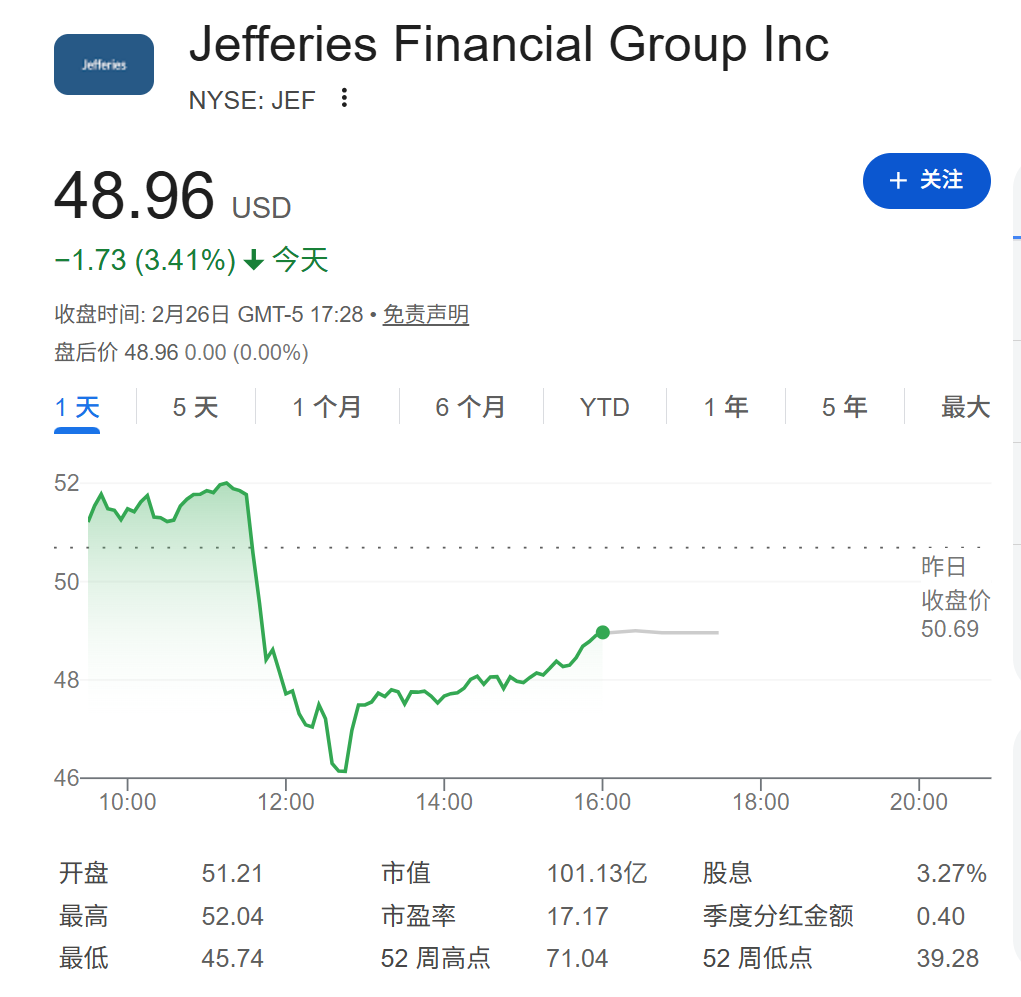
Core Viewpoint - Market Financial Solutions (MFS) has collapsed under fraud allegations, exposing over £2 billion in risk exposure for major Wall Street institutions, raising concerns about the fragility of the private credit market [1][6]. Group 1: Company Overview - MFS, founded in 2006 and headquartered in Mayfair, London, specialized in complex, property-backed loans, primarily offering short-term bridging loans to real estate investors [4]. - The company’s loan book peaked at approximately £2.5 billion, supported by a financing model that relied heavily on debt from Wall Street institutions [4][5]. - MFS's capital structure was weak, with a loan book of about £235 million backed by only £16 million in equity capital [5]. Group 2: Fraud Allegations - MFS's internal subsidiaries disclosed serious violations, including dual pledging of assets and misappropriation of funds, with a potential shortfall of £238 million [7]. - Allegations indicate that MFS has been misdirecting loan repayments and engaging in rehypothecation, leading to significant financial discrepancies [7]. Group 3: Market Impact - The collapse of MFS has led to a decline in stock prices for related institutions, with Jefferies experiencing a drop of over 8% at one point, and Barclays, Apollo Global Management, and Santander also facing declines [1]. - The incident follows a trend of recent bankruptcies in the private credit market, raising alarms about systemic vulnerabilities and the potential for further financial instability [9]. Group 4: Risk Exposure of Major Institutions - Major Wall Street firms have significant exposure to MFS, with Barclays holding the highest risk at approximately £600 million, followed by Apollo Global Management with £400 million [6]. - Jefferies has a risk exposure of about £100 million, while other institutions like Santander and Wells Fargo are also involved, though their specific exposures remain undisclosed [6]. Group 5: Industry Concerns - The private credit market is facing increased scrutiny, with industry experts noting that the recent MFS incident highlights ongoing vulnerabilities and the potential for fraud [9]. - The competitive landscape in the UK bridging loan market has intensified, with a doubling of loan providers over the past five years, leading to heightened reliance on leverage and debt financing [9].

2026年3月A股及港股月度金股组合:节后表现值得期待-20260227
EBSCN· 2026-02-27 10:22
Overall Research - The A-share market showed a mixed performance in February, with major indices mostly rising, particularly the CSI 1000 which increased by 2.9%, while the Sci-Tech 50 saw a decline of 1.6% [1] - The Hong Kong stock market experienced a pullback in February, with the Hang Seng Index falling by 3.7% and the Hang Seng Technology Index dropping by 10.6% [1] - The report anticipates a seasonal rebound in market trading activity post-Chinese New Year, setting a positive foundation for future market performance [1] A-share Insights - The report suggests focusing on growth and cyclical sectors, with growth benefiting from sustained industry enthusiasm and increased risk appetite among investors during the spring market [2] - Key sectors to watch include humanoid robots and the AI industry chain, which are expected to see significant catalytic events [2] - Cyclical sectors are anticipated to benefit from strong commodity prices and supportive policies, with recommendations to focus on resource products and offline service sectors [2] Hong Kong Stock Insights - The Hong Kong market is expected to remain volatile, with strong expectations for recovery in the spring, but concerns about earnings realization and foreign capital inflow persist [3] - Major internet companies are experiencing slower-than-expected profit recovery, which is impacting the overall economic environment [3] - The report recommends a "barbell strategy" for portfolio allocation, combining high-dividend defensive sectors with growth sectors such as semiconductor equipment and AI computing [3] - The report highlights the potential for a structural market recovery driven by domestic capital inflow and policy support [3] A-share Recommended Stocks - The recommended stocks for March 2026 include: - Zhongji Xuchuang (中际旭创) - Communication - Keda Xunfei (科大讯飞) - Computer - Shenghong Shares (盛弘股份) - Power Equipment - Jereh Group (杰瑞股份) - Machinery - Nanjing Bank (南京银行) - Banking - Hualing Steel (华菱钢铁) - Steel - Chuanheng Shares (川恒股份) - Basic Chemicals - China Jushi (中国巨石) - Building Materials - Sun Paper (太阳纸业) - Light Industry Manufacturing - Haier Smart Home (海尔智家) - Home Appliances [3][6] Hong Kong Recommended Stocks - The recommended stocks for March 2026 include: - Hon Teng Precision (鸿腾精密) - Communication - Huiju Technology (汇聚科技) - Power Equipment - Sinopec Oilfield Service (中石化油服) - Oil and Petrochemicals [4][7]





全球资金拥抱“脱虚向实”主题! “HALO”光环之下,欧洲股市迈向13年来最长月度连涨
智通财经网· 2026-02-27 10:20
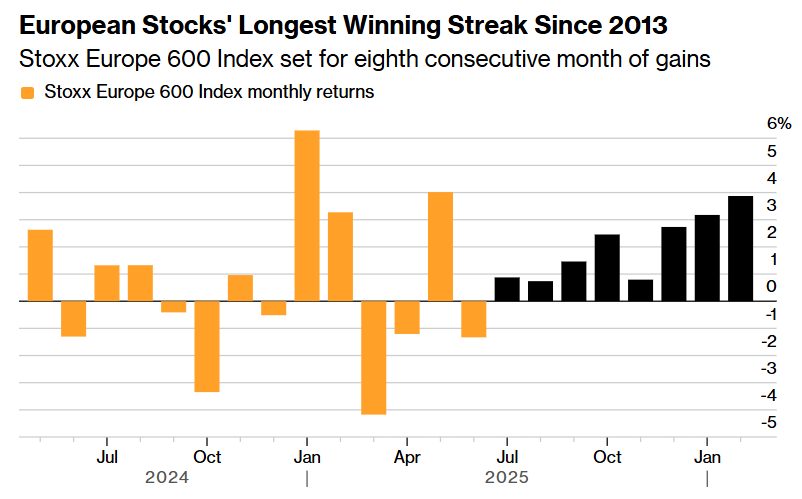
Core Viewpoint - European stock markets are on track to achieve the longest monthly winning streak since 2013, with a potential eight consecutive months of gains, driven by a shift in investor focus from the US market to Europe due to concerns over high valuations in tech stocks and the impact of AI on the digital economy [1][4]. Group 1: Market Performance - The Stoxx Europe 600 index has risen 3.6% in February and is expected to record strong gains for eight consecutive months, outperforming the S&P 500 by 6 percentage points year-to-date [1][4]. - European stock funds saw an inflow of approximately $3.2 billion this week, marking the fourth consecutive week of significant net inflows, totaling around $18 billion for the year so far [1][8]. Group 2: Sector Performance - Heavy asset sectors such as basic resources, energy, telecommunications, and utilities have shown strong performance, with some sectors experiencing double-digit increases, up to 25%, compared to a 7% rise in the Stoxx 600 index [4][7]. - Mining and healthcare stocks in the European market have performed the best, while tourism and media sectors lagged behind [1]. Group 3: Investment Trends - Investors are increasingly favoring heavy asset companies as a safe haven from the "AI disruption" narrative, leading to a significant rotation of funds into European stocks [5][6]. - The "HALO" (Heavy Assets, Low Obsolescence) stocks are gaining traction, as they are perceived to be less vulnerable to AI disruption, with a notable outperformance of 35% compared to lighter capital stocks since early 2025 [6][7]. Group 4: Economic Outlook - The recent rally in European stocks is attributed to the "heavy asset safe-haven effect" amid AI-related fears, robust corporate earnings growth, and positive economic momentum [8]. - Analysts maintain an overweight rating on European and emerging market stocks, anticipating that global capital will increasingly focus on these regions to mitigate exposure to the high valuations in the US market [8].

源达调研策略周报
Xin Lang Cai Jing· 2026-02-27 10:07
Industry Research Highlights - The most researched industries this week (2026/2/23-2026/2/27) include electronics, machinery, automotive, and light manufacturing, with electronics and light manufacturing seeing increased attention compared to the week before the Spring Festival, likely benefiting from export recovery or domestic demand policy expectations [5][20] - Over the past 30 days (2026/1/28-2026/2/27), the most researched industries were machinery, electronics, pharmaceutical biology, and basic chemicals, with a notable increase in the number of research institutions focusing on electronics and machinery [5][21] Company Research Highlights - The companies with the highest number of institutional research visits in the past week include Jerry Holdings, Tin Industry Co., and BOE Technology Group, with Jerry Holdings receiving 14 visits and 22 ratings from institutions [6][24] - Over the past 30 days, the most researched companies include Dazhu Laser, Jerry Holdings, and Hangzhou Bank, with Ninebot, JinkoSolar, and Zhongji Xuchuang also receiving significant attention [2][25] Key Company Insights 1. **Jerry Holdings** - Jerry Holdings is transitioning into a diversified technology-driven industrial group, expanding its core growth areas from traditional oil and gas equipment to gas turbine power generation, focusing on data centers, industrial energy, and new power systems, with over 3.4 billion yuan in gas turbine generator orders from North America [3][18] - The company has established long-term partnerships with Siemens, Baker Hughes, and Kawasaki Heavy Industries, and is enhancing its capabilities in power generation, storage, and distribution [10][29] - Jerry Holdings has completed capacity construction for electric drive/turbine fracturing equipment and gas turbine power generation equipment in North America, with ongoing expansion in Dubai [30][29] 2. **Tin Industry Co.** - Tin Industry Co. is the only A-share listed company with a complete tin industry chain, holding the largest global reserves of tin and indium, with a production capacity of 80,000 tons/year for tin smelting and 12,500 tons/year for cathode copper [11][31] - The company achieved significant revenue and net profit growth in the first three quarters of 2025, with revenues of 34.42 billion yuan and a net profit of 1.745 billion yuan, marking a year-on-year increase of 17.81% and 35.99%, respectively [14][32] - The global tin market is currently characterized by a tight supply-demand balance, with strong demand from emerging sectors such as renewable energy and semiconductor packaging, providing long-term opportunities for the company [18][32]
