储能

Search documents
两大新政下新型储能发展的三大转变!
中关村储能产业技术联盟· 2025-12-24 05:38
Core Viewpoint - The article discusses the significant policy directions and impacts on the renewable energy sector in China, particularly focusing on the integration and development of new energy systems as outlined in recent government documents [2][6]. Group 1: Energy Structure Transformation - China has established the world's largest and fastest-growing renewable energy system, with the share of solar and wind power generation capacity increasing from approximately 25% at the beginning of the 14th Five-Year Plan to 46% currently [3]. - As of October 2025, the total installed power generation capacity reached 375.171 million kilowatts, with solar power capacity at 114.018 million kilowatts (up 43.8% year-on-year) and wind power capacity at 59.039 million kilowatts (up 21.4% year-on-year) [4][3]. Group 2: Challenges in Renewable Energy Development - The challenges include balancing and consumption issues due to the intermittent nature of renewable energy, inadequate grid infrastructure, expanding demand for system regulation resources, the need for improved market mechanisms, and environmental impacts [5]. - The article emphasizes the need for a shift in the development logic of renewable energy, focusing on efficient utilization and multi-dimensional integration rather than solely relying on large power grids [5]. Group 3: Policy Guidance Directions - The recent policy documents aim to address systemic issues in renewable energy development, focusing on planning, infrastructure, market mechanisms, and technological innovation to ensure the reasonable consumption of over 200 million kilowatts of new energy annually by 2030 [6][10]. - The integration of renewable energy with other energy types and industries is highlighted as a core development path, promoting multi-dimensional collaborative development [8][9]. Group 4: Storage Development Impacts - The integration and market development requirements are broadening the application of energy storage, extending from traditional grid-side applications to user-side scenarios such as commercial peak shaving and virtual power plant aggregation [13][16]. - The market environment for energy storage is evolving, with new revenue models emerging that include capacity compensation and demand response, moving towards more refined management of storage operations [16][22]. Group 5: New Energy System Adaptation - The construction of a new power system is emphasized as a core support mechanism, focusing on enhancing regulation capabilities, grid capacity, and optimizing dispatch control [10][11]. - The article discusses the need for a unified national electricity market and the establishment of a regulatory environment that supports the unique characteristics of renewable energy [12].

英大证券晨会纪要-20251224
British Securities· 2025-12-24 03:55
Market Overview - The A-share market showed an upward trend on Tuesday morning, with major indices reaching recent rebound highs, but there was a pullback in the afternoon, reflecting cautious market sentiment [2][9] - The overall market remains in a volatile state, lacking effective support from new momentum, whether from macro policies or micro corporate earnings improvements, which are currently in a relative vacuum period [11] Sector Analysis - **New Energy Sector**: Stocks in the new energy sector, including energy metals, batteries, and lithium mining, showed collective gains. The demand for lithium batteries, photovoltaics, wind power, and energy storage continues to grow as global efforts to achieve carbon neutrality progress [7][9] - **Precious Metals Sector**: The precious metals sector saw an increase, driven by rising prices of gold, silver, platinum, and palladium. Factors contributing to this trend include the onset of a Federal Reserve rate cut cycle, increased geopolitical tensions, and strong demand for gold as a strategic reserve [8][9] Investment Strategy - The report suggests maintaining a consistent investment approach, focusing on sectors with performance support, such as technology growth (semiconductors, AI themes, robotics), cyclical industries (photovoltaics, batteries, chemicals), and dividend stocks (banks, utilities) [3][11] - Investors are advised to avoid high-valuation stocks lacking earnings support and to consider buying on dips in sectors with solid fundamentals [3][11]
锚定“样板间”使命 奋力谱写儋州洋浦高标准建设海南自贸港新篇章
Hai Nan Ri Bao· 2025-12-24 03:08
Core Viewpoint - The article emphasizes the strategic positioning of Danzhou Yangpu in building a high-standard model for Hainan Free Trade Port, focusing on high-level openness and modern industrial development to leverage the opportunities presented by the full closure of the Hainan Free Trade Port [1][2]. Group 1: High-Level Openness and Policy Implementation - High-level openness is identified as a core requirement for creating the model for the Free Trade Port, with Yangpu Economic Development Zone serving as a key platform for external cooperation [2]. - Danzhou Yangpu aims to fully implement Free Trade Port policies, enhance the number of enterprises benefiting from these policies, and reform the ship registration system to improve international competitiveness [2]. - The strategy includes expanding institutional openness and strengthening cooperation with regions like the Guangdong-Hong Kong-Macao Greater Bay Area and the Yangtze River Economic Belt [2]. Group 2: Modern Industrial System Development - Danzhou Yangpu plans to establish a modern industrial system with a focus on new materials, new energy, digital economy, and biomedicine, leveraging post-closure policy advantages [3]. - The goal is to develop a billion-level petrochemical new materials industry cluster and expand the renewable energy sector, including wind, solar, and hydrogen energy [3]. - The digital economy will be enhanced through initiatives like the International Information Port and Smart Yangpu Data Center, aiming to integrate digital technology with traditional industries [3]. Group 3: Business Environment and Social Development - The region is committed to creating a first-class business environment to support enterprise growth, emphasizing the importance of a vibrant private economy and streamlined government services [4]. - Danzhou Yangpu will focus on improving public services in education and healthcare, enhancing social security systems, and promoting high-quality population development [4]. - Infrastructure development will be prioritized to create a livable environment, fostering coordinated regional development among various economic zones [4]. Group 4: Governance and Community Engagement - The governance framework will emphasize the centralized leadership of the Party, strengthening grassroots organizational construction to promote high-quality development [5]. - Efforts will be made to ensure integrity in governance and to engage the community in the development process, fostering a collaborative environment for achieving the goals of the Free Trade Port [5].
海博思创:子公司拟投资20亿元建设智能绿色储能工厂项目
Xin Jing Bao· 2025-12-24 03:05
Core Viewpoint - The company Haibo Sichuang announced the initiation of the "Haibo Sichuang Intelligent Green Energy Storage Factory Project" with a total investment of 2 billion yuan [1] Group 1: Project Overview - The project will be located in the Beijing High-end Manufacturing Base in Fangshan District, Beijing [1] - The core business of the project includes research, development, manufacturing, and testing of energy storage integration systems [1] - The project aims to establish an integrated energy storage industrial base that includes system integration production lines, R&D testing centers, and supporting facilities [1] Group 2: Strategic Goals - The initiative is designed to enhance the scale and intelligence of high-end energy storage product R&D, manufacturing, and testing capabilities [1]
国金证券:能源转型叠加AI驱动 储能周期反转步入繁荣期
Zhi Tong Cai Jing· 2025-12-24 02:48
Core Insights - The global energy storage industry is entering a new growth cycle, with an expected addition of 438 GWh of new installations by 2026, representing a year-on-year growth of 62% [1] - The growth drivers have shifted from solely renewable energy consumption to a combination of "AI computing infrastructure + energy transition demand + grid congestion" [1] - The supply-demand relationship in the industry is significantly improving, transitioning from a destocking phase to a replenishment boom, leading to simultaneous increases in both volume and price in certain segments of the supply chain [1] Regional Insights - China is projected to install 250 GWh by 2026, a year-on-year increase of 67%, with policies shifting from "strong allocation" to "profitability" [2] - The United States is expected to add 70 GWh of installations by 2026, a 35% increase year-on-year, driven by AI [2] - Europe is forecasted to install 51 GWh by 2026, a 55% increase year-on-year, with long-term contracts locking in gigawatt-level demand [2] - Emerging markets are anticipated to add 67 GWh by 2026, a 91% increase year-on-year, with significant growth in Australia, the Middle East, and Chile [2] Technological Developments - AI computing is becoming synonymous with electricity, with energy storage evolving from merely backup power to active supply, addressing voltage fluctuations and serving as a strategic infrastructure for AI data centers [3] - The mismatch between rapid renewable energy generation and slow grid development is intensifying, making energy storage a critical solution for congestion [4] - Solid-state batteries are expected to enter small-scale production by 2026, marking a significant step towards commercialization across various applications [7] Supply Chain and Market Dynamics - The lithium battery supply is expected to recover by 2026 after a two-year destocking phase, driven by sustained high demand from AI and energy storage, while supply expansion slows due to reduced capital expenditure [6] - Trade barriers are increasing, with the U.S. and EU implementing stricter regulations, favoring companies with localized production capabilities [5] Investment Recommendations - Focus on midstream materials that are expected to benefit from supply-demand reversals, particularly lithium fluoride, lithium carbonate, separators, and electrolyte additives [8] - Invest in leading companies with localized manufacturing capabilities and strong ESG frameworks, such as CATL and Sungrow, to capitalize on high-profit markets while mitigating tariff risks [8][9] - Target companies that can integrate into the overseas data center supply chain, providing solar-storage solutions and microgrid systems [9]



肥城储能“三重奏”
Da Zhong Ri Bao· 2025-12-24 02:40
Core Insights - The new policy in 2025 marks the end of the era where the energy storage industry relied heavily on government mandates, shifting towards a market-driven approach [1][3] - The city of Tai'an, particularly Feicheng, is emerging as a microcosm of the new energy storage industry, developing a comprehensive supply chain that includes R&D, manufacturing, operation, and services [2][3] Policy Changes - The cancellation of mandatory energy storage requirements for new energy power plants signifies a critical transition for the energy storage sector, compelling companies to achieve commercial viability without direct subsidies [3][11] - The "136 Document" issued by the National Development and Reform Commission and the National Energy Administration emphasizes market-driven efficiency and business model innovation in the energy storage industry [3][11] Industry Developments - As of September 2025, Shandong province has an operational capacity of 9.65 million kilowatts in new energy storage, ranking third in the country [4] - Feicheng is transforming abandoned salt caverns into compressed air energy storage facilities, attracting multiple large-scale projects and creating a potential trillion-yuan industry [3][5] Technological Innovations - The use of abandoned salt caverns for compressed air energy storage is economically advantageous, with cost savings of approximately 25% compared to traditional methods [4][5] - The first commercial compressed air energy storage plant in Feicheng has catalyzed rapid development in this sector, leading to significant investments and projects from major state-owned enterprises [6][9] Economic Impact - Feicheng aims to establish itself as a leading hub for compressed air energy storage, with 22 projects under construction or negotiation, totaling an investment of 34 billion yuan [6][10] - The local government is actively facilitating the development of a closed-loop industrial chain, integrating salt mining, energy storage, and equipment manufacturing [7][10] Future Directions - The city is also exploring sodium-ion batteries as a strategic alternative to lithium batteries, aiming to mitigate risks associated with lithium resource scarcity [12][13] - A significant investment of 3 billion yuan is underway for a sodium-ion battery manufacturing project, with the first production line expected to launch soon [17] Challenges Ahead - The energy storage industry faces structural challenges, including a reliance on policy support and the finite nature of salt cavern resources [18][19] - Attracting high-end research talent and fostering original innovation capabilities remain critical for sustaining growth and competitiveness in the energy storage sector [19][20]
从“内卷”到“印钞”:储能价格战终结背后 一场关乎万亿电力的价值重估
Quan Jing Wang· 2025-12-24 02:20
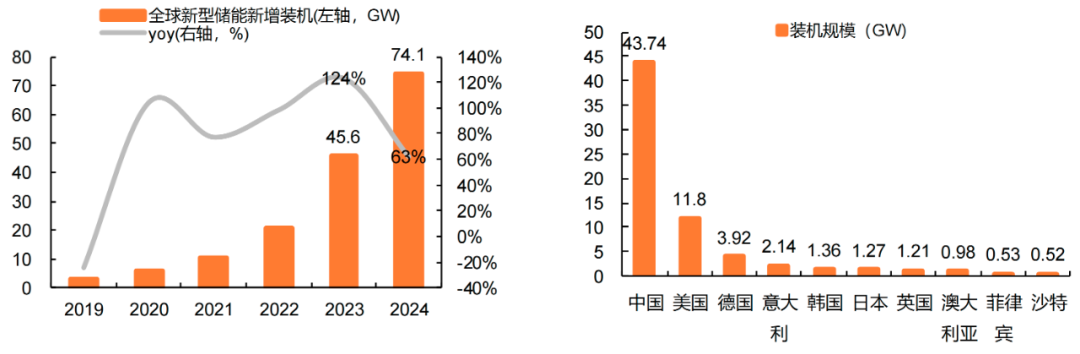
Core Viewpoint - The energy storage industry is experiencing a robust growth phase driven by strong demand both domestically and internationally, with leading battery companies operating at full capacity and battery prices continuing to rise, indicating a shift towards a more profitable and sustainable business model [1] Group 1: Demand Explosion - Global energy storage installations are on the rise, with China being the largest market. In 2024, global new energy storage installations are expected to reach 74 GW, a 62.5% increase year-on-year. China, the US, and Europe will account for 90% of this growth [2] - In 2024, China's new energy storage installations are projected to reach 43.7 GW, a 103% increase year-on-year, marking the first time installations exceed 100 GWh [2] Group 2: Policy Changes - The release of the "136 Document" in February 2025 marks a significant policy shift, ending the controversial "mandatory storage" era and allowing energy storage to operate independently in the electricity market [4] - The "New Energy Storage Scale Construction Action Plan (2025-2027)" aims for a national energy storage capacity of over 180 million kilowatts by 2027, promoting diverse revenue channels for energy storage [4] Group 3: Market Dynamics - In the first half of 2025, new energy storage projects in China added 23.0 GW, with a year-on-year increase of 68% in both power and energy capacity [6] - Local governments are introducing capacity price subsidies, leading to an internal rate of return (IRR) of 6-12% for energy storage projects, significantly boosting bidding and registration volumes [7] Group 4: International Market Trends - In the US, the rapid growth of AI data centers is reshaping energy demand, with projections indicating that by 2030, AI data centers could account for over 20% of electricity demand. This is expected to drive a significant increase in energy storage installations [9] - The European market is also expanding, with expected installations of 20 GWh in 2025, a 131% increase year-on-year, driven by supportive capacity pricing policies [9] Group 5: Price Recovery - The energy storage market is witnessing a price recovery, with the average price of 2-hour storage systems rising by 31% in September 2025. This marks a departure from the previous low-price competition [13][14] - The introduction of capacity pricing and spot markets is expected to enhance the profitability of independent energy storage, leading to sustained demand and price increases [14] Group 6: Conclusion - The growth of the energy storage sector is closely linked to the transition towards renewable energy and the evolving electricity system, positioning it as a critical infrastructure in the AI era [16] - Major players in the industry, including leading battery manufacturers and specialized companies, are being propelled to the forefront of this transformative wave [16][18]

格林大华期货早盘提示:股指-20251224
Ge Lin Qi Huo· 2025-12-24 01:36
| 6、高盛认为中国 AI 模型与美国顶尖模型的差距已缩窄至 3-6 个月。此外研报认为 | | --- | | 字节跳动豆包手机助手等 AI 助手的推出,可能预示着移动应用流量格局的根本性 | | 改变。预计中国头部云服务商 2026 年资本开支将进一步攀升至 5000 亿元。 | | 7、字节跳动初步计划的 2026 年资本支出达 1600 亿元人民币,较今年的 1500 亿元 | | 有所增长。投资重点将集中在 AI 基础设施建设上,其中约一半资金将用于采购先 | | 进芯片以开发 AI 模型和应用。 | | 8、国际半导体产业协会(SEMI)日前发布报告显示,2025 年全球原始设备制造商 | | (OEM)的半导体制造设备总销售额预计达 1330 亿美元,同比增长 13.7%,创历史 | | 新高。预计 2026 年和 2027 年分别达到 1450 亿美元和 1560 亿美元。 | | 9、全国机器人租赁生态峰会暨"擎天租"平台发布会在上海举行。会上,智元机 | | 器人发布机器人租赁平台"擎天租",标志着具身智能行业将向生态化、服务化的 | | 租赁模式深度演进。 | | 10、GGII(高工产 ...
硬氪独家|正浩创新引入前华为高管,开启组织转型
3 6 Ke· 2025-12-24 01:32
Core Insights - Peter Tong, former head of Huawei's consumer business, has joined Zhenghao Innovation, holding a significant position just below the founder and CEO Wang Lei [1] - Zhenghao Innovation has become a unicorn with a valuation and revenue exceeding $1 billion, focusing on portable energy storage products [5] Group 1: Leadership Changes - Peter Tong is the largest shareholder of Shenzhen Haozheng Xingchen Enterprise Management Partnership, holding 44.6% of the shares [1] - Zhenghao Innovation has seen a significant influx of talent from Huawei, including former Huawei VP Jimmy Hu, indicating a strategic shift in organizational structure [4][5] - The company is undergoing a major personnel change, with the departure of CTO Chen Xi, who was instrumental in technology development [4] Group 2: Market Position and Strategy - Zhenghao Innovation leads the global portable energy storage market with a 25.8% market share, having sold over 1 million units of its DELTA 2 product [6][8] - The company is expanding into the home energy storage market, facing competition from major players like Tesla and Huawei, as well as challenges from companies like Anker Innovation [8] - Zhenghao Innovation is preparing for an IPO, aiming to raise at least $300 million, highlighting the urgency for internal organizational upgrades [8] Group 3: Organizational Challenges - The integration of Huawei executives into Zhenghao Innovation is seen as a response to the need for organizational restructuring as the company scales [6][9] - Previous experiences with Huawei executives in other companies have shown mixed results, raising questions about the adaptability of such leadership in startup environments [9] - The outcome of Zhenghao Innovation's organizational changes will be crucial for its IPO process and long-term sustainability in balancing growth and organizational capability [9]

北京发放首批L3级高速公路自动驾驶车辆专用号牌;金、银、铜价格齐创新高丨盘前情报
2 1 Shi Ji Jing Ji Bao Dao· 2025-12-24 01:04
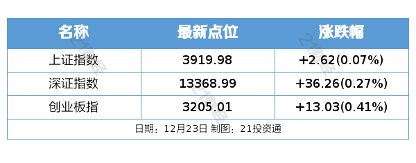
Market Overview - On December 23, the A-share market experienced a pullback after an initial rise, with the three major indices briefly turning negative. The Shanghai Composite Index closed up 0.07%, the Shenzhen Component Index up 0.27%, and the ChiNext Index up 0.41% [1][2] - The total trading volume in the Shanghai and Shenzhen markets reached 1.9 trillion yuan, an increase of 37.9 billion yuan compared to the previous trading day [1] Sector Performance - The Hainan Free Trade Zone concept showed strength, while the lithium battery sector also performed well. Liquid-cooled servers saw a rise in the afternoon, and semiconductor equipment concepts were active. The tungsten sector was notably active as well [1] - Conversely, the commercial aerospace concept experienced a pullback, and several tourism-related stocks declined. The top-performing sectors included photolithography machines, batteries, and the Hainan Free Trade Zone, while tourism and hotels, as well as commercial aerospace, saw the largest declines [1] International Market - In the U.S. stock market, the Dow Jones Industrial Average rose by 79.73 points to close at 48,442.41, a gain of 0.16%. The S&P 500 increased by 31.30 points to 6,909.79, up 0.46%, and the Nasdaq Composite rose by 133.02 points to 23,561.84, up 0.57% [3][4] - European markets showed mixed results, with the UK FTSE 100 up 0.24%, the French CAC40 down 0.21%, and the German DAX up 0.23% [3][4] - International oil prices saw slight increases, with WTI crude oil futures rising by $0.37 to $58.38 per barrel, and Brent crude oil futures up $0.31 to $62.38 per barrel [3] Key Developments - Beijing issued the first batch of L3-level autonomous driving vehicle special license plates, marking a significant milestone in the country's autonomous driving industry [5] - Semiconductor manufacturer SMIC has implemented a price increase of approximately 10% on some of its production capacity, driven by rising demand from mobile applications and AI [5] - The Chinese Ministry of Commerce expressed strong opposition to the U.S. adding foreign drone systems to its "untrusted supplier list," highlighting concerns over market distortion and unilateral actions [5] Commodity Market - Precious metals saw significant price increases, with gold prices nearing $4,500 per ounce and silver prices reaching $71.575 per ounce. Copper prices also hit a record high of $12,159.5 per ton [6][7] - The Shanghai Gold Exchange announced measures to strengthen market risk control due to recent volatility in precious metal prices [7] Institutional Insights - Historical trends suggest that the market tends to exhibit defensive characteristics towards the end of the year, with a preference for large-cap value stocks over small-cap stocks [8] - Analysts expect January 2026 to continue showing a narrow trading range, with a focus on sectors related to insurance, agriculture, and aerospace [8]