
石油天然气

Search documents
张维为《这就是中国》293期:地缘政治安全与中国能源安全
Guan Cha Zhe Wang· 2025-07-27 00:36
Core Viewpoint - China's energy strategy is crucial for national security, especially in the context of ongoing global geopolitical tensions, such as the Russia-Ukraine war and conflicts in the Middle East, which impact energy supply and security [1][3]. Group 1: Energy Production and Consumption - China is the world's largest producer and consumer of coal, accounting for nearly half of global coal production and consumption, approximately 4 billion tons, with coal making up about 54% of its primary energy consumption [3][4]. - As of April 2023, China is also the largest renewable energy country, with solar photovoltaic capacity of about 1 billion kilowatts, representing 40% of global capacity, and wind power capacity of 550 million kilowatts, accounting for 45% of the global total [4][6]. - China ranks as the seventh largest oil producer and the fourth largest natural gas producer globally, while being the largest importer of both oil and natural gas, with a projected oil import dependency of around 72% in 2024 [6][7]. Group 2: Energy Security Assessment - China's energy security can be described as sensitive but not fragile, with a self-sufficiency rate of approximately 85%, as coal does not require imports, and non-fossil energy sources are domestically produced [7][8]. - The implementation of the "Oil and Gas Increase Storage and Production Seven-Year Action Plan" has led to an increase in domestic oil production from 189 million tons in 2018 to 213 million tons in 2024, with a net increase of 4 million tons annually [8][9]. - Current global oil and gas markets are characterized by oversupply, benefiting China's import strategy, as major producers like Saudi Arabia and Russia are increasing their output [9][10]. Group 3: Global Energy Market Integration - China has established a diversified energy import strategy, integrating into the global energy market through various oil and gas cooperation projects across 35 countries, including significant pipelines and strategic partnerships [10][11]. - The development of energy corridors, such as the China-Kazakhstan oil pipeline and the China-Central Asia gas pipeline, has become essential for ensuring energy security and is a hallmark of the Belt and Road Initiative [11][12]. Group 4: Future Energy Transition - The transition to renewable energy is critical, with a focus on key minerals like lithium, cobalt, and nickel, which are essential for energy storage technologies, highlighting the need for domestic production capabilities to reduce import dependency [13][14]. - China's energy strategy emphasizes the importance of maintaining a balance between traditional fossil fuels and renewable energy, with coal's share expected to decrease while natural gas consumption is projected to rise until around 2040 [14][40].


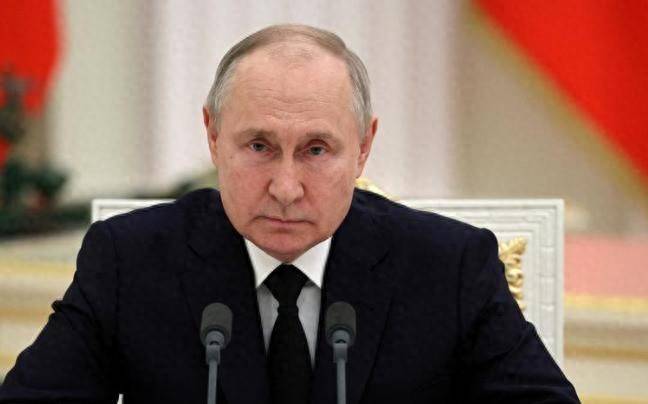
普京终于清醒了,仅靠卖石油天然气收入,俄罗斯只会沦为末流国家
Sou Hu Cai Jing· 2025-07-26 23:43
Core Insights - The article discusses Russia's reliance on oil and gas exports amidst Western sanctions and highlights President Putin's realization that this dependency is unsustainable for the country's future [1][3][5]. Economic Structure - Putin acknowledges that relying solely on resource sales is not a viable long-term economic strategy, indicating a need for structural change in the economy [3][5]. - The article notes that since the onset of the Ukraine conflict, over 30,000 sanctions have been imposed on Russia, affecting key sectors such as energy, finance, technology, and transportation [3][6]. Technological Challenges - The article emphasizes that Russia's historical reliance on military and energy exports has left it vulnerable, especially as global energy demands shift towards renewable sources [6][8]. - It points out that Russia is lagging in technological advancements, particularly in fields like artificial intelligence and biotechnology, which are crucial for modern power dynamics [8][10]. Military and Economic Implications - The ongoing conflict has exposed Russia's military shortcomings, including a lack of advanced weaponry and technology, which has been exacerbated by the war [10][12]. - The article contrasts Russia's traditional heavy industry and energy-based military strategy with Ukraine's resilience, supported by Western technological aid [12][16]. Future Opportunities - Despite the challenges, there are opportunities for Russia to pivot towards technology and innovation, leveraging its educational foundation and scientific talent [12][14]. - Putin's call for redirecting resource revenues into high-tech sectors like semiconductors and aerospace indicates a potential shift in economic focus [14][16].
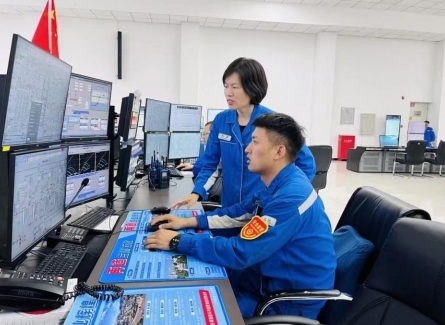
中石油山东济南分公司:酷暑送清凉,关爱沁心田
Qi Lu Wan Bao· 2025-07-25 22:45
Core Viewpoint - The company has initiated a "Cool Delivery" activity to provide care and support to employees working in high-temperature conditions, demonstrating a commitment to employee welfare and safety. Group 1: Response and Action - The company promptly responded to the directive from the party committee, mobilizing the local branch to address employee needs and implement a cooling support plan efficiently [2] - The entire process from planning to delivery was seamless, ensuring that the care from the company reached employees in a timely manner [2] Group 2: Employee Care and Support - The local branch prioritized precise care by selecting refreshing items such as watermelons, green beans, and beverages to help employees cope with the heat [3] - Every expense was carefully considered to ensure that resources were allocated effectively to meet employee needs [3] Group 3: Coverage and Impact - The local branch ensured that every station and employee received the cooling supplies, regardless of location or workload, fostering a sense of appreciation among employees [4] - The smiles and gratitude expressed by employees highlighted the positive impact of the initiative on team morale and cohesion [4] Group 4: Safety and Commitment - Employees expressed that the organization's concern was a valuable gift during the heat, promising to convert this care into a strong motivation for maintaining safety and health [5] - The "Cool Delivery" initiative not only provided immediate relief but also reinforced the foundation for safe production practices within the company [5]
旺季需求提振,7月油价处相对高位
HTSC· 2025-07-25 10:01
Investment Rating - The report maintains an "Overweight" rating for the oil and gas sector [5]. Core Views - The demand for oil has been supported by the traditional peak season in the Northern Hemisphere, with oil prices remaining relatively high since July [1][11]. - The report indicates that the actual tightness in the oil market may be greater than the IEA's supply-demand balance suggests, highlighting the importance of OPEC+'s production adjustments and seasonal consumption trends [1][4]. - Long-term, high-dividend energy companies with the ability to increase production and reduce costs, as well as those with growing natural gas operations, are expected to present investment opportunities [4][66]. Demand Side Summary - Global oil demand growth slowed significantly in Q2 2025, dropping from 1.1 million barrels per day in Q1 to 0.55 million barrels per day in Q2 [2][17]. - China's commercial crude oil inventory saw a record quarterly increase, which is crucial for long-term energy security [2][23]. - The traditional peak season for travel and electricity demand in Q3 is expected to further tighten the market, with historical data indicating a combined increase of 900,000 barrels per day in oil demand for power generation from May to August [2][23]. Supply Side Summary - Global oil supply is projected to increase by 2.1 million barrels per day in 2025 and 1.3 million barrels per day in 2026, with OPEC+ accelerating production [3][38]. - In June, oil exports from the Gulf region surged, driven by concerns over supply disruptions due to geopolitical tensions [3][43]. - OPEC+ has raised its production targets for August, indicating a significant reduction in voluntary production cuts implemented since 2023, which could lead to an oversupply in the market [3][43][66]. Key Recommendations - The report recommends investing in high-dividend energy companies with the capacity to increase production and reduce costs, specifically highlighting China National Offshore Oil Corporation (CNOOC) and China Petroleum [4][66]. - The forecast for Brent crude oil prices is set at $68 and $62 per barrel for 2025 and 2026, respectively, with Q3 and Q4 2025 prices expected to be $68 and $63 per barrel [4][66].

信息化补强、数字化赋能、智能化发展 “数智中国石油”建设驶入快车道
Jing Ji Wang· 2025-07-25 09:56
Core Viewpoint - China National Petroleum Corporation (CNPC) is undergoing a significant digital and intelligent transformation to enhance production efficiency, optimize operations, and innovate business models, aiming for high-quality development in the energy sector [1][2]. Group 1: Digital Transformation Initiatives - CNPC has launched the "Smart China National Petroleum" initiative as part of its strategic measures to drive governance, production, management, and technological innovation through digitalization [1][2]. - The company has established a comprehensive digital governance framework, including the formation of various leadership groups to oversee digital transformation efforts [2]. - A data governance campaign has been initiated to address issues related to data fragmentation and quality, accelerating the information enhancement project [2]. Group 2: Operational Efficiency Improvements - CNPC has optimized 13,000 processes into 923 standardized units, reducing data coding volume by over 35%, which has led to significant improvements in operational management [4]. - The company has achieved a 90% automation rate for financial vouchers and a 70% automation rate for report generation across 145 domestic units [5]. - The implementation of smart operations systems has enhanced decision-making capabilities and emergency response coordination across the entire production chain [4]. Group 3: Technological Advancements - CNPC is developing a comprehensive digital ecosystem that includes a financial shared service system and a cloud platform for shale oil, enhancing operational efficiency and data utilization [6][8]. - The company has successfully deployed 58 digital employees using RPA technology, saving over 1,400 hours of work monthly, equivalent to adding eight management personnel without increasing labor costs [8]. - The development of the Kunlun large model has significantly improved efficiency in seismic interpretation and reduced project cycles by over 20% [9]. Group 4: Smart Energy Solutions - CNPC's smart oil fields have integrated over 15 petabytes of exploration and production data, achieving a 90% real-time data entry rate and enhancing operational efficiency by 20% [11]. - The smart gas sales system has connected 940,000 devices and optimized gas supply plans, contributing to the formation of an "Internet + Energy + Life" ecosystem [11]. - The company has established a comprehensive energy station management system that monitors over 20,000 gas stations and 60,000 charging piles, enhancing service delivery and customer engagement [11]. Group 5: Industry Leadership and Recognition - CNPC has been recognized as a pilot enterprise for digital transformation by the State-owned Assets Supervision and Administration Commission, showcasing its leadership in the energy sector [12]. - The company has developed advanced software for seismic data processing, which is now one of the three major mainstream exploration software globally, demonstrating its technological prowess [12].
上市公司动态 | 中金黄金公布学生参观子公司溺亡情况说明,常熟银行拟合并三家村镇银行,宁波银行上半年净利同比增8.23%
Sou Hu Cai Jing· 2025-07-24 15:45
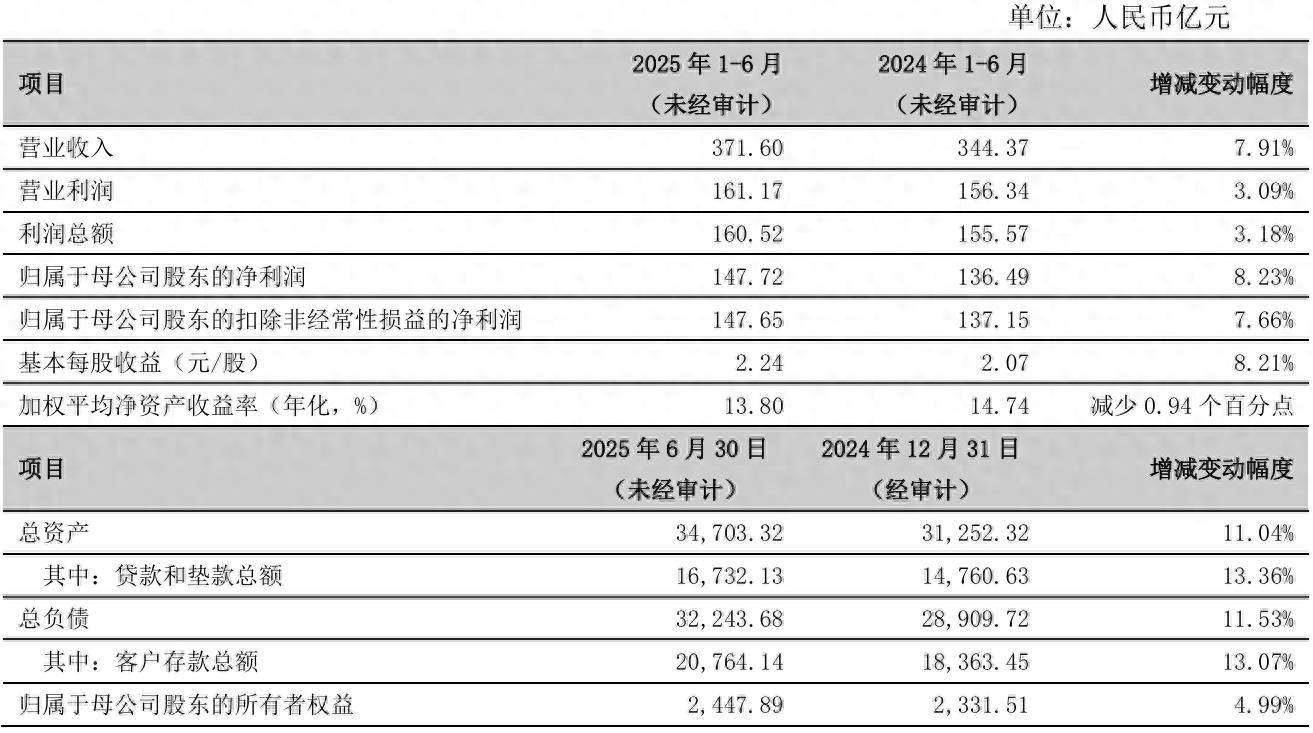
Group 1 - China Gold announced that six students from Northeast University drowned during a visit to its subsidiary, China Gold Group Inner Mongolia Mining Co., Ltd. The incident occurred when a grid plate fell, causing them to fall into a flotation tank. All six were confirmed dead after rescue efforts, and one teacher was injured. The company has activated its emergency plan and is coordinating with local authorities [1] Group 2 - Changshu Bank plans to absorb and merge three village banks and establish branch offices. As of the end of 2024, the total assets of Binhai Xingfu were 1.59 billion yuan, with total deposits of 1.38 billion yuan and total loans of 1.405 billion yuan, showing a non-performing loan ratio of 0.98% and a provision coverage ratio of 361.10% [2] Group 3 - Ningbo Bank reported a net profit of 14.772 billion yuan for the first half of 2025, an increase of 8.23% year-on-year. The bank's total assets reached 3.470 trillion yuan, up 11.04% from the end of the previous year, with total customer deposits of 2.077 trillion yuan, a 13.07% increase [3][4] Group 4 - Zhejiang Merchants Securities reported a net profit increase of 46.54% for the first half of the year [6] Group 5 - China Petroleum & Chemical Corporation (Sinopec) reported a 2.0% year-on-year increase in oil and gas equivalent production for the first half of 2025 [8] Group 6 - Guangzhou Zhujiang Development Group's non-public stock issuance has been approved, aiming to issue up to 256 million A-shares at a price of 2.92 yuan per share, raising no more than 748 million yuan for working capital and debt repayment [9] Group 7 - Full Build Co., Ltd. plans to raise no more than 180 million yuan through a private placement, while Fute Technology aims to raise no more than 528 million yuan [10] Group 8 - Huashu Media reported a total revenue of 4.435 billion yuan for the first half of 2025, a year-on-year increase of 2.07%, with a net profit of 254 million yuan, up 4.63% [13]


中国石化上半年原油产量初步数据1.4亿桶
news flash· 2025-07-24 09:27
智通财经7月24日电,中国石化发布2025年上半年生产经营数据,上半年原油产量初步数据1.4亿桶,同 比下降0.3%;天然气产量初步数据7,362.8亿立方英尺同比增长5.1%。 中国石化上半年原油产量初步数据1.4亿桶 ...

中证香港300价值指数报3220.23点,前十大权重包含工商银行等
Jin Rong Jie· 2025-07-24 09:02
Group 1 - The core viewpoint of the news is the performance of the China Securities Hong Kong 300 Value Index, which has shown significant growth over various time frames, indicating a positive market trend [1][2]. - The China Securities Hong Kong 300 Value Index has increased by 6.54% in the past month, 18.03% in the past three months, and 22.11% year-to-date [1]. - The index is composed of four sub-indices: the China Securities Hong Kong 300 Growth Index, the China Securities Hong Kong 300 Value Index, the China Securities Hong Kong 300 Relative Growth Index, and the China Securities Hong Kong 300 Relative Value Index [1]. Group 2 - The top ten holdings of the China Securities Hong Kong 300 Value Index include major companies such as China Construction Bank (10.36%), HSBC Holdings (9.8%), and China Mobile (7.29%) [1]. - The financial sector dominates the index's industry composition, accounting for 59.00%, followed by communication services at 10.98% and energy at 10.50% [2]. - The index undergoes semi-annual adjustments, with sample changes implemented on the next trading day after the second Friday of June and December [2].



国家统计局:7月中旬生猪(外三元)价格跌4.6%
news flash· 2025-07-24 01:33
Group 1 - The core point of the article is that the price of live pigs (external three yuan) has decreased by 4.6% in mid-July compared to early July 2025 [1] - Among 50 monitored important production materials, 28 products saw price increases, while 20 experienced price declines, and 2 remained unchanged [1] - The price of live pigs is now at 14.4 yuan per kilogram, reflecting a decrease of 0.7 yuan [2] Group 2 - The price of rebar (Φ20mm, HRB400E) increased by 52.4 yuan, marking a rise of 1.7% [2] - The price of aluminum ingots (A00) decreased by 141.2 yuan, a decline of 0.7% [2] - The price of liquefied natural gas (LNG) increased by 38.7 yuan, reflecting a rise of 0.9% [2] - The price of urea (medium and small particles) increased by 2.1 yuan, a rise of 0.1% [3] - The price of natural rubber (standard rubber SCRWF) increased by 477.3 yuan, marking a significant rise of 34% [3]
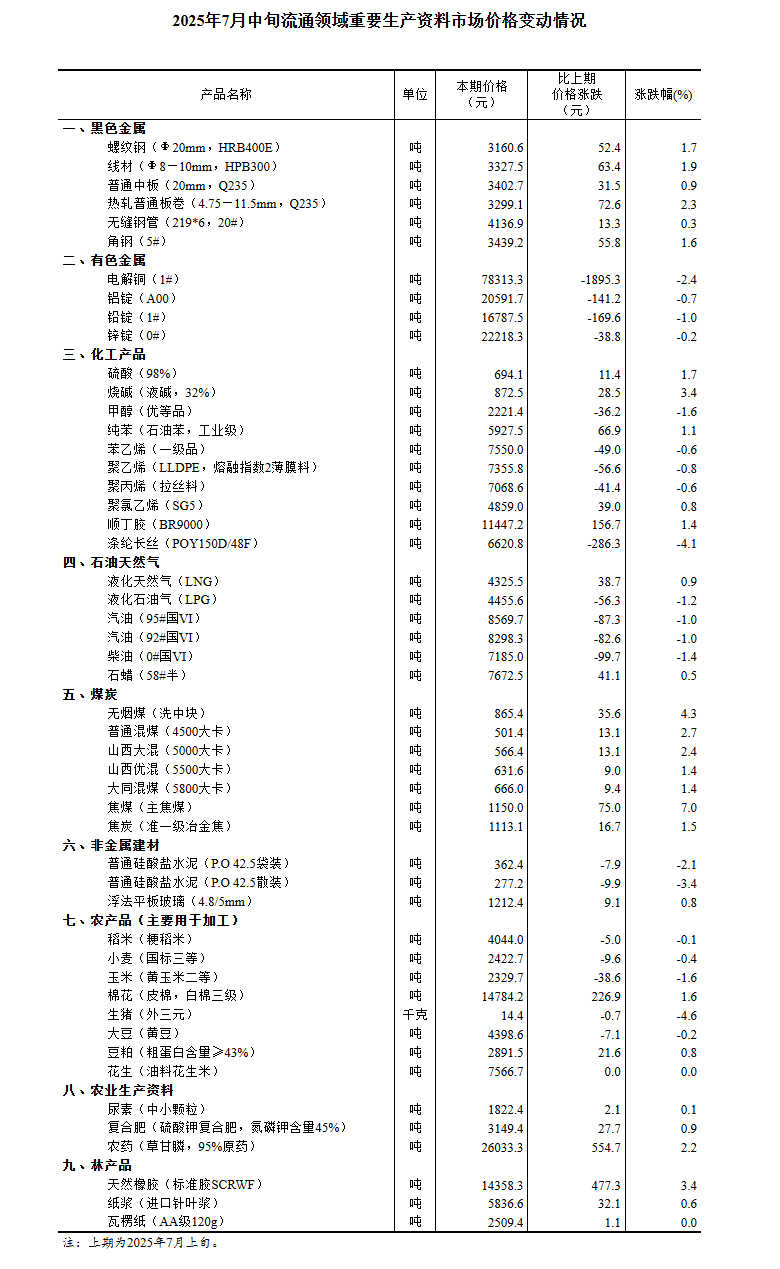
2025年7月中旬流通领域重要生产资料市场价格变动情况
Guo Jia Tong Ji Ju· 2025-07-24 01:30
Core Viewpoint - The monitoring of market prices for 50 important production materials across nine categories indicates a mixed trend, with 28 products experiencing price increases, 20 seeing declines, and 2 remaining stable in mid-July 2025 compared to early July 2025 [2][3]. Group 1: Price Changes in Major Categories - In the black metal category, notable price increases include rebar at 3160.6 CNY per ton (up 1.7%), wire rod at 3327.5 CNY per ton (up 1.9%), and hot-rolled ordinary plates at 3299.1 CNY per ton (up 2.3%) [4]. - In the non-ferrous metals category, prices for electrolytic copper decreased by 1895.3 CNY per ton (down 2.4%), while aluminum ingots fell by 141.2 CNY per ton (down 0.7%) [4]. - Chemical products showed mixed results, with sulfuric acid increasing by 11.4 CNY per ton (up 1.7%) and methanol decreasing by 36.2 CNY per ton (down 1.6%) [4]. Group 2: Energy and Coal Prices - In the petroleum and natural gas sector, liquefied natural gas (LNG) rose to 4325.5 CNY per ton (up 0.9%), while liquefied petroleum gas (LPG) fell to 4455.6 CNY per ton (down 1.2%) [4]. - Coal prices also saw increases, with anthracite coal at 865.4 CNY per ton (up 4.3%) and coking coal at 1150.0 CNY per ton (up 7.0%) [4]. Group 3: Agricultural Products and Inputs - In agricultural products, cotton prices increased by 226.9 CNY per ton (up 1.6%), while corn prices decreased by 38.6 CNY per ton (down 1.6%) [5]. - Fertilizer prices showed a slight increase, with urea at 1822.4 CNY per ton (up 0.1%) and compound fertilizer at 3149.4 CNY per ton (up 0.9%) [5]. Group 4: Monitoring Methodology - The price monitoring encompasses a wide range of products across 31 provinces, involving nearly 2000 wholesalers and dealers, ensuring comprehensive coverage of the market [8][9]. - The methodology includes on-site price collection, as well as inquiries via phone and electronic communication [9].