
科技

Search documents
隔夜美股 | 中国资产暴涨,美股三大指数小幅收涨
Sou Hu Cai Jing· 2025-09-30 03:32
Group 1 - The U.S. stock market saw all three major indices rise, with technology stocks leading the gains, particularly driven by strong performances from Nvidia and Microsoft [1] - The market sentiment was boosted by expectations of a Federal Reserve interest rate cut and news of some corporate mergers [1] - The Nasdaq China Golden Dragon Index experienced significant gains, with popular Chinese concept stocks like Luokung, Xunlei, Alibaba, and New Oriental all rising [1] Group 2 - The derivatives market is heavily betting on a nearly 90% probability of a rate cut by the Federal Reserve in October [1] - However, risks such as a potential U.S. government shutdown and delays in the release of key economic data may increase short-term market volatility [1]
中经评论:数据向好为何美股负面反应
Jing Ji Ri Bao· 2025-09-30 00:01
"卖事实"的交易逻辑也在此轮市场调整中凸显。在降息前,市场已提前押注宽松预期,推动标普 500指数在9月初创下历史新高。当降息落地且经济数据超预期后,投资者反而选择获利了结。此次GDP 数据公布后,美元指数短线拉升、美债收益率攀升,正是资金重新定价的体现。这种"利好出尽是利 空"的现象,反映出市场在政策拐点阶段的脆弱性。 进一步看,美国经济增长动力堪忧。二季度GDP上调的主要贡献来自消费支出与进口下降,而后者 恰恰反映内需动能的不可持续性。美国政府计划于10月起对家具、药品等进口商品加征高额关税,可能 进一步推高国内通胀,抑制企业利润。与此同时,就业市场虽保持韧性,但首次申请失业金人数的波动 显示劳动力市场已出现分化迹象。美联储内部对未来政策的分歧加剧也动摇了市场对政策连贯性的信 心。 历史上,经济数据与美国股市走势"背离"往往出现在周期尾部。2022年,强劲的非农数据曾引发美 股大跌,因市场担忧加息加速;而今,相似的逻辑以反向形式重现:降息周期中,数据向好反而意味着 政策宽松空间收窄。此外,美国财政赤字扩大与债务规模攀升,也限制了通过积极财政政策刺激经济的 余地,使得货币政策面临更大压力。 美股对经济数据向 ...
数据向好为何美股负面反应
Sou Hu Cai Jing· 2025-09-29 22:24
上周,美国发布多项经济数据,有关指标走势向好。不过,"亮眼"的经济成绩单却并未换来资本市场积 极回应,美股市场应声回落。美国"经济向好、股市反跌"的反常现象,折射出美国市场投资者已不再单 纯关注经济基本面,而是更聚焦于美国经济数据背后隐含的货币政策约束与长期风险。 当地时间9月25日,美国商务部公布最终修正数据显示,今年二季度,美国实际国内生产总值(GDP) 环比按年率计算增长3.8%,较此前公布的修正数据上调0.5个百分点,高于市场普遍预期。这也是2023 年三季度以来最快的季度增速。其中,作为经济增长核心引擎的消费者支出,其增速从此前的1.6%上 调至2.5%。就业指标也出现好转。美国劳工部数据显示,截至9月20日当周,经季节调整的首次失业救 济申请人数减少1.4万人,降至21.8万人,为7月以来最低水平,远低于此前市场预期的23.5万人。不 过,经济数据向好却引起美国市场不安,美股三大指数当天跌至一周低点,均回吐了美联储9月议息会 议后的涨幅。 市场产生负面反应的重要原因在于对美联储政策路径的担忧。尽管美联储于9月19日宣布降息25个基 点,但美联储主席鲍威尔在会后强调,此举仅是"风险管理式降息",意在 ...


数据向好 为何美股负面反应
Jing Ji Ri Bao· 2025-09-29 22:19
Economic Data and Market Reaction - The U.S. economy showed positive indicators with a revised GDP growth of 3.8% for Q2, up 0.5 percentage points from previous estimates, exceeding market expectations [1] - Consumer spending, a key driver of economic growth, was revised up from 1.6% to 2.5%, indicating stronger consumer activity [1] - Initial jobless claims fell to 218,000, the lowest level since July, suggesting improvements in the labor market [1] Federal Reserve Policy Concerns - The market's negative reaction is largely attributed to concerns over the Federal Reserve's policy path, despite a recent 25 basis point rate cut [2] - Fed Chair Powell emphasized that the rate cut was a "risk management" move rather than the start of a loosening cycle, dampening expectations for further rate cuts [2] - The upward revision of GDP data alongside persistent inflation pressures indicates that the Fed will need to balance inflation control with employment considerations [2] Market Dynamics and Investor Behavior - The phenomenon of "buy the rumor, sell the fact" was evident as investors took profits after the rate cut and positive economic data, leading to a decline in major stock indices [3] - The rise in the dollar index and bond yields post-GDP release reflects a recalibration of market expectations [3] - Concerns about the sustainability of economic growth are heightened by the fact that the GDP increase was primarily driven by consumer spending and a decline in imports, which may not be sustainable [3] Future Outlook and Challenges - The market's negative response to positive economic data highlights anxiety over the loss of flexibility in monetary policy, as strong growth may not lead to looser liquidity conditions [4] - The future trajectory of the U.S. stock market will depend on the delicate balance between inflation and employment data, as well as the Fed's ability to navigate political pressures and economic realities [4]
[9月29日]指数估值数据(A股港股继续上涨;要不要持股过节;月薪宝体验官福利来了)
银行螺丝钉· 2025-09-29 13:27
Core Viewpoint - The overall market showed a positive trend with significant increases in various indices, indicating a favorable investment environment ahead of the upcoming holidays [1][4][5]. Market Performance - The market opened lower but closed higher, with all market caps (large, medium, and small) experiencing gains [1][3]. - The ChiNext Index saw a substantial rise, reaching a new high for the year, suggesting it is approaching overvaluation [4]. - The securities index also rose significantly, now reflecting a normal to slightly high valuation [5]. - Hong Kong stocks demonstrated strong performance, particularly in the technology sector [6]. Investment Strategy Before Holidays - With the upcoming National Day and Mid-Autumn Festival holidays, there are specific deadlines for purchasing different types of funds to be considered as pre-holiday investments: - Money Market Funds must be bought by September 29, 3 PM [8]. - Bond Funds must be purchased by September 30, 3 PM, as they can still accrue interest during the holiday [9]. - Stock Funds also have the same deadline as bond funds for pre-holiday purchases [11]. - It is noted that stock fund net values will not be updated during the holiday, while Hong Kong stocks will still have trading days [12][13]. Investment Philosophy - The company advises against selling funds simply due to the holiday, emphasizing a long-term investment approach [17][18]. - The analogy is made that just as business owners do not sell their companies before holidays, investors should maintain their positions unless valuations become excessively high [19][20]. Upcoming Schedule - The trading schedule around the holidays is outlined, indicating that A-shares will be closed during the holiday period, and fund transactions will resume afterward [23][24]. - The company will continue its regular investment strategy post-holiday, with a focus on maintaining investment discipline [25]. Investment Opportunities - The current market is rated at 4.2 stars, suggesting it is a good time to invest in the "Monthly Treasure" investment portfolio, which consists of 40% stocks and 60% bonds [2][28]. - The stock portion of the portfolio is described as value-oriented, with current valuations being slightly lower than at the beginning of the year [28]. User Engagement - The company is encouraging user feedback and sharing of investment experiences through a campaign titled "My Investment Smile Curve," highlighting the positive outcomes of consistent investment strategies [28].

香港市场,又有利好!
大胡子说房· 2025-09-29 10:35
Core Viewpoint - The article emphasizes the upcoming investment opportunities in the Hong Kong stock market (港G) due to its undervaluation compared to the A-share market (大A) and the anticipated impact of the Federal Reserve's interest rate cuts on global assets [1][3][10]. Valuation Comparison - The average PE ratio of the Hang Seng Index is approximately 10 times, while the CSI 300 Index has reached a PE ratio of 14 times, indicating that 港G is undervalued [3]. - The Hang Seng Technology Index has a PE ratio of about 21.77 times, significantly lower than the 184 times of the STAR 50 Index in 大A, highlighting the valuation gap in the technology sector [3]. Currency Strength - The RMB has appreciated from 7.24 in April to a low of 7.10, indicating a strong currency that attracts international capital to RMB-denominated assets, particularly 港G [4]. - The ease of capital movement in 港G compared to 大A makes it a more attractive option for foreign investors [4]. Federal Reserve's Interest Rate Cuts - Predictions suggest that the Federal Reserve may cut interest rates three times this year, which could lead to a significant decline in the dollar index and create panic in dollar-denominated assets [5][9]. - Non-dollar assets, including 港G, are expected to benefit from this environment, as they will serve as alternative investments [6][9]. Technical Analysis - The Hang Seng Technology Index is anticipated to break through its previous high of 6195 points if the Federal Reserve continues to lower interest rates and inject liquidity into the market [8]. - A breakthrough above 6100 points could lead to a target of 11000 points, indicating substantial growth potential for 港G [9]. Market Dynamics - The article suggests that the upcoming interest rate cuts will trigger a significant reshuffling of global assets, and investors should prepare for this shift by positioning themselves in undervalued assets [10][11].

美股“泡沫警报”响起!三大趋势预示1999年狂欢前夜重现
Zhi Tong Cai Jing· 2025-09-29 08:33
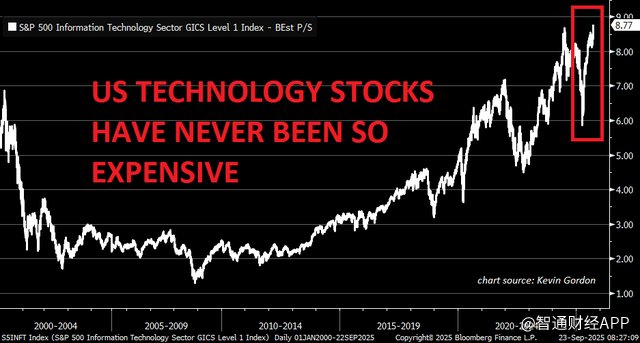
Core Viewpoint - Despite negative signs in the employment and real estate markets, major U.S. stock indices continue to rise, driven by unsustainable fiscal deficits and explosive growth in artificial intelligence spending. Analysts warn of a potential crisis reminiscent of the internet bubble [1]. Group 1: Valuation Concerns - Valuations have reached "crazy" levels, with the expected price-to-sales ratio of the S&P 500 Information Technology sector hitting 8.8 times, significantly higher than the levels seen at the end of the internet boom and the highest ever recorded [2]. - The Shiller price-to-earnings ratio is nearing 40, a level historically seen only twice, and is slightly below the peak reached in 1999. A CAPE above 25 indicates a period of "irrational exuberance" [5][6]. - The stock market capitalization to GDP ratio, known as the "Buffett Indicator," has reached a record high, indicating an overbought market [7]. Group 2: Market Dynamics - The return of "vendor financing" is noted, where companies like Cisco provided financing to customers purchasing their equipment, reminiscent of past market behaviors [9]. - Nvidia announced a potential investment of up to $100 billion in OpenAI to support the construction of data centers powered by Nvidia chips. Analysts are divided on this move, with some viewing it as a sign of robust AI infrastructure growth, while others see it as aiding a cash-strapped client [11][12]. - Market performance is increasingly polarized, with the top ten stocks accounting for about 40% of the total market value, similar to the late 1990s. Nvidia's market cap exceeds $4.3 trillion, surpassing the annual GDP of the UK and France, while Microsoft and Apple are also close to this valuation [13]. Group 3: Investor Sentiment - Factors such as FOMO (fear of missing out), momentum, algorithmic trading, and passive index investing may keep stock prices elevated despite high valuations. However, over time, such high valuations are difficult to sustain, suggesting that the current situation may not differ from past market behaviors [14].




ESG月报(2025年9月):始祖鸟营销争议凸显ESG重要性,9月样本ESG指数跑赢大盘-20250929
Huachuang Securities· 2025-09-29 07:14
Policy Developments - China aims to reduce greenhouse gas emissions by 7%-10% from peak levels by 2035, with non-fossil energy consumption exceeding 30%[8] - Australia sets a 2035 emissions reduction target of 62%-70% from 2005 levels, supported by a AUD 5 billion Net Zero Fund[9] - Thailand's tourism board promotes ESG tourism, increasing community income by approximately 20%[10] Industry Highlights - The controversy surrounding Arc'teryx's fireworks display poses potential risks to Anta's stock price and brand reputation, highlighting ESG's shift from a "soft indicator" to a "hard constraint" impacting investor confidence[12][13] - WWF calls for a global green trade incentive mechanism to promote low-carbon development, suggesting that China could enhance its climate governance influence by leading rule-making[14] Capital Market Dynamics - As of September 26, 2025, ESG indices outperformed the market, with the Sci-Tech Innovation ESG index rising by 8.8% and the CSI ESG100 increasing by 1.0%[3][23] - Approximately 64 pure ESG public funds exist, with a total net asset of CNY 35.5 billion, while the largest ESG strategy subcategory comprises 388 funds with net assets of CNY 522.4 billion, accounting for 50.6% of total assets[3][28] - By September 26, 2025, there were 3,650 ESG bonds with a total balance of CNY 56,234 billion, including 146 new issuances worth CNY 119.39 billion in September[4][33] Risk Considerations - Rapid policy changes and uncertainties, insufficient policy implementation, backlash against ESG initiatives, and high costs of green technologies pose risks to the sector[38]
全球第一经济大省诞生!GDP突破4万亿美元,力压日本跻身世界第四
Sou Hu Cai Jing· 2025-09-29 04:44
Group 1 - California's GDP is projected to exceed $4.1 trillion in 2024, surpassing Japan's GDP of $4.02 trillion and closing in on Germany's $4.65 trillion [2][8] - If California were treated as a separate country, it would rank as the fourth largest economy globally, outperforming over 190 countries [2][3] - The economic strength of California is attributed to its robust technology sector, particularly Silicon Valley, which houses major companies like Apple, Google, Tesla, and Nvidia [3][5] Group 2 - Nvidia's market capitalization reached $4.4 trillion at its peak in 2024, exceeding California's entire GDP, highlighting the immense value of tech companies in the state [3][5] - California's economy benefits from a diverse range of industries, including agriculture, which contributes significantly to its GDP alongside technology [5][6] - The ports of Los Angeles and Long Beach are among the busiest in the world, facilitating substantial logistics and trade activities that further bolster California's economy [5][6] Group 3 - California's cultural influence through Hollywood and its entertainment industry generates significant revenue and global recognition, enhancing its economic profile [6][8] - The venture capital ecosystem in California is highly developed, providing essential funding for startups and fostering innovation [6][12] - In contrast, Japan's economy struggles with aging demographics and a lack of adaptability to new technologies, leading to stagnation in GDP growth [8][9] Group 4 - Guangdong's GDP is projected to reach approximately 14.16 trillion RMB (around $1.98 trillion) in 2024, making it the largest economy in China for 35 consecutive years [10][11] - Guangdong's economic strength is driven by its manufacturing capabilities, with major companies like Huawei and Tencent leading the charge [10][11] - The province's strategic location and port facilities facilitate significant foreign trade, contributing to its economic success [10][11] Group 5 - Despite Guangdong's achievements, it faces challenges in technology development and talent attraction compared to California, particularly in foundational technologies like chip design [11][12] - The flexibility of California's policies and its ability to attract global talent are key advantages over Guangdong [12][13] - Guangdong's rapid implementation of new technologies and large domestic market present opportunities for growth, suggesting potential for future economic advancements [12][13]

中国股市债市迎来全球资本回归
Huan Qiu Wang· 2025-09-29 03:29
Group 1 - The article highlights a significant rebound in China's A-share market and advancements in the high-tech sector, prompting global fund managers to reinvest in China [1][3] - As of June, net foreign capital inflow has exceeded the total annual inflow for 2024 by approximately 60%, indicating a strong momentum in foreign investments [1] - In August, there was a net inflow of $3.2 billion in cross-border funds, with a surplus of $14.6 billion in bank foreign exchange settlements, reflecting stable net inflows from trade and foreign investments in domestic stocks and bonds [1] Group 2 - Goldman Sachs reported that global hedge funds' activity in China's stock market reached its highest level in recent years, contrasting sharply with 2021 when many considered the market "uninvestable" [3] - The CSI 300 index has risen by 16% this quarter, reaching a three-year high, while the tech-focused ChiNext index surged nearly 50%, marking one of the best performances globally [3] - The total market capitalization of China's stock market increased by $2.7 trillion in 2025, indicating substantial growth potential for global funds to increase their positions [3] Group 3 - Chinese tech companies set a record for issuing renminbi-denominated bonds in Hong Kong, with significant participation from a diverse range of global investors [4] - The shift in investor sentiment has moved from risk aversion to seeking opportunities in China, as evidenced by the oversubscription of Alibaba's convertible bonds and the interest from high-quality funds [4] - The strong inflow of capital is expected to support the renminbi and enhance its status in global finance, driven by China's advancements in AI and resilience amid U.S. trade pressures [4][5] Group 4 - The progress in China's tech sector, including developments in AI and domestic chip manufacturing, has shifted investor perceptions, with many now viewing China as a growing economic force [5] - The nominal interest rates on renminbi bonds remain relatively high, providing an attractive investment channel for global investors [5] - The disparity between China's footprint in the global economy and its low representation among global investors signifies a long-term investment opportunity [5]
