
油脂加工

Search documents
棕榈油:B50路测提前,维持低多及区间操作,豆油:美豆假期反弹,豆油跟随油脂高开
Guo Tai Jun An Qi Huo· 2025-10-09 05:12
Report Industry Investment Rating - The report maintains the rating, but the specific rating is not clearly stated [1] Core View - The report provides a comprehensive analysis of the fundamentals of the oil and fat industry, including futures prices, spot prices, industry news, and production and trade data [1][2][4] According to the Related Catalog 1. Futures and Spot Market Data - **Futures Prices**: The closing price of the Malaysian palm oil main contract was 4,546 ringgit/ton with a daily gain of 1.65%, and 4,560 ringgit/ton at night with a gain of 0.33%. The CBOT soybean oil main contract was at 51.29 cents/pound with a gain of 0.49% [1] - **Spot Prices**: The spot price of 24 - degree palm oil in Guangdong was 9,060 yuan/ton, down 50 yuan/ton; the price of first - grade soybean oil in Guangdong was 8,450 yuan/ton, down 30 yuan/ton; the price of fourth - grade imported rapeseed oil in Guangxi was 10,250 yuan/ton, up 120 yuan/ton [1] - **Base Difference**: The base difference of palm oil in Guangdong was - 168 yuan/ton, that of soybean oil in Guangdong was 310 yuan/ton, and that of rapeseed oil in Guangxi was 206 yuan/ton [1] - **Price Spread**: The price spread between the rapeseed and palm oil futures main contracts was 816 yuan/ton, the soybean and palm oil futures main contracts was - 1,088 yuan/ton, etc. [1] 2. Macro and Industry News - **Indonesia's Bio - diesel Policy**: Indonesia is moving towards a B50 biodiesel policy, planning to launch it next year. The implementation of the B50 policy will require 2,010 million liters of palm - based bio - fuel annually, compared with 1,560 million liters for the current B40 policy [2][3] - **Malaysia's Palm Oil Data**: From September 1 - 30, 2025, Malaysia's palm oil exports were estimated to be 1,013,140 tons, a 13.41% decrease from the previous month. Production was estimated to decrease by 2.42% (SPPOMA data) or 2.35% (MPOA data). The estimated inventory in September was 215 tons, a 2.5% decrease from August [4] - **Indonesia's Palm Oil Exports**: From January to August 2025, Indonesia exported 16.2 million tons of crude and refined palm oil, a 13.56% year - on - year increase, with 2.56 million tons exported in August alone [4] - **India's Oil Imports**: In September, India's soybean oil imports increased by 37.3% month - on - month to 505,000 tons, while total edible oil imports decreased by 0.7% to 1.61 million tons. Sunflower oil imports increased by 5.8% to 272,000 tons [5] - **US Crop Forecasts**: S&P Global Commodity Insights lowered the forecast of US soybean average yield to 53.0 bushels/acre and corn average yield to 185.5 bushels/acre [5] - **Brazil's Soybean Forecast**: StoneX predicted that Brazil's 2025/26 soybean production would reach 178.6 million tons, a 0.3% increase from the September forecast [5] - **Argentina's Labor Issue**: Argentina's government suspended the planned indefinite strike of oil workers' unions in processing plants [6] 3. Trend Intensity - The trend intensity of palm oil and soybean oil is both 1, with the range of trend intensity being integers in the [- 2, 2] interval [7]
政策扰动持续油脂强弱分化
Bao Cheng Qi Huo· 2025-10-09 02:53
Report Industry Investment Rating No relevant content provided. Core Views - **Soybean Oil**: Due to the US government shutdown causing a lack of key data, it's difficult to accurately assess the short - term supply - demand pattern of US soybean oil. Brazil may not raise the biodiesel blending ratio from 15% to 16% before March 2026. Indian palm oil imports in September are estimated to drop to a four - month low, while soybean oil imports may reach a three - year high. With reduced international supply disruptions and strong demand, the US soybean oil futures price is oscillating strongly, which boosts domestic prices. However, domestic prices are also affected by domestic soybean costs, so short - term prices will be in a wide - range oscillation [4][40][42]. - **Palm Oil**: In September, Malaysian palm oil exports increased by 7.29 - 9.62% month - on - month. Analysts expect the September - end inventory to be 2.5% lower at 2.15 million tons due to lower production and higher exports. As Southeast Asian production declines from the seasonal peak and demand is boosted by festivals, inventory pressure may ease. But the weakening international crude oil price during the holiday weakens the support for palm oil's biodiesel demand. After the National Day holiday, focus on market capital inflows, and short - term prices will be oscillating strongly [5][42]. - **Rapeseed Oil**: Recently, the harvest pressure of Canadian rapeseed has increased, and exports are weak. The tight supply still supports prices, and domestic inventories are decreasing. In the short term, low domestic inventories and the end of the aquaculture peak season create a long - short game. Ukraine's export tax - exemption policy for rapeseed during the National Day will affect market sentiment. After the holiday, focus on the resumption of production by domestic processing enterprises, and short - term prices may be volatile [6][43]. Summaries by Directory 1 Market Review 1.1 Three Major Oils' Spot Prices Fluctuate Differently - The spot price of Grade - 4 soybean oil in Zhangjiagang is 8350 yuan/ton, down 90 yuan/ton week - on - week. The spot price of 24 - degree palm oil in Guangzhou is 9060 yuan/ton, down 170 yuan/ton week - on - week. The spot price of imported rapeseed - produced rapeseed oil in Guangdong is 10250 yuan/ton, up 80 yuan week - on - week [10]. 1.2 Rapeseed Oil Futures Prices Continue to Show a Stronger Trend - The futures prices of the three major oils in the domestic market showed different trends this week, with rapeseed oil relatively stronger. In terms of capital, the trading volume of all three major oils increased significantly, while soybean oil and palm oil saw significant position reductions [14]. 2 Malaysian Palm Oil Inventory Expected to Fall, Ukraine's Rapeseed Export Tax - Exemption 2.1 Argentina's Tax - Exemption Policy Ends, US Government Shutdown Halts USDA Reports - After Argentina's brief export tax exemption, there are still 7.6 million tons of soybean products and 8.9 million tons of corn worth $4.93 billion for sale. The government has now restored export taxes, with 24.5% for soybean products and 9.5% for corn. The US government shutdown since October 1st led to the cancellation of the weekly export sales report, and analysts previously expected US soybean net sales to be between 300,000 and 1.5 million tons last week [21]. - An Indian industry insider expects the 2025/26 soybean oil imports to increase by 9% to 5.5 million tons compared to the current year, and palm oil imports may drop to about 7.5 million tons from the 2024/25 estimate of 7.9 million tons [22]. 2.2 Malaysian Palm Oil Inventory Expected to Fall, EU Palm Oil Imports Down Year - on - Year - Due to expected production decline from the seasonal peak and potential increased purchases from India during festivals, Malaysian palm oil inventory is expected to drop from a 20 - month high. It's predicted to reach about 1.7 million tons by the end of 2025, a 23% reduction from August. Malaysia's 2025 palm oil exports are expected to reach 17.3 million tons, higher than previous expectations and last year's figure. In 2025, production will not exceed 19.5 million tons [23][24]. - From September 1 - 25, 2025, the palm oil production in South Malaysia decreased by 4.14% month - on - month. In 2025/26, EU palm oil imports are down 25% year - on - year, with Malaysia's share increasing [24]. 2.3 Canadian Rapeseed Harvest Accelerates, Ukraine's Rapeseed Export Tax - Exemption - Nearly three - quarters of Canadian rapeseed has been harvested, with better - than - expected yields. The accelerated harvest increases supply pressure. Ukraine has established a new export mechanism to exempt qualified producers from export tariffs, aiming to resume rapeseed exports [25][26]. 2.4 Inventories of Three Major Oils Continue to Decline - Data on the import costs of soybean oil, palm oil, and rapeseed oil from different countries and regions are provided, including CBOT closing prices, CNF prices, and import costs in RMB [28][29]. 3 Conclusion - **Soybean Oil**: The short - term price will oscillate widely due to data shortages, potential Brazilian policy changes, and strong international demand [40][42]. - **Palm Oil**: Short - term prices will oscillate strongly considering inventory changes, production trends, and international crude oil prices [5][42]. - **Rapeseed Oil**: Short - term prices may be volatile due to harvest pressure, supply - demand imbalances, and policy impacts [6][43].
南华期货油脂产业周报:阿根廷结束低价竞争,油脂未来依然有供应缩紧预期-20250930
Nan Hua Qi Huo· 2025-09-30 10:55
1. Report Industry Investment Rating No relevant content provided. 2. Core Views of the Report - The domestic driving force for edible oils is insufficient, and future price movements depend on positive factors from the origin. In the short - term, the market will trade within a range. Pay attention to China - US and China - Canada relations, the de - stocking progress of palm oil origins, and the implementation of the B40 plan. Consider opportunities such as the positive spread trading of rapeseed oil 1 - 5 contracts and buying palm oil 01 contracts on dips [1]. - In the near - term, there is still pressure on domestic edible oils. The supply of soybeans is sufficient, and there is a risk of over - inventory for soybean oil. Rapeseed oil has high inventory, and palm oil supply may increase. The demand for edible oils is mainly for essential needs, but the Mid - Autumn Festival and National Day holidays may boost catering consumption [3][5]. - In the long - term, the edible oil market will focus on the final determination of the US biofuel obligation policy, the supply - demand balance of palm oil origins, the progress of Indonesia's B40 and B50 policies, and China - US and China - Canada relations [8]. 3. Summary by Relevant Catalogs 3.1 Core Contradictions and Strategy Recommendations 3.1.1 Core Contradictions - The US biodiesel policy is uncertain. In the palm oil market, Malaysia entered the production - reduction season in September, while Indonesia's production is normal. The B40 plan in Indonesia may speed up at the end of the year. For soybean oil, Brazil's soybean sowing progress is fast, and global soybean supply is abundant. The purchase of Argentine soybeans can make up for part of the US soybean gap, delaying the tight supply of domestic soybean oil. For rapeseed oil, Canada's new - season output is optimistic, but the supply may still be tight due to the uncertainty of China - Canada relations and limited substitution from Australian rapeseed [1]. 3.1.2 Trading Strategy Recommendations - **Trend Judgment**: Short - term wide - range oscillation. The price ranges are P2601 [9000 - 9900], Y2601 [8000 - 8700], and OI [9600 - 10500]. Consider the opportunity of rebound after over - decline. Technically, consider going long on P2601 at low levels [13]. - **Basis, Calendar Spread, and Hedging Arbitrage Strategies**: For basis strategies, use accumulated option purchases to reduce basis risk. For calendar spread strategies, consider positive spread trading for P1 - 5 at low levels (190, 200). For hedging arbitrage strategies, expect the rapeseed - soybean spread to widen and the soybean - palm spread to narrow [13]. 3.1.3 Industry Client Operation Recommendations - **Price Range Forecast**: The price ranges for soybean oil, rapeseed oil, and palm oil are 8000 - 8400, 9700 - 10300, and 8900 - 9500 respectively [15]. - **Hedging Strategies**: Traders with high inventory can short Y2601 to lock in profits. Refineries with low inventory can buy Y2601 to lock in procurement costs. Oil mills worried about over - inventory can short Y2601 [15]. 3.1.4 Basic Data Overview - Provides the latest prices and price changes of palm oil, soybean oil, and rapeseed oil futures and spot markets, as well as spreads between different contracts and varieties [18][19][20][21]. 3.2 This Week's Important Information and Next Week's Focus Events 3.2.1 This Week's Important Information - **Positive Information**: Malaysia's palm oil exports from September 1 - 30 increased by 7.3% month - on - month. The operating rate of domestic rapeseed oil mills decreased for the second consecutive week. The operating rate of domestic soybean oil mills decreased during the holiday [22][23]. - **Negative Information**: On September 26, the commercial inventory of three major edible oils in China was 240 million tons, still at a high level in recent years. As of last Thursday, Brazil's 2025/26 soybean planting progress reached 3.2% [24]. - **Spot Transaction Information**: Palm oil transactions improved slightly, soybean oil transactions decreased, and rapeseed oil had almost no transactions [25]. 3.2.2 Next Week's Important Events to Follow - September 29 domestic weekly inventory data, high - frequency production and export data of Malaysian palm oil, and progress on the US small - refinery exemption re - allocation decision [30]. 3.3 Disk Interpretation 3.3.1 Price - Volume and Capital Interpretation - **Domestic Market**: This week, the edible oil market oscillated and sorted. Rapeseed oil was relatively strong, while soybean oil and palm oil oscillated. Some speculative funds left the market cautiously. The market is in a multi - empty situation, and the downward space is limited, expected to trade in a range. Pay attention to the rebound opportunity of palm oil after over - decline [31]. - **Capital Trends**: Key profitable positions in palm oil, soybean oil, and rapeseed oil are cautious. Palm oil prices are at a medium - low level historically, with decreasing positions and a weak short - term trend. Soybean oil prices are declining with decreasing positions and increasing negative trend. Rapeseed oil prices are rising, with significant position fluctuations and cautious market sentiment [31]. - **Calendar Spread Structure**: The near - month term structure of edible oils is steeper. The OI1 - 5 positive spread continues to strengthen due to the expected tight supply of rapeseed oil at the end of this year and in the first quarter of next year. P1 - 5 and Y1 - 5 positive spreads are mainly consolidating [33]. - **Basis Structure**: This week, the basis of major edible oil contracts was weak. High domestic inventory and weak demand led to a continued weak basis [51]. - **Spread Structure**: This week, the rapeseed - palm and rapeseed - soybean spreads strengthened. Rapeseed oil supply in the fourth quarter is not optimistic, while the supply pressure of soybean oil and palm oil has eased [55]. - **Foreign Market**: The domestic market followed the foreign market to oscillate and then weaken. Uncertainties in China - US and China - Canada relations and the closure of Argentine exports limited further downward movement. CBOT soybean oil managed funds reduced their net positions, while producers/ traders/ processors/ users increased their positions slightly [57]. 3.4 Valuation and Profit Analysis 3.4.1 Upstream and Downstream Profit Tracking - The POGO spread is slightly lower but still at a high level, and the BOHO spread is at a low level. The overall cost of bio - fuel production remains high due to the low - price competition of Argentine soybean oil [65]. 3.4.2 Import - Export Profit Tracking - China is a net importer of palm oil. The import cost has slightly decreased, and the import profit inversion has narrowed slightly. However, due to weak domestic demand and inventory pressure, the probability of a significant increase in purchasing is low [68]. 3.5 Supply - Demand and Inventory Deduction 3.5.1 Origin Supply - Demand Balance Sheet Deduction - Malaysia's palm oil production is expected to decline in the fourth quarter due to drought in the first quarter and floods in September. The inventory pressure will be further relieved, and the inventory - to - sales ratio is expected to decline [70]. 3.5.2 Supply - Side and Deduction - **Palm Oil**: The procurement intention of traders is low. The monthly purchase volume in September and October is about 200,000 tons. The supply pressure in the fourth quarter is not large, and inventory is expected to decline further. - **Soybean Oil**: The arrival of soybeans in September and October is high, and the supply in the fourth quarter is sufficient. However, the soybean crushing volume may decrease in December, and the supply of soybean oil may be tight if US soybean purchases are difficult [72][73]. - **Rapeseed Oil**: The domestic inventory is high, and demand is weak. High inventory will be gradually reduced in the fourth quarter. If China - Canada relations do not improve, supply may be tight from the end of this year to the first quarter of next year [73]. 3.5.3 Demand - Side and Deduction - In the short term, the inventory pressure of three major edible oils is large, and demand is weak. The Mid - Autumn Festival and National Day holidays may boost catering consumption, but overall terminal demand is still weak compared to last year [75].
《动物油脂 牛油》国家标准宣贯会在广汉召开,牛油产业规范化发展步入新阶段
Zhong Guo Shi Pin Wang· 2025-09-28 10:18
Core Viewpoint - The establishment of the national standard for animal fat, specifically beef tallow, marks a significant milestone for the beef tallow industry in China, transitioning from disorder to order and enhancing food safety and consumer experience [1][21]. Summary by Relevant Sections Industry Background - The hot pot industry in China is a crucial segment of the catering market, with an annual scale exceeding 600 billion yuan, where beef tallow serves as a core ingredient impacting food safety and consumer experience [1]. Standard Development - The national standard for beef tallow was officially introduced after four years of discussions and research, addressing long-standing issues of quality inconsistency and safety concerns in the industry [2]. - The standard outlines quality requirements, inspection rules, labeling, storage, and transportation, filling a significant gap in the beef tallow industry's safety standards [2]. Industry Impact - The implementation of the national standard is expected to reshape the industry landscape by forcing small-scale operations to upgrade or exit the market, while creating a fair competitive environment for compliant enterprises [2]. - The shift from price competition to quality competition is anticipated, promoting a more standardized and regulated development within the industry [2]. Collaborative Efforts - The standard's success is attributed to a collaborative effort among academia, industry, and research institutions, with significant contributions from various experts and organizations [4][8]. - The commitment from companies like Zhang Bingbing to adhere to and promote the national standard is crucial for fostering industry-wide compliance and improvement [4][7]. Future Outlook - The national standard is seen as a foundation for ensuring food safety and promoting consumption upgrades, with a focus on enhancing product quality and management practices in the beef tallow industry [8][21]. - The emphasis on safety as a core competitive advantage is expected to drive companies to prioritize adherence to quality and safety standards, ultimately benefiting consumers [21].


商品日报(9月25日):集运欧线延续反弹 沪铜跳空高开触及半年新高
Xin Hua Cai Jing· 2025-09-25 09:55
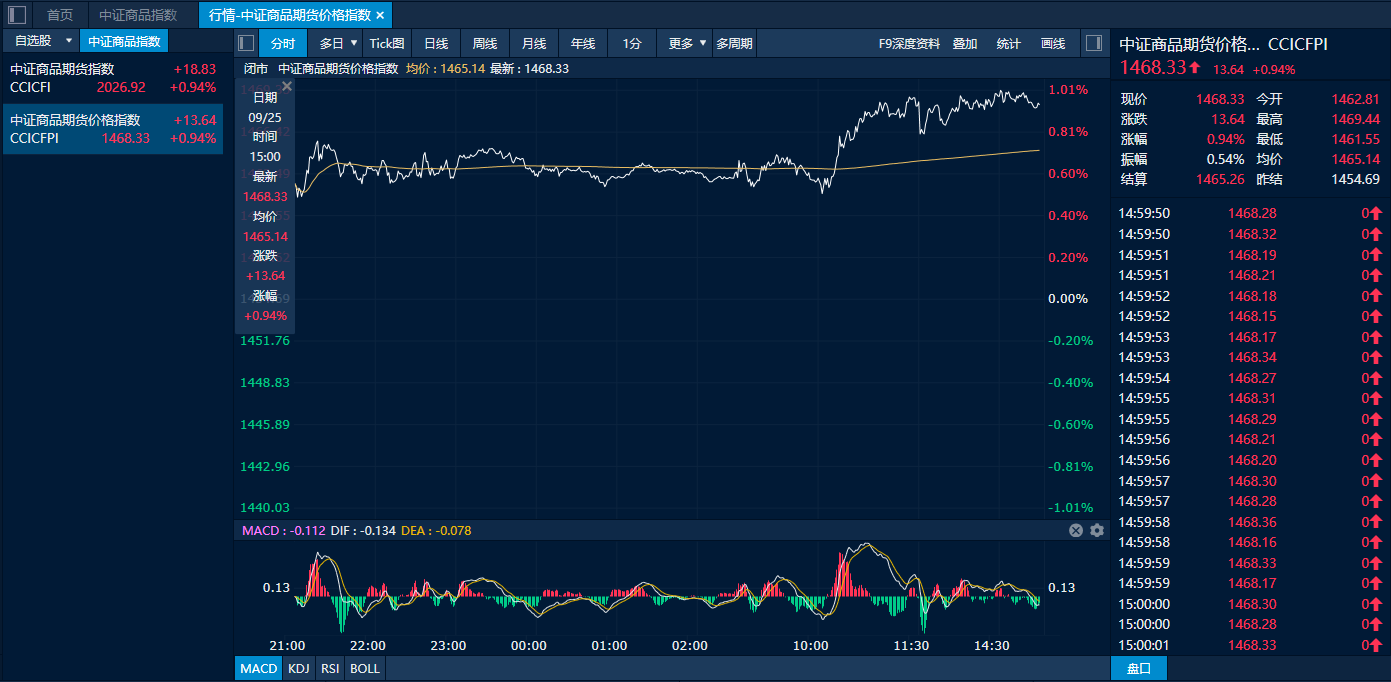
Group 1 - Domestic commodity futures market experienced widespread increases on September 25, with major contracts such as shipping European routes, international copper, and glass rising over 3% [1][2] - The China Securities Commodity Futures Price Index closed at 1468.33 points, up 13.64 points or 0.94% from the previous trading day [1] - The shipping European route continued its upward trend, with the main contract closing up 3.99%, driven by good cargo collection and stable current cabin quotes [2] Group 2 - International copper and Shanghai copper futures opened higher, reaching a six-month high, with respective increases of 3.58% and 3.40% due to supply disruptions from Freeport's Grasberg mine [3] - The suspension of operations at Grasberg is expected to tighten global copper supply further, with forecasts indicating a continued decline in supply growth through 2026 [3] - Other commodities such as glass, rapeseed oil, and coke also saw significant price increases, with glass futures closing up 3.08% [3] Group 3 - Precious metals experienced slight adjustments, with Shanghai gold down 0.45% while silver saw a minor increase, influenced by profit-taking and a lack of new stimuli [4] - Long-term bullish factors for gold remain, including rising U.S. debt and ongoing central bank purchases, despite short-term fluctuations [4] - Natural rubber and No. 20 rubber contracts saw slight declines, with limited impact from weather disturbances, as the Southeast Asian production season is expected to increase output [5]
油脂日报:中国自阿根廷大豆买船增多,油脂震荡-20250925
Hua Tai Qi Huo· 2025-09-25 05:32
Report Industry Investment Rating - The investment rating for the industry is neutral [4] Core Viewpoints - The prices of the three major oils fluctuated yesterday. As the estimated quantity of Chinese buyers' purchases of Argentine soybeans this week continued to increase, the market focus shifted back to the stagnant global trade relations. The price of CBOT soybeans was under continuous pressure, which also exerted some pressure on domestic oil prices [3] - The EU's decision to postpone the implementation of the anti - deforestation regulations by one year provides a temporary respite for palm oil exporters. Although it eases the compliance risks and cost pressures on exporters and reduces the immediate risk of weak palm oil demand, it also prolongs the regulatory uncertainty faced by producers [2] Summary According to Related Catalogs Futures and Spot Market Conditions - Futures: The closing price of the palm oil 2601 contract yesterday was 9,126.00 yuan/ton, a change of +72 yuan or +0.80% compared to the previous day; the closing price of the soybean oil 2601 contract was 8,100.00 yuan/ton, a change of +14.00 yuan or +0.17%; the closing price of the rapeseed oil 2601 contract was 9,921.00 yuan/ton, a change of -75.00 yuan or -0.75% [1] - Spot: The spot price of palm oil in Guangdong was 8,970.00 yuan/ton, a change of +110.00 yuan or +1.24%, and the spot basis was P01 + - 156.00, a change of +38.00 yuan; the spot price of first - grade soybean oil in Tianjin was 8,280.00 yuan/ton, a change of +60.00 yuan/ton or +0.73%, and the spot basis was Y01 + 180.00, a change of +46.00 yuan; the spot price of fourth - grade rapeseed oil in Jiangsu was 10,140.00 yuan/ton, a change of -80.00 yuan or -0.78%, and the spot basis was OI01 + 219.00, a change of -5.00 yuan [1] Market Information - EU's anti - deforestation regulations delay: CIMB Securities believes that the postponement of the EU's anti - deforestation regulations (EUDR) has a slightly positive impact on palm oil producers as it alleviates market concerns about weak demand in Q1 2026 due to the implementation of EUDR. There is still room for further negotiation or policy adjustment before the new deadline [2] - Feed production and price: The national industrial feed output was 29.36 million tons, a month - on - month increase of 3.7% and a year - on - year increase of 3.8%. The output of compound feed, concentrated feed, and additive premixed feed increased by 3.4%, 8.3%, and 7.9% year - on - year respectively. The ex - factory prices of feed products showed a downward trend year - on - year. The ex - factory prices of livestock and poultry compound feed and concentrated feed mainly increased month - on - month, while the ex - factory price of additive premixed feed decreased slightly. The proportion of corn in compound feed produced by feed enterprises was 32.9%, and the proportion of soybean meal in compound feed and concentrated feed was 14.3% [2] - International oil price: The C&F price of Canadian rapeseed (November shipment) was 515 US dollars/ton, up 5 US dollars/ton from the previous trading day; the C&F price of Canadian rapeseed (January shipment) was 524 US dollars/ton, up 4 US dollars/ton. The C&F price of Argentine soybean oil (October shipment) was 1,111 US dollars/ton, down 55 US dollars/ton; the C&F price of Argentine soybean oil (December shipment) was 1,111 US dollars/ton, down 51 US dollars/ton. The C&F quotation of imported rapeseed oil: the price of Canadian rapeseed oil (October shipment) was 1,105 US dollars/ton, unchanged from the previous trading day; the price of Canadian rapeseed oil (December shipment) was 1,085 US dollars/ton, unchanged [2]
从在地化科研到全国推广,胡姬花全球花生产业研究院持续推动河南优质花生“优油优用”
Huan Qiu Wang Zi Xun· 2025-09-25 03:58
Core Insights - The collaboration between Hu Jihua Global Peanut Industry Research Institute and Academician Li Peiwu's team focuses on rapid detection of risk factors and key technologies for green production in the peanut industry, aiming to enhance food quality and safety [2][3][5] Group 1: Research and Development - The partnership aims to develop rapid detection technology for aflatoxins and other contaminants, addressing current challenges such as long detection cycles and high costs [3][5] - Establishing a real-time quality monitoring system from field to factory is a key goal, significantly improving food safety management efficiency [3][5] Group 2: Economic and Social Impact - The initiative is expected to help transform Henan's peanut industry from "high yield" to "high quality," benefiting farmers and enterprises by ensuring quality control from the source [5][8] - Hu Jihua is promoting a localized strategy to ensure that high-quality peanut oil produced in Henan is consumed locally, addressing the issue of insufficient local consumption [6][8] Group 3: Strategic Collaboration - The collaboration involves a tripartite model of government, media, and enterprises to enhance the local consumption ecosystem for peanut oil [8][10] - The project aligns with national strategies for rural revitalization and health, ensuring farmers' income through green planting practices [8][10] Group 4: Brand and Cultural Significance - Hu Jihua focuses exclusively on peanut oil, emphasizing the preservation of traditional techniques and cultural heritage in its production [11][13] - The brand has received international recognition for its products, reinforcing its commitment to high-quality research and development in the peanut industry [13][17] Group 5: Future Prospects - The collaboration is seen as a model that can be replicated and promoted across other peanut-producing regions in China, aiming for a broader impact on food safety and quality [15][17] - Hu Jihua's commitment to leveraging scientific research and traditional techniques positions it well for future growth in the high-quality peanut oil market [17]

美豆油价格小幅走高 9月24日阿根廷豆油(10月船期)C&F价格下调55美元/吨
Jin Tou Wang· 2025-09-25 03:11
Group 1 - Chicago Board of Trade (CBOT) soybean oil futures prices increased slightly, opening at 49.88 cents per pound and currently at 49.90 cents per pound, with a rise of 0.26% [1] - The intraday high for soybean oil futures reached 49.92 cents per pound, while the lowest point was 49.50 cents per pound [1] Group 2 - On September 24, the opening price for CBOT soybean oil was 49.88 cents, with a highest price of 50.55 cents, a lowest price of 49.40 cents, and a closing price of 49.90 cents, reflecting a change of 0.02% [2] - Argentine soybean oil (October shipment) C&F price was $1111 per ton, down by $55 per ton compared to the previous trading day; the December shipment price was also $1111 per ton, down by $51 per ton [2] - As of September 24, the Dalian Commodity Exchange (DCE) soybean oil futures warehouse receipts stood at 25,534 lots, unchanged from the previous trading day [2] - The national first-class soybean oil trading volume reached 26,000 tons on September 24, an increase of 225.00% compared to the previous trading day [2]
油脂日报:阿根廷关税政策调整,油脂承压运行-20250924
Hua Tai Qi Huo· 2025-09-24 05:08
Group 1: Report Industry Investment Rating - The investment rating for the industry is neutral [4] Group 2: Core View of the Report - The adjustment of Argentina's tariff policy has put pressure on the operation of the oil and fat market. The current poor export of US soybeans has alleviated the expected future supply gap in the domestic market, which exerts significant pressure on soybean prices. Attention should be paid to the results of the later negotiations between China and the US [1][3] Group 3: Market Analysis Futures - The closing price of the palm oil 2601 contract was 9054.00 yuan/ton, with a环比 change of -306 yuan and a decrease of -3.27% - The closing price of the soybean oil 2601 contract was 8086.00 yuan/ton, with a环比 change of -280.00 yuan and a decrease of -3.35% - The closing price of the rapeseed oil 2601 contract was 9996.00 yuan/ton, with a环比 change of -147.00 yuan and a decrease of -1.45% [1] Spot - The spot price of palm oil in Guangdong was 8860.00 yuan/ton, with a环比 change of -400.00 yuan and a decrease of -4.32%. The spot basis was P01 + -194.00, with a环比 change of -94.00 yuan - The spot price of first-grade soybean oil in Tianjin was 8220.00 yuan/ton, with a环比 change of -310.00 yuan/ton and a decrease of -3.63%. The spot basis was Y01 + 134.00, with a环比 change of -30.00 yuan - The spot price of fourth-grade rapeseed oil in Jiangsu was 10220.00 yuan/ton, with a环比 change of -140.00 yuan and a decrease of -1.35%. The spot basis was OI01 + 224.00, with a环比 change of +7.00 yuan [1] Market News - An Indonesian state-owned palm oil producer aims for a crude palm oil production target of 415,000 tons in 2025 and 1.07 million tons in 2026 - The C&F price of Argentine soybean oil (October shipment) is 1166 US dollars/ton, up 10 US dollars/ton from the previous trading day; the C&F price of Argentine soybean oil (December shipment) is 1162 US dollars/ton, up 7 US dollars/ton from the previous trading day - The C&F quotation of imported rapeseed oil: Canadian rapeseed oil (October shipment) is 1105 US dollars/ton, unchanged from the previous trading day; Canadian rapeseed oil (December shipment) is 1085 US dollars/ton, unchanged from the previous trading day - The C&F price of Canadian rapeseed (November shipment) is 510 US dollars/ton, down 8 US dollars/ton from the previous trading day; the C&F price of Canadian rapeseed (January shipment) is 520 US dollars/ton, down 7 US dollars/ton from the previous trading day - The C&F price of US Gulf soybeans (November shipment) is 459 US dollars/ton, down 8 US dollars/ton from the previous trading day; the C&F price of US West soybeans (November shipment) is 432 US dollars/ton, down 5 US dollars/ton from the previous trading day; the C&F price of Brazilian soybeans (November shipment) is 479 US dollars/ton, down 6 US dollars/ton from the previous trading day - The import soybean premium quotation: the Mexican Gulf (November shipment) is 240 cents/bushel, down 5 cents/bushel from the previous trading day; the US West Coast (November shipment) is 165 cents/bushel, unchanged from the previous trading day; the Brazilian port (November shipment) is 295 cents/bushel, unchanged from the previous trading day [2]
油脂周报:油脂仍处于磨底阶段,继续关注政策端变化-20250922
Yin He Qi Huo· 2025-09-22 03:12
Group 1: Report Industry Investment Rating - Not provided in the content Group 2: Core Viewpoints of the Report - The recent core events and market review show that the yield and production of Malaysian palm oil decreased in the first 15 days of September, India's port inventory continued to accumulate in August, and the overall price of oils and fats was affected by multiple factors. Short - term oil and fat prices lack obvious drivers but have strong support below. Oils and fats are in the bottom - grinding stage, and it is advisable to consider buying on dips in batches after a pullback [4][5][25] - For palm oil, it is expected that the production in September may decline, exports may increase slightly, and the stable spot price in the producing areas supports the price. For soybean oil, it is affected by the expected US biodiesel policy, and China often exports soybean oil to India. Also, it is necessary to pay attention to whether US soybeans can be imported. Rapeseed oil in China continues to reduce inventory marginally, which supports its price [5][25] Group 3: Summary According to the Directory Part 1: Weekly Core Points Analysis and Strategy Recommendation International Market - **Malaysian Palm Oil**: SPPOMA data shows that from September 1 - 15, the yield per unit area of Malaysian palm oil decreased by 6.94% month - on - month, the oil extraction rate decreased by 0.21% month - on - month, and the production decreased by 8.05% month - on - month, with the decline increasing compared to the first 10 days. ITS data shows that from September 1 - 20, exports increased by 8.7% month - on - month to 1.01 million tons. Malaysia raised the reference price of crude palm oil in October to 4,268.68 ringgit per ton, with an export tax rate of 10%, which supports the price at the cost end [8] - **India's Oil Market**: As of August, India's edible oil imports in the 2024/25 fiscal year reached 12.38 million tons, a year - on - year decrease of 8%. Palm oil imports decreased by 19%, soybean oil imports reached a record high of 3.89 million tons, a year - on - year increase of 43%, and sunflower oil imports decreased by 25% year - on - year. In August, the port inventory continued to accumulate to 970,000 tons, with palm oil inventory increasing from 450,000 to 540,000 tons, and sunflower oil and soybean oil inventory decreasing to about 210,000 tons. India's edible oil import profit is not good recently, and the procurement has slowed down [14] Domestic Market - **Palm Oil**: As of September 12, 2025, the commercial inventory of palm oil in key national regions was 641,500 tons, a week - on - week increase of 22,200 tons or 3.58%. The spot trading volume decreased significantly, the basis was stable and slightly weak, and the import profit gap widened. In the short term, palm oil lacks obvious drivers and maintains a volatile trend. It is recommended to consider buying on dips in batches [17] - **Soybean Oil**: As of September 12, 2025, the commercial inventory of soybean oil in key national regions was 1.2512 million tons, a week - on - week decrease of 100 tons or 0.01%. The basis was stable. Affected by the expected US biodiesel policy, soybean oil prices rose and then corrected. In the future, as the arrival of domestic soybeans decreases, soybean oil inventory may gradually decline. It is recommended to consider buying on dips in batches [20] - **Rapeseed Oil**: As of September 12, 2025, the coastal rapeseed oil inventory was 614,000 tons, a week - on - week decrease of 29,100 tons or 3.3%. The inventory continued to decline marginally, the basis was stable and increasing, and the monthly spread increased significantly. The fundamental situation of domestic rapeseed oil has not changed much, and it is necessary to pay attention to rapeseed and rapeseed oil purchases and policy changes [23] Strategy Recommendation - **Unilateral Strategy**: In the short term, the oil and fat market lacks obvious drivers and is in the bottom - grinding stage. It is advisable to consider buying on dips in batches after a pullback [27] - **Arbitrage Strategy**: Wait and see [27] - **Option Strategy**: Wait and see [27] Part 2: Weekly Data Tracking - Multiple data charts are provided, including the monthly production, export, and inventory of Malaysian palm oil; the supply and demand of Indonesian palm oil; the international soybean oil market; India's oil and fat supply and demand; domestic rapeseed oil, soybean oil, and palm oil import profits; domestic oil and fat supply and demand; domestic oil and fat spot basis; and domestic oil and fat commercial inventory [31][37][39]