
非银金融

Search documents
“申”挖数据 | 资金血氧仪
申万宏源证券上海北京西路营业部· 2026-01-27 02:26
Group 1 - The core viewpoint of the article highlights that in the past two weeks, the main funds have experienced a net outflow of 400.46 billion yuan, with the banking and coal industries seeing the highest net inflows, while the electronic, computer, and defense industries faced the largest net outflows [5][11][12] Group 2 - The current market financing and securities lending balance stands at 27,249.13 billion yuan, reflecting a 3.98% increase from the previous period, with the financing balance at 27,075.43 billion yuan and the securities lending balance at 173.70 billion yuan [5][15] - The average daily trading volume for margin financing and securities lending in this period was 3,346.76 billion yuan, which is a 35.59% increase compared to the previous period, with net purchases in financing averaging 3,337.73 billion yuan, up 35.62% [5][20] Group 3 - In terms of market performance, the number of stocks that increased in value surpassed those that decreased, with the top three performing industries being non-ferrous metals, building materials, and basic chemicals, while the banking, non-bank financials, and food and beverage sectors saw declines [5][25] Group 4 - The overall strength analysis score for all A-shares in the past two weeks was 6.38, indicating a neutral to strong market condition, with the CSI 300 score at 4.52, the ChiNext score at 6.49, and the Sci-Tech Innovation Board score at 6.52 [5][33]


资金风向标 | 26日两融余额增加19.65亿元 有色金属行业获融资净买入居首
Sou Hu Cai Jing· 2026-01-27 01:52
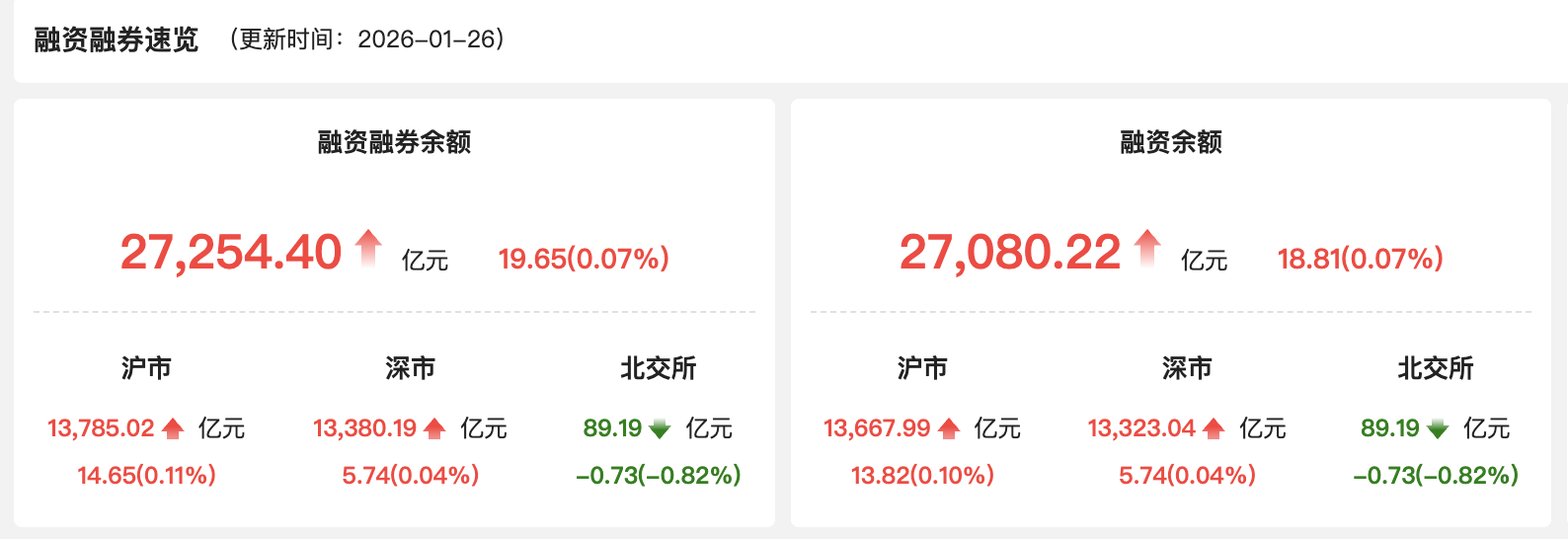
Group 1 - The total margin balance of A-shares reached 27,254.40 billion yuan on January 26, increasing by 19.65 billion yuan from the previous trading day, accounting for 2.62% of the A-share circulating market value [1] - The trading volume of margin transactions on the same day was 3,114.07 billion yuan, an increase of 79.37 billion yuan from the previous trading day, representing 9.48% of the total A-share trading volume [1] Group 2 - Among the 31 primary industries, 17 industries experienced net financing inflows, with the non-ferrous metals industry leading with a net inflow of 3.235 billion yuan [3] - Other industries with significant net financing inflows included electric power equipment, pharmaceutical biology, basic chemicals, and non-bank financials [3] Group 3 - A total of 53 stocks had net financing inflows exceeding 100 million yuan, with China Ping An leading at a net inflow of 444 million yuan [3] - Other notable stocks with high net financing inflows included Northern Rare Earth, China Aluminum, Western Mining, Maiwei Co., Oriental Fortune, Luoyang Molybdenum, Heng Rui Medicine, TBEA, and Industrial Bank [3][4]






主动型公募基金2025年四季报分析:资金流向混债二级基金,周期和大金融占比提升
Hua Yuan Zheng Quan· 2026-01-27 00:41
证券研究报告 | 金工专题报告 | | --- | hyzqdatemark 2026 年 01 月 27 日 资金流向混债二级基金,周期和大金融占比提升 ——主动型公募基金 2025 年四季报分析 投资要点: 主动权益基金规模萎缩,含权债基发行热情高涨 2025 年四季度,公募基金总规模变动不大,但不同类别的基金规模发生明显切换: 投资者因追求稳健收益,资金从高波动的主动权益基金(较上季度规模缩减 1823 亿 元)和低风险的纯债基金(较上季度规模缩减 868 亿元)流出,向中低风险的含权 债基(较上季度规模增加 2398 亿元)迁移,与此同时,含权债基的新发热度升高, 发行数量创下 2020 年以来单季度新高。 证券分析师 主动权益基金 2025 年四季度主动权益基金对港股的配置热情明显下降,从 2025 年二季度的 20.44%持续降低到四季度的 16.47%;对于创业板的配置意愿增强,由 2025 年一季 度的 13.46%抬升至 20.85%。 相比 2025 年三季度,主动权益基金显著增配周期板块,周期板块占比升至 28.31%, 环比增加 4.95pct;大金融板块占比由三季度的 4.57%提升 ...
中金:哪些领域正为公募集中持仓?
中金点睛· 2026-01-27 00:09
Core Viewpoint - The article discusses the increasing concentration of public fund holdings in specific sectors, particularly technology and advanced manufacturing, driven by a consensus on macroeconomic conditions and industry trends [2][4][6]. Group 1: Measurement of Fund Concentration - Public fund concentration is typically assessed through metrics such as the proportion of top holdings (top 10, 50, 100) relative to the fund's net value, indicating a high concentration in certain stocks [1]. - Industry allocation or overweight ratios are also used; a concentration exceeding 30% in a single industry or deviating from historical averages by more than 10% signals increased concentration [1]. - Fund inflows and trading behaviors, such as new funds heavily investing in the same stocks, provide additional insights into concentration trends [1]. Group 2: Reasons for Concentration - The convergence of macroeconomic and industry trend assessments among institutional investors leads to increased fund concentration [2]. - A positive feedback mechanism exists where concentrated holdings attract more capital, enhancing fund size and potentially driving asset prices higher, reinforcing market narratives [2]. Group 3: Global Perspective - Institutional concentration in holdings is common globally, with examples from the U.S. market where significant funds are allocated to major tech stocks, reflecting a similar trend [3]. - The S&P 500's top 10 stocks account for approximately 40% of the index, marking the highest concentration since 2000 [3]. Group 4: Characteristics of Current Fund Concentration - Recent fund concentration trends show a strong focus on technology and advanced manufacturing sectors, with historical patterns indicating that concentration often correlates with industry profitability expectations [4][6]. - The current concentration is characterized by a significant increase in holdings in the semiconductor sector and a notable rise in the electronic industry from 12% in Q4 2023 to 26% in Q3 2025 [6][7]. Group 5: Future Outlook - The outlook for fund concentration remains contingent on corporate fundamentals, with ongoing trends in artificial intelligence and domestic self-sufficiency expected to drive long-term investment strategies [7]. - Market conditions, including liquidity, external interest rates, and institutional investment patterns, will influence future fund allocation and concentration [7][8].

流动性&交易拥挤度&投资者温度计周报:主动权益基金新发规模创2022年以来新高-20260126
Huachuang Securities· 2026-01-26 10:09
Report Industry Investment Rating No relevant information provided. Core Viewpoints of the Report - The new - issue scale of active equity funds reached a new high since 2022. - The capital supply and demand sides both contracted. - The trading congestion showed different trends in various industries. - The self - media A - share search popularity and retail investor capital inflows decreased. [2] Summary by Relevant Catalogs 1. Capital Liquidity: The New - issue Scale of Active Equity Funds Reached a New High Since 2022 1.1 Public Offering Equity New - issue Scale Increased - The newly - established share of public offering equity funds last week was 261.5 billion, a significant increase from the previous value of 97.4 billion. Among them, the newly - issued active funds were 217.1 billion, reaching a new high since 2022, and the newly - issued passive index funds were 44.3 billion. [8] 1.2 Margin Trading Funds: Net Outflow - The latest margin financing balance of 2.71 trillion decreased from the previous value, while the securities lending balance of 1.733 billion increased. The overall balance accounted for 2.61% of the floating - market value, at the 99th percentile in the past three years. - Margin trading funds had a net inflow of about - 8.11 billion last week, a sharp drop from the previous net inflow of 105.22 billion, at the 19th percentile in the past three years. The turnover accounted for 9.8% of the total A - share turnover, a decrease of 1.4 percentage points from the previous value. - The margin trading turnover ratio last week was 50.2%, down from 71.0% in the previous period, at the 88th percentile in the past three years. - The number of individual investors in margin trading business reached 7.933 million, with the average daily trading investors decreasing by 111,000 from the previous value. - Margin trading mainly had a net inflow of 5.07 billion in the non - ferrous metals industry, 2.14 billion in the non - banking financial industry, and 1.43 billion in the banking industry; and a net outflow of 4.06 billion in the electronics industry, 3.68 billion in the computer industry, and 2.63 billion in the media industry. [12][13][19] 1.3 Stock - type ETFs: Net Inflow of - 333.05 Billion, at the 0th Percentile in the Past Three Years - The overall net inflow of stock - type ETFs last week was - 333.05 billion, a significant drop from the previous net inflow of - 141.58 billion. The net flow was at the 0th percentile in the past three years, with large - cap ETFs having a net inflow of - 396.19 billion and thematic ETFs having a net inflow of 4.965 billion. [20] 1.4 Listed Company Repurchases: Repurchase Amount Decreased - The repurchase amount of listed companies last week was 260 million, down from 850 million in the previous period, at the 3rd percentile in the past three years. [22] 1.5 Equity Financing: Amount at the 41st Percentile in the Past Three Years - Based on the listing date, the equity financing amount last week was 715 million, at the 41st percentile in the past three years, including 47 million in IPOs and 669 million in refinancing. [25] 1.6 Industrial Capital Net Reduction Scale Decreased - Last week, industrial capital had an overall increase of 29.1 million and a reduction of - 1.213 billion, with a net reduction of - 1.184 billion, a decrease in scale compared to the previous value of - 1.863 billion. The net reduction scale was at the 90th percentile in the past three years. - By industry, there was a net increase of 0.01 billion in the banking industry last week; and net reductions of - 5.04 billion in the electronics industry, - 1.08 billion in the pharmaceutical industry, and - 0.94 billion in the computer industry. [28][33] 1.7 Restricted - share Unlocking Scale Increased - The market value of unlocked shares last week was 5.842 billion, an increase from the previous value of 5.141 billion, at the 56th percentile in the past three years. The expected market value of unlocked shares this week is 4.051 billion. [35] 1.8 Southbound Capital Net Inflow Increased - The southbound capital flow last week was + 2.101 billion, an increase from + 899 million in the previous week. The weekly net flow intensity was at the 72nd percentile in the past three years. [38] 1.9 Northbound Capital Participation Increased - The trading of northbound capital accounted for 6.9% of the Shanghai and Shenzhen A - shares last week, an increase of 0.4 percentage points from the previous value. The participation was at the 50th percentile in the past three years. [41] 2. Trading Congestion: Construction, Home Appliances, and Semiconductors Rose; Light Industry, Building Materials, and Communications Declined 2.1 Growth - themed Industries - The trading popularity percentile of the semiconductor industry increased by 7 percentage points to 23%. [46] 2.2 Value - themed Industries - The home appliance industry rose to 68%, and the insurance industry rose by 5 percentage points to 49%. [52] 2.3 Cycle - themed Industries - The construction industry rose by 10 percentage points to 49%, and the light industry decreased by 30 percentage points to 45%. [57][61] 2.4 TMT - themed Industries - The media industry rose by 6 percentage points to 75%, and the electronics industry rose by 5 percentage points to 29%. [67] 3. Investor Thermometer: Self - media A - share Search Popularity and Retail Investor Capital Inflows Decreased 3.1 Self - media: A - share Search Popularity Decreased - The market continued its structural differentiation last week. Under regulatory cooling, the Shanghai Composite Index fluctuated slightly upward, and the decline in market trading activity led to a decrease in the self - media A - share search popularity. [71] 3.2 Douyin Users Watching "A - share" Content - The structure distribution of Douyin users watching "A - share" content from January 17th to January 23rd was generally stable. The proportion of high - level cities such as new first - tier and second - tier cities decreased; and the proportion of the young group under 30 years old decreased. [74] 3.3 Kuaishou: "A - share" Video Playback Volume Decreased - From January 17th to January 23rd, the number of "A - share" videos on Kuaishou decreased by 116 compared to the previous period; the playback volume decreased by 2.674 million times; and the interaction volume decreased by 52,000 times. [78] 3.4 Weibo Sentiment: The Outflow of Broad - based ETFs Caused a Rise in Negative Sentiment on Weibo - The overall sentiment on Weibo was stable last week, but the large - scale outflow of broad - based ETFs led to a significant increase in negative sentiment. [80] 3.5 Public Offering Fund Clustering Trend - From January 19th to January 23rd, the public offering fund clustering trend strengthened, with a preference for the growth style and the electronics industry. [83] 3.6 Retail Investor Capital Inflow Decreased - In October 2024, the number of newly - opened accounts was 6.85 million, second only to April 2015 and June 2015 in history; in December 2025, it was 2.6 million, at the 75th percentile in the past decade. - From January 19th to January 23rd, the net inflow of retail investor capital in the Shanghai and Shenzhen A - shares measured by small orders was 119.87 billion, a decrease of 129.43 billion from the previous value, at the 67.8th percentile in the past five years. [89] 3.7 Retail Investor Entry Channels: Download Volume Decreased - From January 17th to January 23rd, the cumulative download volume of Flush was 239,000 times, a decrease of 141,000 times from the previous value; the download volume of Eastmoney was 105,000 times, a decrease of 24,000 times from the previous value. The number of five - star reviews of Flush was 5,340 times, a decrease of 4,501 times from the previous value. [91]
两市主力资金净流出1143.17亿元,电子行业净流出居首
Zheng Quan Shi Bao Wang· 2026-01-26 09:24
1月26日,沪指下跌0.09%,深成指下跌0.85%,创业板指下跌0.91%,沪深300指数上涨0.10%。可交易 A股中,上涨的有1604只,占比29.36%,下跌的3771只。 今日各行业资金流向 | 行业 | 日涨跌幅(%) | 资金流向(亿元) | 行业 | 日涨跌幅(%) | 资金流向(亿元) | | --- | --- | --- | --- | --- | --- | | 非银金融 | 0.79 | 34.93 | 交通运输 | -0.26 | -15.20 | | 医药生物 | 0.29 | 28.39 | 房地产 | -2.23 | -19.26 | | 银行 | 0.44 | 22.50 | 商贸零售 | -1.93 | -20.01 | | 通信 | 0.30 | 13.81 | 公用事业 | -0.19 | -20.36 | | 石油石化 | 3.18 | 8.06 | 建筑装饰 | 0.16 | -21.95 | | 煤炭 | 2.07 | 4.50 | 有色金属 | 4.57 | -28.51 | | 美容护理 | -0.87 | -0.40 | 家用电器 | -1.68 | -3 ...
191.70亿元资金今日流出国防军工股
Zheng Quan Shi Bao Wang· 2026-01-26 09:24
资金面上看,两市主力资金全天净流出1143.17亿元,今日有6个行业主力资金净流入,非银金融行业主 力资金净流入规模居首,该行业今日上涨0.79%,全天净流入资金34.93亿元,其次是医药生物行业,日 涨幅为0.29%,净流入资金为28.39亿元。 主力资金净流出的行业有25个,电子行业主力资金净流出规模居首,全天净流出资金277.21亿元,其次 是电力设备行业,净流出资金为203.06亿元,净流出资金较多的还有国防军工、机械设备、汽车等行 业。 国防军工行业今日下跌4.47%,全天主力资金净流出191.70亿元,该行业所属的个股共138只,今日上涨 的有7只,涨停的有1只;下跌的有130只,跌停的有7只。以资金流向数据进行统计,该行业资金净流入 的个股有16只,其中,净流入资金超3000万元的有6只,净流入资金居首的是钢研高纳,今日净流入资 金1.12亿元,紧随其后的是光启技术、中国船舶,净流入资金分别为9416.43万元、5464.62万元。国防 军工行业资金净流出个股中,资金净流出超亿元的有41只,净流出资金居前的有航天电子、中国卫星、 海格通信,净流出资金分别为40.51亿元、27.47亿元、9.85 ...
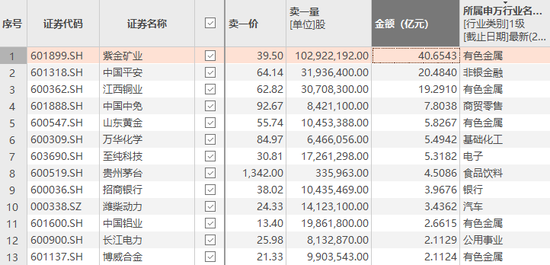
601899,尾盘突现超40亿元压单
Xin Lang Cai Jing· 2026-01-26 09:12
炒股就看金麒麟分析师研报,权威,专业,及时,全面,助您挖掘潜力主题机会! 紫金矿业当日成交额达263亿元,位居A股第一。 | | 601899 紫美矿业 | | | | 39.50 | | +1.94 +5.17% | | --- | --- | --- | --- | --- | --- | --- | --- | | 已收市 CNY | | | | | | ■ 南 ▲ 自选 + ▼ | | | 港(2899):42.060(+4.06%) | | | H/A :- 4.60% | 行情分析 | | 深度分析 | | | 委书 | -97.25% 委美 | | -102万 | 主力流入 | | 1512720 万元 | | | 25 | 39.54 | 197 | | 主力流出 | | 1551621 万元 | | | 英四 | 39.53 | 459 | | 主力净流 | | 38900 万元 | | | 卖三 | 39.52 | 750 | | | | | | | 英二 | 39.51 | 343 | | (万元) | 流入 | | SER | | 委一 | 39.50 | 1029222 | | 超大 ...

休整蓄势 上行基础稳固
Qi Huo Ri Bao· 2026-01-26 08:36
财政部表示,将继续实施更加积极的财政政策,2026年财政赤字、债务总规模和支出总量将保持必要水 平,实现"只增不减"的总体支出力度和"只强不弱"的重点领域保障。这表明积极的财政政策将继续支持 经济增长和关键领域发展,同时更加注重战略性、结构优化和精准滴灌。此外,财政部还提到财政金融 协同促内需一揽子政策已经陆续发布,旨在通过协同发力,更大力度地"激发民间投资"和"促进居民消 费"。在支持科技创新方面,财政部提出了多维度培育新动能的政策举措。 整体看,在积极的财政政策、适度宽松的货币政策以及财政金融协同发力的推动下,国内经济将呈现结 构更优、内生动能更强的良好发展态势。 工业生产稳中有进,2025年规模以上工业增加值同比增长5.9%,其中制造业增加值同比增长6.4%,表 现强劲。装备制造业增加值同比增长9.2%,占全部规模以上工业增加值的比重达到36.8%。高技术制造 业增加值同比增长9.4%,已成为引领工业高质量发展的核心驱动力。在新旧动能加速转型期,虽然整 体经济仍受房地产等传统领域调整的影响,但消费市场活力提升、新质生产力加快形成,为经济复苏奠 定了坚实基础。 宏观政策积极发力 1月20日,国新办举办两场 ...
粤开市场日报-20260126-20260126
Yuekai Securities· 2026-01-26 07:44
Market Overview - The A-share market saw most indices decline today, with the Shanghai Composite Index slightly down by 0.09% closing at 4132.61 points, the Shenzhen Component Index down by 0.85% at 14316.64 points, the ChiNext Index down by 0.91% at 3319.15 points, and the STAR 50 Index down by 1.35% at 1532.8 points [1] - Overall, there were 1602 stocks that rose and 3767 stocks that fell, with a total trading volume of 32,482 billion yuan, an increase of 1630 billion yuan compared to the previous trading day [1] Industry Performance - Among the primary industries, non-ferrous metals, petroleum and petrochemicals, coal, agriculture, forestry, animal husbandry, and fishery led the gains with increases of 4.57%, 3.18%, 2.07%, 0.85%, and 0.79% respectively [1] - Conversely, industries such as defense and military, automotive, social services, electronics, and real estate experienced declines, with decreases of 4.47%, 2.31%, 2.30%, 2.24%, and 2.23% respectively [1] Concept Sector Performance - The top-performing concept sectors included gold and jewelry, vaccines, selected rare metals, animal health, blood products, industrial metals, nickel ore, rare earths, influenza, cobalt ore, small metals, and biotechnology [2] - Sectors such as satellite internet, commercial aerospace, satellite navigation, and military information technology experienced pullbacks [2]