
银行

Search documents
摩根大通减持金力永磁(06680)111.98万股 每股作价约21.31港元
智通财经网· 2026-02-09 11:29
智通财经APP获悉,香港联交所最新资料显示,2月4日,摩根大通减持金力永磁(06680)111.98万股,每 股作价21.3127港元,总金额约为2386.6万港元。减持后最新持股数目约为1631.12万股,最新持股比例 为6.94%。 ...
小摩增持重庆农村商业银行约394.28万股 每股作价约5.8港元
Zhi Tong Cai Jing· 2026-02-09 11:19
联交所最新资料显示,2月4日,小摩增持重庆农村商业银行(03618)394.2838万股,每股作价5.803港 元,总金额约为2288.03万港元。增持后最新持股数目约为2.04亿股,最新持股比例为8.11%。 ...

“红利+”指数集体上行,红利ETF易方达(515180)、自由现金流ETF易方达(159222)等产品受资金关注
Sou Hu Cai Jing· 2026-02-09 11:18
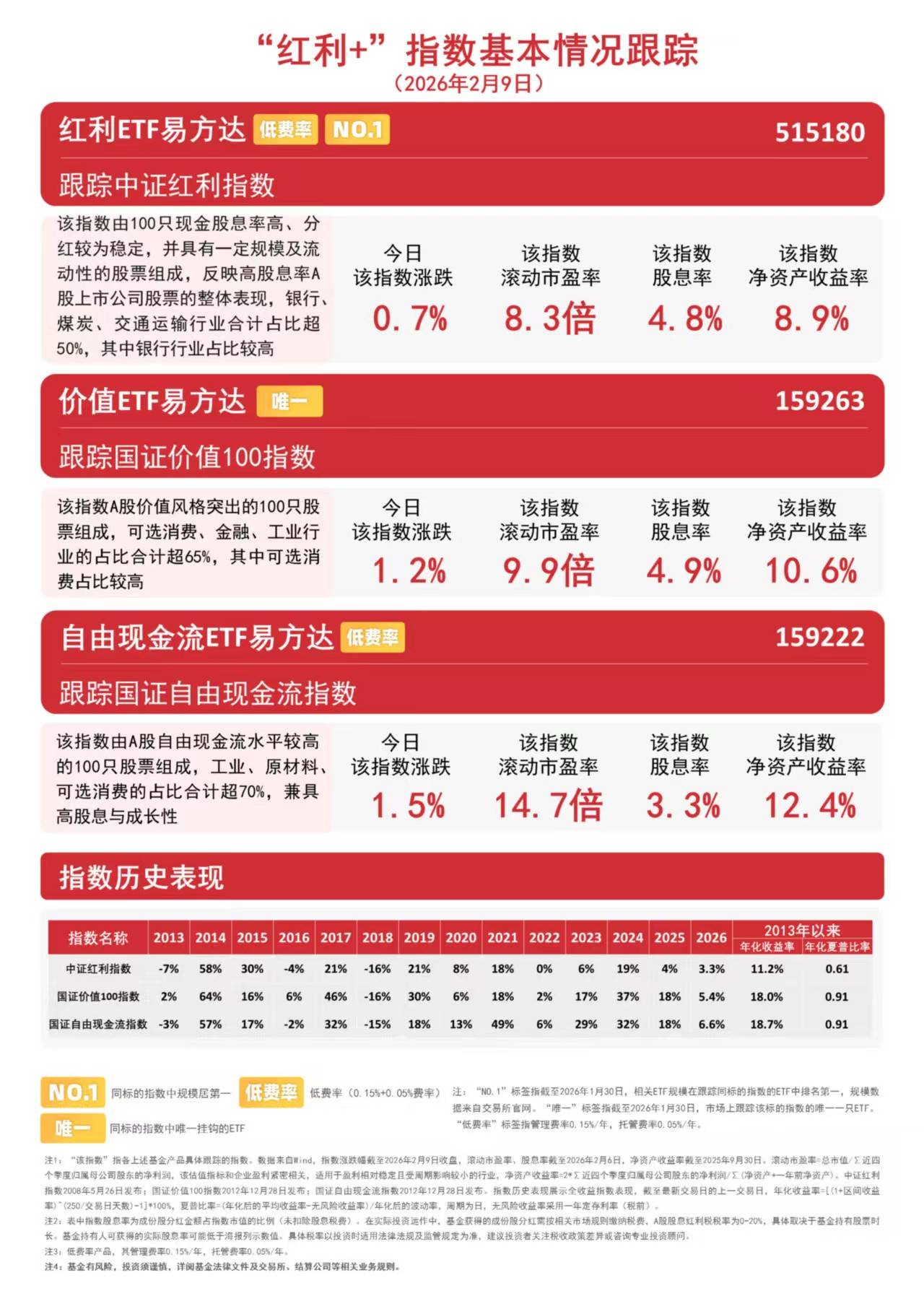
Core Viewpoint - The report provides an overview of various ETFs tracking different indices, highlighting their composition, performance, and sector allocations. Group 1: Index Overview - The Hongli ETF tracks the China Securities Dividend Index, composed of 100 stocks with high and stable cash dividend yields, primarily from the banking, coal, and transportation sectors, which together account for over 50% of the index [1]. - The Value ETF tracks the National Value 100 Index, consisting of 100 stocks with prominent value characteristics, with over 65% of the index made up of consumer discretionary, financial, and industrial sectors [1]. - The Free Cash Flow ETF follows the National Free Cash Flow Index, which includes 100 stocks with high free cash flow levels, with over 70% from industrial, materials, and consumer discretionary sectors, combining high dividends with growth potential [1]. Group 2: Performance Metrics - The annualized return for the China Securities Dividend Index from 2013 to 2026 is 11.2%, with notable fluctuations in individual years, including a peak of 58% in 2014 and a decline of 16% in 2019 [2]. - The National Value 100 Index shows an annualized return of 18%, with significant highs of 64% in both 2014 and 2015, and a low of -16% in 2019 [2]. - The National Free Cash Flow Index has an annualized return of -18.7%, with a peak of 57% in 2014 and a low of -49% in 2022 [2].

证监会发布《关于境内资产境外发行资产支持证券代币的监管指引》|每周金融评论(2026.2.2-2026.2.8)
清华金融评论· 2026-02-09 11:13
Regulatory Framework - The China Securities Regulatory Commission (CSRC) released guidelines on the issuance of asset-backed security tokens overseas, establishing a compliance path for cross-border tokenization of real-world assets (RWA) and defining business boundaries with a "filing system" regulatory model [6][7]. - Six major prohibitions were outlined, including restrictions on financing through capital markets for legally prohibited assets, projects that may endanger national security, and assets with ownership disputes [7]. Banking and Insurance Regulations - The National Financial Regulatory Administration issued the "Banking and Insurance Institutions License Management Measures," effective from June 1, 2026, to enhance the management of banking and insurance licenses and ensure legal operations [8]. - The revised measures aim to improve the classification of licenses and strengthen compliance management, with a focus on preventing illegal operations [8]. International Cooperation - The inaugural meeting of the China-UK Financial Working Group was held in Beijing, focusing on macroeconomic stability, financial regulation, and sustainable finance [9]. - The working group aims to facilitate regular communication and cooperation between the two countries' financial sectors, including mutual recognition of regulatory standards [9]. Taxation Policy - The State Taxation Administration announced an increase in the VAT threshold from 500 yuan to 1000 yuan starting in 2026, with specific conditions for certain transactions [10][11]. - This policy aims to balance tax efficiency and fairness, reducing the tax burden on individuals and allowing small-scale taxpayers flexibility in tax exemptions [11]. Gold Reserves - The People's Bank of China reported a continuous increase in gold reserves for 15 consecutive months, reaching 74.19 million ounces by the end of January 2026, with foreign exchange reserves rising to $339.91 billion [12]. - This strategy aims to optimize the structure of foreign exchange reserves and enhance financial security amid global monetary system adjustments [12]. Stock Market Performance - The Nikkei 225 index surged by 5.15%, reaching an all-time high of 57,000 points, driven by expectations of economic stimulus policies following the ruling party's electoral success [13]. - Market optimism is fueled by anticipated fiscal expansion and continued monetary easing, although concerns about long-term debt sustainability remain [13].
美元债双周报(26年第6周):气回升难掩财政忧虑,美债曲线陡峭化博弈加剧-20260209
Guoxin Securities· 2026-02-09 11:08
证券研究报告 | 2026年02月09日 美元债双周报(26 年第 6 周) 弱于大市 景气回升难掩财政忧虑,美债曲线陡峭化博弈加剧 美国 1 月 ISM 数据显示,制造业与服务业景气度同步回升,经济动能明显改 善。制造业 PMI 从 47.9 大幅跃升至 52.6,显著高于预期,重返扩张区 间并创近几年新高,新订单与产出强劲反弹是主要拉动因素,显示企业 补库存与需求修复加快。不过,就业指数仍低于荣枯线,制造业用工恢 复偏慢,叠加物价支付指数回升,反映成本压力再度抬头。服务业方面, PMI 维持在 53.8 的阶段性高位,扩张态势稳健,商业活动表现较好,但 新订单增速放缓,就业几乎停滞于荣枯线附近,显示需求与用工修复并 不同步。同时,价格指数走高,提示服务业通胀压力有所回升。整体而 言,美国经济开年景气度改善明确,但就业恢复偏弱、成本压力上行, 结构性特征依然突出。 市场避险情绪升温,但美债需求并不强劲。在上周市场对美联储换帅导致 的流动性冲击以及 AI 对软件的替代影响的担忧而出现抛售时,美债价 格上涨幅度却相当温和,而且收益率曲线显著趋陡,10 年-2 年期限利 差逼近多年高位。这表明尽管市场存在避险情绪 ...
量价齐升
第一财经· 2026-02-09 10:58
Market Overview - The A-share market indices experienced a significant rise, with the Shanghai Composite Index returning to 4100 points, supported by stable performances from traditional sectors such as finance and real estate [4] - The Shenzhen Component Index outperformed the Shanghai index, driven by growth sectors including technology, pharmaceuticals, and consumer goods, while the ChiNext Index showed the strongest performance due to surges in chips, computing power, and CPO sectors [4] Market Sentiment - A total of 4609 stocks rose, indicating a clear upward trend with over 80% of stocks in the market showing gains, reflecting a low level of market divergence and a clear direction of funds towards sectors like computing hardware, CPO, semiconductors, AI applications, and photovoltaics [5] - The market displayed a volume-price rise pattern, with a trading volume increase of 4.83%, as funds concentrated on technology growth sectors, leading to a 30%-50% increase in trading volumes for stocks within these sectors [7] Fund Flow - Institutional investors showed strong entry into the market, with funds shifting from defensive sectors like liquor and banking to communication equipment, photovoltaic equipment, semiconductors, IT services, and consumer electronics, indicating a strategic positioning for the post-Spring Festival market [8] - Retail investors exhibited a cautious approach, primarily investing in technology growth sectors while reducing holdings in traditional heavyweight stocks such as liquor, banking, and oil, with some opting to cash out on high-performing stocks in photovoltaics and CPO, reflecting a "holding cash for the festival" mentality [8]

金融城上演强强联手!天河再迎重磅签约
Xin Lang Cai Jing· 2026-02-09 10:55
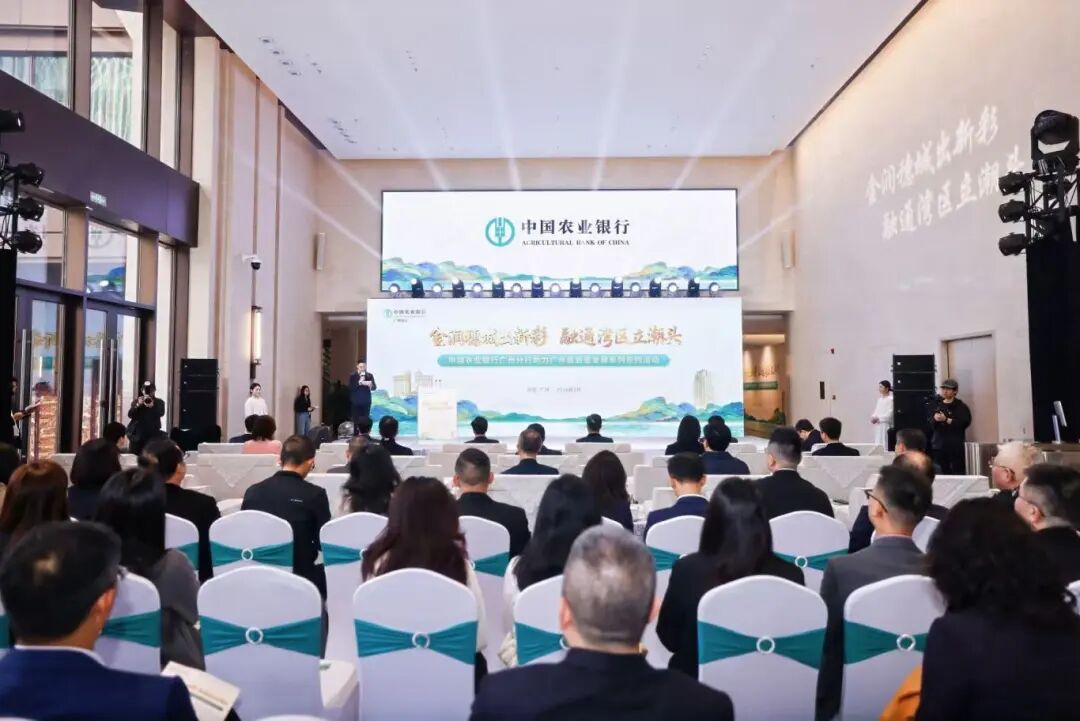
聚焦实体经济,注入金融活水 为切实落实金融服务实体经济的要求,本次活动还举行了多轮专项签约。 (来源:广州金融) 2月6日,中国农业银行广州分行(以下简称"农行广州分行")联合广州市"百千万工程"指挥办、天河区政府及相关战略合作企业,在广州国际金融城隆重 举办"金融助力广州高质量发展"系列签约活动。 立足金融城,深化银政企协同 作为首家入驻广州国际金融城的国有大行区域总部,以及天河区重点税源单位和银行业收入首位机构,农行广州分行始终肩负着服务国家战略与地方发展 的双重使命。 活动现场,农行广州分行与天河区政府正式签署战略合作协议。双方将以此次签约为契机,进一步深化银政合作,通过金融纽带的深度连接,共同提升核 心城区的发展能级。此次合作旨在紧扣国家发展战略,立足区域特色,紧抓"十五五"发展主线,将支持省、市、区高质量发展的决策部署转化为扎实的行 动。 助力乡村振兴与城乡融合 农行广州分行与4家"百千万工程"重点企业签约,旨在通过金融力量助力县域发展提质、推动城乡融合共进,为乡村振兴提供坚实的金融支撑。 赋能重点产业与重大项目 该行还与12家重点战略客户达成深度合作。合作将聚焦实体经济、重点产业及重大项目建设,通 ...

港股通红利低波ETF(159117)涨0.28%,成交额307.89万元
Xin Lang Cai Jing· 2026-02-09 10:48
规模方面,截止2月6日,港股通红利低波ETF(159117)最新份额为8440.12万份,最新规模为9122.08 万元。回顾2025年12月31日,港股通红利低波ETF(159117)份额为1.45亿份,规模为1.48亿元。即该 基金今年以来份额减少41.95%,规模减少38.39%。 来源:新浪基金∞工作室 流动性方面,截止2月9日,港股通红利低波ETF(159117)近20个交易日累计成交金额1.46亿元,日均 成交金额731.35万元。 港股通红利低波ETF(159117)现任基金经理为闫冬、余展昌。闫冬自2025年9月30日管理(或拟管 理)该基金,任职期内收益7.68%;余展昌自2025年9月30日管理(或拟管理)该基金,任职期内收益 7.68%。 最新定期报告显示,港股通红利低波ETF(159117)重仓股包括江西铜业股份、远东宏信、中国神华、 中国海洋石油、恒隆地产、中国石油股份、信和置业、恒安国际、中国石油化工股份、恒生银行,持仓 占比如下。 股票代码股票名称持仓占比持仓股数(股)持仓市值(元)00358江西铜业股份4.39%16.80万650.67万 03360远东宏信3.33%67.80 ...
——北交所策略周报(20260202-20260208):海外科技股剧烈调整释放风险,关注节前情绪修复可能-20260209
Shenwan Hongyuan Securities· 2026-02-09 10:25
Group 1 - The report indicates that the overseas technology stocks have experienced significant adjustments, which may release risks and suggests a potential recovery in market sentiment before the holiday [1][6][7] - The North Exchange 50 index fell by 0.7%, with trading volume decreasing by 28.7%. The market showed considerable volatility, particularly influenced by the "Wosh trading" on Monday, leading to a notable decline [6][10] - Certain sectors such as food and beverage, beauty care, transportation, and banking performed relatively well due to their low valuation and growth rates, while the power equipment sector was more volatile due to themes related to space photovoltaic [6][10] Group 2 - The report highlights that the North Exchange's PE (TTM) average is 82.05 times, with a median of 39.37 times, indicating a decline in valuation metrics [10][12] - The trading volume for the North Exchange was 4.218 billion shares, a decrease of 29.24% week-on-week, and the total trading amount was 102.42 billion yuan, down 28.70% [10][17] - The report notes that 63 stocks rose while 224 stocks fell, resulting in a rise-to-fall ratio of 0.28, with *ST Yunchuang and Optec leading the gains [26][28] Group 3 - The report mentions that the upcoming week will see the listing of Aide Technology, with no new stocks listed this week. As of February 6, 2026, there are 292 companies listed on the North Exchange [19][39] - The report identifies specific stocks to watch due to potential mispricing from reduced risk appetite, including Liancheng CNC, Gebijia, Kaide Quartz, and others [7][26][39]
绿色金融筑底色 北京农商银行连续两年入选ESG百强榜单
Jin Rong Jie Zi Xun· 2026-02-09 10:20
Core Viewpoint - Beijing Rural Commercial Bank has been recognized for its outstanding ESG practices, being included in the "2025 China Enterprise ESG 100 Index" for the second consecutive year, highlighting its commitment to green finance and sustainable development [1][2]. Group 1: ESG Recognition - The "2025 China Enterprise ESG 100 Index" was released at the "Third China Brand Image Overseas Communication Forum," selecting the top 100 companies from over 5,000 based on ESG performance [1]. - The evaluation process involved major domestic and international ESG assessment frameworks and was independently verified by the China Quality Certification Center, focusing on environmental performance, social responsibility, and corporate governance [1]. Group 2: Green Finance Practices - Beijing Rural Commercial Bank integrates green development into its business strategy, actively responding to the national "dual carbon" goals and enhancing its green finance product and service system [1]. - The bank's innovative financial product design combines ESG principles with business development, creating a unique green finance service model that meets the financing needs of enterprises undergoing green transformation [1]. Group 3: Future Plans - Looking ahead to 2026, Beijing Rural Commercial Bank plans to deepen the integration of ESG with business development, focusing on key areas such as energy conservation and environmental protection, and launching more innovative financial products [2]. - The bank's green finance innovations are expected to provide valuable insights for the financial industry in supporting ecological protection and addressing climate change, contributing to the green transformation and high-quality development of the economy and society [2].