信息技术

Search documents
北交所科技成长产业跟踪第二十六期:AI+发展驱动鸿蒙全场景智效跃升,关注北交所AI+产业企业
Hua Yuan Zheng Quan· 2025-05-19 01:51
Group 1: AI and HarmonyOS Development - Huawei's HarmonyOS aims to achieve cross-terminal intelligent collaboration and resource sharing through a "one-time development, multi-terminal deployment" architecture[6] - The first HarmonyOS computer will be officially released on May 19, 2025, featuring the HarmonyOS 5 operating system[9] - In Q4 2024, HarmonyOS captured a 19% market share in China, surpassing Apple's iOS at 17%[30] Group 2: Market Performance and Trends - The median price change for technology growth stocks on the Beijing Stock Exchange was +1.11% from May 12 to May 16, 2025, with 58% of companies experiencing gains[43] - The median TTM P/E ratio for the machinery equipment industry increased by 6.48% to 62.5X, while the electronic equipment industry's median P/E rose from 56.0X to 58.5X[48] - The total market value of the electronic equipment industry decreased to 1390 billion yuan, while the machinery equipment industry's market value increased to 1044 billion yuan[51][59] Group 3: Industry Insights - The AI+ industry on the Beijing Stock Exchange comprises 28 companies, including leaders in cloud computing and AI applications[37] - The automotive industry's median TTM P/E ratio rose from 32.9X to 33.5X, with total market value increasing to 570.7 billion yuan[67] - The information technology industry's median TTM P/E increased from 86.4X to 87.0X, despite a decrease in total market value to 882 billion yuan[63][66]
鞍山“五业并举”助推工业经济提质增效
Liao Ning Ri Bao· 2025-05-19 01:06
Core Insights - Anshan's industrial economy is experiencing high-quality development, with a significant increase in industrial output value and production capacity in various sectors [1][2] Group 1: Industrial Growth - Anshan's industrial added value in the first quarter increased by 11.3% year-on-year, surpassing the provincial growth rate of 7.7% and achieving the best level in recent years [1] - The annual production capacity of Liaoning Yusen Hygiene Products Co., Ltd. is expected to reach 185,000 tons, with an annual output value exceeding 3 billion yuan after the second phase of the project is put into operation [1] Group 2: Traditional Industry Transformation - The steel industry is optimizing its industrial chain, with high-end steel products accounting for 16.3% of total production in the first quarter, and the added value of the steel and deep processing industry increasing by 9.2% year-on-year [2] - The magnesium industry has transformed from high-energy consumption and pollution to a green and intelligent model, while the circular economy industry has established the largest waste steel processing industrial cluster in Northeast China, with an annual output value exceeding 10 billion yuan [2] Group 3: Emerging Industries - Breakthroughs have been made in the cultivation of emerging industries, with the sodium-ion battery project developed by Liaoning Xingkong Sodium Battery achieving international advanced technical indicators [2] - Key projects such as hydrogen energy industrial parks and intelligent computing centers are accelerating, injecting new momentum into industrial economic development [2] Group 4: Future Strategies - Anshan aims to stabilize the industrial economy and achieve the "double over half" goal by implementing technology, digital, energy-saving, environmental protection, and safety transformation projects [2]
京津冀区域出口额创历史同期新高
Jing Ji Ri Bao· 2025-05-18 21:58
Group 1 - The core viewpoint of the articles highlights the significant growth in exports from the Beijing-Tianjin-Hebei region, with a total export value of 4,454.6 billion yuan in the first four months of the year, marking a historical high for the same period and a growth of 1.7% [1] - In April alone, exports reached 1,216.6 billion yuan, achieving a historical high for the month with an 8% increase, the highest growth rate since June 2024 [1] - Beijing's share of exports in the region increased to 45%, up 1.4 percentage points from the previous year, indicating its crucial role in driving export growth in the region [1] Group 2 - Private enterprises have shown remarkable performance, becoming a key driver of export growth in the region, with the number of exporting companies increasing by 10.1% to 31,274 [1] - The number of private enterprises rose by 11.7% to 27,465, contributing 2,000.1 billion yuan in exports, which is an 11.3% increase and accounts for 44.9% of the region's total exports, up 3.9 percentage points [1] - Emerging industries such as automotive parts, information technology, aerospace, shipbuilding, and trendy toys have contributed significantly to the overall export growth, with specific export increases of 19.5%, 39.4%, 4.4%, 45.1%, and 47% respectively [2] Group 3 - The Daxing Airport Customs has reported a significant increase in import and export activities, with the comprehensive bonded zone's import and export values reaching 26.7 billion yuan in the first four months, a 50.9% year-on-year increase [3] - The establishment of the "smart port" initiative aims to enhance logistics services and streamline customs processes, thereby improving the overall efficiency of trade in the Beijing-Tianjin-Hebei region [3] - The Daxing Airport has launched its first international all-cargo flight route, facilitating cross-border e-commerce and enhancing international trade connections for local enterprises [2][3]
邮储银行安徽省分行共建“天空之城”产业生态圈
Zheng Quan Ri Bao Zhi Sheng· 2025-05-18 13:43
Core Viewpoint - Anhui Province is a pilot region for airspace reform in China, focusing on developing a low-altitude economy and integrating various sectors into a smart transportation system [1] Group 1: Low-altitude Economy Development - The low-altitude economy refers to economic activities conducted below 1,000 meters, including drone logistics, low-altitude tourism, aircraft manufacturing, and flight training [1] - Precision manufacturing of aviation hydraulic pump components is crucial for the development of the low-altitude economy, as demonstrated by Lantu Precision Manufacturing Co., which has upgraded its capacity significantly [1][2] Group 2: Financial Support from Postal Savings Bank - Postal Savings Bank of China has established a financial support system for low-altitude economy enterprises, providing a "full-cycle, full-scenario, and full-element" technology financial service framework [1] - The bank completed credit approval for Lantu Precision in just one week, enabling the company to procure essential raw materials for equipment upgrades [2] - The bank has tailored financing solutions for technology-driven companies like Lantu Precision, utilizing a "look to the future" evaluation model to assess R&D investments and patent reserves [2] Group 3: Ecosystem Building - Postal Savings Bank aims to build a comprehensive ecosystem for the low-altitude economy, supporting not just individual companies but the entire industry chain [3] - Companies like Wuhu Tianke Aviation Technology Co. have benefited from increased loans, allowing them to expand production and enhance R&D capabilities [3] - The bank has provided over 34.5 billion yuan in credit support to more than 4,000 innovative enterprises in Anhui, positioning itself as a key player in the province's low-altitude economic growth [4]

如何看待公募基金回归基准?
Hua Er Jie Jian Wen· 2025-05-18 10:13
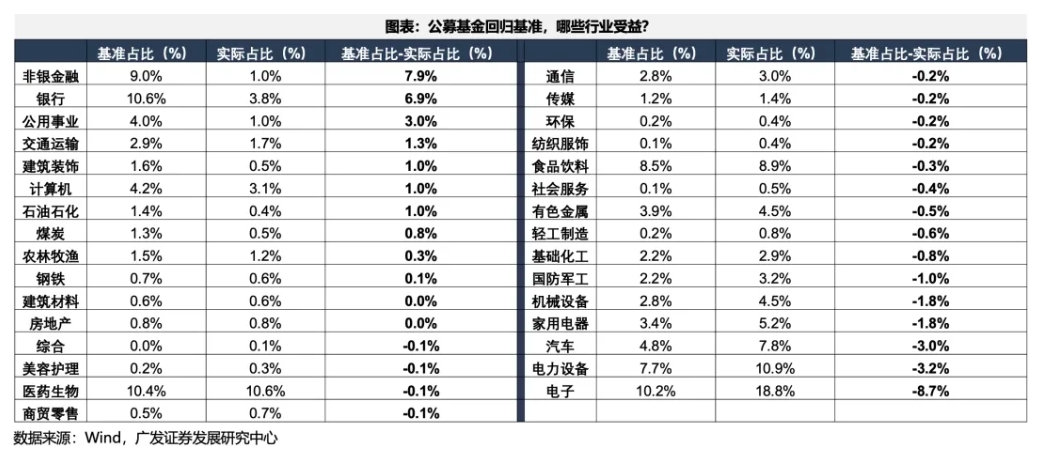
市场对公募考核新规以及回归基准行业配置的理解或存在误区。公募基金的目标仍然是跑赢基准,决定公募基金超低配行业的因素还是取决于行业 的实际基本面、产业的趋势、以及对公司估值的判断。长期来看最大的影响是活跃头寸的占比下降。 短期上涨非因调仓导致 5月7日,证监会印发《推动公募基金高质量发展行动方案》。其中最关键的变化包括: 业绩基准约束:对基金经理的考核,要求基金产品业绩指标权重不低于80%,对三年以上产品业绩低于业绩比较基准超过 10 个百分点 的,要求其绩效薪酬应当明显下降; 风格漂移监管:对长期(超1年)偏离基准20%以上的基金将进行重点监控; 行业配置披露:季度报告必须详细说明行业配置与基准指数的差异及调整计划; A股大金融板块应声而动,银行板块持续发力,刷新2015年7月中旬以来新高。 广发证券测算认为,假设完全回归基准,非银金融、银行、公用事业可能是需要买入最多的行业,基准占比-实际占比分别为7.9%、6.9%和3%。 | | | | | 图表:公募基金回归基准,哪些行业受益? | | | | | --- | --- | --- | --- | --- | --- | --- | --- | | | ...

中美关税进展积极,股指走势分化
Dong Zheng Qi Huo· 2025-05-18 07:45
Report Industry Investment Rating - The rating for stock index is "oscillation" [1] Core View of the Report - The global stock market rose this week, especially the US stocks driving the significant recovery of developed markets. The Sino-US Geneva talks achieved better-than-expected progress, with a 91% reduction in reciprocal tariffs, and 24% of the tariffs suspended for 90 days. This will lead to trade restoration between the two countries in the next 90 days, and the external cycle will support the domestic economy. However, policy efforts may remain conservative, and the inflation situation is hard to strengthen. Given the current high valuation of the stock market, the potential return on investment is restricted. The short - term market is expected to maintain an oscillatory trend [2][9] Summary According to the Directory 1. One - Week View and Macro Key Event Overview - **Next Week's View**: The market is expected to wait for the return of liquidity. The short - term market will maintain an oscillatory trend due to Sino - US trade restoration, conservative policy efforts, and high stock market valuations [2][9] - **This Week's Key Event Concerns**: - On May 12th, Sino - US Geneva economic and trade negotiations made positive progress, with a 91% reduction in reciprocal tariffs. The US and China will adjust relevant tariff policies, and China will take measures to suspend or cancel non - tariff countermeasures against the US. Also, 34 cities will be selected for the third batch of enterprise digital transformation pilot projects. Japan's Prime Minister demanded the US to cancel all additional tariffs [10][11][12] - On May 13th, China's leader proposed to start five major projects with Latin American countries. The National Development and Reform Commission emphasized the importance of work - relief. The central bank's deputy governor summarized four changes in the central bank's policy framework. India plans to impose tariffs on some US products. China's central bank and Brazil's central bank signed relevant agreements [14][15][16][17][18] - On May 14th, China's leader met with leaders of Colombia and Chile, promoting bilateral cooperation. Seven departments issued policies to build a science - technology finance system. Tax data showed that the national enterprise sales revenue increased by 4.3% year - on - year in April. China's M2 growth rate was 8% and M1 was 1.5% in April [19][20][21][22] - On May 15th, China will implement a visa - free policy for five South American countries. The Supreme People's Court and the CSRC jointly issued a document to combat illegal activities in the capital market. The agricultural machinery market index in April showed a weak peak season [23][24][25] - On May 16th, the average annual salary of urban non - private employees in 2024 was 124,110 yuan, with a 2.6% increase, and that of private employees was 69,476 yuan, with a 4% increase. Public fund professionals refuted the view of market repositioning due to public fund assessment benchmarks. The Ministry of Commerce emphasized the importance of duty - free shopping for consumption [26][27][28] 2. One - Week Market Quotes Overview - **Global Stock Market Weekly Overview**: From May 12th to May 16th, the global stock market denominated in US dollars generally rose. The MSCI Global Index rose 3.97%, with developed markets (+4.08%) > emerging markets (+2.98%) > frontier markets (+1.72%). The stock index of Taiwan, China rose 5.37%, leading the world, while the Japanese stock market fell 0.48%, performing the worst globally [29] - **Chinese Stock Market Weekly Overview**: Chinese equity assets were divided into markets, with Chinese concept stocks > A - shares > Hong Kong stocks. The average daily trading volume of A - shares in the Shanghai, Shenzhen, and Beijing stock exchanges was 1266.4 billion yuan, a decrease of 87.2 billion yuan from last week. A - share indexes were differentiated, with blue - chip indexes such as the Beijing Stock Exchange 50 and the Shanghai Stock Exchange 50 rising more than 1%, while the CSI 500, CSI 1000, and STAR 50 indexes fell [32] - **Weekly Overview of GICS Primary Industries in Chinese and Foreign Stock Markets**: Most global GICS primary industries rose this week, with the information technology industry leading (+7.39%), and the healthcare industry performing poorly (-0.02%). In the Chinese market, the financial industry led the rise (+1.91%), and the information technology industry led the decline (-0.84%) [35] - **Weekly Overview of Chinese A - Share CITIC Primary Industries**: Among Chinese A - share CITIC primary industries, 21 rose (30 last week) and 9 fell (0 last week). The leading industry was the automobile industry (+2.71%), and the industry with the largest decline was the national defense and military industry (-1.61%) [36] - **Weekly Overview of Chinese A - Share Styles**: The large - cap growth style was dominant [41] - **Overview of Stock Index Futures Basis**: No specific data was summarized in the text [44] 3. Index Valuation and Earnings Forecast Overview - **Broad - Based Index Valuation**: The text provided PE and PB data for various broad - based indexes this week, at the beginning of the year, and their changes and eight - year percentile rankings [53] - **Primary Industry Valuation**: The text provided PE and PB data for various primary industries this week, at the beginning of the year, and their changes and eight - year percentile rankings [54] - **Broad - Based Index Equity Risk Premium**: The ERP of the CSI 300, CSI 500, and CSI 1000 decreased slightly this week [55][60] - **Consensus Earnings Growth Rate of Broad - Based Indexes**: The expected earnings growth rate of the CSI 300 in 2025 was adjusted down to 8.38% and up to 8.09% in 2026; that of the CSI 500 in 2025 was adjusted down to 37.38% and down to 16.00% in 2026; that of the CSI 1000 in 2025 was adjusted up to 1.55% and down to 18.76% in 2026 [61] 4. Liquidity and Capital Flow Tracking - **Interest Rates and Exchange Rates**: This week, the yield of the 10 - year Treasury bond and the 1 - year Treasury bond rose, and the spread widened. The US dollar index was 100, and the offshore RMB exchange rate was 7.20 [68] - **Trading - Type Capital Tracking**: This week, the average daily trading volume of northbound funds decreased by 13.3 billion yuan compared with last week, and the margin trading balance increased by 4.3 billion yuan [71] - **Capital Inflow Tracking through ETFs**: There were 28 on - site ETFs tracking the CSI 300, 27 tracking the CSI 500, 15 tracking the CSI 1000, and 29 tracking the CSI A500. The share of ETFs tracking the CSI 300 decreased by 1.6 billion shares, that of the CSI 500 decreased by 200 million shares, that of the CSI 1000 decreased by 700 million shares, and that of the CSI A500 decreased by 4.3 billion shares [73][74][78] 5. Tracking of Domestic Macro High - Frequency Data - **Supply Side**: The tire operating rate rebounded rapidly [80] - **Consumption Side**: The number of second - hand housing listings decreased, and international oil prices slightly recovered [90] - **Inflation Observation**: Agricultural product prices reached a new low this year [101]
据CNBC:英伟达(NVDA.O)、思科(CSCO.O)和OpenAI支持阿联酋“星际之门”数据中心建设。
news flash· 2025-05-16 19:28
Group 1 - Nvidia, Cisco, and OpenAI are supporting the construction of the "Gateway to the Stars" data center in the UAE [1]

闻泰科技: 董事会关于公司股票价格在本次交易首次公告日前20个交易日内波动情况的说明
Zheng Quan Zhi Xing· 2025-05-16 16:13
闻泰科技股份有限公司董事会 票价格累计下跌 5.99%,同期上证指数(000001.SH)累计上涨 1.74%,信息技 术行业指数(882008.WI)累计下降 0.91%。剔除上述大盘因素和同行业板块因 素影响后,闻泰科技股票价格在本次重大资产重组首次披露前 20 个交易日期间 内的累计涨跌幅未达到 20%,价格波动未达到《上海证券交易所上市公司自律监 管指引第 6 号——重大资产重组》的相关标准。综上,公司本次交易首次披露前 股票价格波动不存在异常波动的情况。 特此说明。 (以下无正文) (本页无正文,为《闻泰科技股份有限公司董事会关于公司股票价格在本次交易 首次公告日前 20 个交易日内波动情况的说明》之盖章页) 闻泰科技股份有限公司董事会 闻泰科技股份有限公司(以下简称"上市公司"或"公司"或"闻泰科技") 拟以现金交易的方式向立讯精密工业股份有限公司及立讯通讯(上海)有限公司 (以下简称"交易对方")转让公司下属的昆明闻讯实业有限公司、黄石智通电 子有限公司、昆明智通电子有限公司、闻泰科技(深圳)有限公司、Wingtech Group (HongKong) Limited(含 PT. Wingtec ...

国脉科技(002093) - 002093国脉科技投资者关系管理信息20250516
2025-05-16 13:30
Group 1: AI Intelligent Body Development - The company plans to release three types of AI intelligent bodies based on home care scenarios in the current quarter [2][4] - The AI intelligent body will serve as an efficient assistant for precise customer acquisition and a guide for seniors and their families during the transition to new living arrangements [3][4] Group 2: Market Potential and Demographics - By the end of 2024, the elderly population aged 60 and above in China is projected to reach 310 million, accounting for 22% of the total population, with an annual growth rate of approximately 10 million [4] - Home care is the dominant choice for elderly care, representing about 90% of the market, indicating a strong demand for home care services [4] Group 3: Competitive Advantages - The company focuses on developing specialized AI intelligent bodies for home care and health management, differentiating from generic models available in the market [4][6] - The integration of the "Guomai University Elderly Care" project provides real application scenarios and data feedback, facilitating product performance verification and optimization [6][8] Group 4: Marketing and Promotion Strategies - The AI intelligent body will first be implemented in the "Guomai University Elderly Care" community to ensure optimal user experience before broader market rollout [6][7] - The company emphasizes both traditional and online marketing channels, achieving over one million exposures since the project's initial promotion [7] Group 5: Financial Performance - In 2024, the company achieved its best historical performance, with revenue reaching a six-year high and net profit increasing by 61% year-on-year [10] - In Q1 2025, the net profit grew by 55% year-on-year and 345% quarter-on-quarter, indicating strong growth momentum [11]

【广发金工】美国可转债被动化投资历程与启示
广发金融工程研究· 2025-05-15 06:29
Domestic Convertible Bond ETF Development Status - Two convertible bond ETFs have been issued in China: Bosera CSI Convertible Bond and Exchangeable Bond ETF (as of Q1 2025, size 37.66 billion RMB) and Haifutong SSE Investment Grade Convertible Bond ETF (as of Q1 2025, size 5.78 billion RMB), together accounting for 6.1% of the total market size of convertible bonds [1][6][12] - The management fee rates for these ETFs are lower than those of actively managed convertible bond funds (0.15% and 0.25% respectively) [1][12] - Since 2024, institutional investors have accounted for over 97% of the holdings, indicating a strong demand for ETF allocation to diversify non-systematic risks [1][12] - Performance-wise, the returns for 2024 are 5.87% for Bosera and 8.32% for Haifutong, outperforming the average of actively managed convertible bond funds [1][12][22] U.S. Convertible Bond Market - The U.S. convertible bond market is the largest and most mature globally, with a total outstanding size of 254 billion USD by the end of 2024, covering a wide range of issuers from small to large companies, primarily in TMT, consumer, and healthcare sectors [2][42] - The terms of U.S. convertible bonds are designed to be flexible, with a stable default rate compared to the Chinese market [2][66] U.S. Convertible Bond Index and Index Funds - The U.S. has a well-established convertible bond index system, with various indices compiled by Bloomberg, ICE BofA, and iBoxx, dating back to 1988 [3][70] - The first U.S. convertible bond ETF, SPDR Bloomberg Convertible Securities ETF (CWB), was launched in 2009, with current sizes of 4 billion USD for CWB and 2.6 billion USD for iShares' ICVT [3][77] - Over the past five years, the annualized returns for passive ETFs (10%-11%) have significantly outperformed the average of actively managed funds (7.3%) [3][88] Insights and Recommendations - Suggestions for the development of China's convertible bond market include improving the index system and developing segmented strategy indices [4][89] - Emphasizing low fees as a core competitive advantage for passive products [4][89] - Enhancing liquidity of ETFs and underlying assets to increase trading activity [4][90] - Innovating bond terms to introduce more flexible mechanisms while protecting investors [4][90]