
农产品加工

Search documents
双塔食品:欧盟启动豌豆蛋白反倾销调查,具体影响暂难估计
Ge Long Hui A P P· 2025-09-01 10:46
Core Viewpoint - The European Commission has initiated an anti-dumping investigation into high-protein pea protein from China, which may impact the company's export sales to the EU significantly in the coming years [1] Group 1: Company Impact - The company's sales of pea protein products to the EU are projected to account for approximately 3.92% of total revenue in 2024 and 6.48% in the first half of 2025 [1] - The company has established a special task force and hired legal counsel to actively respond to the investigation [1] - The company plans to explore emerging international markets and accelerate the construction of overseas factories [1] Group 2: Investigation Status - The investigation is currently in its early stages, and no detailed information regarding potential tariffs has been disclosed yet [1] - The company will closely monitor the progress of the investigation and fulfill its information disclosure obligations in a timely manner [1]

双塔食品(002481.SZ):欧盟对中国豌豆蛋白启动反倾销调查
Ge Long Hui A P P· 2025-09-01 10:46
Core Viewpoint - The European Commission has initiated an anti-dumping investigation into Chinese pea protein, following a complaint from the Ad Hoc Coalition of Union Pea Protein Producers, which may impact the company's export sales to the EU [1] Group 1: Investigation Details - The investigation targets high-protein pea protein with a protein content exceeding 65% on a dry weight basis, covering all types derived from peas, including but not limited to yellow and green peas, in all physical forms (solid like powder, liquid like solution, regardless of whether they are organized) [1] Group 2: Financial Impact - In 2024, the sales revenue from pea protein with a protein content exceeding 65% exported to the EU is expected to account for approximately 3.92% of the company's total operating income [1] - For the first half of 2025, this figure is projected to rise to about 6.48% of the company's total operating income [1] Group 3: Future Uncertainty - The anti-dumping investigation is currently in the inquiry stage, and the future outcome of the investigation remains difficult to predict [1]
瑞达期货玉米系产业日报-20250901
Rui Da Qi Huo· 2025-09-01 09:24
Report Summary 1. Report Industry Investment Rating No relevant content provided. 2. Core Views - **Corn**: In the domestic market, the new corn season is approaching in the Northeast production area. Reserve rotation corn is continuously released to supplement market supply. Traders' confidence in price support has weakened, accelerating the sale of remaining grains. Feed - using enterprises have relatively sufficient inventories and low procurement enthusiasm, preferring to wait for new grains. Some price - setting enterprises have continuously lowered their quotes. Recently, due to short - covering by bears, the corn futures price has rebounded slightly from the low level [2]. - **Corn Starch**: With the resumption of work of previously overhauled enterprises, the operating rate of the corn starch industry has rebounded recently, increasing supply - side pressure. Meanwhile, downstream demand is still in the off - season, with poor order signing and shipment. The supply of corn starch far exceeds demand, and inventory pressure remains high. Affected by the corn rebound, the starch price has oscillated higher [3]. 3. Summary by Directory Futures Market - **Domestic Futures**: The closing price of the active corn starch futures contract is 2193 yuan/ton (up 2 yuan), and that of the active corn futures contract is 2500 yuan/ton (down 1 yuan). The 1 - 5 corn monthly spread is - 69 yuan/ton, and the 11 - 1 corn starch monthly spread is - 35 yuan/ton (down 2 yuan). The active - contract positions of yellow corn and corn starch are 974389 hands and 205537 hands respectively, with the latter down 3350 hands. The net long positions of the top 20 futures holders for corn starch and corn are - 83289 hands and - 35460 hands respectively, with the latter down 427 hands. The registered warehouse receipts of yellow corn and corn starch are 67737 hands and 7450 hands respectively, with the former down 1689 hands. The CS - C spread of the main contract is 226 yuan/ton (down 20 yuan) [2]. - **CBOT Futures**: The closing price of the active CBOT corn futures contract is 9.25 cents/bushel. The total CBOT corn positions are 1456701 contracts (down 109666 contracts), and the non - commercial net long positions are - 70940 contracts (up 34270 contracts) [2]. Spot Market - **Corn Spot**: The average spot price of corn is 2364.12 yuan/ton (down 0.59 yuan), the FOB price at Jinzhou Port is 2280 yuan/ton (up 10 yuan), and the CIF price of imported corn is 1926.14 yuan/ton (down 15.15 yuan). The international freight of imported corn is 0 dollars/ton. The basis of the corn main contract is - 2.59 yuan [2]. - **Corn Starch Spot**: The ex - factory quotes of corn starch in Changchun, Weifang, and Shijiazhuang are 2660 yuan/ton, 2900 yuan/ton, and 2830 yuan/ton respectively, all unchanged. The basis of the corn starch main contract is 160 yuan (up 1 yuan), and the weekly spread between Shandong starch and corn is 370 yuan/ton (up 34 yuan) [2]. - **Substitute Spot**: The average spot price of wheat is 2428.06 yuan/ton (down 0.83 yuan), the weekly spread between tapioca starch and corn starch is 184 yuan/ton (up 27 yuan), and the daily spread between corn starch and 30 - powder is - 67 yuan/ton (unchanged) [2]. Upstream Situation - The predicted sown areas of corn in the US, Brazil, Argentina, China, and Ukraine are 398.93 million hectares, etc. The predicted corn yields in these countries are 35.12 million tons, 22.6 million tons, 7.5 million tons, 44.3 million tons, and 30.5 million tons respectively (only the US yield is down 0.25 million tons) [2]. Industry Situation - **Inventory**: The corn inventories at southern ports, northern ports, and deep - processing enterprises are 9.9 million tons, 175 million tons, and 294.2 million tons respectively, with the latter down 20.5 million tons. The weekly inventory of starch enterprises is 131.8 million tons (down 2.1 million tons, a 1.57% weekly decrease, 0.53% monthly increase, and 31.41% year - on - year increase) [2][3]. - **Trade Volume**: The monthly import volume of corn is 6 million tons (down 10 million tons), and the monthly export volume of corn starch is 15940 tons (up 1440 tons) [2]. - **Output**: The monthly output of feed is 2827.3 million tons (down 110.4 million tons) [2]. Downstream Situation - The average inventory days of sample feed corn is 28.13 days (down 0.72 days). The deep - processing corn consumption is 114.02 million tons (up 0.4 million tons). The operating rates of alcohol and starch enterprises are 42.87% and 51.01% respectively, with the latter down 1.29% [2]. - The processing profits of corn starch in Shandong, Hebei, and Jilin are - 117 yuan/ton (down 11 yuan), - 51 yuan/ton (up 11 yuan), and - 79 yuan/ton (down 14 yuan) respectively [2]. Option Market - The 20 - day and 60 - day historical volatilities of corn are 7.91% (up 0.02%) and 6.37% (down 0.17%) respectively. The implied volatilities of at - the - money call and put options on corn are 10.01% (up 0.18%) and 10.02% (up 0.19%) respectively [2]. Industry News - Brazilian ethanol producer Inpasa and grain processing and export giant Amaggi will establish a joint venture to build at least three new corn ethanol plants in Mato Grosso [2]. - The Buenos Aires Grain Exchange (BAGE) reported that the corn harvest in Argentina is nearing completion. As of August 27, the harvest progress of the 2024/25 Argentine corn crop was 97.2%, 1.3% higher than a week ago [2]. - Pro Farmer's final yield forecast report shows that the total US corn production in 2025 is expected to reach 1.6204 billion bushels, with an average yield of 182.7 bushels per acre, which is a record high but lower than the USDA's August forecast of 1.6742 billion bushels and 188.8 bushels per acre [2]. Key Points of Concern - Monitor the weekly corn consumption and the operating rate and inventory of starch enterprises on Thursday and Friday as reported by Mysteel [3].

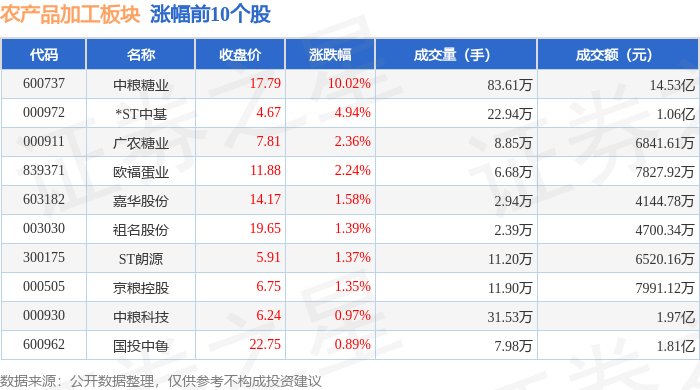
农产品加工板块9月1日涨2.14%,中粮糖业领涨,主力资金净流入1.01亿元
Zheng Xing Xing Ye Ri Bao· 2025-09-01 08:39
Market Overview - The agricultural processing sector rose by 2.14% on September 1, with COFCO Sugar leading the gains [1] - The Shanghai Composite Index closed at 3875.53, up 0.46%, while the Shenzhen Component Index closed at 12828.95, up 1.05% [1] Individual Stock Performance - COFCO Sugar (600737) closed at 17.79, with a significant increase of 10.02% and a trading volume of 836,100 shares [1] - Other notable performers included *ST Zhongji (000972) with a 4.94% increase, and Guangnong Sugar (000911) with a 2.36% increase [1] - The trading volume and turnover for COFCO Sugar reached 14.53 billion yuan [1] Capital Flow Analysis - The agricultural processing sector saw a net inflow of 101 million yuan from institutional investors, while retail investors experienced a net outflow of 1.14 billion yuan [2][3] - COFCO Sugar attracted a net inflow of 2.29 billion yuan from institutional investors, despite a net outflow of 1.84 billion yuan from retail investors [3] - Other stocks like Morning Light Bio (300138) and *ST Zhongji (000972) also saw varying levels of net inflow and outflow from different investor categories [3]


国投期货综合晨报-20250901
Guo Tou Qi Huo· 2025-09-01 08:18
gtaxinstitute@essence.com.cn 综合晨报 2025年09月01日 (原油) 上周国际油价震荡,布伦特11合约涨0.3%。俄乌、伊核谈判仍处僵局,但在近期地缘风险溢价小 幅向上修复后暂无迹象表明供应受到明显阻碍。旺季过后石油市场供应过剩压力将进一步凸显,关 注9月7日0PEC+议产会议对剩余165万桶/天自愿减产恢复的讨论,若无进一步地缘犹动原油市场下 行压力增加。 【贵金属】 周五美国公布核心PCE温和上涨符合预期,进一步稳定了9月美联储降息预期,叠加特朗普解雇库克 事件成肠美联储独立性,责金属偏强运行。国际金价通近历史高点,一旦突破则上涨可能具备一定 持续性,本周关键的美国非农数据或将决定多空走向。此外美联邦巡回上诉法院裁定特朗普关税措 施非法,关注最高法院裁决。 (铜) 上周五伦铜走出9900美元8月最高收盘价,主要受金银涨势提振,市场等待9月中旬联储兑现降息, 且部分机构关注美国失业数据的调整。国内铜市关注废铜因整顿补贴、落实反向开票成本上调后, 市场报价的调整。铜市基本面编中性,但联储降息引起的资金共振可能带动铜价短线突破上冲,少 量多单短线参与。 (铝) 周五夜盘沪铝窄幅波 ...
“媒体+”赋能,玩转短视频、小红书!清远丝苗米区域公用品牌宣传推广培训班即将开讲
Nan Fang Nong Cun Bao· 2025-09-01 08:06
Core Viewpoint - The training program for promoting the Qingyuan Si Miao rice brand aims to leverage new media platforms like short videos and Xiaohongshu to enhance brand visibility and market reach in the context of rural revitalization and increasing competition in agricultural branding [4][5][6]. Group 1: Training Program Overview - The Qingyuan Si Miao rice regional public brand promotion training class will officially start on September 2, focusing on empowering modern agricultural industry development through media [12][13]. - The training will address industry pain points by offering practical courses on short video production and Xiaohongshu operations, combining theoretical knowledge with hands-on practice [14][15][16]. Group 2: Industry Context - Qingyuan Si Miao rice is one of the five hundred billion-level modern agricultural industries in Qingyuan, transitioning from a "quality product" to a "well-known brand" [4][5]. - New media platforms have become crucial channels for agricultural brands to reach consumers and open up markets [6]. Group 3: Challenges Faced - Many agricultural processing enterprises, including those in Qingyuan, face challenges such as lacking promotional strategies and the inability to generate traffic despite having quality content [8][9][10]. Group 4: Expert Involvement - The training will feature industry experts who will provide insights on short video shooting techniques and Xiaohongshu operational strategies, helping participants create engaging content that resonates with consumers [25][32][38]. - The training will be held at the intelligent processing base of Guangdong Suiyuan New Agricultural Technology Co., Ltd., a benchmark enterprise in the Qingyuan Si Miao rice industry [19][20].

重庆涪陵:一颗青菜头“榨”出155亿元
Huan Qiu Wang· 2025-09-01 07:59
Core Insights - The article highlights the unique geographical and climatic advantages of Fuling District in Chongqing, which contribute to the high-quality production of Fuling pickled vegetables, specifically the green cabbage head [1][4] - The Fuling pickled vegetable industry has transformed from a small-scale operation to a billion-dollar industry, with a projected output value exceeding 15.5 billion yuan in 2024 [1][4] Group 1: Agricultural Production - Fuling's green cabbage head, known scientifically as Brassica juncea, benefits from a 110-day growth period due to its unique latitude and climate, which includes temperatures between 3°C and 15°C and limited sunlight [1][2] - The region's purple soil, formed during the Jurassic period, is rich in essential trace elements like selenium, calcium, and potassium, enhancing the nutritional quality of the green cabbage head [1][2] Group 2: Research and Innovation - The Chongqing Southeast Agricultural Science Institute, located in Fuling, is the only research institution in China focusing on comprehensive studies of pickled vegetables, housing 1,336 varieties of mustard seed resources [2] - The institute has developed early-maturing varieties such as "Yuzhao 100," which allows for earlier market entry of fresh cabbage heads, and "ZB5," which extends the supply period to four seasons [2] Group 3: Sustainable Practices - The introduction of MVR evaporation technology allows for the recycling of saline wastewater from pickled vegetable production, converting it into reusable brine for pickling and producing soy sauce, thus achieving green development goals [3] - Fuling pickled vegetables serve as a significant source of income for local farmers, with early-maturing varieties fetching higher prices compared to regular cabbage heads, leading to increased farmer income [3] Group 4: Economic Impact - The cooperative model established in Fuling, involving "enterprises + cooperatives + farmers," provides farmers with stable income through short-term labor opportunities and profit-sharing from cooperatives [3] - The average income per mu (0.067 hectares) of green cabbage head cultivation exceeds 2,000 yuan, with individual farmers achieving a net income of over 3,200 yuan [3]
江苏首部“地名经济”指导文件出台
Jiang Nan Shi Bao· 2025-09-01 06:31
Core Viewpoint - Jiangsu Province has issued its first guiding document on "place name economy," aiming to integrate place names with various sectors such as culture, tourism, and local industries to enhance economic development Group 1: Integration of Place Names and Rural Development - The document emphasizes the deep integration of rural place name elements with rural industry development to increase agricultural efficiency, rural vitality, and farmers' income [2] - Initiatives like "Famous Rural Action" and enhancement of rural specialty industries will transform place names from mere cultural symbols into productive elements driving rural brand development [2] - The document also highlights the importance of place names in the construction of beautiful rural areas, including standardizing naming practices and improving signage to reflect local cultural characteristics [2] Group 2: Place Names and Culinary Development - The document creatively combines local cuisine with place names to create new consumption hotspots, launching activities like "Taste of Jiangsu" and "Experience Cuisine by Place Name" [3] - It aims to protect and promote local culinary culture, particularly focusing on regional cuisines such as Huaiyang, Jinling, and Su-Xi, while establishing a comprehensive system for the transmission of place names and culinary heritage [3] - The establishment of a digital promotion system for "place name + cuisine" will facilitate the creation of a "place name food map," encouraging public engagement with local culinary offerings [3] Group 3: Place Names and Cultural Tourism - The document outlines plans to leverage place names as cultural links to enhance the quality of cultural tourism in Jiangsu [4] - It proposes the development of cultural tourism routes that connect significant regional cultures and historical sites, promoting a diverse tourism experience [5] - The document also emphasizes the protection and utilization of revolutionary cultural resources, aiming to create a database of red place names and organize themed activities around historical events [5]
粕类周报:供需缺口博弈,关注中美政策-20250901
Guo Mao Qi Huo· 2025-09-01 05:56
1. Report Industry Investment Rating - The report does not explicitly mention an overall industry investment rating. However, the investment view for both soybean meal and rapeseed meal is "oscillating" [3]. 2. Core Viewpoints of the Report - The supply - demand situation of soybean meal and rapeseed meal is complex, influenced by multiple factors such as US soybean production, domestic inventory, import policies, and feed demand. The market is expected to be in an oscillating state, and the key to future trends lies in Sino - US policies [3]. 3. Summary According to Relevant Catalogs 3.1 Main Viewpoints and Strategy Overview - **Supply**: The USDA August report adjusted the US soybean yield and planting area, resulting in a tight supply - demand balance sheet for new - crop US soybeans in 2025/26. The domestic soybean arrival volume in September is expected to exceed 10 million tons, and soybean meal is in a stockpiling cycle. The supply - demand gap for soybean meal in the first quarter of next year depends on Sino - US policies. The supply of imported rapeseed meal and rapeseed in China is expected to decrease under Sino - Canadian trade policies, while the opening of Australian rapeseed imports is expected to supplement the domestic rapeseed meal supply in the fourth quarter [3]. - **Demand**: Short - term high inventories of pigs and poultry support feed demand, but policy guidance to control pig inventory and weight may affect future pig supply. Soybean meal has high cost - effectiveness and high pick - up volume, and the peak season of aquaculture supports rapeseed meal demand. However, wheat substitution for corn in some areas reduces protein consumption, and downstream transactions of soybean and rapeseed meal are cautious this week [3]. - **Inventory**: Domestic soybean inventory has reached a high level, soybean meal inventory is rising (lower than the same period last year but still in a stockpiling cycle), and the inventory days of feed enterprises' soybean meal are increasing. Domestic rapeseed inventory has declined to a low level, and rapeseed meal inventory is being depleted but remains at a high level compared to the same period in previous years [3]. - **Basis/Spread**: The basis is weak [3]. - **Profit**: Brazilian soybean crushing profit has deteriorated, while Canadian rapeseed crushing profit is good [3]. - **Valuation**: The prices of soybean and rapeseed meal on the futures market are currently at a neutral valuation position [3]. - **Macro and Policy**: Attention should be paid to the results of Sino - US negotiations on soybeans. China has started to release imported soybeans from reserves, and is expected to open up Australian rapeseed imports and actively apply for relevant GMOs [3]. - **Investment View**: For soybean meal, the M01 contract was weak this week due to Sino - US peace - talk expectations and reserve releases, but the tight supply - demand situation of US soybeans supports the CBOT US soybean futures market. The spread between US soybeans and Brazilian soybeans' CNF premiums has narrowed to a normal range, and it is expected that the decline of Brazilian soybeans' CNF premiums will be limited. With the support of import costs, the downside space of M01 is expected to be limited, and it is expected to move in an oscillating manner in the short term. The basis and spread trends depend on Sino - US policies. For rapeseed meal, with the absence of Canadian supply, domestic inventory is expected to decrease, but the opening of Australian rapeseed imports is expected to supplement the supply. The RM01 contract is a off - season contract, and it is expected that the supply - demand contradiction will not be significant, and it will generally follow the oscillation of soybean meal, with attention paid to policy changes [3]. - **Trading Strategy**: Unilateral trading is expected to be oscillating, and arbitrage is advised to wait and see. Risks to watch include policies and weather [3]. 3.2 Fundamental Supply - Demand Data of Meal Products - **Soybean and Rapeseed Inventory - to - Consumption Ratios**: In August 2025, the inventory - to - consumption ratios of US soybeans and global soybeans in the 2025/26 season decreased. The report also shows the inventory - to - consumption ratios of Brazilian and Argentine soybeans, as well as global and Canadian rapeseed over the years [35][36][45]. - **US Soybean Production and Sales**: The sowing rate and excellent - good rate of US soybeans are presented. The domestic crushing profit of US soybeans is rising, the NOPA soybean crushing volume and USDA US soybean monthly crushing volume data are provided, and this week's US soybean exports declined [47][51][63]. - **Import and Cost**: The CNF premium of soybeans, the import cost of Canadian rapeseed, and the exchange rate of the US dollar against the Brazilian real are shown. The import profit of Brazilian soybeans has deteriorated, while that of Canadian rapeseed is good [70][74][77]. - **Domestic Inventory and Transaction**: Domestic soybean inventory is at a high level, soybean meal is in a stockpiling cycle but lower than last year, and the inventory days of feed enterprises are increasing. The inventory of domestic imported rapeseed has declined, and rapeseed meal inventory is being depleted. The transaction volume of soybean meal is normal, and the pick - up volume is high, while the transaction volume of rapeseed meal is also presented [81][102][109]. - **Feed and Livestock Farming**: The monthly output of feed is shown, as well as the breeding profits and related data of pigs, broilers, and laying hens. Pig prices are falling [116][118][122].
油脂油料早报-20250901
Yong An Qi Huo· 2025-09-01 04:21
Group 1: Report Industry Investment Rating - No relevant information provided Group 2: Core Views of the Report - Indonesia set the reference price for crude palm oil in September at $954.71 per ton, higher than $910.91 per ton in August, which will increase the export tax from $74 to $124 per ton, and a 10% special tax is also imposed on palm oil [1] - As of the week ending August 24, Canadian canola exports decreased by 13.5% to 78,500 tons compared to the previous week, and from August 1 to August 24, 2025, Canadian canola exports were 434,500 tons, a 47.6% decrease compared to the same period last year, with a commercial inventory of 603,400 tons as of August 24 [1] - The U.S. Energy Information Administration (EIA) data showed that the use of soybean oil for biofuel production in the U.S. in June rose to 1.045 billion pounds, up from 1.025 billion pounds in May, and soybean oil remains the main raw material for biodiesel in the U.S. [1] Group 3: Summary Based on Related Catalogs Overnight Market Information - Indonesia set the September reference price for crude palm oil at $954.71 per ton, up from $910.91 per ton in August, increasing the export tax from $74 to $124 per ton, and a 10% special tax is imposed on palm oil [1] - As of the week ending August 24, Canadian canola exports decreased by 13.5% to 78,500 tons compared to the previous week, and from August 1 to August 24, 2025, Canadian canola exports were 434,500 tons, a 47.6% decrease compared to the same period last year, with a commercial inventory of 603,400 tons as of August 24 [1] - The U.S. Energy Information Administration (EIA) data showed that the use of soybean oil for biofuel production in the U.S. in June rose to 1.045 billion pounds, up from 1.025 billion pounds in May, and soybean oil remains the main raw material for biodiesel in the U.S. [1] Spot Prices - The spot prices of soybean meal in Jiangsu, rapeseed meal in Guangdong, soybean oil in Jiangsu, palm oil in Guangzhou, and rapeseed oil in Jiangsu from August 25 to August 29, 2025, are presented in a table [3] Protein Meal Basis - No specific content provided Fat Basis - No specific content provided Fat and Oil Futures Spread - No specific content provided