纺织服装

Search documents
午评:沪指涨0.72%,汽车、医药等板块拉升,信创概念等活跃
Zheng Quan Shi Bao Wang· 2025-05-29 04:58
Market Performance - The stock indices in the two markets showed strong upward momentum, with the Shenzhen Component Index and the ChiNext Index rising over 1%, and more than 4,400 stocks in the market showing gains [1] - As of the midday close, the Shanghai Composite Index increased by 0.72% to 3,363.97 points, while the combined trading volume of the Shanghai, Shenzhen, and Beijing markets reached 759.6 billion yuan [1] Sector Performance - Key sectors that experienced significant gains include automotive, pharmaceuticals, logistics, textiles and apparel, semiconductors, real estate, and brokerage [1] - Emerging themes such as innovative drugs, autonomous driving, and information technology innovation were notably active [1] Economic and Policy Insights - After the reduction of tariff and trade risks, the focus has shifted to changes in domestic economy and liquidity, as well as the implementation of policies, which are seen as core concerns for the current market phase [2] - The market is expected to be supported by timely monetary easing and policy backing, with a barbell strategy recommended for asset allocation [2] - The second quarter is anticipated to see a shift from "grabbing transshipment" to "grabbing exports," with external demand showing a pulse-like improvement that may support economic resilience, although concerns about economic downturn remain [2] Liquidity and Market Sentiment - The period from May to June is characterized by a lack of clear guidance due to the earnings report vacuum, leading to a predicted decrease in market trading activity [2] - The upcoming end-of-quarter assessments and mid-year liquidity tightening may exert pressure on institutional repositioning, potentially lowering market risk appetite and slowing capital inflows [2] - Increased uncertainty in the U.S. market, characterized by a weak dollar, weak U.S. stocks, and high U.S. bond yields, may also affect domestic market sentiment [2] Investment Strategy - There is a need to focus on technology growth sectors that exhibit certain growth prospects, while dividend-paying and stable cash flow stocks are considered important choices for low-risk preference incremental capital allocation in a declining risk-free interest rate environment [2]
传统消费升级与新型消费扩容双轮驱动,消费板块“低估值+高分红”凸显吸引力
Sou Hu Cai Jing· 2025-05-28 15:40
Core Viewpoint - The current consumption policies are driving a dual engine of "traditional consumption upgrade" and "new consumption expansion," leading to a significant surge in the consumption sector, particularly in Hong Kong stocks, which have seen multiple companies reach historical highs [1][5]. Consumption Sector Analysis - The consumption sector, represented by food and beverage, textiles and apparel, and home appliances, has maintained strong dividend capabilities, with an average dividend yield of around 4% and a median yield of 5% for companies with a market capitalization over 200 billion [2][3]. - High dividend rates signal healthy financial conditions and strong profitability, enhancing investor confidence and potentially leading to higher valuation premiums for the sector [3]. Investment Preferences - The consumption sector is favored for its stability and maturity, with a low valuation (20x PE) and high dividend yield (3.41%), making it attractive compared to fixed-income products [4]. - Institutional investors, such as pension funds and social security funds, are increasingly allocating to the consumption sector, with the latter's holdings reaching 28% by the end of 2024 [4]. Future Consumption Trends - The expansion of domestic demand is being driven by two main trends: the rise of electric vehicles and the explosive growth of smart home technology, with the smart home market expected to exceed 800 billion by 2025 [6][7]. - The integration of AI in traditional home appliances is expected to enhance competitiveness and market share in the smart home sector [8]. Market Dynamics - The upcoming consumption peaks during the Dragon Boat Festival and the 618 shopping festival are anticipated to create significant consumer demand, particularly in electronics and home appliances, with price reductions of 20%-30% due to subsidies [10]. - Cultural consumption is also expected to rise, with historical data indicating that cultural activities during holidays can account for 25%-40% of spending in major provinces [10]. Challenges in Consumption - Certain sectors, such as luxury goods, may face demand challenges due to a shift towards more rational consumer behavior and competition from local brands [11]. - Traditional fuel vehicles are likely to experience long-term demand pressure as the market shifts towards electric vehicles, particularly in the sub-150,000 yuan segment [11]. New Consumption Concepts - The emergence of new consumption concepts, such as emotional and experiential consumption, is reshaping valuation logic in the industry, requiring a shift from traditional financial metrics to a combination of hard data and soft value assessments [12]. - Companies that successfully integrate emotional value with their business models may uncover new growth opportunities beyond traditional valuation frameworks [12]. Investment Opportunities - The consumption sector presents investment opportunities driven by policy support and the dual appeal of low valuations and high dividends, particularly in areas like smart wearables and home appliances [13]. - Emerging consumption scenarios, such as blind box consumption and pet economy, also offer significant market potential [13].
国泰海通|纺服:挖掘外贸新航道与内需alpha——纺织服装2025年中期策略
国泰海通证券研究· 2025-05-28 15:01
报告导读: 行业评级:增持。 市场表现复盘。1 )国内市场: 年初以来品牌表现分化,基本面稳健高股息龙头估值率先修复;制造端强 alpha 的户外代工龙头领涨,受关税预期影响部分企业股价回调。 2 )海外市场:①美国: 25 年至今高 端户外运动龙头及休闲服饰龙头表现较优, AS/URBN/GAP/RL 上涨 34%/33%/22%/21% 。 ②欧 洲: 奢侈品龙头 Richemont 及 Canada Goose 涨幅居前,涨幅分别为 16%/14% 。 25Q1 基本面复盘。1 )品牌端: 25Q1 在高基数及宏观环境波动背景下,销售普遍承压,主业收入增长 企业已属优异。 2 )制造端: 24 年产能利用率普遍上行, 25Q1 已显分化,海外产能爬坡及核心品类 放量的个股盈利相对较优。 25 年行业趋势展望。1 )品牌服饰:行业层面, 看好①运动赛道,尤其高端细分领域运动;②受惠房地 产企稳、补贴政策推动销售改善的家纺板块;③受益于电商平台流量向头部品牌倾斜的企业。 个股层面, 看好①渠道积极变革,拥抱新业态的公司;②库存低位, 25 年轻装上阵的品牌;③稳定现金流带来高分 红的高股息龙头。 2 )纺织 ...


成交量跌破万亿,市场继续抱团
格隆汇APP· 2025-05-27 10:08
Market Performance - Major global stock markets showed a mixed adjustment trend, with A-shares and Hong Kong stocks primarily declining and trading volume slightly shrinking compared to the previous day [1] A-share Market - The Shanghai Composite Index closed at 3340.69 points, down 0.18% - The Shenzhen Component Index closed at 10029.11 points, down 0.61% - The ChiNext Index experienced the largest decline, falling 0.68% to 1991.64 points - Total trading volume in both markets was 998.9 billion yuan, falling below the 1 trillion yuan mark, with a relatively balanced number of rising and falling stocks: 2539 up and 2410 down [2] Strong Performing Sectors - **Consumer Sector**: - Cultivated diamonds and jewelry led the gains, benefiting from a recovery in wedding demand and expectations of luxury consumption revival - Food and beverage (dairy and sugar substitute concepts) performed actively, likely due to early preparations for the summer consumption peak - Cosmetics sector continued to rise, with stocks like Qingdao Kingking and Liren Lizhuang increasing over 4% [3] - **Textiles and Apparel**: - Jin Hong Group hit the daily limit, with Xinhua Jin and Mercury Home Textiles also rising, possibly due to improved export orders and heightened interest in domestic brands [4] - **Banking and Energy**: - The banking sector maintained its strength, with Hangzhou Bank and Shanghai Rural Commercial Bank leading the gains, driven by policy support for increased credit issuance and high dividend yields attracting risk-averse funds [5] - **Nuclear Energy Concept**: - The nuclear energy sector was boosted by expectations of a surge in global uranium demand, with stocks like Hahuan Huadong rising significantly, supported by policies from the Trump administration promoting nuclear power capacity expansion [6] Market Volatility Analysis - **Automotive Industry**: - The automotive supply chain faced significant setbacks, with the depreciation rate of electric vehicles accelerating (used car prices dropping 30%-50% within a year), and new car promotions leading to a collapse in the used car market, compounded by intensified competition among companies like Tesla and BYD [7] - **Technology Sector**: - Technology stocks, including robotics, CPO, and AI chips, continued to face adjustment pressure, as institutional funds shifted towards defensive sectors, exacerbating selling pressure on growth stocks [8] - **Macroeconomic Risk Factors**: - Long-term interest rates are rising, with the US 30-year Treasury yield approaching 6%, creating a high-interest environment that suppresses risk asset valuations - Signs of consumer contraction were evident, as retail giant Target reported a decline in first-quarter sales, reflecting weakened consumer capacity among the middle class and negatively impacting global market sentiment [9] Future Outlook - The market is expected to continue its volatile pattern in the short term, with a focus on sectors and stocks with improving performance over the next month to month and a half. Attention should also be paid to potential impacts from rising US Treasury rates, escalating geopolitical conflicts, and changes in industry policies [10]

锦泓集团20250526
2025-05-26 15:17
Summary of Jin Hong Group Conference Call Company Overview - Jin Hong Group experienced a slight decline in overall performance, but the Vigna brand's decline has narrowed, and the Yun Jin business showed strong growth, with a 10% increase in Q1 and a remarkable 40%-50% growth in April and May, indicating significant growth potential [2][4] Key Business Segments IP Licensing Business - Jing Hong Group's IP licensing business generated over 30 million in revenue with a gross margin exceeding 90%, primarily from the Tini Vini brand. The rapid growth is attributed to a revenue-sharing model with suppliers, achieving over 100% growth in April and May [2][5][6] - The company signs three-year contracts with partners, ensuring brand protection, product approval, and quality requirements, aiming for long-term cooperation with leading suppliers [2][7] - The IP licensing business is expected to continue expanding, with plans to introduce two to three new product categories this year [10][22] Yun Jin Business - The Yun Jin business set a growth target of 40%, driven by the appeal of national trends and cultural heritage IP to younger consumers. The projected revenue for this year is 130 million, with future targets of 800-1,000 million [2][12][13] - The Yun Jin product line saw significant online growth of approximately 50%, with sales channels including Tmall, JD.com, and Douyin [3][24] Financial Performance - The gross margin for the Yun Jin business is over 70%, with a net margin of 20%-24%. The upcoming Yun Jin Museum project is expected to maintain a net margin above 15% [2][14] - The company's debt has significantly decreased, with acquisition loans reduced from 3.3 billion to 450 million, and current working capital loans below 300 million, alleviating previous debt concerns [2][15] Market Position and Valuation - Jin Hong Group's online business growth rate exceeds 50%, with a gross margin of over 70%. The company is positioned in the mid-to-upper tier of the textile and apparel industry, yet its valuation remains low despite strong growth potential [27][28] - The company has unique IP and intangible cultural heritage products, which provide a competitive advantage over other textile and apparel firms [28] Additional Insights - The company is focusing on expanding its product offerings, including plush toys, which are expected to launch soon and have shown good sales performance in offline stores [11][21] - The pricing strategy for Yun Jin products varies significantly, catering to different consumer segments, with prices ranging from hundreds to tens of thousands of yuan [25] Conclusion - Jin Hong Group is navigating a challenging market environment with strategic growth in its IP licensing and Yun Jin businesses, while effectively managing debt and maintaining a strong gross margin. The company is well-positioned for future growth, particularly among younger consumers, and is expected to leverage its unique IP assets for further expansion [2][28]

云中马龙虎榜:营业部净卖出314.07万元
Zheng Quan Shi Bao Wang· 2025-05-26 13:54
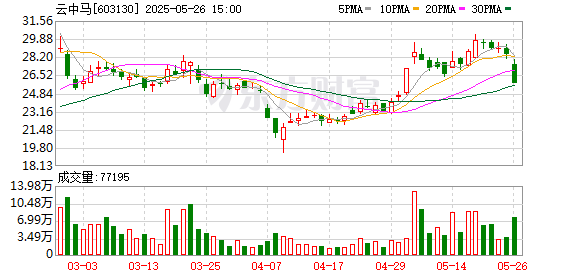
Group 1 - The stock of Yunzhongma (603130) experienced a decline of 9.31% with a turnover rate of 15.12% and a trading volume of 204 million yuan, showing a fluctuation of 8.74% [2] - The stock was listed on the Shanghai Stock Exchange due to a daily price deviation of -9.27%, with a net selling amount of 3.14 million yuan from brokerage seats [2] - The top five brokerage seats accounted for a total transaction amount of 75.02 million yuan, with a buying amount of 35.94 million yuan and a selling amount of 39.08 million yuan, resulting in a net selling of 3.14 million yuan [2] Group 2 - The largest buying brokerage was Guotai Junan Securities Headquarters, with a buying amount of 11.55 million yuan, while the largest selling brokerage was Guosheng Securities Ningbo Sangtian Road, with a selling amount of 12.66 million yuan [2] - The stock saw a net outflow of 22.38 million yuan in main funds today, including a net outflow of 5.81 million yuan from large orders and 16.58 million yuan from major orders, with a total net outflow of 40.70 million yuan over the past five days [2] - The company's Q1 report indicated a revenue of 586 million yuan, representing a year-on-year increase of 7.04%, while the net profit was 10.35 million yuan, showing a year-on-year decrease of 57.09% [2]

21深度|南极电商欲撕“吊牌之王”标签
2 1 Shi Ji Jing Ji Bao Dao· 2025-05-26 10:38
Core Viewpoint - The company is transitioning from a "brand licensing" model, known for its "label-selling" business, back to a self-operated model, aiming to revitalize the "Nanji Ren" brand and improve its market position [1][18]. Business Strategy - Starting in 2023, the company has shifted some core categories of the "Nanji Ren" brand from brand licensing to self-operated sales, launching new product lines including thermal clothing and planning to enter the down jacket market [1][18]. - The company aims to position "Nanji Ren" as a brand that combines the pricing of Decathlon, the variety of Uniqlo, and the quality of Lululemon [2]. Financial Performance - In 2024, the company expects revenue growth of 24.75% to reach 3.358 billion yuan, but it anticipates a net loss of 237 million yuan, marking a shift from profit to loss [1]. - The company's revenue has been declining, with total revenue falling from 3.888 billion yuan in 2021 to 2.692 billion yuan in 2023, and net profit dropping from 477 million yuan to a loss of 298 million yuan in the same period [16]. Historical Context - The "Nanji Ren" brand began as a thermal underwear seller but transitioned to a "label-selling" business model around 2008, focusing on brand licensing and outsourcing production [4][10]. - At its peak in 2019, the brand achieved a GMV of 27.138 billion yuan across e-commerce platforms, with significant market share in various categories [5]. Market Challenges - The company faces challenges related to quality control and brand positioning, as the "label-selling" model has led to inconsistent product quality and legal disputes [12][14]. - The decline in e-commerce platform traffic and the limitations of a single brand strategy have highlighted the need for diversification and improved quality management [16]. Marketing and Sales - The company has increased its marketing budget significantly, with sales expenses projected to reach 588 million yuan in 2024, a 430.28% increase from the previous year [19]. - The company plans to enhance its marketing efficiency and focus on product planning and overall marketing strategies moving forward [20]. Future Outlook - The company is optimistic about its self-operated business model, believing it will yield results in the next one to two years despite current losses [20]. - The company continues to invest in mobile internet marketing, which has been a significant revenue contributor, accounting for over 80% of total revenue in recent years [21].

出口额激增16.1%和15.2%!纺织鲁企“出海”创新突围
Da Zhong Ri Bao· 2025-05-26 09:11
Group 1: Export Market Dynamics - Shandong enterprises are expanding their textile and apparel exports, with Korea, the US, and ASEAN being the top three markets, contributing 45.2% of the export share in 2024 [1] - The export growth rates for these markets are projected at 2.3%, 9.9%, and 16.3% respectively, while emerging markets in Latin America and Europe are seeing significant increases of 16.1% and 15.2% [1] Group 2: Company Transformation - Feite Garment Co., Ltd. has shifted from a reliance on the US market, which once accounted for 95% of its exports, to a more diversified approach, with non-US markets now exceeding 50% of its exports [2] - The company has actively participated in international trade shows and utilized technology to overcome language barriers and time zone challenges [2] Group 3: E-commerce and Innovation - Cross-border e-commerce is becoming a key driver for Shandong's textile and apparel companies, with over 3,000 firms entering mainstream platforms and a projected 28% growth in cross-border e-commerce exports in 2024 [3] - Companies are leveraging brand storytelling and personalized services to enhance their international competitiveness [3] Group 4: Technological Advancements - Shandong textile enterprises are adopting technological innovations to enhance production efficiency, with some companies reporting a 30% increase in production efficiency through automation [4] - The digital transformation coverage among large textile enterprises in Shandong exceeds 90%, with a 75% application rate of green low-carbon technologies [5] Group 5: Policy Support and Market Expansion - The Shandong government has introduced measures to support the textile industry, aiming for a 2.9% increase in export value to 210.6 billion yuan in 2024 [7] - The government plans to organize over 370 overseas exhibitions, with a focus on emerging markets, and offers substantial subsidies for exhibition fees [7][8] Group 6: Collaborative Strategies - Shandong is promoting a collaborative approach for small and medium enterprises to enhance their international marketing capabilities through organized procurement events and the establishment of an external trade product library [8] - The province is also focusing on integrating cross-border e-commerce with the textile industry to accelerate digital transformation and expand export opportunities [8]
市场监管总局:拟禁止直接或间接利用再加工纤维生产婴幼儿纺织产品、内衣
news flash· 2025-05-26 07:13
Core Viewpoint - The State Administration for Market Regulation is proposing to prohibit the direct or indirect use of recycled fibers in the production of textile products and underwear for infants and young children, aiming to enhance the quality and safety regulation of fiber products [1] Regulatory Changes - The draft revision of the "Quality Supervision and Management Measures for Fiber Products" has been formed and is open for public consultation [1] - The proposal specifically bans the use of recycled chemical fibers, except for recycled polyester fibers, as filling or padding materials in products intended for infants [1]
品质可见,信任可感:稳健集团的全棉之旅正在被更多人看见
Zheng Quan Shi Bao Wang· 2025-05-26 03:28
Core Insights - The core message emphasizes the importance of trust in consumer products, particularly through the transparent manufacturing process and real-life endorsements from brand ambassadors [1][2][3] Group 1: Brand Engagement and Trust - The brand ambassadors, including Olympic champion Guo Jingjing and host Chen Weihong, visited the cotton towel production facility, highlighting the rigorous quality control and hygiene standards in place [2] - Guo Jingjing expressed that the strict production controls enhance consumer confidence in product safety, while Chen Weihong praised the company's commitment to environmental responsibility [2] - Zhao Liying, as the global ambassador for the brand, participated in a live-stream event to share her personal experiences with the products, reinforcing the message of comfort, health, and environmental consciousness [3] Group 2: Product Quality and Innovation - The brand's philosophy, "medical care close to life, cotton care for health," drives its commitment to extending medical product standards to everyday consumer goods [4] - Continuous innovation in product development is evident through the proprietary Cotton Tech fabric technology, which offers various benefits such as softness, breathability, and antibacterial properties [4] Group 3: Long-term Commitment to Quality - The company's consistent focus on quality control, production optimization, and responsiveness to consumer feedback establishes a reliable product choice for consumers [5] - The engagement of brand ambassadors is seen as a natural outcome of years of professional accumulation and trust-building efforts [5] Group 4: Future Vision - The company aims to connect with users through professional manufacturing and authentic communication, balancing technology, product quality, and brand messaging [6] - There is a commitment to collaborate with more partners to promote a lifestyle that values quality and understanding, extending beyond mere products [6]