
债券

Search documents
哪些城投债以面值提前兑付?
Tianfeng Securities· 2025-08-14 12:45
Report Industry Investment Rating No relevant content provided. Core Viewpoints - The situation where face - value redemption was the mainstream for urban investment bonds' early redemption has changed. Issuers tend to offer fairer prices such as face - value plus compensation or net price for early redemption. The choice of face - value redemption is related to the bond issuance method, issuer region, and issuer qualification, showing three characteristics: private placement bonds have a higher face - value redemption ratio than public bonds; there are differences in the face - value redemption ratio among different regions; the lower the implied rating, the higher the ratio of premium bonds redeemed at face value [4][30] Summary by Directory 1. How has the early redemption of urban investment bonds been since 2025? - **Overall scale and rhythm**: As of August 12, 2025, the scale of urban investment bonds proposed for early redemption since 2025 was 55.8 billion yuan. Compared with the two small peaks of early redemption after October 2023 (2023Q4 and 2024Q4), the early redemption rhythm slowed down in 2025, and no obvious peak was formed. Only in 2025Q2 was the scale relatively high, with 28.5 billion yuan proposed for early redemption [1][9] - **Provincial distribution**: Regions with more early redemptions since 2025 include Chongqing, Yunnan, Hunan, Jiangsu, Sichuan, and Hubei, with the scale of proposed early - redeemed urban investment bonds all exceeding 4.5 billion yuan. Some regions with large - scale early redemptions in 2023 - 2024 had few early redemptions since 2025, such as Guizhou, Liaoning, Anhui, and Zhejiang [11] - **Redemption price distribution**: From 2023Q4 to 2024Q1, face - value redemption was the mainstream. Since 2024Q2, the face - value redemption ratio has declined, and the ratios of face - value plus compensation and ChinaBond valuation net - price redemption have increased. Since 2025, the face - value redemption ratio has generally remained below half. In 2025Q3, the face - value redemption ratio was only 22% [2][13] - **Redemption price distribution for premium and discount bonds**: Discount bonds are basically redeemed at face value. For premium bonds, from 23Q4 - 24Q2, face - value redemption was the main method, with the ratio in the 67 - 78% range. Since 24Q3, the face - value redemption ratio of premium bonds has decreased significantly, and except for a slightly higher ratio in 2025Q1, it has been generally below 50% in other quarters [20] 2. Which premium bonds are redeemed at face value? - **By issuance method**: Private placement bonds have a higher ratio of face - value redemption than public bonds. From 2023Q4 to August 12, 2025, among premium bonds, the proportion of private placement bonds proposed for face - value redemption was 61.23%, while that of public bonds was 45.24%. Since 2025Q2, the gap between public and private placement bonds has become more obvious [23] - **By region and administrative level**: Among regions with large - scale early redemptions, Guizhou, Guangxi, and Heilongjiang have a high ratio of face - value redemption of premium bonds (over 90% in the country), followed by Liaoning, Zhejiang, and Hubei (over 80%). Chongqing, Jiangsu, and Anhui have relatively low ratios. In terms of administrative levels, the differences in the distribution of each administrative level are not large. District - level and national - level parks have relatively high ratios of face - value redemption of premium bonds, at 64% and 60% respectively; the ratio for prefecture - level cities is 56% [26] - **By implied rating**: Generally, the lower the implied rating, the higher the ratio of premium bonds proposed for face - value redemption. The ratios of AAA, AA +, AA, AA(2), AA -, and below AA implied ratings for face - value redemption of premium bonds are 0%, 8%, 28%, 47%, 68%, and 100% respectively. Regions with relatively low ratios of face - value redemption of premium bonds with medium - low implied ratings include Chongqing, Yunnan, Jiangsu, Anhui, and Xinjiang [29]
投教宣传|一图看懂指数化投资之指数百科第二十一期:沪AAA科创债指数 沪科创债投资新工具
野村东方国际证券· 2025-08-14 10:54
Core Viewpoint - The article emphasizes the rapid development and increasing acceptance of index investment in China, particularly focusing on the growth of technology innovation bonds (科创债) and the introduction of related indices to facilitate investment opportunities [7][12]. Group 1: Background and Market Overview - As of now, there are 356 issuers of technology innovation bonds in the market, with a total of 1,360 bonds issued, amounting to a scale of 1.95 trillion yuan. The Shanghai and Shenzhen stock exchanges have issued 935 bonds, totaling 1.23 trillion yuan, representing a growth of approximately 14.7 times and 13 times compared to the end of 2022, respectively [9][10]. - Since 2025, policies supporting the issuance of technology innovation bonds have been frequently introduced, enhancing the long-term capital investment environment for hard technology [12]. Group 2: Index Development - In August 2023, the Shanghai Stock Exchange and China Securities Index Company launched the Shanghai AAA Technology Innovation Company Bond Index, which selects bonds that meet specific criteria to reflect the overall performance of technology innovation company bonds on the exchange [14]. - The current outstanding technology innovation bonds on the Shanghai Stock Exchange total 795, with a combined scale of 1.1 trillion yuan. The AAA technology innovation bond index includes 785 bonds, with a total scale of 1.0943 trillion yuan, accounting for 88% of the total market scale of technology innovation bonds [15]. Group 3: Investment Characteristics - The bonds included in the index are all rated AAA, ensuring high credit quality, with implied ratings of AA+ and above [16]. - The index covers a wide range of issuers, including central and local enterprises as well as technology innovation private enterprises, addressing the challenges investors face in identifying and investing in individual technology innovation bonds [17]. - In the current low-interest-rate environment, technology innovation bonds offer higher annualized returns compared to government bonds and money market funds, providing a stable investment option [18]. Group 4: Performance Metrics - Since the base date of June 30, 2022, the Shanghai AAA Technology Innovation Bond Index has outperformed the Shanghai market benchmark corporate bonds and the 5-year government bond index, with a cumulative increase of 14.4% and an annualized return of 4.3% as of July 31, 2025 [19][21]. Group 5: ETF Products - As of July 31, 2025, there are three domestic ETFs tracking the Shanghai AAA Technology Innovation Bond Index, which have quickly reached their fundraising limits of 3 billion yuan since their public offering on July 7. The total scale of these products has now reached 28.6 billion yuan, indicating growing market recognition of the investment value of technology innovation bonds [24].


深交所:2025年记账式贴现(四十八期)国债8月14日上市交易
Sou Hu Cai Jing· 2025-08-14 10:53
来源:金融界 8月12日,深交所发布公告,关于2025年记账式贴现(四十八期)国债上市交易的通知。 2025年记账式贴现(四十八期)国债已发行结束,根据财政部有关规定,本期债券于2025年8月14日起 在深交所上市交易。本期债券为182日期贴现式国债,证券编码"110154",证券简称"贴债2548",发行 总额600亿元。 ...
债市日报:8月14日
Xin Hua Cai Jing· 2025-08-14 07:50
Core Viewpoint - The bond market is experiencing a short-term correction, with government bond futures declining and interbank bond yields rising slightly, indicating suppressed market sentiment [1][2]. Market Performance - Government bond futures closed lower across the board, with the 30-year main contract down 0.36% to 117.88, and the 10-year main contract down 0.12% to 108.325 [2]. - Interbank bond yields generally increased, with the 30-year government bond yield rising by 0.5 basis points to 1.97%, and the 10-year government bond yield increasing by 0.75 basis points to 1.7275% [2]. International Market Trends - In North America, U.S. Treasury yields fell across the board, with the 2-year yield down 5.84 basis points to 3.668% and the 10-year yield down 6 basis points to 4.231% [3]. - In Asia, Japanese bond yields rose, with the 10-year yield up 2.3 basis points to 1.543% [4]. Primary Market Insights - The Ministry of Finance reported weighted average winning yields for 3-year and 20-year government bonds at 1.42% and 2.0596%, respectively, with bid-to-cover ratios of 2.86 and 5.2 [5]. Liquidity Conditions - The central bank conducted a reverse repurchase operation of 128.7 billion yuan at a rate of 1.40%, resulting in a net withdrawal of 32 billion yuan for the day [6]. - The social financing scale increased by 2.399 trillion yuan in the first seven months of the year, reflecting a year-on-year increase of 5.12 trillion yuan [6]. Institutional Perspectives - Institutions suggest that the bond market's configuration strength remains intact despite concerns about deposits moving to the stock market, as overall bank deposits have not decreased [8]. - The economic fundamentals are expected to remain stable, with potential for monetary policy easing, leading to a forecasted decline in bond yields by year-end [8][9].
利率周记(8月第2周):债市是利空出尽,还是利好出尽?
Huaan Securities· 2025-08-14 06:53
[Table_IndNameRptType]2 固定收益 固收周报 债市是利空出尽,还是利好出尽? ——利率周记(8 月第 2 周) 报告日期: 2025-08-14 [Table_Author] 首席分析师:颜子琦 执业证书号:S0010522030002 电话:13127532070 邮箱:yanzq@hazq.com [Table_Author] 分析师:洪子彦 执业证书号:S0010525060002 电话:15851599909 邮箱:hongziyan@hazq.com 主要观点: ⚫[Table_Summary] 债市当前是利多出尽还是利空出尽? 8 月以来债市延续震荡走势,随着权益、商品市场的"隔山打牛式"冲击,上 周卖方看多观点锐减近三成——做多情绪的"瓦解"比几个 BP 的调整更加令 人担忧,债市正是从 2024 年的对利空免疫,转向对利多免疫。当前时点,如 果继续抱持多头思维,关键之问在于"利空出尽了吗"?而在声势见涨的空头 思维下,"利好是否出尽"不乏讨论。 各花入各眼,多头面临的利空挑战明显更偏定性,并且更像市场情绪的因变 量,例如权益市场的上涨与主流叙事的转变是互相增益的关系,这一 ...
低利率环境下债券市场投资研究的突围之路
Tianfeng Securities· 2025-08-14 05:44
Group 1: Report Industry Investment Rating - Not provided in the given content Group 2: Report's Core View - The bond market pricing logic has shifted from "asset - end" to "liability - end". A new framework based on "liquidity", "institutional behavior", and "relative value" is proposed to help institutions trade flexibly. The concept of fixed - income sell - side research also needs to change [8] Group 3: Summary by Relevant Catalogs 1. Current Bond Market's "Liability - End" Pricing Logic - **Key Variable for Interest Rate Fluctuation and Macroeconomic "Desensitization" - Money Velocity**: Interest rate and macro - economy relationship has become "desensitized". The link between interest rate changes and macro - economic trends assumes stable money velocity. Economic structural adjustment may have reduced money velocity, leading to a decline in nominal growth and a decrease in real - sector funding demand [9][10] - **Macro Observation of "Liability - End" Pricing of Interest Rate Trends - Relative Liquidity**: Interest rate pricing now depends more on the "liability - end" or the supply side of funds. With the weakening of real - sector financing demand, bond yields are more determined by the relative scale of funds chasing bonds, i.e., "relative liquidity" [15][16] - **Micro Observation of "Liability - End" Pricing of Interest Rate Trends - Institutional Allocation and Trading Power**: Institutional behavior is an intermediary variable affecting bond pricing. Institutions should be classified by "allocation behavior" and "trading behavior". Allocation behavior has seasonal characteristics, while trading behavior occurs in a short time and requires micro - confirmation [21][22] 2. Bond Investment Solutions in a Low - Interest - Rate Environment - Active Trading to Increase Returns - **Trading is a Process of Exchanging Liquidity for Returns**: Trading is not a zero - sum game but a process of exchanging liquidity for returns. Higher trading activity can bring liquidity premiums. Institutions can exchange liquidity for returns, and the central bank's policies aim to enhance market liquidity [29][30] - **Two Trading Strategies: Trend Strategy and Relative Value Strategy**: Trend strategy focuses on accurately judging the pricing factors of a target to follow the trend and gain returns, relying on grasping "common points". Relative value strategy focuses on finding the different pricing factors between related targets, reducing model complexity and analysis difficulty, and is a grasp of "differences" [32] - **Role of Two Trading Strategies' Logic in Allocation - Type Institutions**: For allocation - type institutions, timing corresponds to the logic of the trend strategy, and bond selection corresponds to the logic of the relative value strategy. When timing, they need to consider long - term and short - term factors; when selecting bonds, they need to judge the dynamic relative value [34] 3. New Framework for Bond Investment Research - Pyramid Pricing System Based on a Low - Interest - Rate Environment - **Triple Structure of the Pyramid Pricing System: Liquidity, Institutional Behavior, and Relative Value**: The bottom layer is the "liquidity" system, which includes macro, meso, and micro variables related to funds and bond liquidity. The middle layer is the "institutional behavior" system, which requires a complete and forward - looking research system. The upper layer is the "relative value" system, which shows the relative position of spreads but is not a decisive factor for relative value strategies [40][44][47] - **Building a Decision - Factor Tree for Relative Value Trading Strategies**: Select appropriate liquidity, institutional behavior, and relative value factors according to the target of a relative value trading strategy to build a decision - factor tree. Analyze each factor and assign weights to judge the strategy's win - rate and odds. Allocation - type institutions can transform their position adjustment problems into relative value trading strategies for analysis [51] 4. Understanding of the New - Era Fixed - Income Sell - Side Research Concept - In the high - interest - rate stage, fixed - income sell - side research provided macro - level information to support investment decisions. In the low - interest - rate stage, it should provide bottom - up market characteristics to support investment trading and position management, and its positioning should shift from "guiding direction" to "assisting execution" [54]
大类资产早报-20250814
Yong An Qi Huo· 2025-08-14 03:17
1. Report Industry Investment Rating - No relevant content found 2. Core Viewpoints of the Report - The report presents the performance data of various global asset markets on August 13, 2025, including bond yields, exchange rates, stock indices, and futures trading data [3][5][6] 3. Summary by Related Catalogs Global Asset Market Performance Bond Yields - **10 - year Treasury Bond Yields**: Yields of major economies showed different changes in the latest, weekly, monthly, and yearly periods. For example, the US 10 - year Treasury bond yield was 4.235 on August 13, 2025, with a latest change of - 0.056, a weekly change of 0.006, a monthly change of - 0.222, and a yearly change of 0.446 [3] - **2 - year Treasury Bond Yields**: Similar to the 10 - year bonds, yields of different countries had varying changes. The US 2 - year Treasury bond yield was 3.760 on August 13, 2025, with a latest change of 0.000, a weekly change of 0.070, a monthly change of - 0.150, and a yearly change of - 0.400 [3] Exchange Rates - **Dollar against Major Emerging Economies' Currencies**: The dollar's exchange rates against currencies like the Brazilian real, Russian ruble, South African rand, etc., had different changes. For example, the dollar - Brazilian real exchange rate was 5.398 on August 13, 2025, with a latest change of 0.16%, a weekly change of - 1.21%, a monthly change of - 3.07%, and a yearly change of - 5.68% [3] - **Renminbi**: The on - shore, off - shore, and middle - price of the renminbi, as well as the 12 - month NDF, also had their respective values and changes on August 13, 2025 [3] Stock Indices - **Major Economies' Stock Indices**: Stock indices of major economies such as the Dow Jones, S&P 500, and Nasdaq showed positive changes in the latest, weekly, monthly, and yearly periods. For example, the Dow Jones index was 6466.580 on August 13, 2025, with a latest change of 0.32%, a weekly change of 1.92%, a monthly change of 3.24%, and a yearly change of 24.69% [3] - **Other Stock Indices**: Including the Russian index, Nikkei, Hang Seng Index, etc., also had their own performance and changes [3] Credit Bond Indices - Credit bond indices of emerging economies and developed economies had different values and changes on August 13, 2025. For example, the emerging economies' investment - grade credit bond index was 3467.280, with a latest change of 0.46%, a weekly change of 0.29%, a monthly change of 2.08%, and a yearly change of 4.65% [3][4] Stock Index Futures Trading Data - **Index Performance**: A - shares, CSI 300, SSE 50, ChiNext, and CSI 500 had their closing prices, price changes, and other data. For example, the CSI 300 index closed at 4176.58 on August 13, 2025, with a price change of 0.79% [5] - **Valuation**: PE (TTM) and risk premiums of different indices were presented, along with their changes [5] - **Fund Flows**: The latest values and 5 - day average values of fund flows in different markets were given [5] - **Trading Volume**: The latest trading volumes and their changes of different markets were provided [5] - **Main Contract Premiums and Discounts**: The basis and basis spreads of IF, IH, and IC were shown [5] Treasury Bond Futures Trading Data - Treasury bond futures T00, TF00, T01, and TF01 had their closing prices and price changes on August 13, 2025 [6] - **Funding Rates**: R001, R007, and SHIBOR - 3M had their rates and daily changes [6]
中信期货晨报:国内商品期货多数下跌,黑色系普遍收跌-20250814
Zhong Xin Qi Huo· 2025-08-14 02:53
Group 1: Report Overview - The report is titled "Domestic Commodity Futures Mostly Decline, Black Series Generally Close Lower - CITIC Futures Morning Report 20250814" [1] Group 2: Market Performance Domestic Main Commodities - Index futures generally showed an upward trend. For example, the CSI 300 futures had a daily increase of 0.96%, a weekly increase of 2.15%, a monthly increase of 2.81%, a quarterly increase of 7.33%, and a year - to - date increase of 6.37% [4] - Treasury futures mostly had minor fluctuations. The 2 - year Treasury futures had a daily increase of 0.03%, a weekly decrease of 0.02%, a monthly increase of 0.02%, a quarterly decrease of 0.13%, and a year - to - date decrease of 0.59% [4] - In the foreign exchange market, the US dollar index decreased by 0.20% weekly, 21.98% monthly, 13.4% quarterly, and 9.60% year - to - date [4] - Interest rates showed different trends. The 10Y Chinese bond yield increased by 7.9bp quarterly and 0.1bp year - to - date, while the 10Y US Treasury yield increased by 5bp quarterly and decreased by 26bp year - to - date [4] Popular Industries - Some industries like the grass - colored gold industry had good performance, with a daily increase of 1.28%, a weekly increase of 4.59%, a monthly increase of 4.37%, a quarterly increase of 11.54%, and a year - to - date increase of 31.85%. While some industries like the pharmaceutical industry had a daily decrease of 0.86%, a weekly decrease of 0.88%, a monthly decrease of 0.88%, a quarterly increase of 12.63%, and a year - to - date increase of 21.76% [4] Overseas Commodities - In the energy sector, NYMEX WTI crude oil decreased by 1.44% daily, 0.43% weekly, 9.03% monthly, 2.91% quarterly, and 12.23% year - to - date [4] - Precious metals such as COMEX gold increased by 0.17% daily, decreased by 1.69% weekly, increased by 1.71% monthly, increased by 2.55% quarterly, and increased by 28.81% year - to - date [4] - In the non - ferrous metals sector, LME copper increased by 1.17% daily, 0.74% weekly, 2.43% monthly, decreased by 0.38% quarterly, and increased by 12.05% year - to - date [4] - In the agricultural products sector, CBOT soybeans increased by 2.18% daily, 4.64% weekly, 4.24% monthly, 0.46% quarterly, and 2.20% year - to - date [4] Other Domestic Commodities - Many commodities showed various trends. For example, the shipping container freight rate to Europe (ECSA) increased by 5.96% daily, decreased by 7.17% weekly, decreased by 6.46% monthly, decreased by 0.44% quarterly, and decreased by 40.93% year - to - date [5] Group 3: Macroeconomic Analysis Overseas Macro - The overseas market is facing a situation where the US economic fundamentals are weak. The China - US tariff negotiation period is postponed to November 12. The US CPI in July met expectations. The upcoming tariff implementation in August may test market sentiment. The internal personnel change in the Fed and the US CPI data next week will guide market expectations for interest rate cuts and risk appetite [9] Domestic Macro - China's exports in July increased by 7.2% year - on - year, mainly relying on the strong demand from non - US markets to offset the decline in exports to the US. However, this may be due to pre - tariff rush shipments, and future exports face the risk of decline and restricted re - export trade [9] Asset Views - Domestically, reduce the allocation of domestic equities and wait for the policy and profit repair window in the second half of the month. Maintain the allocation of commodities with a focus on the infrastructure and export chain, and maintain the allocation of gold. Overseas, reduce the allocation of US stocks due to high valuations and maintain the allocation of US bonds. Slightly increase the allocation of RMB funds to relieve pressure from the weak US dollar and reduce the allocation of US dollar money market funds to be cautious about interest rate cut games. Overall, maintain a defensive layout and focus on the policy and data inflection points in late August [9] Group 4: Viewpoints on Different Sectors Finance - Stock index futures: Growth opportunities are spreading, and the short - term outlook is a fluctuating upward trend. Stock index options: Layout offensive strategies, with a short - term fluctuating upward trend. Treasury futures: The bond market is still under pressure, with a short - term fluctuating trend [10] Precious Metals - Gold and silver are expected to fluctuate upwards as the market returns to the logic of the restart of the interest rate cut cycle, with the US economic fundamentals weakening [10] Shipping - The shipping container freight rate to Europe is expected to fluctuate as the market focuses on the game between peak - season expectations and the implementation of price increases [10] Black Building Materials - Most products in this sector, such as steel, iron ore, coke, and coking coal, are expected to fluctuate. For example, steel has strong cost support, and iron ore has a healthy fundamental situation [10] Non - ferrous Metals and New Materials - Copper, aluminum, zinc, etc. have different short - term trends. Copper is expected to fluctuate downward, while aluminum is expected to continue to recover, but the overall demand weakness needs to be noted [10] Energy and Chemicals - Most products in this sector are expected to fluctuate. For example, crude oil is expected to fluctuate downward due to geopolitical concerns easing and supply pressure remaining. Some chemicals like LPG are expected to fluctuate due to cost and demand factors [12] Agriculture - Oils, fats, and protein meals are expected to continue to be strong, while corn/starch is expected to continue to fluctuate weakly [12]
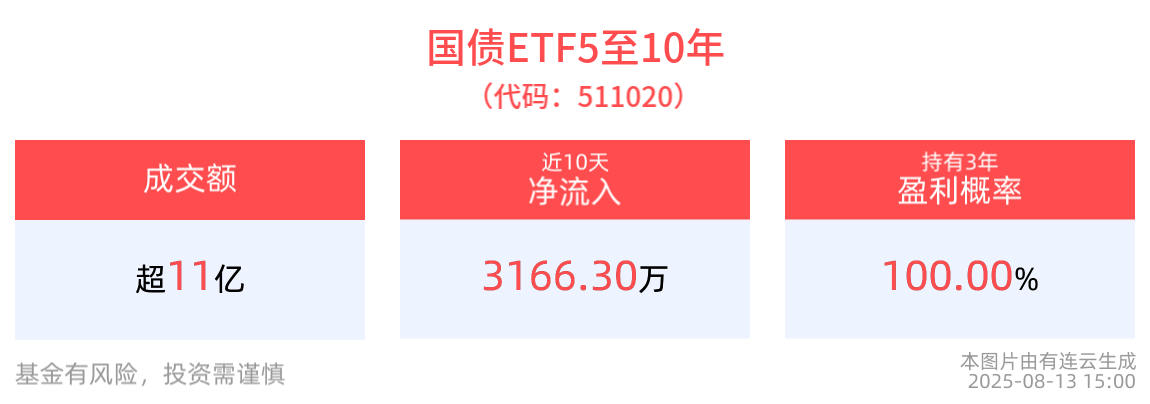
成交额超11亿元,国债ETF5至10年(511020)近10个交易日“吸金”3166.30万元
Sou Hu Cai Jing· 2025-08-14 01:46
Group 1 - The core viewpoint indicates that U.S. Treasury yields have declined as investors digest the prospect of a Federal Reserve rate cut in September [1] - The recommendation for bond selection suggests avoiding 2-3 year and 6 year maturities for government bonds, while focusing on 3 year and 7 year positions for agricultural development bonds [1] - The 10-year government bond spread is currently around 2 basis points, with expectations of a switch to a main bond within half a month due to the existing scale of 299 billion yuan [1] Group 2 - As of August 13, 2025, the 5-10 year Treasury ETF index has increased by 0.04%, with a one-year cumulative increase of 4.32% [3] - The trading volume for the 5-10 year Treasury ETF was 11.87 billion yuan, indicating active market participation [3] - The latest scale of the 5-10 year Treasury ETF reached 14.85 billion yuan, with a net value increase of 20.80% over the past five years [3] Group 3 - The 5-10 year Treasury ETF has a Sharpe ratio of 1.12 over the past two years, indicating a favorable risk-adjusted return [4] - The maximum drawdown for the ETF in the last six months was 1.92%, with a recovery period of 108 days [4] - The management fee for the ETF is 0.15%, and the tracking error over the past two months is 0.044% [4]
十年国债(511260)获融资买入0.13亿元,近三日累计买入1.02亿元
Sou Hu Cai Jing· 2025-08-14 00:19
Group 1 - The core point of the article highlights the financing activities related to the ten-year government bonds, indicating a net sell-off in recent trading days [1] - On August 13, the ten-year government bond (511260) had a financing buy-in amount of 0.13 billion, ranking 1234th in the market, with a financing repayment amount of 0.73 billion, resulting in a net sell-off of 59.9184 million [1] - Over the last three trading days (August 11-13), the financing buy-ins for the ten-year government bond were 0.82 billion, 0.07 billion, and 0.13 billion respectively [1] Group 2 - In terms of securities lending, on the same day, there were no shares sold or net sold [2]