
云服务

Search documents
签下OpenAI大单 亚马逊股价创历史新高
Bei Jing Shang Bao· 2025-11-04 16:13
Core Insights - The partnership between Amazon and OpenAI, involving a seven-year cloud service procurement agreement worth $38 billion, is driving significant interest and investment in AI, leading to a surge in stock prices for major players like Amazon and Nvidia [1][2]. Company Developments - Amazon's stock rose by 4% to reach a historic high, adding over $100 billion to its market capitalization following the announcement of the OpenAI deal [1]. - OpenAI is set to receive hundreds of thousands of Nvidia GPUs through this agreement, which is a strong endorsement for Amazon Web Services (AWS) amidst concerns about its competitiveness against Microsoft and Google [1]. - AWS reported robust growth in its third-quarter earnings, alleviating investor concerns about its position in the AI market [1][3]. AI Infrastructure Investments - OpenAI has committed to investing $1.4 trillion to develop 30 gigawatts (GW) of computing resources, which could power approximately 25 million American households [3]. - Nvidia announced a potential investment of up to $100 billion to assist OpenAI in building and deploying AI data centers with at least 10 GW of capacity [2]. - OpenAI is also exploring partnerships with other GPU manufacturers like AMD and is working on developing custom ASIC chips for AI acceleration [2][3]. Market Outlook - Citigroup forecasts that global AI industry revenue will reach $975 billion by 2030, reflecting a compound annual growth rate of 86% from $43 billion in 2025, driven by accelerated adoption and commercialization of AI technologies [4]. - There is ongoing debate in the market regarding the potential for an AI bubble, with concerns about whether the substantial investments in AI infrastructure will yield the expected returns [4].

美股涨跌互现,加密货币闪崩,黄金重回4000美元
第一财经· 2025-11-03 23:47
Core Viewpoint - The article discusses the mixed performance of the U.S. stock market, driven primarily by artificial intelligence (AI) related trades, while also highlighting significant movements in the cryptocurrency market and upcoming earnings reports from major companies [3]. Market Performance - On Monday, the Dow Jones Industrial Average fell by 226.19 points, or 0.48%, closing at 47,336.68 points. The Nasdaq rose by 0.46% to 23,834.72 points, and the S&P 500 increased by 0.17% to 6,851.97 points [3]. - The Philadelphia Semiconductor Index rose nearly 1%, with IREN signing a multi-year agreement worth $9.7 billion with Microsoft, boosting market sentiment [3]. Cryptocurrency Market - The cryptocurrency market experienced a sharp decline, with Bitcoin dropping over 3% and Ethereum falling more than 6% due to a hacker attack on Balancer, which resulted in losses exceeding $100 million [3]. Notable Company Movements - Amazon's stock rose by 4.0%, reaching a historical high after announcing a $38 billion agreement with OpenAI to run and expand its AI operations on Amazon Web Services (AWS) [4]. - Other tech stocks showed mixed results, with Microsoft down 0.1%, Google up 0.8%, and Meta down 1.6% [5]. Chinese Stocks - The Nasdaq China Golden Dragon Index increased by 0.26%, with Alibaba down 1.6% and Baidu up 0.3% [6]. Upcoming Earnings Reports - Several major companies, including AMD, Shopify, McDonald's, and Spotify, are set to release their quarterly financial reports later this week [6]. Economic Data - The U.S. manufacturing index fell from 49.1 in September to 48.7 in October, below market expectations of 49.5. The S&P Global U.S. manufacturing index was revised up to 52.5 from an initial 52.2, showing slight improvement [6]. Federal Reserve Insights - The ISM price index's decline last month provides more basis for potential interest rate cuts by the Federal Reserve. The market currently anticipates a 65% probability of a 25 basis point rate cut next month [7]. Bond and Commodity Markets - U.S. Treasury yields showed mixed performance, with the 10-year yield rising by 1 basis point to 4.11% and the 2-year yield falling by 1 basis point to 3.60% [8]. - International oil prices remained stable, with WTI crude oil at $64.05 per barrel and Brent crude at $64.89 per barrel [8].




美股震荡,美联储释放降息大消息
Zhong Guo Ji Jin Bao· 2025-11-03 22:33
Market Overview - The U.S. stock market experienced a slight decline, with the Dow Jones dropping by 200 points, while the Nasdaq opened high but saw its gains diminish, and the S&P 500 briefly turned negative [1] Technology Sector - The technology sector saw significant gains, highlighted by Amazon's stock jumping nearly 5% after signing a $38 billion agreement with OpenAI to supply NVIDIA AI chips over the next seven years. This move is seen as a validation of Amazon's capabilities in building and operating large-scale data center networks [2] - NVIDIA's stock rose nearly 3% following the approval of a deal allowing Microsoft to sell chips to the UAE, including advanced GB300 GPUs [3] Manufacturing Sector - U.S. manufacturing activity contracted for the eighth consecutive month in October, with the manufacturing index falling by 0.4 points to 48.7, indicating a contraction as readings below 50 signify a decline. The output index decreased by 2.8 points to 48.2, suggesting that production has contracted in two of the last three months [5] - The ISM employment component has also contracted for nine months, although the pace of contraction slowed slightly compared to September. Twelve manufacturing industries reported contraction, with textiles, apparel, and furniture showing the largest declines [5] Federal Reserve Insights - Federal Reserve officials are closely monitoring economic data ahead of the December meeting, with concerns about inflation remaining a priority. Chicago Fed President Austan Goolsbee expressed worries about inflation trends, which have been above target for over four years [6][7] - Goolsbee indicated that while there is room for further rate cuts, it may be prudent to align rate cuts with inflation trends. Fed Governor Stephen Milan advocated for more significant rate cuts, arguing that current monetary policy is too restrictive [7]

倒反天罡?美国经济正变得越来越依赖股市
Jin Shi Shu Ju· 2025-11-03 05:47
Core Insights - The distinction between Wall Street and Main Street is becoming increasingly blurred as rising asset prices stimulate consumer spending, which accounts for approximately 70% of the US GDP [1] - The "wealth effect" has become more pronounced over the past 15 years, with a 1% increase in stock wealth leading to a 0.05% increase in consumer spending, compared to less than 0.02% in 2010 [1] - The increase in household wealth is making consumers more optimistic about their financial situations, leading to increased spending [1] Group 1 - The wealth effect is expected to drive higher marginal propensity to consume in the coming years, particularly as retirees, who have higher net worth, rely more on their wealth for consumption [1] - The omnipresence of digital media accelerates consumer reactions to market news, further enhancing the wealth effect [2] - Consumer spending has remained resilient despite challenges such as inflation and uncertainty from trade wars, largely due to the stock market's performance, particularly in AI-related stocks [2] Group 2 - The stock market's dependence on AI-related companies like Nvidia, Microsoft, and Google is increasing, with estimates suggesting that the tech sector's stock market gains over the past year could boost annual consumer spending by nearly $250 billion [2] - A survey indicates that over 54% of Americans with annual incomes between $30,000 and $79,900 are retail investors, with many having started investing in the past five years [3] - The wealth effect is particularly pronounced among the highest income earners, who contributed half of total consumer spending in the second quarter, marking a historical high [3] Group 3 - The economy is increasingly reliant on discretionary spending from high-income earners, which in turn depends on the continued prosperity of risk assets [4] - This dynamic creates a stronger implicit support mechanism for risk assets, as both monetary and fiscal policies are likely to focus on sustaining the stock market [4] - The interconnectedness of the stock market and overall consumer spending suggests that declines in asset prices could slow spending and economic growth [4]
A股:今晚3大利好,国常会、证监会同时出手,连续两日放量下跌,下周行情如何
Sou Hu Cai Jing· 2025-11-02 19:08
Core Viewpoint - A-shares experienced a sudden influx of favorable policies after two days of significant declines, with the government and regulatory bodies sending clear signals to stabilize the market [1][6]. Market Performance - The Shanghai Composite Index closed at 3954 points, down 32 points, marking the second consecutive day of decline, with trading volume exceeding 1.2 trillion yuan [1]. - Despite the index drop, nearly 4000 stocks rose, indicating a divergence where small and mid-cap stocks outperformed large-cap stocks [3][12]. - The North Securities 50 index saw a weekly increase of over 7%, while the Sci-Tech 50 index fell more than 3% [3]. Sector Analysis - Sectors that underperformed included housing construction, communication equipment, gaming, semiconductors, and wind power equipment, which experienced profit-taking after previous gains [3][5]. - In contrast, sectors such as energy metals, photovoltaic equipment, cloud services, battery industry, and the internet showed strong performance, with some stocks experiencing continuous upward trends [5][6]. Policy Impact - The National Development and Reform Commission emphasized boosting consumer spending and removing unreasonable restrictions, which directly benefits sectors like liquor and consumer goods [6][8]. - The State Council's meeting highlighted the importance of application scenarios for new technologies, which is expected to promote the commercialization of new products [6]. Technical Analysis - The A-share market is undergoing a correction after an eight-day rally, with key support around the 20-day moving average [10]. - The market is showing signs of a potential downward trend, but analysts believe this is a normal pullback after a breakout [10][20]. Fund Flow and Market Sentiment - Despite the index decline, market activity remains robust, with a trading volume above 1.2 trillion yuan, indicating ongoing capital seeking opportunities [12]. - Northbound capital showed a net outflow of approximately 3.5 billion yuan, while domestic institutional funds displayed a shift towards lower-priced sectors [12][18]. Valuation and Economic Indicators - The valuation levels indicate a significant difference among indices, with the ChiNext index at around 35 times earnings and the Shanghai Composite at about 12 times [16]. - Upcoming macroeconomic data, including the manufacturing PMI, is expected to support market sentiment, with predictions of a rebound above the 50% mark [16]. Derivative Market Insights - The options market reflects increased expectations for short-term volatility, with the implied volatility of the Shanghai 50 ETF options rising to around 25% [14][21]. - The financing balance decreased by 4.2 billion yuan, indicating a cautious attitude among leveraged funds [14].

AWS创三年最快增速,资本支出超预期,亚马逊盘后涨14%
硬AI· 2025-10-31 14:05
Core Insights - Amazon's Q3 performance exceeded market expectations, driven by a 20% growth in AWS, marking the largest increase in three years, which led to a 14% surge in stock price post-announcement [2][7] - The company is significantly investing in AI infrastructure, with projected capital expenditures of approximately $125 billion for 2025, surpassing analyst forecasts of $118.76 billion [9][10] Financial Highlights - Net sales for Q3 increased by 13% to $180.2 billion, exceeding both the previous year's $158.9 billion and analyst expectations of $177.82 billion [3] - Operating profit remained stable at $17.4 billion, with special expenses expected to impact future profits [3] - Net profit rose to $21.2 billion, with earnings per share at $1.95, surpassing analyst predictions of $1.58 [3] - Cash flow from operations grew by 16% to $130.7 billion over the past 12 months [3] Business Segment Performance - North America segment sales grew by 11% to $106.3 billion, with operating profit impacted by special expenses [4] - International segment sales increased by 14% to $40.9 billion, with a slight decline in operating profit [4] - AWS revenue grew by 20% to $33 billion, exceeding analyst expectations, and accounted for about two-thirds of Amazon's total operating profit [4][8] Q4 Guidance - Net sales are projected to be between $206 billion and $213 billion, reflecting a growth of 10% to 13% compared to Q4 of the previous year [5] - Operating profit is expected to range from $21 billion to $26 billion, compared to $21.2 billion in Q4 of the previous year [6] AI Investment and Strategy - Amazon is heavily investing in AI, with a $110 billion project to enhance collaboration with Anthropic, and has reported high demand for its self-developed AI chips [10][12] - The company aims to expand its cloud services to include a wide range of AI tools, despite facing competition from Google and Microsoft [8][12] - Amazon's AI shopping assistant, RUFUS, has seen significant user growth, indicating strong market interest in AI applications [10]

亚马逊(AMZN.US)、苹果(AAPL.US)点燃科技行情!日经指数再创新高 单月涨幅创30年纪录
Zhi Tong Cai Jing· 2025-10-31 08:48
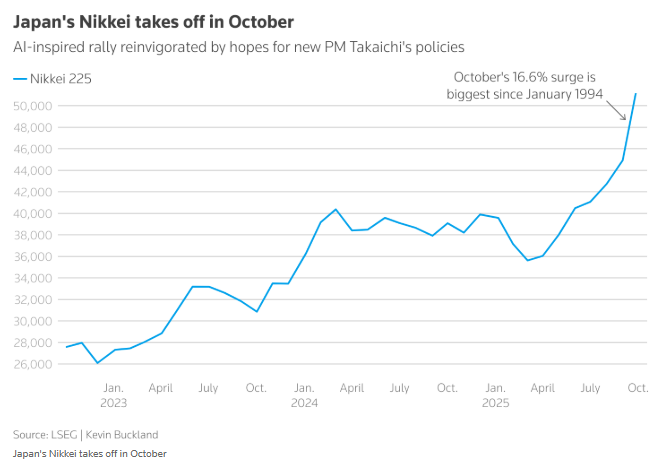
Group 1 - The Nikkei 225 index reached a historical high, closing at 52,411.34 points, with a monthly increase of 16.6%, the largest since January 1994 [1][4] - Amazon's cloud business revenue growth hit a three-year high, exceeding market expectations for quarterly sales guidance [4] - Apple's CEO Tim Cook provided forecasts for holiday season iPhone sales and overall revenue that surpassed Wall Street analysts' expectations [4] Group 2 - Japanese semiconductor stocks were significant contributors to the index's rise, with Socionext's stock soaring nearly 17% and Advantest rising 3.9% [4] - AI-related stocks, such as Hitachi, also performed well, with Hitachi's stock increasing by 7.2% [4] - The recent surge in technology stocks is driven by global excitement around AI and expectations of fiscal stimulus policies from Japan's new Prime Minister, Sanna Takashi [4] Group 3 - Mitsubishi UFJ Asset Management noted that the focus of Takashi's policies includes AI innovation, suggesting that Japanese tech stocks will benefit from both global tech trends and domestic policy support [4] - The chief market economist at Mitsubishi UFJ, Naoya Oshikubo, indicated that the Nikkei index's breakthrough of 52,000 points is just a stop on the way up, with an expected further increase of around 10% by April next year [4] - Oshikubo emphasized that the current upward trend is not a bubble [4]
A股盘前播报 | 云业务创三年最快增速!亚马逊盘后涨14% 中美经贸磋商达成多项成果共识
智通财经网· 2025-10-31 00:21
Company - Apple's Q4 revenue reached $102.466 billion, a year-on-year increase of 8%, with diluted earnings per share of $1.85, up 13%, exceeding market expectations [1] - Cook forecasts that the company's revenue for Q1 of fiscal year 2026 will grow by 10% to 12% year-on-year, with iPhone sales expected to achieve double-digit growth [1] - China Life reported a net profit of 126.873 billion yuan for Q3, a year-on-year increase of 91.5% [13] - China Pacific Insurance reported a net profit growth of 28.9% year-on-year for the first three quarters [15] - Guotai Junan reported a net profit growth of 132% year-on-year for the first three quarters after merging with Haitong Securities [15] - BYD's net profit for the first three quarters decreased by 7.55% year-on-year [15] - COSCO Shipping's net profit for the first three quarters decreased by 29% year-on-year, with a decline in revenue per container [15] - *ST Chuangxing's chairman was arrested on criminal charges [15] Industry - Five departments, including the Ministry of Finance and the Ministry of Commerce, announced improvements to the duty-free shop policy, effective from November 1, 2025, to boost consumption and optimize the layout of duty-free shops [2] - The US and China reached several consensus outcomes during trade negotiations, including the cancellation of the 10% tariff on fentanyl and a one-year suspension of certain export controls [3] - A new policy financial tool of 500 billion yuan has been fully deployed, expected to drive total project investment exceeding 7 trillion yuan, focusing on technology innovation, consumption expansion, and stabilizing foreign trade [4] - The demand for high-performance computing chips is expected to surge due to rapid growth in downstream applications such as AI, data centers, gaming, and autonomous driving [11] - The price of key materials for electrolytes has surged over 23% due to tight supply, benefiting the profitability of companies in the lithium battery industry [12]
亚马逊被曝裁减多达 3 万个岗位,涉及所有业务部门
Jing Ji Guan Cha Wang· 2025-10-28 07:09
Core Viewpoint - Amazon is reportedly planning to announce a significant round of layoffs starting October 28, potentially cutting up to 30,000 jobs, which would represent about 10% of its total workforce [1] Group 1: Layoff Details - The layoffs would affect nearly all business departments within Amazon [1] - If confirmed, this would mark the largest layoff in Amazon's history, surpassing the previous largest cut of approximately 27,000 jobs announced at the end of 2022 [1] Group 2: Context of Previous Layoffs - The previous layoffs in 2022 were a response to the need for cost-cutting after rapid expansion during the COVID-19 pandemic [1]
财报前瞻丨亚马逊或再添万亿美元市值
美股研究社· 2025-10-27 11:43
Core Viewpoint - Amazon's recent underperformance is attributed to short-term fluctuations rather than fundamental issues, with the company maintaining a strong position through continuous innovation and a robust business ecosystem. The stock price has remained stable, indicating high attractiveness in current valuations [1]. Financial Performance Outlook - Amazon is set to release its Q3 earnings report on October 30, with Wall Street predicting a revenue growth rate of nearly 12% year-over-year and a non-GAAP EPS growth of 9.2%. This revenue growth rate is consistent with previous quarters, reflecting strong growth momentum in cloud services and AI [5]. - The alignment between earnings and revenue growth is crucial, with the expected net profit growth slightly lagging behind revenue growth, which is acceptable given Amazon's prioritization of R&D over net profit. Historical trends show that this strategy has solidified Amazon's leading position in e-commerce and cloud services [5]. - Over the past eight quarters, Amazon has consistently exceeded EPS expectations, with actual EPS often surpassing forecasts by approximately 20%. Revenue has also generally exceeded expectations, with the last quarter's revenue exceeding Wall Street predictions by $5.6 billion [6]. Analyst Expectations - Analyst expectations are trending positively, with no downgrades and 38 upgrades in revenue forecasts, indicating strong confidence in the growth potential driven by AI [6]. Long-term Growth Drivers - Amazon is expected to sustain impressive growth over the long term, leveraging its leading position in cloud infrastructure through AWS as a solid foundation for AI development. This positions Amazon ahead of competitors like Microsoft and Google [8]. - The advantages of AI are anticipated to create a flywheel effect for the company, enhancing cross-selling of AI features to existing cloud customers, optimizing internal processes, and improving customer experiences in e-commerce and digital advertising [9][10]. - Reports suggest that Amazon plans to implement a new round of layoffs, potentially affecting up to 15% of HR staff, as a result of increased AI application in internal processes. This aligns with broader trends of automation impacting a significant portion of the workforce [10]. Valuation Insights - Amazon's current valuation is attractive, with a projected decline in forward P/E ratio by nearly half over the next five years, indicating a bullish signal. The forward P/E ratio is expected to fall below 20 times by FY2028, suggesting extreme undervaluation given Amazon's dominance in e-commerce and cloud services [12]. - The potential for automation to reduce the workforce by approximately 600,000 positions could significantly enhance the company's long-term valuation, even if such reductions take 5-7 years to implement [12]. Conclusion - The potential for automation alone could add $1.2 trillion to Amazon's current market value of $2.3 trillion, making continued investment at current low stock prices a compelling choice. Even if the automation revolution takes a decade to fully realize, the opportunity remains valuable as Amazon continues to capitalize on AI advancements [15].
