AI

Search documents
小微盘风格强势复苏,热点轮动后机会在哪
Di Yi Cai Jing· 2025-05-15 13:08
Group 1: Market Performance - The A-share market has shown a strong recovery in small-cap stocks, with over 90% of small-cap stocks rising since April 8, 2023 [1][3] - The Wande Micro-cap Index and North Exchange 50 have outperformed large-cap indices, with the North Exchange 50 index rising by 35.57% from April 8 to May 15 [3] - The performance of small-cap themed equity products has been robust, with all relevant products showing positive returns during the same period [4] Group 2: Fund Activity - There has been a significant increase in institutional interest in small-cap stocks, with the number of small-cap stocks under institutional research rising from 300 to 1224 in one month [6] - Some small-cap themed funds have implemented large subscription limits due to rapid inflows, such as the CITIC Prudential Multi-Strategy Fund, which announced a suspension of large subscriptions over 2 million yuan [5] - The top-performing funds related to the North Exchange 50 have seen returns exceeding 30%, with many small-cap funds turning from losses to gains this year [4] Group 3: Market Outlook - The market is currently in a phase of risk preference recovery, with expectations of limited downside due to policy support and economic pressures [2] - Analysts suggest that the small-cap stock sector may face profit-taking risks if the upward trend continues, potentially leading to a short-term correction [6] - Historical data indicates that April often serves as a turning point for small-cap stocks, with opportunities emerging after adjustments [7]
如何理解AI资产重估?
李迅雷金融与投资· 2025-05-15 12:07
Core Viewpoint - A structural transformation is occurring in the Chinese economy, characterized by a concentration of capital and technology in leading enterprises, particularly in AI and high-end manufacturing, while employment and consumption lag behind [1][2][3] Group 1: AI Technology Breakthrough - The domestic AI model DeepSeek has achieved significant breakthroughs, showcasing higher reasoning efficiency and local computing compatibility, marking a shift towards commercial expansion of Chinese AI models [1][2] - The valuation logic in the capital market is changing as Chinese AI companies transition from relying on foreign technology to establishing their own core capabilities, leading to a re-evaluation of their long-term growth potential [2][3] - A significant concentration of investment is observed in leading AI firms, with the DeepSeek index rising by 41.61% from February 4 to March 18, 2025, compared to a mere 22.37% increase in the Hang Seng Index during the same period [2][3][6] - The "winner-takes-all" dynamic is evident, where investment flows heavily favor a few leading companies, creating a feedback loop that enhances their competitive edge [3][4][6] Group 2: Industrial Upgrade and Concentration - High-end manufacturing is increasingly reliant on strong R&D capabilities and system integration, with government support favoring leading firms capable of overcoming technical challenges [9][10] - The concentration of capital in high-end manufacturing is not due to a lack of innovation among smaller firms, but rather the necessity for complete industrial chain support and strategic execution aligned with policy [10][11] - The average price-to-earnings ratio of leading firms in the industrial mother machine sector increased by over 20% in 2024, while second-tier firms saw declines, indicating a clear preference for established leaders [10][11] Group 3: New Cycle of Tech Investment and Employment Market - Despite a surge in tech investment, the employment market is experiencing structural challenges, with a significant drop in venture capital investment events, down nearly 50% from 2021 highs [13][15] - The investment focus has shifted towards a few hard-tech sectors, leaving traditional employment-intensive industries underfunded and shrinking, leading to a mismatch in job supply and demand [19][20] - The automation trend is exacerbating employment issues, as companies like BYD see revenue growth outpacing employee growth, reducing overall job absorption capacity [22][25] Group 4: Policy Expectations and Economic Structure - The current macroeconomic policy is transitioning towards structural adjustments, emphasizing quality and stability over broad stimulus measures [26][27] - The government faces a dual challenge of advancing key technologies while ensuring employment stability, leading to a more nuanced approach to economic policy [27][28] - Recent policy measures indicate a shift towards supporting strategic sectors like AI and high-end manufacturing, while traditional industries may continue to face valuation challenges [28][29] Group 5: Asset Allocation Recommendations - The core assets in the AI sector are now driven by engineering capabilities and profitability rather than mere policy support, indicating a shift towards long-term asset allocation [30][31] - Investment strategies should focus on defensive assets, leading AI firms, and safety assets like gold and military equipment, reflecting the current market dynamics and policy direction [33]

【帮主郑重】指数玩跳水!消费股逆袭藏玄机?午盘暗战大揭秘
Sou Hu Cai Jing· 2025-05-15 04:41
老铁们,帮主盯着盘面直拍大腿——今天A股这出戏太刺激了!三大指数集体玩起高台跳水,创业板半天就栽了1.35%,3600只股票绿得发慌。但你们猜怎 么着?美容、港口、农业这几个板块愣是杀出重围,上演逆袭剧本! 港口航运的逆袭密码 中日韩自贸区谈判重启的消息,让沿海港口集体嗨了。连云港、宁波海运涨停不是偶然——三国贸易量每增10%,港口吞吐量就能涨15%。但老铁们注意 了,这波行情有"政策预期"加持,等具体协议落地可能利好出尽,现在追高容易被挂旗杆。 农业股竟成避风港? 中央一号文件提到的"农业新质生产力",让秋乐种业这类企业突然吃香。数字农业管理系统能精准控制施肥量,节水30%的同时增产15%,这才是资金追捧 的硬逻辑。但农业股波动大得像坐过山车,没金刚钻别揽瓷器活。 先说这冰火两重天 开盘半小时就看出端倪:AI智能体、液冷服务器这些科技小鲜肉集体扑街,军工老大哥也蔫了吧唧。反观美容护理板块,芭薇股份直接30cm涨停,连云 港、川宁生物这些冷门股突然变显眼包。这行情就像火锅局——辣锅沸腾(消费股),清汤寡水(科技股),吃得人冰火两重天。 美容股为啥突然吃香? 山东卫健委刚甩出王炸政策——允许医美机构搞光电注射项 ...
红星美凯龙创始人被立案调查;娃哈哈客服回应纯净水由今麦郎代工;甘薇和贾跃亭离婚,否认得到40亿元;雷军微博限制评论丨邦早报
创业邦· 2025-05-14 23:52
Group 1 - Red Star Macalline's founder, Che Jianxing, is under investigation by the Yunnan Provincial Supervisory Committee, but the company's board operations remain normal and control has not changed [2][3] - Manus's parent company, Butterfly Effect, denied reports of a $100 million financing round at a $1.5 billion valuation, stating the information is false [2] - Actor Gan Wei announced her divorce from Jia Yueting, denying any asset transfer or claims of receiving 4 billion yuan [3] Group 2 - Tencent reported Q1 2025 revenue of 180 billion yuan, a 13% year-on-year increase, with WeChat and WeChat's combined monthly active users reaching 1.402 billion, up 3% year-on-year [7] - JD.com announced that users whose orders were delayed by over 20 minutes during a system outage would receive a refund [8] - Neta Auto denied bankruptcy rumors, clarifying that a third-party advertising company filed for bankruptcy, not the company itself, while acknowledging internal difficulties [8] Group 3 - Wahaha's customer service confirmed that its purified water is produced by Jinmailang under quality standards, addressing consumer concerns about product differences [11] - Xiaomi's founder Lei Jun limited comments on his Weibo posts, citing a challenging period for the company [5] - The International Energy Agency projected that by 2025, one in four new cars sold globally will be electric, with sales expected to exceed 20 million units [24] Group 4 - Nvidia's market capitalization reached $3 trillion, with CEO Jensen Huang's net worth increasing by 50% year-on-year to approximately $120 billion [15] - CATL received over $50 billion in institutional orders, achieving a 30-fold oversubscription for its IPO, potentially making it the largest IPO of the year [15] - Meizu launched the Note16 series smartphones with prices starting at 594.15 yuan after subsidies [17]

5月14日|财经简报 A股指数上涨,成交破万亿 五大部门约谈外卖平台
Sou Hu Cai Jing· 2025-05-14 08:38
以下是2025年5月14日的财经热点总结,结合市场动态、政策调整及国际事件: --- 一、A股市场表现 1. 指数上涨,成交破万亿 二、政策与国际动态 1. 中美关税调整落地 - 自5月14日起,中国对美加征关税税率从34%降至10%,并暂停24%关税90天。美国同步取消91%的对华关税,市场预期出口链 企业盈利修复,航运、家电等板块受益。 - 外贸企业反应:美国客户连夜下单,部分订单从越南回流中国,外贸企业业务回暖。 - 沪指涨0.86%报3403.95点,深成指涨0.64%,创业板指涨1.01%,两市成交额达1.31万亿元,北向资金净流入超80亿元。 - 板块分化: - 金融板块领涨:保险(中国人保涨停)、券商(红塔证券涨停)、酿酒等蓝筹股强势,反映市场对长线修复行情的预期。 - 航运港口爆发:受中美关税调整影响,中远海发、宁波海运等多股涨停,集运指数期货周涨32%。 - 科技股分化:AI产业链(算力、CPO)活跃,但半导体、新能源车板块资金流出明显。 2. 资金流向 - 主力资金净流出7.97亿元,但超大单净流入77亿元,小单资金净流入125亿元,显示散户活跃度提升。 --- 2. 中巴深化合作 - 中 ...



红杉AI峰会六大关键议题解读(5):AI商业化范式转移,从“模型调用”迈向“组织结构调用”
Haitong Securities International· 2025-05-14 07:45
Investment Rating - The report does not explicitly provide an investment rating for the industry. Core Insights - The consensus at the 2025 Sequoia AI Summit is the shift in AI commercialization from "model invocation" to "organizational structure invocation" [1][6] - The AI industry currently prioritizes computational scale and parameter stacking as core competencies, but the real constraints are in organizational structures, processes, and toolchains that are not adapted for intelligent operations [1][6] - Future competition will focus on building more efficient collaborative networks and smarter organizational structures [1][6][10] Summary by Sections AI Application Development - The focus of AI application development is shifting from isolated model optimization to organizational alignment, which will redefine workflows and technical pathways [2][7] - The industry is currently trapped in a "technical obsession," prioritizing computational power while neglecting the deeper logic of deployment [2][7] Limitations of Model Invocation - Model invocation is limited in achieving true business synergy and value closure, which organizational structure invocation can resolve through systemic integration [3][8] - Model-centric strategies often isolate optimization at the algorithmic level, failing to address fragmented workflows and data silos [3][8] Organizational Structure Invocation - Organizational structure invocation integrates AI with existing resources, processes, and personnel through structural optimization, creating a closed loop from model application to value creation [3][8] - Claude Code's implementation by Anthropic demonstrates the transformative power of organizational adaptation, achieving over 70% of production code submissions internally [4][9] Future of AI Competition - The future of AI competition will pivot from model performance to optimizing organizational structures and collaboration networks, reshaping industry dynamics [4][10] - Enterprises will leverage high-density agent-driven logic for end-to-end intelligent operations, moving away from reliance on labor scale [4][10]
大摩最新发声!中国经济迎关键机遇期,人民币资产吸引力有望提升
券商中国· 2025-05-14 03:39
Core Viewpoint - The article discusses the substantial progress made in the high-level economic talks between China and the U.S., highlighting the potential for China to seize opportunities in the global economic landscape amidst ongoing trade disputes and structural changes in the economy [1][2]. Economic Resilience - The ongoing trade negotiations between China and the U.S. are moving towards a more controllable state, which may alleviate the current trade standstill and positively impact GDP growth in the upcoming quarters [3]. - China has established a robust social and economic foundation to withstand external shocks, with significant room for policy stimulus to stabilize economic growth [4]. - The long-standing advantages of China's industrial chain clusters are expected to help maintain economic stability despite trade tensions [5]. Policy Collaboration and Domestic Demand - There is a need for China to enhance fiscal measures to boost domestic demand, as monetary policy alone may not suffice [6]. - Suggested measures include increasing fiscal deficits, reforming state-owned enterprises to support social security systems, and shifting fiscal spending from infrastructure to social welfare [7][8]. Strategic Opportunities - China aims to enhance the attractiveness of its assets and market competitiveness by implementing the "2030 Major Strategy," which includes increasing domestic demand by 30% and achieving zero tariffs, zero entry restrictions, and zero subsidy limitations for countries outside the U.S. by 2030 [9][10][13]. - The growth in domestic demand is projected to fill the global demand gap created by U.S. trade protectionism, thereby enhancing China's role in global trade and geopolitical stability [12]. Conclusion - The article emphasizes that despite uncertainties in the U.S. economy and its tariff policies, China's proactive measures and potential reforms could position it favorably in the global economic landscape, making it crucial for China to capitalize on this strategic opportunity [14].
小米胜诉,获赔55万;京东美团等外卖平台被五部门约谈;迪奥就客户信息泄露致歉;哪吒汽车被申请破产;极氪回应吉利私有化提议丨邦早报
创业邦· 2025-05-13 23:52
Core Viewpoint - The article discusses various recent developments in different companies and industries, highlighting regulatory actions, legal disputes, financial performance, and strategic changes. Group 1: Regulatory Actions and Legal Issues - Five government departments have interviewed major food delivery platforms like JD.com, Meituan, and Ele.me regarding competition issues, urging them to comply with relevant laws and ensure fair competition [2] - Dior has reported a data breach affecting customer information, prompting the company to take immediate measures to control the situation and advise customers to be cautious [2] - Xiaomi won a lawsuit against Juhao Technology for defamation, resulting in a compensation of 550,000 yuan and a requirement for Juhao to publish a statement to mitigate the impact [3][4] Group 2: Company Financial Performance - JD Group reported a revenue of 301.1 billion yuan for Q1 2025, a year-on-year increase of 15.8%, with a net profit of 10.9 billion yuan compared to 7.1 billion yuan in Q1 2024 [10] Group 3: Corporate Restructuring and Strategic Changes - Zeekr announced that it has not made any decisions regarding the privatization proposal from its parent company Geely, which currently holds approximately 65.7% of Zeekr's shares [7] - Honor has established a new AI division and implemented a competitive recruitment process for key positions in China, with 45% of the positions seeing changes [9] - Nissan plans to reduce its production facilities from 17 to 10 by the 2027 fiscal year and aims to cut 20,000 jobs as part of a restructuring plan [16] Group 4: Market Trends and Product Launches - Toyota's new car sales in China increased by 20.8% in April, while Honda and Nissan experienced declines of 40.8% and 15.7%, respectively [22] - Samsung officially launched the Galaxy S25 Edge, starting at a price of 7,999 yuan, featuring advanced imaging capabilities and AI integration [20]

投顾看涨二季度 消费和高股息板块迎配置良机——上海证券报·2025年第二季度券商营业部投资顾问调查报告
Shang Hai Zheng Quan Bao· 2025-05-13 18:45
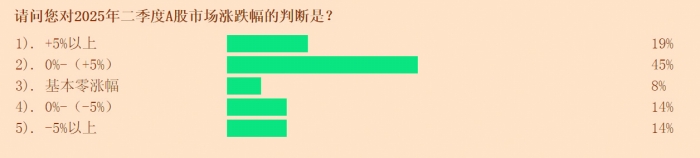
Group 1: Economic Outlook - The investment advisory community holds a generally optimistic view on the macroeconomic outlook for Q2, with over 60% expressing a neutral to optimistic stance on the current economic situation [5][7][8] - A significant portion of advisors (44%) believe that the economy will show improvement in Q2 compared to Q1, while 29% anticipate some downward pressure [8] Group 2: Stock Market Predictions - Over 60% of advisors predict that the A-share market will rise in Q2, driven by ongoing growth stabilization policies [6][10] - The most favored investment theme remains technology stocks, although there is a noted decrease in enthusiasm for this sector [10][13] Group 3: Sector Preferences - Advisors are increasingly optimistic about the consumer sector and high-dividend stocks, with many indicating that these areas present good investment opportunities [10][14] - In the technology sector, 41% of advisors still favor it, but this is a decline of 17 percentage points from the previous quarter [13] Group 4: Asset Allocation - Equity assets are viewed as the most attractive for allocation in Q2, with 42% of advisors recommending stocks [15][16] - There is a notable increase in the recommendation for gold and precious metals, with 20% of advisors suggesting these assets, up 11 percentage points from the previous quarter [15][16] Group 5: High Net Worth Client Behavior - In Q1, 65% of high net worth clients reported profits, an increase of 6 percentage points from the previous quarter [21] - 45% of high net worth clients opted to increase their positions in Q1, with technology stocks being the primary focus [22] Group 6: Hong Kong Market Insights - The investment attractiveness of the Hong Kong market has risen, with 81% of advisors recognizing its investment value [25][26] - High net worth clients have shown increased enthusiasm for Hong Kong stocks, with 41% increasing their investments in this market [25][26]
SoftBank turned a corner. All eyes are now on its big AI bets.
Business Insider· 2025-05-13 14:47
Core Viewpoint - SoftBank has posted its first annual profit in four years, with a net income of 1.15 trillion yen ($7.8 billion) for the year ended March, overcoming a previous loss of $1.5 billion, signaling a potential turnaround for the company as it invests heavily in AI [1][2][3]. Financial Performance - The fourth quarter saw a 124% year-on-year increase in quarterly profit, driven by a significant rise in Alibaba shares, which have increased over 55% this year, and profits from its telecom unit, including T-Mobile [2]. - The overall profit recovery provides relief for CEO Masayoshi Son, who has faced criticism for past losses, including a disastrous investment in WeWork and significant losses in the Vision Fund [3]. AI Investment Strategy - Masayoshi Son is heavily investing in AI, believing it will surpass human intelligence by 2035, and is making high-risk moves to achieve this vision [4]. - SoftBank has become a key backer of OpenAI, leading a $40 billion funding round and investing a total of $2.2 billion, viewing OpenAI as the closest partner to achieving artificial general intelligence [5]. - The company is also focusing on the necessary computing power for AI development, with Son serving as chairman of Stargate, a $500 billion infrastructure project in the US [6]. Broader AI Initiatives - In addition to OpenAI, SoftBank holds a majority stake in AI chip firm Arm and has established a new holding company, Robo HD, for its robotics investments [7]. - However, these investments come with risks, including legal challenges faced by OpenAI and uncertainties surrounding the Stargate project due to external factors like tariffs [8]. Market Concerns - There are concerns regarding the long-term demand for AI chips, as evidenced by Arm's decision not to provide full-year revenue guidance, leading to an 11% drop in its shares after earnings [9].