
云计算

Search documents
杭州自贸片区多项发展成果领跑全国
Hang Zhou Ri Bao· 2025-11-12 02:26
Core Insights - The Hangzhou Free Trade Zone has achieved significant milestones in the past five years, becoming a national leader in various sectors, including digital trade and artificial intelligence [2][4][5] Group 1: Economic Achievements - Seven companies in the artificial intelligence sector have surpassed 10 billion yuan in revenue, positioning Hangzhou as the second in national computing power levels [1] - The cross-border e-commerce exports reached 38.74 billion yuan in the first half of 2025, contributing to a 12.5% increase in overall city exports [1] - The digital security market holds the largest global market share, while cloud computing and e-commerce platform transaction volumes rank first in the Asia-Pacific and nationwide, respectively [1] Group 2: Policy and Regulatory Innovations - The Hangzhou Free Trade Zone has introduced over 170 innovative measures, including more than 20 national firsts, such as the knowledge property pledge financing model [2][3] - The region has established the first local digital trade regulations in China, promoting a negative list for cross-border data flow in e-commerce [3] - A unique international cargo station has been launched, along with a pilot program for recognizing high-skilled foreign talent [3] Group 3: Future Directions - The Hangzhou Free Trade Zone aims to enhance its digital trade ecosystem by fostering new business models in cross-border e-commerce and digital services [5][6] - The focus will be on deepening investment liberalization reforms and creating a market-oriented, legal, and international business environment [5] - The zone plans to strengthen the integration of innovation and industry chains, leveraging digital technology for the transformation of traditional industries [5]
消息确认:巨头宣布大裁员!涉及多个核心部门
Sou Hu Cai Jing· 2025-11-12 02:22
Core Insights - Amazon has announced a global organizational optimization, resulting in a net reduction of approximately 14,000 corporate jobs, marking the largest restructuring since late 2022 [1][2] - The layoffs affect multiple core departments, including Human Resources, AWS, Advertising, and Devices & Services, with a significant impact on the China region where some departments have seen a 50% reduction [2] - Since 2022, Amazon has laid off over 27,000 employees, driven by a strategy focused on AI transformation and organizational flattening [2][3] Organizational Changes - The layoffs are part of Amazon's strategy to focus on AI transformation and make the organization more agile, reallocating resources to priority areas [3] - Amazon's Senior Vice President of Human Experience and Technology, Beth Galetti, stated that the layoffs are necessary despite the company's strong performance, as the world is rapidly changing [3] - The company reported a net sales figure of $167.7 billion for Q2 of fiscal year 2025, a 13% year-over-year increase, with net profits rising 35% to $18.2 billion [3] International Business Performance - Amazon's international business growth has slowed, with a reported growth rate of 4.9% in Q1 of 2025, attributed to increased uncertainty in the global trade environment and competition from emerging platforms [4] - Employees have reported that middle management has been the primary target for layoffs, with strict criteria set by headquarters for those with fewer than seven direct reports [4] Strategic Shift - Amazon is transitioning from a strategy of "scale expansion" to "efficiency priority," with layoffs in the China region reflecting this global strategic adjustment [6] - The company aims to concentrate resources on high-profit and high-growth areas such as AI and cloud computing to enhance overall operational efficiency and profitability [6]



11月业绩真空期,机构喊话加仓计算机板块!云计算ETF天弘(517390)近两周回调超7%
2 1 Shi Ji Jing Ji Bao Dao· 2025-11-12 01:21
Group 1 - The technology sector experienced a pullback on November 11, with the Computer ETF (159998) declining by 1.61%, while storage leader Jiangbolong saw a rise of over 6% [1] - From October 28 to November 11, the Cloud Computing ETF Tianhong (517390) has retraced over 7%, and the Computer ETF (159998) has dropped more than 5% since October 30 [1] - Overall, the computer industry reported revenue growth of 5.04%, net profit growth of 27.31%, and non-recurring profit growth of 25.96% for the third quarter, confirming a performance recovery trend this year [1] Group 2 - The Cloud Computing ETF Tianhong (517390) tracks the CSI Hong Kong-Shenzhen Cloud Computing Industry Index, providing access to competitive cloud computing assets across A-shares and Hong Kong stocks [2] - A research team from the Chinese Academy of Sciences has made significant progress in neutral atom quantum computing, proposing a new architecture that addresses challenges in achieving high parallelism, speed, and stability [2] - The National Development and Reform Commission and other departments have issued a plan to promote the application of technologies like IoT, cloud computing, big data, AI, and blockchain in the logistics sector [2]

“AI泡沫”的领先指标--美国云厂商的债券遭遇连续抛售
Hua Er Jie Jian Wen· 2025-11-12 00:56
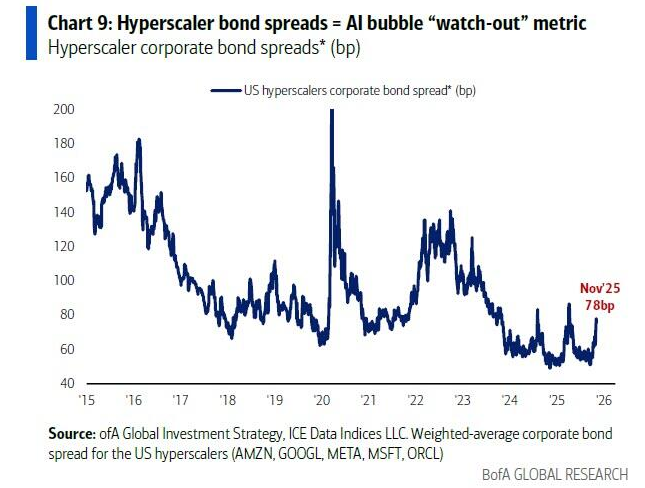
Core Insights - Concerns over AI spending by large tech companies have spread to the bond market, with debt spreads for hyperscale cloud computing firms reaching multi-month highs, indicating a potential risk reassessment of the entire AI narrative [1][3] - Barclays downgraded Oracle's debt rating, citing that the company's capital expenditures for AI contracts have significantly exceeded its free cash flow capacity, leading to a heavy reliance on external financing [1][4] Debt Market Dynamics - The yield spread of bonds issued by hyperscalers, including Alphabet, Meta, Microsoft, and Oracle, has risen to 0.78 percentage points above U.S. Treasuries, marking a significant increase from 0.5 percentage points in September [3] - Over the past seven weeks, tech companies have issued more than $120 billion in bonds, primarily to fund data center construction, raising concerns about overcapacity, long-term profitability, and energy demand [3] Oracle's Financial Strain - Oracle's situation is particularly notable, with Barclays predicting a severe financing gap starting in fiscal year 2027 and potential cash exhaustion by November 2026, driven by a high leverage ratio of 500% compared to Amazon's 50% and Microsoft's 30% [4][5] - Oracle's bond prices have dropped nearly 5% since mid-September, contrasting with a 1% decline in an index tracking high-rated tech bonds, reflecting investor concerns [5] Industry-Wide Implications - The challenges faced by Oracle are indicative of broader industry pressures stemming from the AI investment boom, with JPMorgan strategists warning that building AI infrastructure could cost over $5 trillion, necessitating participation from public capital markets, private credit, alternative capital, and even government [6] - Despite holding approximately $350 billion in cash and investments, tech giants are opting for significant debt issuance, signaling a shift from conservative financial strategies to higher leverage operational models [6] Recent Major Transactions - Meta completed a $30 billion bond issuance at the end of October, the largest corporate bond deal of 2023, and secured a $27 billion private debt agreement for data center funding [7] - Alphabet issued $25 billion in bonds in early November, while Oracle sold $18 billion in bonds in September to finance infrastructure leasing, including the "Stargate" data center for OpenAI [8] Market Reactions and Future Outlook - The credit market's pressure is affecting smaller core participants, with CoreWeave's stock dropping over 20% in the past two weeks, coinciding with the bond sell-off by large tech firms [9] - Some analysts view the bond market sell-off as a healthy market response, suggesting that price corrections following significant bond supply are a positive sign [9]

2025年湖北“智慧之光”在汉点亮,14项创新成果签约,加速向全省转化
Chang Jiang Ri Bao· 2025-11-12 00:45
Core Insights - The "Wisdom Light" event in Hubei Province aims to facilitate the transformation of innovative achievements from academicians and postdoctoral researchers into practical applications, showcasing the province's commitment to innovation and entrepreneurship [1][4]. Group 1: Event Overview - The event took place on November 11, 2025, in Wuhan, gathering academicians, experts, postdoctoral researchers, and representatives from technology service institutions and enterprises [1][3]. - A total of 14 expert achievement transformation projects were signed, with a signing amount exceeding 57 million yuan, indicating a successful transition of innovations from theoretical concepts to market-ready products [4][9]. Group 2: Project Highlights - One notable project led by Professor Tu Zhigang from Wuhan University focuses on "intelligent restoration and behavior recognition technology for dark and complex scene video images," marking a significant original innovation in low-light vision technology [10]. - This technology has already been implemented in various units in Yichang City, enhancing public safety and urban governance during nighttime operations [13]. Group 3: Environmental Innovations - The event also featured environmentally friendly products made from agricultural waste, such as fully biodegradable agricultural films and containers, developed by Dr. Su Xiaohai from Yichang Agricultural Technology Co., which have been applied to 3,000 acres in Huangpi District and are set for further expansion [16]. - The initiative has attracted over 1,000 academicians and experts over the years, resulting in the release of more than 2,700 achievements and demands, successfully promoting over a hundred research outcomes in Hubei's specialized industries [16].

全球科技业绩快报:Coreweave25Q3
Haitong Securities International· 2025-11-12 00:45
Investment Rating - The report assigns a positive investment rating, indicating an "Outperform" expectation for the company over the next 12-18 months [18]. Core Insights - The company's third-quarter performance for 2025 showed a revenue of $1.40 billion, a 134% year-over-year increase, significantly exceeding market expectations. Adjusted operating income was $217 million with a 16% margin, and adjusted EBITDA reached $838 million, more than double the previous year, with an EBITDA margin of 61% [1][6]. - The strong performance was driven by a tight supply-demand balance in AI cloud capacity, with continued partnerships with major clients like Meta and OpenAI, showcasing high customer retention [2][7]. - The company has accelerated its capacity expansion, increasing active power to approximately 590 MW and contracted power to 2.9 GW, while diversifying delivery risks through new data centers in the U.S. and Europe [3][8]. - Financially, the company optimized funding costs, achieving a quarterly capital expenditure of $1.9 billion and a cash balance of $3.0 billion, supported by approximately $14 billion in debt and equity financing [4][9]. Summary by Sections Financial Performance - Revenue for Q3 2025 was $1.40 billion, up 134% year-over-year, with adjusted EPS at -$0.22, and adjusted operating income of $217 million, reflecting a 16% margin. Adjusted EBITDA was $838 million, with a margin of 61% [1][6]. - Despite a GAAP net loss of $110 million, the adjusted net loss narrowed to $41 million, with operating expenses totaling $1.30 billion [1][6]. Business Drivers - The key driver for the quarter's outperformance was the expansion in volume due to a tight supply-demand balance for AI cloud capacity. The company maintained strong relationships with major clients, with 90% of the top 10 customers making repeat purchases [2][7]. - The company’s differentiated software solutions improved resource utilization and customer stickiness, enhancing its market reputation [2][7]. Capacity Expansion - The company significantly accelerated its capacity expansion, with active power rising to ~590 MW and contracted power increasing to 2.9 GW. It added eight new data centers in the U.S. and advanced European sites, adopting a dual-track model to mitigate delivery risks [3][8]. Financial Strategy - The company’s capital expenditures reached $1.9 billion, with a cash balance of $3.0 billion. It completed about $14 billion in financing, optimizing its debt maturity profile and reducing overall funding costs [4][9]. - The financing strategy included a new $3.0 billion facility with a lower interest rate, contributing to a favorable financial position for rapid expansion [4][9]. Future Outlook - For FY2025, the company guided revenue expectations of $5.05–5.15 billion and adjusted operating income of $690–720 million, with anticipated capital expenditures of $12–14 billion. The management expects capital expenditures in 2026 to exceed double that of 2025 [5][10].
美科技巨头扩大海外AI算力:谷歌微软在欧洲投资超1000亿
Feng Huang Wang· 2025-11-12 00:02
Core Insights - Google and Microsoft are set to invest over $16 billion (approximately 113.9 billion RMB) in AI infrastructure in Europe, marking a significant commitment from U.S. tech giants to enhance overseas AI capabilities [1][2] Group 1: Microsoft Investment - Microsoft plans to invest over $10 billion to build a data center hub in Sintra, Portugal, starting early next year [1] - The project will involve collaboration with NVIDIA, Nscale Global Holdings, and Start Campus, deploying around 12,600 NVIDIA GB300 GPUs [1] - This investment is noted as Microsoft's largest in Portugal and one of the biggest in Europe's AI computing sector [1] Group 2: Google Investment - Google intends to invest €5.5 billion (approximately $6.36 billion) in Germany by 2029 to expand its AI infrastructure and office spaces [1] - The investment will include a new data center in Ditzingen, enhancements to existing facilities in Hanau, and office expansions in Berlin, Frankfurt, and Munich [1] Group 3: Industry Context - These investments reflect U.S. companies' efforts to meet the growing demand for AI services and expand their operations abroad [2] - Since the launch of ChatGPT by OpenAI in late 2022, there has been a surge in AI investments in Europe, with tech giants committing billions to strengthen data centers, cloud services, and AI infrastructure [2] - Recent collaborations include NVIDIA and Deutsche Telekom's €1 billion partnership to establish one of Europe's largest AI factories in Germany, and Amazon's announcement of over €1.4 billion investment in the Netherlands over the next three years [2]


利空突袭!刚刚,全线跳水!
券商中国· 2025-11-11 23:53
Cryptocurrency Market - The cryptocurrency market experienced a significant decline, with the overall index dropping by 5.85% to 77.69 points, and Bitcoin falling over 2.8% [1] - Over the past 24 hours, more than 150,000 individuals were liquidated in the cryptocurrency market [1] - The International Organization of Securities Commissions (IOSCO) reported that tokenized assets linked to mainstream financial assets may pose new risks to investors, highlighting ongoing debates within the financial industry regarding the benefits and drawbacks of tokenization [1] U.S. Stock Market - The U.S. stock market showed mixed results, with the Dow Jones Industrial Average rising by 1.18% to reach a record high, while the Nasdaq Composite Index fell by 0.25% [2] - A key factor driving the rise in the Dow and S&P indices was the return of the House of Representatives to Washington to vote on a bill to end the government shutdown [2] - Nvidia shares fell nearly 3% after SoftBank Group announced it had sold its entire stake in Nvidia for $5.83 billion, raising concerns about an AI bubble [2] Chinese Concept Stocks - The Nasdaq Golden Dragon China Index saw a slight decline of 0.06%, with notable movements in individual stocks such as XPeng Motors rising over 7% and Alibaba falling over 3% [3] Banking Regulations - U.S. banking regulators have reportedly reached an agreement to relax a series of capital requirements, which banks argue limit their ability to hold more U.S. Treasury securities [4] - The proposed changes to the Enhanced Supplementary Leverage Ratio (eSLR) would lower the capital ratio that large banks need to maintain relative to their total assets [4]


巴克莱下调甲骨文债务评级:明年11月现金或将耗尽,最终可能沦为"垃圾债"
美股IPO· 2025-11-11 23:37
Core Viewpoint - Barclays Bank has downgraded Oracle's debt rating to "underweight," citing that Oracle's massive capital expenditures for AI data center construction have far exceeded its free cash flow capabilities, resulting in a debt-to-equity ratio of 500%, the highest among major tech companies. The bank predicts Oracle's credit rating may fall to BBB-, nearing junk status [1][3][22]. Group 1: Debt Rating and Financial Health - Oracle's capital expenditures for fulfilling large AI contracts have significantly outstripped its free cash flow, forcing the company to rely heavily on external financing [3][16]. - Barclays forecasts that Oracle will face a severe financing gap starting from fiscal year 2027, with cash potentially running out by November 2026 [3][18]. - Oracle's debt-to-equity ratio stands at 500%, compared to Amazon's 50% and Microsoft's 30%, indicating a precarious financial position [3][16]. Group 2: Industry Trends and Capital Expenditure - The construction cost of an AI data center can reach $50 to $60 billion per gigawatt, which is three times that of traditional data centers, with over half of the costs attributed to purchasing NVIDIA GPUs [7][11]. - Announced AI data center projects in the U.S. are expected to increase power demand by over 45 gigawatts, corresponding to an investment of over $2 trillion [11][12]. - The capital expenditure forecasts for the industry have nearly doubled since early 2025, indicating a significant increase in funding requirements [7][10]. Group 3: Market Impact and Debt Issuance - The issuance of debt by large-scale suppliers has surged, with major companies raising approximately $140 billion in bonds in recent months, and total issuance for the year expected to reach $160 billion [13][14]. - Even companies with AA ratings, such as Meta and Google, have seen significant widening of bond spreads, reflecting market concerns over absorbing such large volumes of debt [15]. - The trend of increased debt issuance is expected to continue as the AI race intensifies, with companies like Meta, Google, and Oracle facing tighter cash flows [15][22]. Group 4: Comparative Financial Position - Among large-scale suppliers, Oracle is the only company with negative free cash flow, highlighting its financial vulnerability [16]. - Meta has a liquidity buffer of approximately $80 billion, while Google maintains over $70 billion in liquidity, reducing their immediate refinancing pressures [18][19]. - Amazon and Microsoft are projected to maintain positive net free cash flow even under extreme capital expenditure scenarios, indicating greater financial stability [20].

美股指数涨跌不一,道指创历史新高,市场押注美国政府停摆将结束
Feng Huang Wang· 2025-11-11 22:40
Market Overview - The U.S. stock market showed mixed results with the Dow Jones reaching a historical high, driven by expectations of an end to the government shutdown [1] - The Senate passed a budget bill to end the government shutdown, which is now under consideration by the House of Representatives [1] - Concerns over high valuations in AI stocks led to a decline in companies like Nvidia, which saw a sell-off after SoftBank liquidated its Nvidia shares for $5.8 billion [1][2] Employment and Economic Data - Recent ADP data indicated a loss of an average of 11,250 jobs per week in the U.S. private sector over the last four weeks, contributing to negative market sentiment [2] Stock Performance - The Dow Jones increased by 559.33 points (1.18%) to close at 47,927.96, while the Nasdaq fell by 58.87 points (0.25%) to 23,468.30 [3] - The S&P 500 rose by 14.18 points (0.21%) to 6,846.61, with healthcare and energy sectors performing well, while the technology sector declined by 0.72% [3] Notable Company Movements - Nvidia's stock dropped by 2.96%, reflecting broader concerns in the AI sector [4] - CoreWeave, an Nvidia-invested cloud computing company, lowered its revenue guidance for the year, further pressuring AI stocks [2][4] - AMD's CEO stated that the AI data center market is expected to exceed $1 trillion by 2030, with significant growth anticipated in their data center business [6] - Google announced a $6.4 billion investment in Germany for data center construction, marking a significant commitment to European infrastructure [7] - Microsoft plans to invest $10 billion in Portugal for AI infrastructure, collaborating with Nvidia and other partners [8]


