
商业航天

Search documents
长城基金基金经理尤国梁:商业航天的远期空间与短期估值
Shang Hai Zheng Quan Bao· 2026-01-18 18:39
Core Viewpoint - The commercial aerospace sector has experienced a significant surge, but a market correction has occurred following this rise. The current adjustment is viewed as a potential phase of consolidation rather than a long-term downturn, given the upward industrial trend in the domestic commercial aerospace sector [1]. Group 1: Industry Trends - The commercial aerospace boom is attributed to multiple factors, including a notable increase in rocket launch frequency in the second half of 2025 and the successful orbiting of reusable rockets, which alleviated the domestic capacity bottleneck and laid the groundwork for commercialization [2]. - The "14th Five-Year Plan" emphasizes the goal of becoming a "space power," indicating the government's strategic focus on the aerospace sector [2]. - The commercial aerospace industry is seen as having substantial growth potential, with low-orbit satellite internet already connecting numerous users and the overseas "Starlink" business proving the viability of its business model [2]. Group 2: Market Dynamics - Concerns regarding the valuation of the commercial aerospace sector exist, as the overall industry valuation was already high before the 2025 market surge. The sector is currently at the early stage of an industrial inflection point, where anticipated increases in rocket and satellite launches may not immediately reflect in financial statements [3]. - The market's focus and rotation of funds align with the future development rhythm of the industry, initially concentrating on the rocket sector, which has seen the most significant changes and breakthroughs recently [3]. - Future market dynamics are expected to depend on which sector experiences major catalysts or industrial advancements, with ongoing performance across various directions including satellite manufacturing and operational services [3].
广发基金段涛:商业航天有望成为中长期主线
Shang Hai Zheng Quan Bao· 2026-01-18 18:24
Core Viewpoint - The commercial aerospace industry is expected to reach a critical inflection point in 2026, driven by policy support, technological advancements, breakthroughs in capital markets, and a consensus on commercialization potential [1][2]. Industry Trends - The commercial aerospace sector is transitioning from a conceptual phase to industrialization, becoming a significant focus in the capital market at the beginning of the year [2]. - Three core drivers of the current commercial aerospace market include: 1. The thematic heat similar to the robotics sector in 2025 2. Resonance between domestic and international industry and capital levels 3. Continuous event catalysts expected to last until at least the Chinese New Year [2]. Investment Focus - The industry is characterized by a complete market-driven value chain encompassing rockets, satellites, and applications, with the application segment further divided into space computing and ground operation services [2]. - Key bottlenecks in the industry are identified in the rocket segment, particularly the breakthrough of reusable rocket technology, which is essential for the practical application of low Earth orbit satellites [3]. Strategic Positioning - Institutional investors are beginning to systematically evaluate the long-term potential of the industry, focusing on segments with clear evolutionary directions within the value chain [4]. - Key areas of interest include: 1. Rocket segment: Focus on core components with technological barriers and potential asset integration opportunities, particularly in critical manufacturing processes like 3D printing 2. Satellite segment: Attention to high-barrier subfields such as payloads, with an emphasis on the increasing value and complexity of satellites as constellations evolve 3. Application segment: Recognized as the largest growth area, with significant potential demand in communication, navigation, and IoT as low Earth orbit constellation density increases 4. SpaceX supply chain: Anticipated growth in SpaceX user numbers from over 7 million to between 300 million and 500 million, with substantial increases in satellite launches [4]. Future Outlook - The global commercial aerospace sector is expected to develop four core trends by 2026: 1. Miniaturization of satellites, enabling mass networking and wide-area coverage 2. Giant constellations formed by small satellites becoming a global focus for building space infrastructure 3. Reusability of rockets significantly lowering launch costs, crucial for large-scale applications 4. Mainstreaming of applications, integrating aerospace services into daily life across various sectors [7].
重大预警,2026年春节前中国A股或将再现历史级行情
Sou Hu Cai Jing· 2026-01-18 18:16
Core Viewpoint - The A-share market is experiencing a significant surge in trading volume and financing, indicating a potential bull market, with major sectors like commercial aerospace and technology seeing substantial gains [1][4][7]. Group 1: Market Performance - The first week of 2026 saw a trading volume of 14.26 trillion, nearly breaking the record from August 2025, with financing balances surpassing 2.6 trillion for the first time [1]. - The Shenzhen Component Index reached 14,000 points, and the ChiNext Index hit a four-year high, with the commercial aerospace sector rising by 20% and aerospace equipment by 26% in just one week [1]. - The Shanghai Composite Index recorded a 16-day consecutive rise with a cumulative increase of 3.35%, while the Shenzhen and ChiNext indices rose by 5.59% and 4.93%, respectively, marking the strongest start to the year in nearly a decade [4]. Group 2: Capital Flow - Net financing purchases amounted to 79 billion, with the electronics sector receiving 24.1 billion, power equipment 12 billion, and defense and military industries 9.4 billion [3]. - Major funds have shifted over 600 billion into electronics and computer sectors, with mechanical and power equipment sectors also seeing inflows exceeding 500 billion [3]. Group 3: Policy Support - The government is actively promoting investment with the upcoming "14th Five-Year Plan," focusing on technology, consumption, and domestic demand, alongside direct financial incentives like birth subsidies [5][13]. - The recent policies are expected to stimulate consumer spending, benefiting sectors such as consumer goods and services [13]. Group 4: Sector Opportunities - The commercial aerospace sector is highlighted as a key growth area for 2026, with strong policy support and performance expectations similar to the rise of the new energy vehicle sector [7][10]. - AI applications are gaining traction, with companies in AI healthcare and education reporting significant revenue growth, indicating a shift towards commercial viability [10]. - The consumer sector shows signs of recovery, particularly in dining, tourism, and healthcare services, although disparities exist within sub-sectors like liquor and medical services [11]. Group 5: Historical Context and Future Outlook - Historically, the A-share market tends to rise before the Spring Festival, with the Shanghai Composite Index showing an average increase of 1.72% in the five trading days leading up to the holiday [8]. - The current market dynamics suggest a more rational participation from investors, with a higher proportion of long-term funds compared to speculative short-term trading [11].


“春季躁动”行情仍在延续 市场主线有望回归业绩基本面
Shang Hai Zheng Quan Bao· 2026-01-18 18:15
Group 1 - The current "spring rally" in the A-share market is ongoing, with a focus on the collaboration of fiscal policy, monetary policy, and industrial capital providing a solid foundation for market growth [2][4] - Recent adjustments in financing margin ratios are expected to impact market structure, leading to intensified capital competition in thematic sectors, while the reliance on narrative-driven single-sided rallies may diminish [3][5] - The upcoming earnings forecast period is anticipated to shift market focus back to performance metrics, with high-growth sectors expected to yield excess returns for companies with solid fundamentals [4][5] Group 2 - Institutions suggest that the market's main focus may shift from thematic concepts lacking fundamental support to sectors with sustainable growth potential [4][5] - Investment strategies are recommended to include a combination of resources and traditional manufacturing, with attention to sectors such as chemicals, non-ferrous metals, power equipment, and new energy [5][6] - There is a suggestion to monitor the expansion of technology industries, particularly in AI computing, AI applications, and robotics [6]

险资看好2026权益市场 掘金“硬科技”投资机会
Shang Hai Zheng Quan Bao· 2026-01-18 18:15
Group 1 - The influx of incremental funds is expected to act as a "catalyst" for market growth, with residents shifting their asset allocation from deposits to other assets due to low long-term deposit rates [1] - There is a noticeable increase in residents' enthusiasm for purchasing insurance, particularly dividend insurance products, which may channel funds into the stock market in the future [1] - The trend of "deposit migration" indicates that household savings are entering the capital market through various channels, with ordinary residents' funds likely becoming a major source of market entry by 2026 [1] Group 2 - Insurers are adopting a "barbell" asset allocation strategy, heavily investing in dividend assets while also allocating to growth assets, particularly in response to emerging structural opportunities in the equity market [2] - The market's profit growth rate is expected to rebound in 2026, with a focus on "hard technology" sectors such as AI computing power, industrial software, high-end machine tools, hydrogen energy, and aerospace support [2] - Technology and advanced manufacturing are identified as key investment themes for 2026, with firms like Huatai Asset actively positioning in AI, semiconductors, robotics, and new energy sectors while selectively investing in finance, cyclical, and consumer sectors [2] Group 3 - Mid-sized insurance companies are focusing on growth assets that can deliver tangible results, targeting three main areas: manufacturing with global competitive advantages, sectors experiencing accelerated domestic substitution with real demand, and early-stage industries supported by clear policies and capital [3] - Key sectors of interest include engineering machinery, new energy equipment, semiconductors, new materials, commercial aerospace, and AI applications [3]
成长股仍是优先主线
Xin Lang Cai Jing· 2026-01-18 17:25
Group 1 - The performance of various industry sectors was mixed, with notable gains in the computer, electronics, non-ferrous metals, and media sectors, driven by AI application concepts and the information technology innovation sector [1] - The electronics sector strengthened due to better-than-expected performance in storage chips and expectations of expanded demand for semiconductor equipment [1] - The non-ferrous metals sector maintained an upward trend supported by the strength of precious metals, industrial metals, and small metals sub-sectors [1] Group 2 - Growth stocks remain the market's priority, although there will be some internal structural shifts, with previously hot sectors like commercial aerospace, brain-computer interfaces, and AI applications experiencing short-term pullbacks [2] - As the earnings forecast disclosure period approaches, sectors with high earnings certainty such as AI computing power construction, storage chips, semiconductor equipment materials, innovative drugs, and CXO are recommended for allocation [2] - The continuous rise in commodity prices has increased market volatility, and regulatory tightening adds uncertainty, making stock opportunities potentially more reliable than commodities, while also highlighting the need to pay attention to underperforming sectors like rare earths [2]
众多机构年内密集调研脑机接口等领域上市公司
Zheng Quan Ri Bao· 2026-01-18 16:48
Group 1 - The A-share market has seen a significant increase in institutional research activities, with 1,357 institutions conducting approximately 4,897 research sessions on listed companies as of January 18, 2026 [1] - Key focus areas for research include information technology, industrial machinery, and healthcare, particularly in advanced technologies such as brain-computer interfaces, semiconductors, robotics, and solid-state batteries [1] Group 2 - Companies like Henan Xiangyu Medical Equipment Co., Ltd., Beijing Haitan Ruisheng Technology Co., Ltd., and Jiangsu Aipeng Medical Technology Co., Ltd. have been heavily researched, each receiving over 100 institutional inquiries [2] - Institutions are particularly interested in the feasibility of technologies, commercialization timelines, and policy alignment, with specific inquiries directed at brain-computer interface products and rehabilitation robotics [3] Group 3 - Foreign institutions have also been actively researching A-share companies, with notable interest in semiconductor materials and ultrasonic welding equipment, indicating a recognition of China's capabilities in high-end manufacturing [4] - Companies such as Anji Microelectronics Technology Co., Ltd. and Guangdong Aopute Technology Co., Ltd. have attracted high-density foreign institutional research, reflecting their strong R&D investment and visibility of orders [4] Group 4 - UBS analysts indicate that semiconductor equipment companies are likely to receive orders from advanced process production, with a capacity preparation cycle of approximately 2 to 8 quarters [5] - Despite the early market response for semiconductor equipment companies, investors tend to focus on larger market opportunities, leading to widespread interest in computing and wafer manufacturing sectors [5]
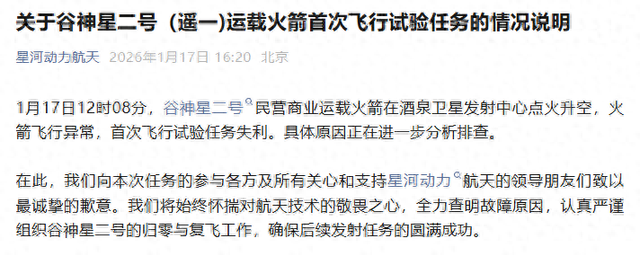
谷神星二号民营商业运载火箭首次飞行试验任务失利,星河动力致歉:将全力查明故障原因,认真严谨组织归零与复飞工作
Xin Lang Cai Jing· 2026-01-18 16:22
Group 1 - The core point of the article is that the private commercial launch vehicle "Ceres-2" experienced an abnormal flight and failed its first flight test mission on January 17, 2026 [1][3] - The launch took place at 12:08 PM at the Jiuquan Satellite Launch Center, and the specific reasons for the flight anomaly are currently under further analysis and investigation [1][3] - The company, Xinghe Power Aerospace, issued an apology to all parties involved in the mission and expressed a commitment to thoroughly investigate the failure and ensure the success of future launch missions [1][3]
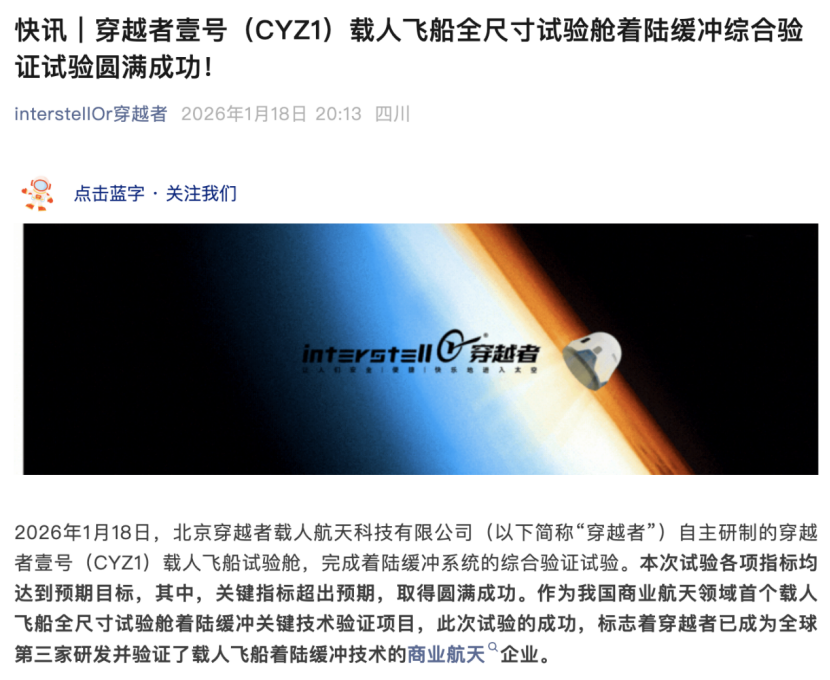
商业航天 突传多条重磅消息!
Mei Ri Jing Ji Xin Wen· 2026-01-18 16:18
这是我国商业航天领域首个载人飞船全尺寸试验舱着陆缓冲关键技术验证项目,此次成功标志着穿越者已成为全球第 三家研发并验证了载人飞船着陆缓冲技术的商业航天企业。 据官方介绍,穿越者是国内首家集可重复使用飞船研制与太空旅游运营于一体的商业载人航天企业,是唯一获批国家 级商业载人航天项目立项的民企。公司致力于打造中国的"龙飞船",实现为国家和商业低成本送人送货。 1月18日,多条关于商业航天的重磅消息突然传来。 中国商业航天首次!载人飞船着陆缓冲技术获成功验证 1月18日晚间,穿越者官微"interstellOr穿越者"发文称,穿越者壹号(CYZ1)载人飞船试验舱,完成着陆缓冲系统的 综合验证试验。本次试验各项指标均达到预期目标,其中,关键指标超出预期,取得圆满成功。 集团公司党组书记、董事长陈锡明围绕"突出一个引领、聚焦三大业务、提升六个能力"对2026年重点任务作出具体部 署。强调要聚焦航天防务产业、航天防务国际化、航天防务技术应用三大业务,坚决扛起强军胜战顶梁之责,推动装 备性能和企业经济效益双提升,构建航天防务技术应用发展体系。要全面提升质量管控、技术基础、改革攻坚、经营 管理、风险管控、党建引领等六个方面的 ...
深夜!最火赛道,突传利好!
Zhong Guo Ji Jin Bao· 2026-01-18 16:16
Group 1 - The successful verification of the landing buffer technology for the manned spacecraft marks a significant milestone for China's commercial space industry, making it the first of its kind in the country [2][3] - The test involved a full-scale experimental capsule, weighing approximately 5 tons, which was dropped from a height of over 3 meters to simulate the descent speed after parachute deployment, achieving all expected performance indicators [3] - The landing buffer system utilized a reverse thrust engine to create a stable counter-thrust, effectively reducing the capsule's speed upon landing, demonstrating the feasibility and reliability of the "cloud sensing landing" system proposed by the company [3] Group 2 - The company, established in 2023, is the only private enterprise in China approved for a national-level commercial manned space project, focusing on reusable manned spacecraft and space tourism services [4] - Recent developments in the commercial space sector include both positive advancements, such as the successful test by the company, and setbacks, including the failure of two rocket launches on January 17 [7] - Regulatory bodies are emphasizing a cooling of the market rather than a complete halt, aiming to direct investments towards quality projects and core technologies, which reflects a broader confidence in the future of commercial space and AI applications [8]