
制造

Search documents
大华银行最新报告:多数中国企业对商业前景较为乐观
Zhong Zheng Wang· 2025-07-17 12:10
Group 1 - The core viewpoint of the report is that the majority of Chinese enterprises are optimistic about their business prospects, expecting market improvements starting in 2026, and plan to integrate supply chain restructuring, overseas expansion, digital transformation, sustainability, and workforce management into their core strategies over the next three years [1] - Over 50% of surveyed enterprises believe in a positive business outlook, and more than 80% intend to expand their overseas operations within the next three years [1] - The main challenges identified by enterprises regarding supply chains include rising supply costs, procurement challenges, and difficulties in working capital management. Companies aim to enhance supply chain resilience through localization, diversification, and digitalization [1] Group 2 - Over 90% of surveyed enterprises have implemented digital solutions, with medium-sized enterprises particularly excelling in cost reduction and efficiency improvement [1] - Advanced technologies such as artificial intelligence, automation, cloud computing, and generative AI are widely adopted, with nearly 80% of enterprises planning to increase digital investment by over 10% by 2025 [1] - The digitalization of supply chains is accelerating, especially in inventory management, with one-third of surveyed enterprises using digital platforms for inventory information or cross-border e-commerce platforms to source materials and suppliers [1] Group 3 - 57% of surveyed enterprises indicate they will accelerate the implementation of sustainable development practices, with over half already starting to apply sustainable practices in one or more areas [2] - In the specific sectors of sustainable practices, oil and gas, healthcare, and manufacturing are leading the way [2]

政策解读:上交所制定《推动提升沪市上市公司ESG评级专项行动方案》
Sou Hu Cai Jing· 2025-07-15 01:27
Core Insights - The Shanghai Stock Exchange (SSE) has launched a special action plan to enhance ESG ratings for listed companies, responding to regulatory requirements and aiming to improve the international competitiveness of the A-share market [1][2] - As of the end of 2024, 342 companies are included in the MSCI ESG ratings, with 8 achieving AAA ratings and 52 in the AAA-A tier, indicating significant progress but highlighting structural challenges [1][2] - The action plan aims to address issues such as climate disclosure and supply chain management, which lag behind international benchmarks, emphasizing the need for improved rating methodologies and data reliability [1][2] Policy Framework - The SSE's ESG rating initiative is built around six core measures that create a systematic breakthrough, focusing on institutional norms, information disclosure, and evaluation systems [2] - The initiative aims to eliminate market information barriers, strengthen corporate responsibility awareness, and transition the ESG ecosystem from fragmented exploration to standardized and systematic practices [2] Rating Improvement System - The plan establishes a logical chain of "indicators-disclosure-management" and develops industry-specific rating guidelines, providing templates for governance structure design and disclosure examples [3] - It includes performance benchmarking analysis to help companies identify "rating pain points," particularly in sectors like chemicals, where pollution control and environmental risk management disclosures are emphasized [3] Collaborative Governance Platform - A regular dialogue mechanism between listed companies and rating agencies will be established, facilitating communication through training and industry forums [4] - This two-way communication aims to resolve information asymmetry, allowing companies to better understand rating criteria and improve their ESG management practices [4] Disclosure Quality Enhancement - The plan promotes a "financial materiality" disclosure principle, requiring companies to reveal the impact of ESG issues on financial performance within a structured framework [5] - It also advances the electronic standardization of sustainability reports to enhance the traceability and comparability of ESG information [5] Best Practices Matrix - The initiative will compile ESG practice white papers across industries, showcasing leading companies and typical scenarios, and organize workshops to address common challenges [6] - This approach aims to create a virtuous cycle of "benchmark demonstration-industry follow-up" [6] ESG Financial Ecosystem - The plan integrates ESG ratings into financing product designs, encouraging banks to offer "ESG performance-linked loans" and promoting the issuance of sustainable development-linked bonds [8] - By 2025, the scale of ESG-themed funds in the SSE is expected to grow by 40%, with significant cost advantages for higher-rated companies [8] Management Capability Foundation - Companies are encouraged to involve ESG professional investors in governance to enhance management expertise and establish a "pre-rating" mechanism for early diagnosis [9] - This mechanism has already helped a medium-sized manufacturing company identify shortcomings in occupational health and safety indicators, leading to successful inclusion in the MSCI rating system [9] Policy Effect Assessment - The SSE's ESG rating initiative represents a systematic reshaping of the capital market's sustainable development ecosystem, driving companies to optimize their environmental governance and social responsibility practices [10] - The ongoing effects of the policy are expected to shift the capital market focus from short-term profit to long-term value investment [10] Value Creation Model Innovation - The initiative encourages companies to shift from "passive disclosure" to "active management," enhancing environmental governance and social responsibility [11] - For instance, a steel company improved its production processes and achieved cost-effective financing through ESG rating enhancements, demonstrating the synergy between environmental investment and economic benefits [11] Resource Allocation Optimization - As ESG ratings become deeply integrated into investment decisions, capital is expected to flow towards higher-rated companies, creating a positive cycle of "rating improvement-valuation premium-quality development" [12] - By 2026, the number of AAA-A rated companies in the SSE is projected to double, with ESG index fund scales surpassing one trillion [12] Global ESG Governance Contribution - The plan incorporates international rating experiences while emphasizing "Chinese characteristics" in ESG practices, providing a reference for developing countries [13] - As the international recognition of SSE companies' ESG ratings increases, the A-share market's influence in the global ESG investment system is expected to grow [13] Summary and Outlook - The SSE's ESG rating enhancement initiative is not just a technical optimization of rating indicators but a profound restructuring of capital market development logic [14] - The initiative aims to transform listed companies from "profit centers" to "value centers," establishing the capital market as a key link between economic development and social progress [14]
@求职者 百日千万招聘专项行动提供岗位需求超6.1万人次
Yang Shi Xin Wen· 2025-07-08 10:18
Group 1 - The "Hundred Days of Millions of Recruitment Special Action" launched online recruitment events for four industries: e-commerce, artificial intelligence, internet, and healthcare, with over 3,600 employers participating and a recruitment demand exceeding 61,000 positions [1] - The e-commerce sector will have over 550 employers offering positions such as internet platform customer service, cross-border e-commerce operations, live streaming hosts, and visual design, with a recruitment demand of over 6,300 positions [1] - The artificial intelligence sector will feature 40 employers providing roles like AI research engineers, AGI application development engineers, and image algorithm engineers, with a recruitment demand of over 1,000 positions [1] - The internet sector will involve over 1,600 employers offering positions such as analysis engineers, research engineers, product managers, machine learning algorithm engineers, and senior backend engineers for large models, with a recruitment demand of over 12,000 positions [1] - The healthcare sector will include over 1,400 employers providing roles such as clinical doctors, sales representatives, and medical staff, with a recruitment demand of 42,000 positions [1] Group 2 - On July 10 at 19:00, the "Employment Online" platform will host a live broadcast event titled "Human Resources (Employment) Bureau Directors Entering the Live Room," featuring three directors from human resources and social security departments of Tibet Autonomous Region, Xinjiang Uygur Autonomous Region, and Xinjiang Production and Construction Corps [1] - This event will organize employers from manufacturing, business services, and education sectors, offering positions such as marketing, operations supervisors, store managers, and teachers [1] Group 3 - Employers and job seekers can access the recruitment events through the China Public Recruitment Network, China National Talent Network, and Employment Online platforms, either directly entering the industry recruitment sections or through the logos of participating organizations on the main event page [2]
涉税名词一起学|税前扣除系列(10)哪些税金类支出可直接扣除?
蓝色柳林财税室· 2025-07-08 09:49
Core Viewpoint - The article discusses the types of expenses that can be directly deducted when calculating taxable income for enterprises, emphasizing the importance of understanding which taxes and expenditures qualify for deductions [3][5]. Summary by Sections Deductible Expenses - Enterprises can deduct actual expenses related to income generation, including costs, fees, taxes, losses, and other reasonable expenditures when calculating taxable income [3]. Types of Taxes - The article specifies various taxes that qualify for deduction, excluding corporate income tax and allowable VAT deductions. These include consumption tax, resource tax, urban maintenance and construction tax, land value-added tax, education fee surcharges, local education surcharges, property tax, vehicle and vessel tax, urban land use tax, stamp tax, and environmental protection tax [4][5]. Example Calculation - An example is provided where a manufacturing enterprise with a profit of 4 million yuan pays 500,000 yuan in VAT, with 300,000 yuan being deductible. The total deductible taxes amount to 60,000 yuan, leading to a taxable income of 3.94 million yuan after deductions [5]. Legal Basis - The article cites the "Corporate Income Tax Law of the People's Republic of China" and its implementation regulations, which outline the criteria for deductible expenses and the definition of taxes eligible for deduction [5]. Future Topics - The article hints at future discussions regarding other compliant expenditures that can be deducted before tax [5].


全球紧盯!美联储7月降息的最后希望,全看今夜非农
美股研究社· 2025-07-03 11:08
Core Viewpoint - The article discusses the upcoming U.S. non-farm payroll report for June, highlighting expectations of a slowdown in job growth and potential implications for Federal Reserve policy [4][5][6]. Economic Indicators - Economists predict an increase of 110,000 in non-farm payrolls for June, a decrease from 139,000 in May, with the unemployment rate expected to rise slightly from 4.2% to 4.3% [4]. - Year-over-year wage growth is anticipated to remain steady at 3.9%, while month-over-month growth is expected to slow from 0.4% in May to 0.3% [4]. Labor Market Trends - There are signs of a cooling labor market, with a notable increase in continuing unemployment claims, reaching nearly 2 million, the highest level since November 2021 [9]. - The ADP report indicates a surprising reduction of 33,000 jobs in the private sector for June, marking the first monthly job loss since March 2023 [9]. Unemployment Rate Predictions - There is a divergence among economists regarding the unemployment rate, with some predicting it could rise to 4.4% due to weak job growth and challenges in the summer hiring season for college graduates [10]. - Factors such as immigration policies and labor force participation rates are influencing unemployment metrics, with some analysts suggesting that the actual unemployment rate could be higher if not for a decline in labor force participation [10]. Sector-Specific Insights - Economists are closely monitoring various sectors, including leisure and hospitality, healthcare, construction, manufacturing, and trade and transportation, for signs of employment trends [12]. - The leisure and hospitality sector showed strong hiring in May, but this trend may reverse in June due to reduced consumer spending on travel and related services [12]. Market Reactions - The S&P 500 index has recently reached new highs, driven by investor optimism regarding potential Fed rate cuts and trade agreements [15]. - A disappointing jobs report could trigger a sell-off in the stock market, with predictions that a non-farm payroll figure below 100,000 or an unemployment rate of 4.4% could lead to at least a 1% decline in stocks [15]. Gold Market Outlook - The article suggests that if the non-farm payroll data is below expectations, it could lead to a new round of dollar selling and increase the likelihood of Fed rate cuts, which would be bullish for gold prices [16]. - Conversely, better-than-expected employment data could alleviate concerns about the labor market and delay expectations for aggressive Fed easing, potentially putting downward pressure on gold [17].

ADP报告:私人企业6月份减少了33,000个就业岗位,专业和商业服务以及教育和医疗服务领域的岗位减少是此次下降的主要原因。休闲和酒店业以及制造业则实现了增长。
news flash· 2025-07-02 12:26
Core Insights - The ADP report indicates that private sector employment decreased by 33,000 jobs in June, primarily driven by declines in professional and business services as well as education and healthcare services [1] - Conversely, the leisure and hospitality sector, along with manufacturing, experienced job growth during the same period [1]
600亿美元!“他一直是慷慨的终极榜样”
新华网财经· 2025-06-29 08:32
Core Viewpoint - Warren Buffett converted 8,239 shares of Berkshire Hathaway Class A stock into 12,358,521 shares of Class B stock and donated them to the Gates Foundation and four family charitable organizations, marking his largest annual donation in nearly two decades, totaling $6 billion [1][2]. Group 1: Donation Details - The donation consists of 9,433,839 shares to the Gates Foundation, 943,384 shares to the Susan Thompson Buffett Foundation, and 660,366 shares distributed among the Sherwood Foundation, Howard G. Buffett Foundation, and NoVo Foundation [2]. - The donation is set to be processed by June 30 [2]. Group 2: Buffett's Philanthropic Strategy - Since 2006, Buffett has made annual donations before Thanksgiving, converting Class A shares to Class B shares prior to donations, as part of a "lifetime commitment" to philanthropy [3][4]. - Buffett's plan involves donating 5% of his remaining shares each year to the five foundations, which include the Gates Foundation and four family-run charities [4]. Group 3: Future of the Gates Foundation - Bill Gates announced plans to donate nearly all his wealth through the Gates Foundation over the next 20 years, with the foundation expected to spend over $200 billion by 2045 [6]. - The Gates Foundation, co-founded by Gates and his ex-wife Melinda in 2000, is one of the largest charitable organizations globally, focusing on improving health and productivity [6]. Group 4: Historical Context - The philanthropic actions of Buffett and Gates echo the legacy of Andrew Carnegie, who emphasized the importance of using wealth for the greater good in his essay "The Gospel of Wealth" [7].

7月起,国内或将出现5大趋势,普通家庭必须提早准备!
Sou Hu Cai Jing· 2025-06-29 05:56
Group 1 - The core viewpoint is that making money is becoming increasingly difficult due to various economic factors [3][5] - The ongoing US-China trade war has led to a significant reduction in orders for domestic export companies, resulting in layoffs and salary cuts [3] - The real estate market remains sluggish, with a notable decline in housing demand affecting 56 related industries, including construction materials, decoration, furniture, and home appliances [3] Group 2 - Since 2022, housing prices across the country have entered a long-term adjustment phase, with an average decline of 30% [7] - Major cities like Shanghai and Shenzhen are now experiencing price drops, which were previously limited to lower-tier cities [7] - It is expected that housing prices will continue to show a trend of "steady decline" in the second half of the year, with a potential correction in high-price cities [7] Group 3 - Bank deposit interest rates have been continuously decreasing, with a drop from 3.15% to 1.8% for three-year deposits, representing a decline of over 40% [9] - The groups most affected by this trend are middle-aged and elderly individuals with significant bank deposits and families relying on interest income [9] - There is an expectation of further reductions in deposit rates, pushing those who previously relied on interest income to seek employment [9] Group 4 - The government plans to accelerate the construction of affordable housing, with a target of 6 million units over the next five years, averaging 1.2 million units annually [12] - The pricing of affordable housing will be significantly lower than that of surrounding market-rate homes, reducing the purchasing cost for low-income families [12] - The influx of affordable housing is expected to divert demand from the market housing sector, increasing downward pressure on housing prices [12] Group 5 - The era of artificial intelligence is already underway, with various industries adopting AI technologies to replace traditional labor [13] - High-end restaurants are using robots for food delivery, and service companies are implementing AI customer service solutions [13] - The trend indicates a gradual reduction in labor-intensive job opportunities as more manufacturing companies adopt industrial robots [13]

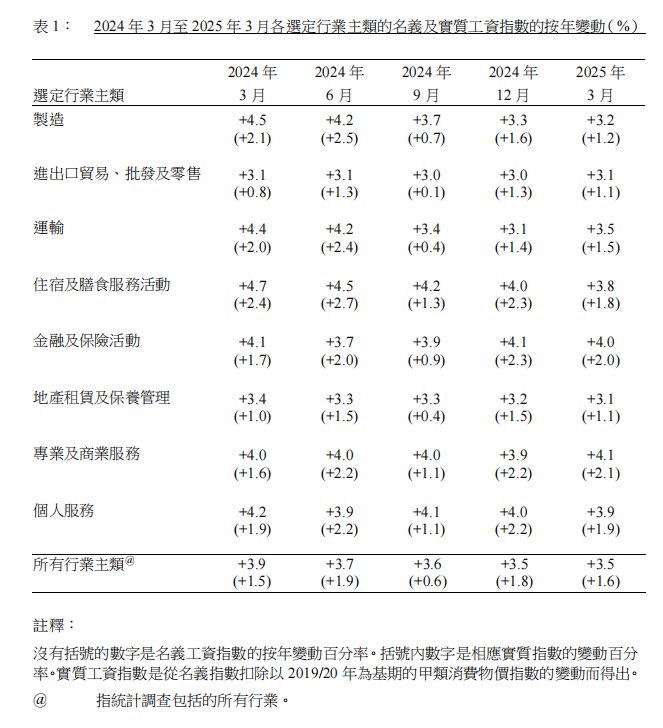
香港:3月名义平均工资率同比上升3.5%
智通财经网· 2025-06-26 08:59
Core Insights - The average wage rate in Hong Kong increased by 3.5% year-on-year in March 2025, with approximately 62% of companies reporting wage increases, while 34% experienced declines [1][2] - After adjusting for inflation, the real average wage rate rose by 1.6% in March 2025 [1][2] - The nominal average salary index for employed individuals increased by 3.2% year-on-year in the first quarter of 2025, with a real increase of 1.6% after accounting for inflation [1][2] Industry Changes - All selected industry categories recorded year-on-year increases in nominal wage indices ranging from 3.1% to 4.1% in March 2025 [2] - Real wage indices across all selected industries also saw year-on-year increases, varying from 1.1% to 2.1% in March 2025 [2] - The nominal average salary index for all selected industries in the first quarter of 2025 increased between 2.0% and 3.9% year-on-year, while real average salary indices rose between 0.4% and 2.3% [2] Wage Index Data - The nominal wage index for the manufacturing sector was +3.2% in March 2025, with a real increase of +1.2% [3] - The wholesale and retail trade sector recorded a nominal increase of +3.1% and a real increase of +1.1% [3] - The transportation sector saw a nominal increase of +3.5% and a real increase of +1.5% [3] - The accommodation and food services sector had a nominal increase of +3.8% and a real increase of +1.8% [3] - The financial and insurance activities sector recorded a nominal increase of +4.0% and a real increase of +2.0% [3] - The real wage index for professional and business services was +2.1% with a nominal increase of +4.1% [3] - The personal services sector experienced a nominal increase of +3.9% and a real increase of +1.9% [3]
支持消费类企业上市融资 创投募投退循环更畅通
Zheng Quan Shi Bao· 2025-06-25 18:18
Group 1 - The core viewpoint of the news is the release of the "Guiding Opinions on Financial Support for Boosting and Expanding Consumption" by six Chinese government departments, which outlines 19 specific measures to enhance consumption's foundational role in economic development [1] - The new policy is expected to boost investor confidence in the consumer sector, creating a favorable market atmosphere for consumer companies' IPOs and supporting the venture capital industry's cycle of fundraising and investment [1][2] - The policy encourages the development of equity financing for quality consumer enterprises, allowing them to choose to list on A-shares, Hong Kong stocks, or other markets, with a focus on brand and retail companies benefiting first [2][3] Group 2 - The improved expectations for consumer enterprise IPOs indicate support for service consumption, new consumption, and supply chain efficiency companies, which may lead to increased certainty for investor exits and enhance the attractiveness of domestic capital markets [3][4] - The policy aims to revitalize the investment landscape for consumer sectors, which have faced challenges in recent years, and is expected to enhance the confidence of investment institutions in this area [4][5] - Financial support is anticipated to facilitate industry consolidation and resource integration, providing more merger and acquisition exit opportunities for invested companies [5] Group 3 - Despite the positive signals from the policy, challenges remain for consumer enterprises seeking to list on A-shares, with suggestions for refining approval standards and methods to support the rapid development of quality consumer companies in the domestic market [6] - Recommendations include differentiating and enhancing inclusivity in the review standards for various boards, focusing on user scale quality, brand health, and cash flow potential rather than solely on short-term profitability [6]