
非银金融

Search documents
东方财富上周获融资资金“加仓”超93亿元丨资金流向周报
2 1 Shi Ji Jing Ji Bao Dao· 2025-07-14 02:31
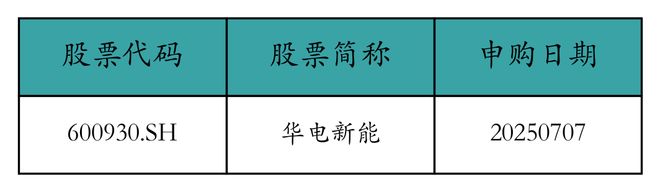
Market Overview - The Shanghai Composite Index rose by 1.09% to close at 3510.18 points, with a weekly high of 3555.22 points [1] - The Shenzhen Component Index increased by 1.78% to 10696.1 points, reaching a peak of 10757.24 points [1] - The ChiNext Index saw a 2.36% rise, closing at 2207.1 points, with a maximum of 2223.31 points [1] - In contrast, major global indices mostly declined, with the Nasdaq Composite down by 0.08%, the Dow Jones Industrial Average down by 1.02%, and the S&P 500 down by 0.31% [1] - In the Asia-Pacific region, the Hang Seng Index increased by 0.93%, while the Nikkei 225 fell by 0.61% [1] New Stock Issuance - One new stock was issued last week: Huadian New Energy (600930.SH) on July 7, 2025 [2] Margin Financing and Securities Lending - The total margin financing and securities lending balance in the Shanghai and Shenzhen markets reached 18698.91 billion yuan, with a financing balance of 18566.83 billion yuan and a securities lending balance of 132.08 billion yuan [3] - This represents an increase of 228.3 billion yuan from the previous week [3] - The Shanghai market's margin balance was 9469.95 billion yuan, up by 121.87 billion yuan, while the Shenzhen market's balance was 9228.96 billion yuan, increasing by 106.43 billion yuan [3] - A total of 3413 stocks had margin buying, with 74 stocks seeing over 1 billion yuan in buying, led by Dongfang Caifu, Shenghong Technology, and Zhongji Xuchuang with 93.56 billion yuan, 50.39 billion yuan, and 47.9 billion yuan respectively [3][4] Fund Issuance - Seventeen new funds were issued last week, including various mixed funds and bond funds from multiple fund companies [5][6] Share Buybacks - Twenty-three companies announced share buybacks last week, with the highest amounts executed by ST Huadong (22.81 million yuan), Tian'ao Yezhi (20.69 million yuan), and Hanwujing (20.06 million yuan) [7] - The sectors with the highest buyback amounts were defense and military, electronics, and automotive [7][8]


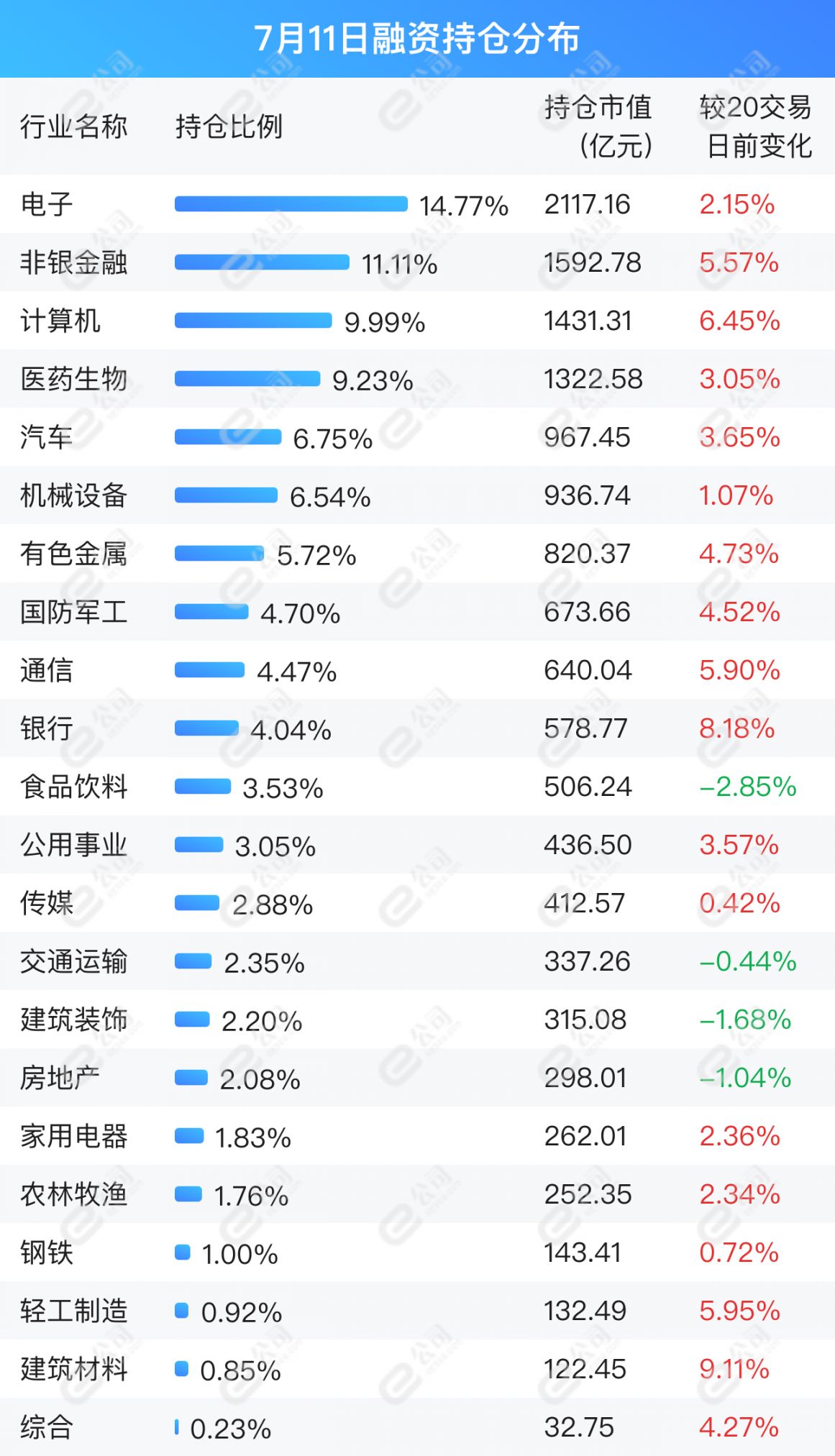
融资最新持仓曝光!加仓非银金融、有色金属、计算机
Zheng Quan Shi Bao Wang· 2025-07-14 02:26
| | | 7月11日融资持仓分布 | | | | --- | --- | --- | --- | --- | | 行业名称 | 持仓比例 | | 持仓市值 | 较20交 | | | | | (亿元) | 日前变 | | 电子 | | 14.77% | 2117.16 | 2.15% | | 非银金融 | | 11.11% | 1592.78 | 5.57% | | 计算机 | | 9.99% | 1431.31 | 6.45% | | 矢药生物 | | 9.23% | 1322.58 | 3.05% | | 汽车 | | 6.75% | 967.45 | 3.65% | | 机械设备 | 6.54% | | 936.74 | 1.07% | | 有色金属 | 5.72% | | 820.37 | 4.73% | | 国防军工 | 4.70% | | 673.66 | 4.52% | | 通信 | 4.47% | | 640.04 | 5.90% | | 银行 | 4.04% | | 578.77 | 8.18% | | 食品饮料 | 3.53% | | 506.24 | -2.85% | | 公用事业 | ...
策略周聚焦:新高确认牛市全面启动
Huachuang Securities· 2025-07-14 02:15
Group 1 - The recent surge in the A-share market indicates the confirmation of a bull market, with the Shanghai Composite Index breaking through previous high points and showing significant trading volume, suggesting a recovery from earlier declines [1][8][6] - The impact of tariffs announced by Trump is viewed as limited, with historical examples indicating that trade wars do not significantly affect economic performance, as seen during the 1930 trade war [1][17][20] - The bull market is expected to generate three wealth effects: stabilizing expectations, supporting consumption, and restoring financing functions, with increased retail participation in the stock market [1][25][39] Group 2 - Historical analysis shows that sectors tend to rotate after new highs, with financials, cyclical resources, and military industries frequently leading the market, while manufacturing and consumer sectors rely more on their own trends [2][43][44] - Potential rotation directions in the current market include non-bank financials and cyclical resource sectors, with expectations for real estate stabilization being crucial for economic recovery [3][7] - The report highlights that the current bull market is characterized by a significant inflow of funds into the stock market, driven by increased retail investor activity and policy support [1][25][39]
14个行业获融资净买入,非银金融行业净买入金额最多
Zheng Quan Shi Bao Wang· 2025-07-14 01:52
Summary of Key Points Core Viewpoint - As of July 11, the market's latest financing balance reached 1,862.586 billion yuan, showing an increase of 2.082 billion yuan compared to the previous trading day, with 14 out of 31 industries experiencing an increase in financing balance [1][2]. Industry Financing Balance Changes - The non-bank financial sector saw the largest increase in financing balance, rising by 2.273 billion yuan to a total of 159.278 billion yuan, reflecting a growth rate of 1.45% [1]. - Other industries with notable increases include: - Non-ferrous metals: increased by 1.210 billion yuan, total 82.105 billion yuan, growth rate of 1.50% [1]. - Computer: increased by 0.632 billion yuan, total 143.933 billion yuan, growth rate of 0.44% [1]. - Banking: increased by 0.532 billion yuan, total 57.877 billion yuan, growth rate of 0.93% [1]. - Conversely, 17 industries reported a decrease in financing balance, with the electronic sector experiencing the largest drop of 1.431 billion yuan, totaling 213.174 billion yuan, a decline of 0.67% [2]. Notable Increases and Decreases by Industry - Industries with the highest financing balance increases: - Steel: increased by 0.229 billion yuan, total 14.341 billion yuan, growth rate of 1.62% [1]. - Non-ferrous metals: increased by 1.210 billion yuan, growth rate of 1.50% [1]. - Non-bank financial: increased by 2.273 billion yuan, growth rate of 1.45% [1]. - Industries with the largest decreases: - Food and beverage: decreased by 0.387 billion yuan, total 50.716 billion yuan, decline of 0.76% [2]. - Electronic: decreased by 14.31 billion yuan, total 2131.74 billion yuan, decline of 0.67% [2]. - Pharmaceutical and biological: decreased by 6.46 billion yuan, total 1326.05 billion yuan, decline of 0.48% [2].
279股获杠杆资金大手笔加仓
Zheng Quan Shi Bao Wang· 2025-07-14 01:24
Market Overview - On July 11, the Shanghai Composite Index rose by 0.01%, with the total margin trading balance reaching 1,875.794 billion yuan, an increase of 2.081 billion yuan from the previous trading day [1] - The margin trading balance in the Shanghai market was 946.995 billion yuan, up by 2.007 billion yuan; in the Shenzhen market, it was 922.896 billion yuan, up by 0.016 billion yuan; while the North Exchange saw a decrease of 0.086 billion yuan, bringing the total margin trading balance to 1,875.794 billion yuan [1] Industry Analysis - Among the industries tracked by Shenwan, 14 sectors saw an increase in margin trading balances, with the non-bank financial sector leading with an increase of 2.273 billion yuan, followed by the non-ferrous metals and computer sectors with increases of 1.210 billion yuan and 0.632 billion yuan, respectively [1] Individual Stock Performance - A total of 1,734 stocks experienced an increase in margin trading balances, accounting for 47.11% of the total, with 279 stocks seeing an increase of over 5% [1] - The stock with the highest increase in margin trading balance was C Tongyu, which saw a balance of 92.6532 million yuan, an increase of 78.63% from the previous trading day, and its stock price rose by 5.99% [1] - Other notable stocks with significant increases included Qin Chuan Wulian and Hanwei Technology, with increases of 38.48% and 38.31%, respectively [1] Top Gainers and Losers - Among the top 20 stocks with the highest increase in margin trading balances, the average increase in stock prices was 2.46%, with notable gainers including Fushun Special Steel, Yamaton, and Tonghui Information, which rose by 10.06%, 10.00%, and 9.50%, respectively [2] - Conversely, the stocks with the largest declines included Qin Chuan Wulian, Zhongshe Consulting, and Kairun Zhikong, with declines of 11.16%, 8.93%, and 3.55%, respectively [2] Margin Trading Balance Changes - The top 20 stocks with the highest margin trading balance increases included C Tongyu, Qin Chuan Wulian, and Hanwei Technology, with balances of 92.6532 million yuan, 43.4903 million yuan, and 2.7126 million yuan, respectively [3][4] - In contrast, 1,947 stocks saw a decrease in margin trading balances, with 252 stocks experiencing a decline of over 5%. The largest decrease was seen in Biyang Technology, with a balance of 6.4262 million yuan, down by 37.65% [5][6]
险资长周期考核机制落地!三分钟看完周末发生了什么
Sou Hu Cai Jing· 2025-07-14 01:06
Market Overview - Global major asset performance shows A-shares leading with a rise of 1.71% this week, while the Dow Jones Industrial Index fell by 1.02% [2][3] - The real estate sector led the A-share market with a weekly increase of 6.12%, while the banking sector saw a decline of 1.00% [2][4] Industry Performance - The real estate industry increased by 6.1% this week, while steel rose by 4.4%, and non-bank financials by 4.0% [4][5] - The banking sector experienced a decline of 1.0% year-to-date, while the real estate sector is down 1.4% [4] Strategic Insights - The market is showing signs of a "bull market atmosphere," with the A-share index breaking through key levels, indicating a potential for sustained upward movement [6][7] - The upcoming fiscal policies in the U.S. and the anticipated improvements in the supply-demand dynamics in China by 2026 are expected to enhance market sentiment [6][8] Key News - The introduction of a long-term assessment mechanism for insurance funds is expected to bring in significant capital inflows into the A-share market [10] - The recent announcements regarding the optimization of the ChiNext index and the implementation of new trading regulations are aimed at enhancing market liquidity and investment quality [11][12]

财报季如何把握投资机会?
2025-07-14 00:36
Summary of Key Points from Conference Call Records Industry and Company Overview - The conference call discusses the impact of the Trump administration's tariff policies on various industries, particularly focusing on manufacturing and trade dynamics between the U.S. and China. [1][3][8] Core Insights and Arguments - **Tariff Policies**: The Trump administration's tariff policies include reciprocal tariffs, Section 232 investigations, and anti-dumping tariffs, aimed at different objectives with varying negotiation outcomes. [1][3] - **Section 232 Investigations**: This investigation covers ten product categories including copper, steel, aluminum, and automobiles, imposing tariffs ranging from 25% to 50%, with a total scale of approximately $300-400 billion. A new round of investigations includes copper, timber, and semiconductors, estimated at $650 billion, accounting for 20% of total imports. [1][6] - **Fentanyl Tariffs**: The U.S. has imposed a 20% tariff on fentanyl-related products from China and 25% on those from Canada and Mexico, using it as leverage in trade negotiations. [1][7][8] - **Impact on Chinese Manufacturing**: The tariff policies are designed to suppress Chinese manufacturing and serve as negotiation tools in U.S.-China trade talks. [1][8] - **Market Predictions for 2025**: The market is expected to experience a volatile upward trend, shifting from policy-driven to fundamentals and liquidity-driven factors. Key sectors to watch include light manufacturing, non-bank financials, electronics, and social services, with projected profit growth rates of 37.2%, 33%, 19.1%, 17.4%, and 15.9% respectively. [2][9][10] Additional Important Insights - **REITs Market Performance**: The public REITs market has seen a decline, with a negative return of 1.26% this week. The REITs index closed at 142.35 points. [12] - **Market Trading Volume**: The top three trading volumes were in sectors related to housing and infrastructure, indicating a shift in investor interest. [13] - **Investment Style Performance**: Small-cap investment strategies have shown significant excess returns in event-driven opportunities, outperforming broader indices. [17] - **Sector Performance Variability**: Different sectors exhibit varied performance in fundamental factors, with transportation and real estate showing positive returns in key metrics. [16] This summary encapsulates the critical insights from the conference call, highlighting the implications of tariff policies, market predictions, and sector performance trends.
A股市场大势研判:大盘冲高回落,三大指数小幅上涨
Dongguan Securities· 2025-07-13 23:30
Market Performance - The major indices experienced slight increases, with the Shanghai Composite Index closing at 3510.18, up 0.01%, and the Shenzhen Component Index at 10696.10, up 0.61% [2] - The ChiNext Index led the gains with a rise of 0.80%, closing at 2207.10, while the STAR 50 Index increased by 1.48% to 994.45 [2] Sector Performance - The top-performing sectors included Non-Bank Financials, which rose by 2.02%, and Computers, which increased by 1.93% [3] - Conversely, the Banking sector saw a decline of 2.41%, and the Coal sector fell by 0.60% [3] - Concept stocks such as Rare Earth Permanent Magnet and MLOps showed strong performance, with gains of 5.64% and 3.05% respectively [3] Market Outlook - The market showed a mixed performance with a notable rebound in the Rare Earth Permanent Magnet concept stocks and active trading in CRO concept stocks [4] - The overall market sentiment was positive, with more stocks rising than falling, indicating a healthy market environment [4] - The report anticipates a cautious bullish outlook for the market, particularly as it stabilizes around the 3500-point mark, with a focus on technology growth and sectors benefiting from consumer recovery expectations [6]
沪指放量上攻突破关键点位机构:投资者交易策略或应转向
Shang Hai Zheng Quan Bao· 2025-07-13 19:46
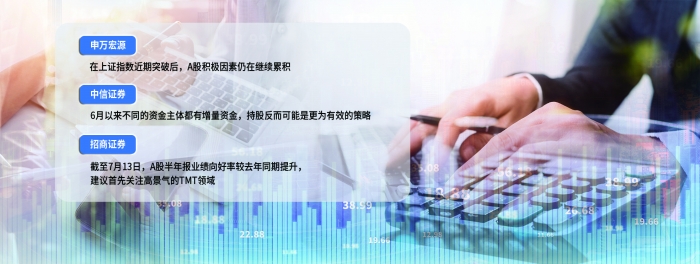
Group 1 - The A-share market has shown strong upward momentum, with the Shanghai Composite Index breaking through the 3500-point mark and trading volume exceeding 1.7 trillion yuan [2] - The financial sector has led the market rally, supported by a surge in short-term capital chasing high-performing stocks as semi-annual earnings forecasts are released [2] - Institutions suggest that investors should shift from a trading strategy to a holding strategy in light of the market's transition from a stock-based to an incremental market [4][5] Group 2 - Positive factors for the A-share market continue to accumulate, with strong risk appetite reflected in trading behavior and capital flows [3] - The market is increasingly focusing on fundamental factors rather than external disturbances, indicating a shift in pricing dynamics [3] - The strong upward trend in the A-share market is expected to continue, with significant conditions for a major rally accumulating [3] Group 3 - The market has seen a shift from net outflows to net inflows in actively managed public funds since June, marking a reversal in the trend of capital withdrawal [4] - Different sectors, including non-ferrous metals, telecommunications, and gaming, have shown synchronized upward movement, indicating the presence of incremental capital across various funding entities [5] Group 4 - The performance of semi-annual earnings is crucial for trading strategies, with sectors like TMT (Technology, Media, and Telecommunications) expected to perform well [6] - High-growth industries such as automotive parts, automation equipment, and consumer goods are recommended for investment, alongside sectors with improving performance like precious metals and pharmaceuticals [6] - Predictions indicate that industries such as light industry, non-ferrous metals, and non-bank financials may experience high growth rates in their semi-annual earnings [6]




晨会纪要:开源晨会-20250713
KAIYUAN SECURITIES· 2025-07-13 15:16
Core Insights - The report highlights the ongoing macroeconomic adjustments aimed at addressing "involution" in corporate competition, emphasizing the need for quality improvement and orderly exit of outdated capacities [7][8][9] - The A-share market has shown resilience despite external uncertainties, with significant participation from retail investors and a focus on sectors like technology and finance [12][15][19] - The solid-state battery industry is accelerating its industrialization, with key milestones set for 2027 and 2030, indicating a robust growth trajectory [35][36] Macro Economic Analysis - Recent macro policies focus on promoting a unified national market and addressing low-price competition among enterprises, with an emphasis on enhancing product quality [7][8] - The construction and cement industries are implementing "anti-involution" measures, including production cuts to stabilize the market [8] - Consumer policies are being optimized to stimulate spending, with initiatives like tax refunds and subsidies to boost consumption [8] Market Strategy - The report identifies two main opportunities in the market: the resurgence of new stocks and thematic investments in deep-sea technology, which are expected to outperform in the current economic climate [13][19] - A suggested investment strategy includes a diversified approach focusing on technology, military, finance, and stable dividend stocks, alongside gold [19] Industry Insights - The solid-state battery sector is experiencing rapid advancements, with companies like Ningde Times and others making significant progress towards mass production [35][36] - The REITs market is showing strong performance, with environmental REITs leading the way, indicating a favorable investment environment for income-generating assets [39][41] - The non-bank financial sector is witnessing a positive outlook, particularly for brokerage firms, as they report better-than-expected mid-year results [44][45] Company Recommendations - The report recommends focusing on leading companies in the liquor industry, such as Kweichow Moutai and Shanxi Fenjiu, as they are expected to recover from recent demand pressures [32][33] - In the semiconductor sector, companies involved in probe station equipment are highlighted for their growth potential, driven by increasing domestic demand and technological advancements [29][27]