食品

Search documents
从“食品+动漫”梦碎到年报“失踪” 动漫食品存在终止挂牌风险
Xi Niu Cai Jing· 2025-07-03 09:52
公开资料显示,动漫食品的"年报拖延症"几乎成了习惯。自登陆新三板以来,该公司仅有两份年报是按时披露的,其余均出现不同程度的延期。监管层对此 并非无动于衷,实控人翁盛平已多次因信披违规被公开谴责,但问题仍未得到根治。 更令人担忧的是,动漫食品的内控漏洞远不止于此。从违规担保到关联交易未披露,从股份代持到资金占用嫌疑,一系列问题暴露出这家企业的公司治理已 千疮百孔。 值得注意的是,动漫食品曾试图打造"食品+动漫"的双轮驱动模式,并购天亿马动漫后一度业绩亮眼。然而,随着核心IP《我要回家》热度消退,动漫业务 收入占比从巅峰时期的10.77%跌至不足2%,动漫食品的战略重心被迫回归传统食品赛道。 广东唯诺冠动漫食品股份有限公司(证券简称:动漫食品,代码:839756)正站在退市的悬崖边。截至2025年6月30日,这家新三板挂牌企业仍未披露2024 年年度报告,按照全国股转系统的规定,若无法在最后期限内补交财报,动漫食品将面临强制终止挂牌的命运。 有业内人士指出,动漫食品当初挂牌新三板时应该并没有做好充分准备,包括治理结构等方面。若最终摘牌,中小股东权益如何保障? 这场由年报"失踪"引发的强制终止挂牌风波,或许只是动漫 ...


我们想聊聊那些「确定」的事|以「匠心」,至「世界」2025出海大会来了!
36氪· 2025-07-03 09:25
变局之下,探讨企业出海新常态。 国货品牌,正在闪耀世界舞台。 走在纽约街头,奶茶店玻璃上贴着HEYTEA的logo;东南亚超市,货架上摆满白象方便面;巴西的港口,正卸下国产新能源汽 车…… 国内经济增速放缓的当下,企业出海正在成为为数不多的高速增长的赛道。据《2024年中国品牌全球信任指数》发布的数据,中 国品牌海外综合信任度3年增长14个百分点。对于中国企业来说,一个事实越来越清晰: 想要寻求突破,出海已不是选择题,而 是必答题。 企业出海已驶入深水区,接下来,如何让中国企业的出海之路一路坦途?如何在不确定中寻找"确定"? 36氪作为深耕科技创新与商业生态的新型服务平台,持续关注报道中国企业出海全球化进程,为中国企业提供丰富的信息和洞 见。 7月25日,2025以"匠心"至"世界"出海大会将落地浙江钱塘,探讨出海征程中"确定"的事,帮助更多中国企业"走出 去"、"融进去"。 "East Forward 2025"作为36氪全新打造的聚焦全球化与出海领域的IP盛会,设立主会场及分会场"投资金砖"-国别合作对接会。大 会主会场将分为"不确定中确定"和"在全球做生意"两大篇章,聚焦消费、科技、电商、金融、医疗、新 ...

山东蒙阴:6月份居民生活消费(食)品价格总体上涨1.66%
Zhong Guo Fa Zhan Wang· 2025-07-03 03:15
Summary of Key Points Core Viewpoint - In June, the average prices of 53 major consumer goods in the traditional markets of Mengyin County, Shandong Province, showed a general increase of 1.66% compared to the previous month, with 12 items rising, 28 remaining stable, and 13 declining [1]. Group 1: Meat, Poultry, and Eggs - The average price of 8 monitored meat, poultry, and egg products remained stable overall, with a slight average decrease of 0.89%. Specific prices included: lean pork at 15 yuan/kg, fatty pork at 12.5 yuan/kg, boneless hind leg meat at 13 yuan/kg, spare ribs at 18 yuan/kg, beef at 30 yuan/kg, lamb at 30 yuan/kg, and white strip chicken at 12 yuan/kg. Eggs decreased by 7.09% to 3.28 yuan/kg [1]. Group 2: Aquatic Products - The average price of 4 monitored aquatic products showed a mixed trend with 2 items increasing and 2 remaining stable, resulting in an average increase of 3.01%. Prices included: live crucian carp at 9.25 yuan/kg (up 8.82%), live carp at 8 yuan/kg (up 3.23%), and both frozen hairtail and frozen mackerel at 10 yuan/kg (stable) [1]. Group 3: Vegetables - The average price of 17 monitored vegetable products increased by 7.45%, with 9 items rising, 1 stable, and 7 declining. Notable price increases included: celery at 2.13 yuan/kg (up 41.67%), cabbage at 1.4 yuan/kg (up 47.37%), and ginger at 5.88 yuan/kg (up 17.5%). Prices for some vegetables decreased, such as potatoes at 1.08 yuan/kg (down 34.85%) [2]. Group 4: Fruits - The average price of 3 monitored fruit products decreased by 12.8%, with 1 stable and 2 declining. Prices included: pears at 2.5 yuan/kg (stable), bananas at 2.5 yuan/kg (down 7.41%), and watermelons at 1 yuan/kg (down 31.03%) [2].
“清凉驿夏”苏州工会驿站送清凉活动启动
Su Zhou Ri Bao· 2025-07-03 00:14
Group 1 - The "Cool Summer" initiative launched by the Suzhou Trade Union aims to provide relief to new economy workers during the summer heat through various activities and services [1][2] - The initiative includes health services such as blood pressure measurement, consultations, and traditional Chinese medicine treatments provided by a team of general practitioners [1] - The Suzhou High-tech Zone's union station serves as a multifunctional hub for new employment groups, offering services like training, legal aid, and recreational activities since its opening in October 2022 [1] Group 2 - From July to August, the Suzhou Federation of Trade Unions will hold eight themed events at union stations to enhance awareness and service quality for outdoor workers [2] - Activities include collective birthday celebrations, family photo sessions, legal knowledge lectures, and health services, aimed at improving the well-being of new economy workers [2] - Local companies have been encouraged to contribute to the initiative by providing cooling resources and services to outdoor laborers [3] Group 3 - The initiative calls for businesses to leverage their resources to support outdoor workers by offering cooling spaces, drinking water, and emergency supplies [3] - Restaurants and retail businesses are encouraged to provide discounts and free services to outdoor laborers, enhancing their comfort during hot weather [3] - The proposal emphasizes community involvement and the importance of creating a supportive environment for outdoor workers [3]
“日本消费研究第一人”三浦展、萨莉亚前社长、明治食品“爆款教父”,8月齐聚上海
创业家· 2025-07-02 09:59
Core Viewpoint - The article emphasizes the importance of learning from Japan's consumer market strategies during economic downturns, highlighting the need for innovation and efficiency in the face of challenges in the Chinese consumer market [6][7][14]. Group 1: Event Overview - The event will take place from August 7 to August 9 in Shanghai, featuring prominent figures from the Japanese and Chinese consumer industries [9][11]. - The course aims to provide a deep dive into the methodologies of Japanese consumer giants, focusing on efficiency, demand reconstruction, and capital strategies [5][13]. Group 2: Key Insights from Japanese Market - Historical analysis shows that during economic downturns, brands can experience significant growth, as evidenced by Japanese companies like Salaria and Uniqlo [14]. - Specific strategies such as "reduction management" and "demand reconstruction" are crucial for navigating low-growth environments [14][18]. Group 3: Course Content - The course will cover three main areas: efficiency revolution, demand reconstruction, and capital strategies, with insights from industry leaders [14][16]. - Notable speakers include former executives from successful Japanese companies who will share their experiences and strategies for thriving in challenging markets [17][21]. Group 4: Target Audience - The event is aimed at founders and CEOs of consumer enterprises looking to break through growth ceilings and optimize cost structures [24].

豫园股份拟发行40亿公司债券偿债 珠宝业务下跌60%销售毛利承压
Chang Jiang Shang Bao· 2025-07-02 03:50
Group 1: Company Debt and Financing - Yuyuan Group plans to issue up to 4 billion yuan in corporate bonds to optimize its debt structure, with a maximum term of 7 years and a face value of 100 yuan per bond [1] - The funds raised will be used for repaying due debts and supplementing working capital, addressing short-term repayment pressure [1] - As of Q1 2025, short-term loans increased by 9.78%, while accounts payable and contract liabilities decreased by 16.92% and 12.75%, respectively [1] Group 2: Financial Performance - In 2024, Yuyuan Group's jewelry fashion segment generated 299.77 billion yuan in revenue, accounting for 64% of total revenue, but saw an 18.38% year-on-year decline [2] - The company reported a record high revenue of 581.47 billion yuan in 2023, but net profit dropped by 45% to 20.24 billion yuan [2] - In Q1 2025, revenue plummeted nearly 50% to 87.82 billion yuan, with net profit down 71% to 51.8 million yuan [2] Group 3: Business Challenges and Strategies - The jewelry fashion segment faced significant challenges due to price volatility, changing consumer preferences, and pressure on the franchise model, leading to a net reduction of 200 stores [2] - The company acknowledged that structural adjustments in the consumer industry have pressured overall sales margins [2] - Yuyuan Group initiated a "slimming down" strategy, focusing on channel management and gradually exiting heavy asset projects in the real estate sector [2]

第二十六届安徽糖酒会将于11月15-17日在合肥举办
Qi Lu Wan Bao· 2025-07-02 02:15
Group 1 - The 26th China (Anhui) International Sugar and Wine Food Trade Fair will be held from November 15-17 at Hefei Binhu International Convention and Exhibition Center [2] - Anhui Province, as a traditional production and sales hub for alcoholic beverages and food, is experiencing new development opportunities due to its strong economic growth [3] - In 2024, Anhui's GDP is projected to reach 5,062.5 billion yuan, with a year-on-year growth of 5.8%, ranking 11th nationally and leading the six central provinces by 0.8 percentage points [3] Group 2 - The economic prosperity in Anhui has led to an influx of population, creating new growth opportunities for the food and beverage market [5] - As of the end of 2024, Anhui is the only province in Central China to experience positive population growth, with an increase of 20,000 people compared to 2023 [5] - The influx of young talent and diverse consumer preferences are expected to drive new variables and opportunities in the Anhui food and beverage market [5] Group 3 - The Anhui Sugar and Wine Fair has established itself as a key platform for food and beverage companies to enter the Anhui market, benefiting from the province's development potential [6] - The fair has a long history and strong brand recognition, having successfully held 25 editions and received multiple honors, including UFI certification [7] - The fair's effectiveness is demonstrated by the increasing participation of food and beverage companies, making it a premier platform for brands like Xifeng, Fenjiu Zhuyeqing, and others to debut in Anhui [9][10] Group 4 - The current competitive landscape of the food and beverage industry favors exhibitions that genuinely serve market expansion and customer needs, positioning the Anhui Sugar and Wine Fair for future growth [13]

2025年4月美国行业库存数据点评:美国Q2或进入主动去库
CMS· 2025-07-01 13:33
Overall Inventory Cycle - In April, the total inventory in the U.S. increased by 3.37% year-on-year, compared to a previous value of 3.43%[1] - The total sales in April rose by 3.74% year-on-year, down from 4.04% previously[1] - The data indicates a preliminary shift towards active destocking in the U.S. inventory cycle[1] Industry Inventory Cycle - Among 14 major industries in April, 10 were in passive restocking, including construction materials, metals, and consumer goods[12] - The historical percentile for overall inventory in April was 39.2%, with chemical products at 85.7% and construction materials at 83.2%[12] - Oil and chemical sectors are likely transitioning to active destocking, while construction and metal inventories remain high[12] Future Outlook - Despite uncertainties regarding tariffs, the U.S. inventory cycle is expected to lean towards active destocking in Q2 due to previous overstocking[1] - The "panic import" demand has extended the passive restocking cycle for downstream industries[14] - Active destocking is anticipated for automotive and automotive parts as of December 2024, with a continued trend into April 2025[14]
平安证券晨会纪要-20250701
Ping An Securities· 2025-07-01 01:27
Group 1 - The report indicates a positive outlook for equity assets, supported by a stock-bond rotation model showing a marginal decline in private sector financing growth but still in an upward trend, with inflation factors decreasing and economic recovery signals persisting [4][9] - The sentiment index for the A-share market has turned optimistic for the upcoming month, with indicators such as stock investment ratios and net inflows from large orders maintaining a bullish outlook [4][9] - The report recommends maintaining a high allocation to equity assets, with a focus on small-cap and growth styles for July, while suggesting stable fixed-income products for conservative investors [4][10] Group 2 - The report highlights the implementation of consumption policies aimed at enhancing consumer capacity and expanding financial support for consumption, with 19 key measures proposed [5][12] - A high-quality development plan for inclusive finance has been published, emphasizing the establishment of a comprehensive inclusive financial system over the next five years [5][12] - The second quarter monetary policy meeting indicated a more optimistic view of the domestic economy, while maintaining a stance of "moderate easing" in monetary policy [5][12] Group 3 - The report notes that the ETF market has performed well recently, with significant inflows into broad-based ETFs, particularly in the ChiNext index ETF and financial real estate sector ETFs [6][15] - The report mentions that 16 new ETFs were launched in the past two weeks, with a total issuance of 6.621 billion units, indicating growth in the ETF market [6][15] - The performance of thematic ETFs, such as those tracking AI and robotics, has been highlighted, with notable inflows and returns [6][17] Group 4 - The report discusses the wind power sector, forecasting a doubling of global offshore wind installations by 2025, with a compound annual growth rate of 21% expected over the next decade [19][20] - It also mentions the competitive landscape in the energy storage market, with prices for lithium iron phosphate battery systems continuing to decline, reflecting increased competition [20][21] - Investment recommendations include focusing on companies in the offshore wind sector and those involved in energy storage, highlighting specific firms such as Mingyang Smart Energy and Sunshine Power [21][22] Group 5 - The report emphasizes innovation in the liquor industry, with companies like Luzhou Laojiao focusing on low-alcohol and youth-oriented products to meet changing consumer demands [22][23] - It identifies opportunities in the beverage and snack sectors, driven by evolving consumer preferences and the introduction of functional products [22][23]
下一站,多元资产配置|全球大类资产半年度复盘与展望
Sou Hu Cai Jing· 2025-06-30 10:31
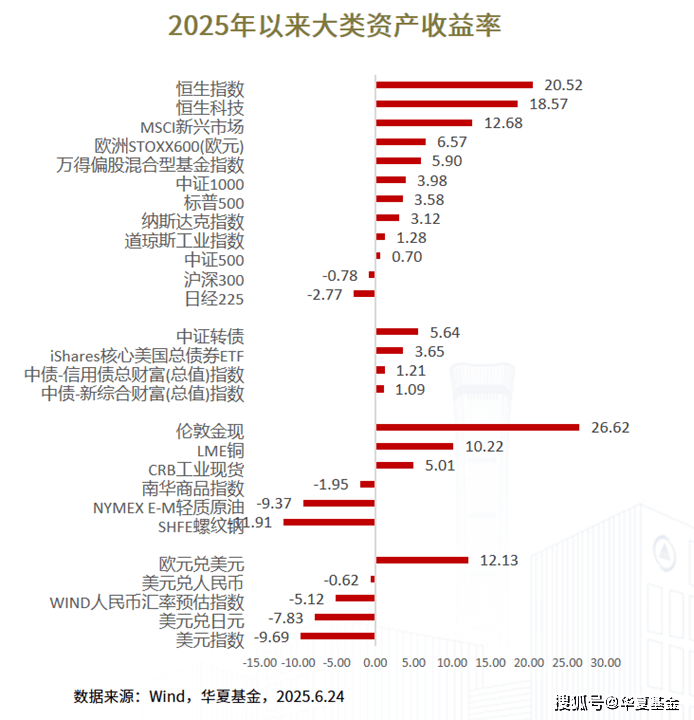
Group 1 - The first half of 2025 has seen a significant rebalancing of global funds, characterized by a "funding boom and asset scarcity" [2][4] - Gold has emerged as a star asset, with a 26% increase in international spot gold prices, driven by geopolitical conflicts and a weakening dollar [5][37] - The Chinese central bank has increased its gold reserves for seven consecutive months, reaching 73.83 million ounces, indicating a collective move towards "de-dollarization" [5][37] Group 2 - The bond market is experiencing volatility, with U.S. Treasury yields fluctuating above 4.0%, while China's 10-year government bond yields have dropped to a historical low of 1.65% [6][7] - Credit bond ETFs have rapidly gained popularity, with a total market size exceeding 210 billion yuan, reflecting a shift towards stable income assets [8] - The divergence in economic cycles between the U.S. and China is evident, with the U.S. experiencing a slowdown while China is bottoming out [8] Group 3 - The Hong Kong stock market has shown resilience, with the Hang Seng Index leading global markets with a 20.5% increase, supported by liquidity from southbound funds [10] - The A-share market has seen strong sector rotation, particularly in the AI industry and consumer sectors, indicating a lack of a consistent overarching theme [11][15] - The current market is driven by liquidity, with expectations of a stabilization in earnings, suggesting a potential return to value-based investing [15] Group 4 - Three key underlying logics have emerged in the market: the continuous rise of certainty premiums, the revaluation of industrial narratives, and the rebalancing of global asset allocation [16][19] - The demand for certainty is reflected in the strong performance of gold and high-dividend assets, as investors seek visible cash flows amid macro uncertainties [17] - The AI industry is transitioning from concept to performance, with significant growth in cloud business revenues and capital expenditures among leading tech firms [18] Group 5 - The outlook for major asset classes in the second half of 2025 emphasizes the importance of strategic asset allocation amid increasing market volatility [23][24] - A diversified asset allocation strategy is recommended, with a focus on both undervalued, high-dividend value stocks and growth sectors driven by AI [27][28] - The U.S. stock market faces risks from high valuations and downward adjustments in earnings expectations, necessitating caution [32]