
家电

Search documents
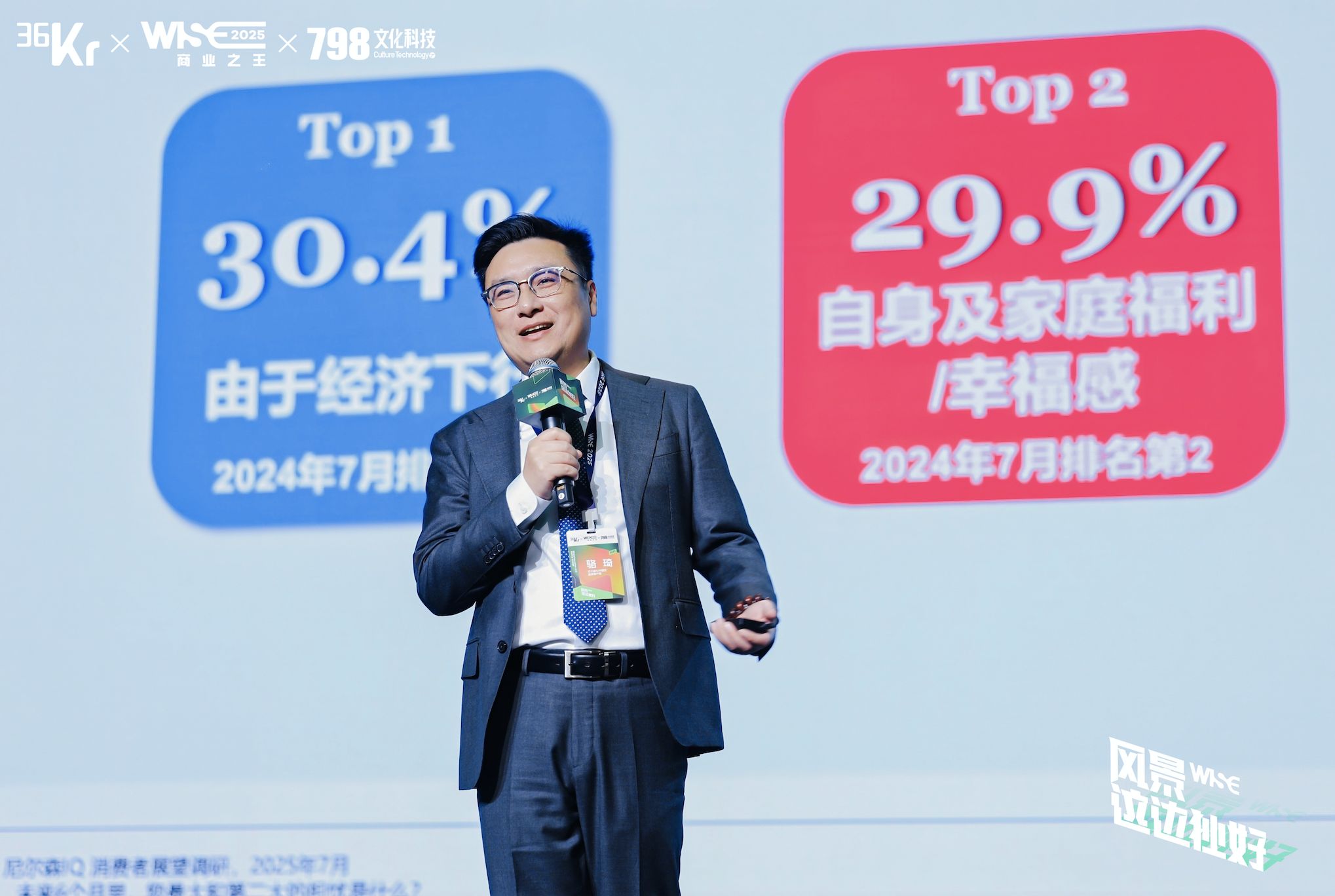
尼尔森 IQ 中国区首席客户官骆琦:“体验”成为未来推动消费的重要力量,不同世代消费者都愿意为“活得更好”买单丨WISE2025商业之王大会
3 6 Ke· 2025-12-04 07:57
Core Insights - The WISE 2025 Business King Conference aims to anchor the future of Chinese business amidst uncertainty, focusing on the theme "The Scenery Here is Unique" [1][2] Consumer Behavior - Global consumer confidence is declining, but Chinese consumer confidence is improving, although their continuous consumption ability is hindered [4][8] - Chinese consumers are less focused on promotions and pricing, with experience becoming a key driver for consumption [4][10] - Different generations exhibit varying consumption behaviors, with Baby Boomers and Generation Y being the most willing to spend, while Generation Z and affluent Generation X are more cautious [4][12] Generational Insights - Baby Boomers (60+) are redefining aging, showing a willingness to try new products and use AI for shopping, with 83% open to AI assistance [13][14] - Generation X (45-59) is pragmatic and financially savvy, with 37% being budget-conscious and preferring local brands [16][19] - Generation Y (29-44) prioritizes experience over products, with 70% willing to pay for better experiences and 81% favoring quick delivery services [20][21] - Generation Z (18-28) is divided, with 31% eager to spend while 34% are financially constrained, focusing on products that resonate with their social circles [22][23] Market Opportunities - The aging population presents new business opportunities, as older consumers seek to enhance their quality of life and are open to innovative products [14][15] - Companies need to adapt their strategies to cater to the unique needs of different generations, emphasizing product quality, experience, and effective communication [23]

近3900只个股下跌
第一财经· 2025-12-04 07:40
2025.12. 04 本文字数:778,阅读时长大约2分钟 作者 | 一财阿驴 12月4日,沪指、深证成指窄幅震荡;创业板指涨超1%,早盘一度跌超0.5%。截至收盘,沪指跌 0.06%,深成指涨0.4%,创业板指涨1.01%。 | 代码 | 名称 | 两日图 | 现价 | 涨跌 | 涨跌幅 | | --- | --- | --- | --- | --- | --- | | 000001 | 上证指数 | 25 | 3875.79 с | -2.21 | -0.06% | | 399001 | 深证成指 | arm | 13006.72 c | 51.46 | 0.40% | | 399006 | 创业板指 | 1 | 3067.48 с | 30.70 | 1.01% | 盘面上,大消费走弱,零售、餐饮、白酒、电商方向跌幅靠前;铝业、黄金、稀土、房地产行业表现 不振。摩尔线程、商业航天、机器人、半导体概念股走强。 具体来看,机器人概念股走强,日发精机、巨轮智能、四川金顶、和而泰等超10股涨停。 | 代和马 | 名称 | 福特 | 王州十六 | | --- | --- | --- | --- | | 3009 ...


收盘丨创业板指探底回升涨超1%,机器人概念股掀涨停潮
Di Yi Cai Jing· 2025-12-04 07:21
大消费板块震荡调整,同庆楼、海欣食品、中水渔业跌停。 | 板块名称 | 涨幅◆ | 涨速 | | --- | --- | --- | | 海南 | -3.43% | -0.06% | | 海南自贸区 | 0 -3.35% | -0.05% | | 旅游及酒店 | -3.20% | +0.01% | | ही ग | 0 -3.13% | -0.08% | | 食品加工制造 | -2.69% | +0.02% | | 饮料制造 | -2.55% | -0.03% | | 互联网电商 | -2.44% | -0.01% | | 中船系 9 | -2.42% | -0.05% | | 预制菜 9 | -2.36% | -0.04% | | 种植业与林业 | -2.31% | -0.01% | | 培育钻石 | 8 -2.18% | -0.00% | | 9 啤酒概念 | -2.06% | -0.04% | | 人造肉 9 | -2.03% | -0.03% | | 网红经济 | o -2.03% | -0.01% | | 美容护理 | -2.02% | +0.01% | | 零售 | -2.01% | -0.03% ...


关税博弈常态化:解析美国贸易政策对A股产业链影响
Guo Ji Jin Rong Bao· 2025-12-04 06:05
Core Insights - The article discusses the recent phase agreement between China and the U.S. to "pause" certain tariffs, indicating a temporary ceasefire in trade tensions, but warns against viewing this as a resolution to the broader U.S.-China relationship [1] - It highlights a shift in U.S. trade policy from merely correcting trade deficits to a more complex strategy aimed at long-term containment of China's industrial upgrades, influenced by domestic inflation and manufacturing costs [1][4] - The article emphasizes the need for A-share investors to adapt to a new valuation logic that prioritizes "safety and resilience" over "efficiency and growth" in the context of ongoing tariff negotiations [1][8] Macro Mechanism - The U.S. trade policy has evolved into a bipartisan consensus characterized by a systematic approach to competition, moving from a focus on trade deficits to a strategy aimed at containing China's industrial advancements [3] - The recent tariff proposals, including a 34% punitive tariff on China, were initially perceived as a threat to globalization, but the subsequent pause indicates a recognition of the high costs associated with unilateral tariffs [2][4] Industry Impact - The normalization of tariff negotiations is expected to fundamentally reshape the valuation logic of A-share industries, with a shift towards valuing companies based on their ability to withstand external shocks and maintain supply chain resilience [8] - The technology sector is experiencing a revaluation towards "self-sufficiency," as companies seek to mitigate risks associated with U.S. trade policies by increasing domestic production capabilities [9] - Advanced manufacturing is transitioning from a "product export" model to a "capacity export" model, with companies establishing overseas production bases to navigate tariff barriers and geopolitical risks [10] Micro Strategies - Companies are shifting from an "efficiency-first" approach to a "resilience-first" strategy, necessitating increased inventory and diversified supply chains to mitigate risks from trade tensions [13] - There is a growing emphasis on "hardcore" innovation and reducing reliance on U.S. technology, with firms investing in foundational research and development to enhance their competitive edge [14] Long-term Investment Strategy - The article suggests that investors should focus on three categories of assets that are likely to thrive amid ongoing trade tensions: technology leaders achieving domestic breakthroughs, manufacturers with global production capabilities, and consumer brands benefiting from domestic market growth [16]
日本制造,在华大溃退
Xin Lang Cai Jing· 2025-12-04 05:48
Core Viewpoint - The article discusses the withdrawal of Japanese manufacturing companies from the Chinese market, highlighting the decline of brands like Canon, Yakult, and Mitsubishi, which were once dominant players in their respective industries. This trend reflects a broader shift in the competitive landscape as Chinese companies advance in technology and market presence, leading to a significant reduction in the market share of Japanese brands [1][9][11]. Group 1: Canon's Closure - Canon's production line at its Zhuhai facility ceased operations on November 21, 2025, marking the end of its 20-year presence in China [21][22]. - The factory, once a significant employer in the region, had seen its workforce shrink to just over 1,400 employees by the time of closure [29]. - Canon's market share in the Chinese laser printer market plummeted to 3.9% by the third quarter of 2025, down from 16% in 2010 [11][37]. Group 2: Other Japanese Brands - Yakult announced the closure of its Guangzhou factory, which had been operational for 23 years, and previously shut down its Shanghai factory [23][31]. - Mitsubishi Motors ceased all local production in China, with its vehicle sales dropping from 133,000 units in 2019 to just 33,600 units in 2022 [31][34]. - The article notes that the decline of these brands is not an isolated incident but part of a larger trend of Japanese companies exiting the Chinese market, including Sony and Toshiba [24][33]. Group 3: Market Dynamics - The decline of Japanese brands is attributed to several factors, including the rise of local competitors and a shift in consumer preferences towards more affordable and innovative products [12][38]. - The Chinese market for printers has evolved, with local brands capturing 41.5% of the market share by 2025, while Japanese brands struggle to adapt [11][37]. - Japanese companies are perceived to have failed to respond to changing market conditions, maintaining outdated business models and product offerings [12][41]. Group 4: Global Perspective - Despite their struggles in China, Japanese manufacturers still hold significant global market shares, with Canon commanding 22% of the global printer market as of 2023 [15][42]. - The profitability of Japanese automotive brands remains strong on a global scale, with Toyota's profits significantly outpacing those of Chinese competitors [44]. - The article concludes that while Japanese brands face challenges in China, their global competitiveness remains intact, indicating a need for adaptation rather than a complete retreat from the market [17][47].

A股行业中观景气跟踪月报(2025年11月):继续看好中上游PPI涨价链条持续性-20251204
Shenwan Hongyuan Securities· 2025-12-04 02:48
Core Insights - The report maintains a positive outlook on the sustainability of price increases in the midstream and upstream PPI chain, indicating a favorable environment for investment opportunities in these sectors [1] Industrial Sector Monthly Tracking - The automotive manufacturing, oil and coal extraction and processing, black metal mining, and electricity and heat sectors show improvements in economic indicators, while sectors like pharmaceuticals, food and beverage, textiles, and non-metallic materials are in a phase of supply clearing and potential recovery [2] - As of October 2025, industries with improving inventory and fixed asset growth include pharmaceuticals, non-metallic mining and products, light manufacturing, textiles, and food and beverage [2] Economic Conditions - The manufacturing PMI for November 2025 slightly rebounded to 49.2%, with price conditions improving due to reduced internal competition; raw material prices are in an expansion phase [3] - Order conditions have improved, particularly in export orders, while inventory replenishment sentiment has decreased, with the service sector returning to contraction [3] High-Frequency Indicators by Sector - **Consumer Sector**: Service consumption outperforms durable goods, with strong resilience in external demand [3] - Automotive sales, particularly in new energy vehicles, show a year-on-year retail sales growth of 7.3% in October 2025, despite a 0.8% decline in overall passenger vehicle sales [3] - Home appliance sales face high base pressure, with negative growth expected in domestic production for major appliances due to previous demand overextension [3] - Retail growth in textiles stabilizes, with upstream raw material prices showing signs of recovery [3] - **Advanced Manufacturing**: Prices for new energy products remain high, with significant growth in sales of engineering machinery and heavy trucks [3] - The photovoltaic sector sees stable supply-demand dynamics, while lithium battery materials face severe supply-demand mismatches, leading to price increases [3] - **Technology Sector**: Improvements in telecommunications business volume and base station equipment shipments, with domestic chip sales accelerating [3] - **Financial Sector**: Insurance premium growth slows after product repricing, while secondary market transaction volumes recover [3] - **Real Estate Chain**: Real estate sales and prices remain weak, with cement prices fluctuating at low levels [3] - **Cyclical Commodities**: Oil prices fluctuate within a narrow range, while coal prices rise due to winter storage replenishment [3] Supply Indicators - As of October 2025, the inventory growth rate and fixed asset investment growth rate are low, indicating a continued process of supply clearing in various sectors [6]
消费团队联合展望 - 2026年度策略报告汇报会议
2025-12-04 02:21
Summary of Key Points from Conference Call Records Industry Overview - **Liquor Industry**: Despite facing challenges, the liquor sector shows investment potential due to low inventory, low valuations, and high dividend yields. Some quality companies may have already passed their worst period, focusing on strong brands, stable demand, and refined operations [1][8]. - **Consumer Goods Sector**: The dining chain shows improvement, benefiting frozen food and seasoning companies. Rapid development in snack wholesale stores and new channels, along with new product categories like konjac, brings growth opportunities. Health products are gaining attention due to health trends [1][4]. - **Dairy Industry**: A turning point in the cost cycle is anticipated, with decreasing raw material costs like raw milk and molasses benefiting large dairy companies and alleviating price war pressures, thus restoring profits [1][6]. - **Home Appliance Industry**: The core strategy is "going overseas," with traditional categories like white and black appliances holding high market shares. Emerging categories like pool robots and lawn mowers have significant growth potential, especially in the context of the US interest rate cut cycle and markets in developing countries [1][13]. - **Textile and Apparel Industry**: The strategy is "export first, internal demand accumulation." The US interest rate cut cycle is expected to boost demand, while stable China-US tariffs favor exports. High-end markets and brands with strong aesthetic appeal are more attractive [1][18]. Investment Opportunities - **Consumer Sector**: In 2026, despite a poor performance in 2025, there are investment opportunities in both traditional and new consumption sectors. The liquor index remains low compared to the overall market, indicating potential for recovery [2]. - **Food and Beverage Sector**: Opportunities include the expansion of duty-free policies, which enhance sales potential by attracting more inbound travelers and encouraging domestic consumption [3]. - **Snacks and Health Products**: The snack industry benefits from new channels and low-calorie products, while health products are gaining traction due to increased consumer health awareness [4][5]. - **Cost Cycle Impact**: The decline in raw milk prices is expected to benefit large dairy companies, while the decrease in molasses costs will enhance profit elasticity [6][11]. Challenges and Market Dynamics - **Liquor Industry Challenges**: The liquor sector has seen a decline in demand post-Spring Festival, with some companies reporting revenue drops exceeding 50%. However, the low inventory and high dividend yields suggest that some quality companies may recover in the coming quarters [8]. - **Dining Industry Status**: The dining sector is currently in a marginal profit state, but recent data indicates a recovery trend. The overall environment is improving, providing opportunities for related companies [7]. - **Home Appliance Market**: The domestic market faces pressure, but overseas markets are expected to grow faster. Companies need to adapt to changes and seek transformation to capture growth [13][17]. Future Outlook - **Food and Beverage Investment Strategy**: Focus on quality liquor companies post-cleanup, alongside opportunities in snacks, beverages, and health products driven by new channels and cost cycle benefits [11]. - **Home Appliance Export Opportunities**: Traditional categories have high market shares, while emerging categories like pool robots present significant growth potential. The US market is expected to improve gradually [14][15]. - **Textile and Apparel Export Growth**: The US interest rate cut cycle is likely to boost demand, with companies in the textile sector showing resilience and growth potential [18][19]. Additional Insights - **Duty-Free Policy Impact**: Recent updates to the duty-free policy have expanded the customer base, significantly enhancing sales potential for duty-free products [27][29]. - **Cross-Border E-commerce Trends**: The sector is driven by new product logic, with emerging household necessities like 3D printers and AI applications expected to become significant growth drivers [34]. - **High-End Retail Trends**: The service industry is shifting towards high-quality offerings, with high-end retail and medical aesthetics showing strong performance [35].
政策协同显身手 经济活力持续释放
Zhong Guo Zheng Quan Bao· 2025-12-03 20:28
Economic Recovery Indicators - In November, the manufacturing PMI rose to 49.2%, indicating an improvement in economic conditions [1] - The new export orders index increased by 1.7 percentage points to 47.6%, reflecting strong resilience in foreign trade [1] Consumer Market Dynamics - The consumption upgrade policy has driven sales exceeding 2.4 trillion yuan, benefiting over 360 million people in the first ten months of the year [2] - Retail sales of new energy passenger vehicles reached 10.15 million units, a year-on-year increase of 21.9% [2] Logistics and Delivery Growth - The express delivery business volume surpassed 180 billion pieces for the first time, indicating robust consumer activity [3] - The average monthly express delivery volume since 2025 has exceeded 16 billion pieces, showcasing a new growth trajectory in consumption [3] Policy Support for Economic Growth - The government has allocated 500 billion yuan for local government debt to enhance financial capacity and stimulate effective investment [4] - New policy financial tools have been implemented to support over 2,300 projects with a total investment of approximately 7 trillion yuan, focusing on digital economy and AI [4] Future Economic Outlook - The upcoming Central Economic Work Conference is expected to set a proactive macroeconomic policy for 2026, emphasizing domestic demand and technological self-reliance [5] - Fiscal and monetary policies are anticipated to remain supportive, with potential for further reductions in reserve requirements and interest rates [5]
消费主题基金业绩“掉队” “出海”成选股关键词
Zheng Quan Shi Bao· 2025-12-03 17:51
Core Viewpoint - The A-share market has been buoyed by the technology sector, aiming for the 4000-point mark, while traditional consumer stocks have underperformed, leading to significant losses for funds heavily invested in these areas [1] Group 1: Performance of Consumer Stocks - Traditional consumer sectors like liquor and home appliances have shown weak performance, with some consumer-themed funds declining over 10% this year [2] - A specific consumer-themed fund in East China saw a 17% drop in the first half due to heavy investments in Moutai and Wuliangye, and despite shifting focus to consumer electronics in the second half, performance remained lackluster [2] - New consumption stocks also faced a downturn in the third quarter, with companies like Pop Mart and Laopu Gold experiencing significant pullbacks after reaching yearly highs, impacting funds that had built positions at elevated levels [2] Group 2: Market Sentiment and Valuation - Fund managers believe that the consumer sector is showing signs of bottoming out, with the past four years of bear market attributed to declining birth rates, damaged consumer confidence, and negative wealth effects, which may stabilize by 2025 [3] - Current valuations in the consumer sector are seen as attractive, with the dynamic price-to-earnings ratio at 23.42, placing it in the 28.52% percentile over the past five years, indicating a potential for recovery [4] - Funds like the Huabao CSI Subdivision Food and Beverage ETF have seen significant inflows, suggesting a growing interest in consumer stocks despite recent underperformance [4] Group 3: Investment Strategy and Focus - Fund managers are increasingly focusing on companies with international expansion potential, emphasizing the importance of "going overseas" as a key selection criterion [6] - The competitive advantages of Chinese consumer companies in global markets are highlighted, including supply chain efficiency, product innovation, and cultural adaptability, particularly in the gaming sector [7] - The long-term growth potential of Chinese companies in international markets is viewed as significant, with many expected to stabilize their revenue structures through overseas operations [7]

并购发力研发加码推动美的集团转型科技巨擘
Zheng Quan Shi Bao· 2025-12-03 17:35
Group 1 - The core transformation of Midea Group during the "14th Five-Year Plan" period reflects the development of Guangdong's capital market, evolving from a home appliance company to a diversified technology giant covering smart home, new energy, industrial technology, building technology, robotics and automation, healthcare, and smart logistics [1] - Midea Group has made significant capital moves in recent years, acquiring controlling stakes in listed companies such as Hekang New Energy, Wandong Medical, and Kelon Electronics, thereby entering new sectors like new energy and industrial automation, medical imaging, and energy management [1] - The chairman of Midea Group, Fang Hongbo, stated that the company's strategy involves extending the life cycle of its home appliance business while simultaneously promoting B2B business growth, creating a "growth relay" effect [1] Group 2 - Midea Group has invested over 60 billion yuan in research and development over the past five years, ranking eighth globally and first among private enterprises in China for patent families according to the 2023 global patent leaders list [2] - The company has established 38 R&D centers in 12 countries, creating a global R&D network structured as "2+4+N" [2] - Fang Hongbo emphasized that the core strategy of Midea Group is technological leadership, with plans to increase R&D investment, pursue breakthroughs in fundamental research and disruptive technologies, and enhance the research system by attracting global leading experts and high-quality PhD talents [2]
