保险业

Search documents
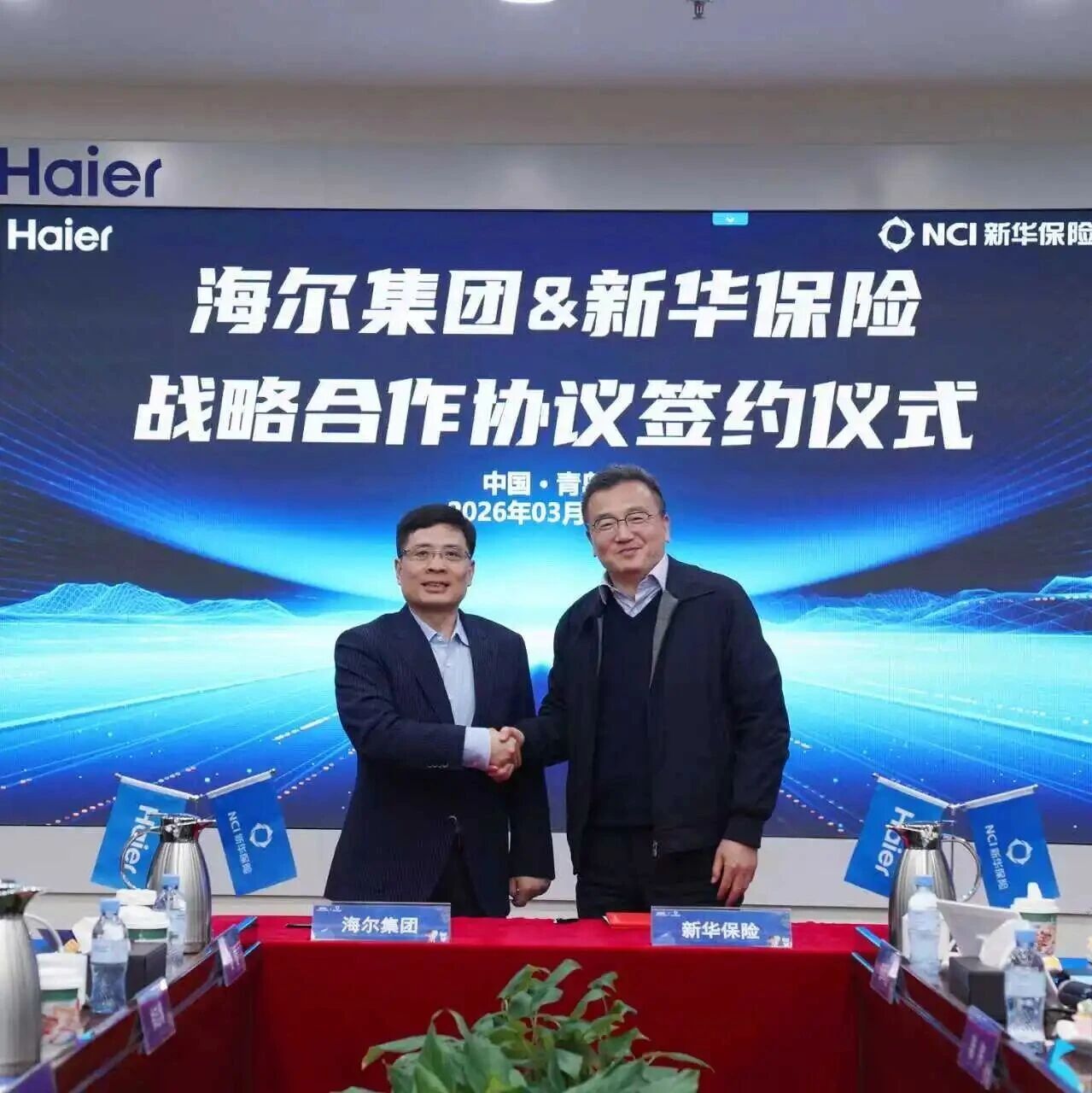
新华保险与海尔集团签署战略合作协议
阿尔法工场研究院· 2026-03-24 09:26
Core Viewpoint - The strategic cooperation agreement between Xinhua Life Insurance and Haier Group aims to enhance collaboration in various sectors, including joint marketing, smart park construction, elderly community services, health management, industrial investment and financing, and new energy technologies [2][3] Group 1 - The signing ceremony took place in Qingdao, attended by key executives from both companies, highlighting the importance of this partnership [2] - Haier Group emphasizes its role as a leading provider of solutions for a better life and aims to effectively implement the cooperation to benefit the economy and society [2] - Both companies share a common mission in serving national strategies and fulfilling the public's desire for a better life, indicating a strong alignment in corporate strategies and values [3] Group 2 - The cooperation is seen as a significant step for both companies to contribute to the construction of a manufacturing and financial powerhouse in China [3] - The agreement focuses on deep collaboration through scenario co-construction and ecological integration, aiming to explore new service models for customers [3] - The partnership is positioned as a response to the new development stage and national priorities, with a commitment to translating cooperation outcomes into tangible benefits for society [3]



流动性阶段受扰,货币政策或为破局关键
Southwest Securities· 2026-03-23 09:45
Report Industry Investment Rating - Not provided in the given content Core Viewpoints - The short - term trading of inflation expectations may have come to a temporary end. Before the next round of price data is released, the market's motivation for re - pricing inflation is limited, and the trading focus is expected to shift from fundamental expectations to the marginal changes in the capital and liquidity environment. The central bank is likely to continue to support liquidity and hedge through other monetary policy tools at key points, but there may still be a "frictional" liquidity shock due to the staggered rhythm of liquidity withdrawal and injection and the end - of - quarter factors. It is recommended to moderately reduce the allocation weight of highly crowded ultra - short - term assets and focus on 3 - 5 - year bonds [2][88]. Summary by Directory 1. Important Matters - In January - February 2026, the cumulative year - on - year growth rate of national fixed asset investment was 1.8%, showing a mild recovery. Manufacturing investment was resilient, and state - owned investment accelerated, while private investment was still in a cautious range [5]. - In March 2026, the 1 - year LPR was 3.00% and the 5 - year - plus LPR was 3.50%, remaining unchanged from the previous month. The reason may be that the comprehensive social financing cost has decreased, and the net interest margin of banks is still under pressure [9]. - On March 20, 2026, the draft of the Financial Law of the People's Republic of China was publicly solicited for opinions. The central bank focuses on the dual - pillar framework of monetary policy and macro - prudential policy, the National Financial Regulatory Administration focuses on micro - prudential and conduct supervision, and the China Securities Regulatory Commission focuses on capital market construction [10][11]. - In March 2026, the Fed maintained the policy interest rate, but the expectation of interest rate hikes increased. The market's pricing of the interest rate cut path in 2026 has converged, and the probability of not cutting interest rates is over 50% by December [12]. 2. Money Market 2.1 Open Market Operations and Fund Interest Rate Trends - From March 16 to 20, 2026, the central bank injected 2423 billion yuan through 7 - day reverse repurchase operations, with 1765 billion yuan due, resulting in a net injection of 658 billion yuan. From March 23 to 27, 2026, the expected maturity and withdrawal of base money is 6923 billion yuan [17]. - Last week, liquidity was still relatively loose, with DR001 fluctuating around 1.32%. As of March 20, 2026, R001, R007, DR001, and DR007 were 1.396%, 1.477%, 1.321%, and 1.421% respectively, with changes of 0.45BP, - 2.64BP, - 0.09BP, and - 4.07BP compared to March 16 [20]. 2.2 Certificate of Deposit Interest Rate Trends and Repurchase Transaction Conditions - Last week, the issuance scale of inter - bank certificates of deposit was 758.69 billion yuan, a decrease of 87.19 billion yuan from the previous week. The maturity scale was 1162.86 billion yuan, an increase of 154.66 billion yuan from the previous week, and the net financing scale was - 404.17 billion yuan [27]. - The issuance interest rates of inter - bank certificates of deposit decreased last week. The average issuance interest rates of 3 - month and 1 - year inter - bank certificates of deposit for state - owned banks were 1.48% and 1.53% respectively, with changes of - 2.00BP and - 2.83BP from the previous week [31]. - In the secondary market, the demand for liquid assets was still strong. The yields of inter - bank certificates of deposit decreased significantly, and the term spread widened to some extent [33]. 3. Bond Market - In the primary market, last week, 98 interest - rate bonds were issued, with an actual issuance amount of 1071.234 billion yuan, a maturity amount of 253.192 billion yuan, and a net financing amount of 818.042 billion yuan. The issuance rhythm of national bonds in 2026 was slightly behind that of local bonds [35]. - In the secondary market, long - term bonds were still weak, while medium - and short - term bonds continued to perform well. The yield curve became steeper. The active bonds of 10 - year national bonds and 10 - year policy financial bonds changed, and the average spread between the active and secondary - active bonds of 10 - year national bonds and 10 - year policy financial bonds widened [35][45]. 4. Institutional Behavior Tracking - In February 2026, the leverage ratio of inter - bank institutions decreased seasonally, and the leverage ratio of securities companies decreased from a high level. Last week, the scale of leveraged trading remained high due to the relatively loose liquidity environment [61]. - In the cash bond market, large banks bought a large amount of national bonds with a maturity of less than 5 years, small and medium - sized banks continued to increase their holdings of national bonds with a maturity of more than 10 years, insurance companies increased their buying efforts, securities companies continued to sell, and funds continued to prefer policy financial bonds [70]. 5. High - Frequency Data Tracking - Last week, the settlement price of rebar futures increased by 5.97% week - on - week, the settlement price of wire rod futures decreased by 5.71% week - on - week, the settlement price of cathode copper futures increased by 2.04% week - on - week, the cement price index decreased by 0.37% week - on - week, and the Nanhua Glass Index increased by 2.02% week - on - week [86]. - The CCFI index decreased by 4.00% week - on - week, and the BDI index increased by 4.75% week - on - week. The wholesale price of pork decreased by 2.53% week - on - week, and the wholesale price of vegetables decreased by 5.02% week - on - week. The settlement prices of Brent crude oil futures and WTI crude oil futures decreased by 1.41% and 1.78% respectively week - on - week. The central parity rate of the US dollar against the RMB was 6.92 [86]. 6. Market Outlook - In the short term, the trading of inflation expectations may have ended. The trading focus will shift to the capital and liquidity environment. The central bank is likely to maintain the overall stability of the capital market, but there may be a "frictional" liquidity shock. It is recommended to reduce the allocation of ultra - short - term assets and focus on 3 - 5 - year bonds [88].
陆家嘴财经早餐2026年3月23日星期一
Wind万得· 2026-03-22 22:54
Group 1 - Premier Li Qiang emphasized that China's competitive advantages come from deepening reforms and innovation, not subsidies or protectionism, and highlighted the importance of fair competition in the market economy [4] - Central Bank Governor Pan Gongsheng stated that the People's Bank of China will maintain a supportive monetary policy stance to create a favorable environment for stable economic growth and high-quality development [4] - The National Internet Emergency Center and the China Cybersecurity Association released security guidelines for the use of OpenClaw, providing recommendations for ordinary users and cloud service providers [5] Group 2 - The China Development Forum 2026 released multiple policy signals, indicating a focus on high-quality development and global economic stability [6] - The Chinese automotive industry achieved a significant milestone by surpassing Japan in global annual sales for the first time, with nearly 27 million vehicles sold [17] - The Ministry of Finance plans to increase public service spending and implement consumer-friendly policies to stimulate domestic demand, including a special fund of 100 billion yuan to promote consumption [9][10] Group 3 - The latest findings from the Ministry of Natural Resources revealed a significant increase in rare earth resources in Sichuan, with verified reserves totaling 9.67 million tons, marking an over 200% increase compared to previous estimates [18] - The launch of the "TERAFAB" chip manufacturing project by Tesla aims to achieve an annual production capacity of over 1 terawatt, with an estimated total investment of $20 billion [21] - Apple CEO Tim Cook announced continued support for innovation and education in China, pledging additional donations to a national vocational education pilot project [22]






杨岳斌:为什么多数企业不赚钱?详解巴菲特“商品”生意
点拾投资· 2026-03-22 11:00
Core Viewpoint - The article discusses Warren Buffett's investment philosophy, particularly focusing on the distinction between "franchise" and "commodity" businesses, emphasizing the importance of competitive advantages and sustainable economic moats for long-term investment success [1][2]. Summary by Sections Definition of "Commodity" Businesses - Buffett defines "commodity" businesses as those lacking differentiation in performance, appearance, and service, making them susceptible to profit challenges, especially in industries with overcapacity [3]. - The article outlines three non-market forces that can mitigate profit challenges: government price interventions, illegal price collusion among companies, and actions by international cartels like OPEC [3]. Economic Characteristics of "Commodity" Businesses - Industries characterized by overcapacity and lack of buyer preference for providers are likely to experience poor economic outcomes, often leading to disaster [3]. - The article highlights that in "commodity" sectors, only a few producers can achieve profitability through sustainable low-cost advantages, while most face a harsh economic equation: continuous overcapacity plus lack of pricing power equals weak profitability [4][6]. Case Study: Textile Industry - The textile industry serves as a textbook example of a "commodity" business, where high product homogeneity leads to minimal returns unless in a supply-constrained environment [7]. - Historical context is provided, detailing how the U.S. textile industry faced severe overcapacity due to international competition, leading to poor investment returns for companies like Berkshire Hathaway [7][9]. Insurance Industry as a "Commodity" Business - The insurance industry is presented as another example of a "commodity" business, where competition primarily revolves around pricing, and brand differentiation is largely ineffective [11][12]. - The article discusses how the insurance market's unique characteristics, such as product homogeneity and the psychological nature of capacity, contribute to persistent overcapacity [12]. GEICO's Differentiation Strategy - GEICO is highlighted as an exception in the insurance sector, successfully establishing a competitive moat through strong financial backing and strict pricing discipline [15][21]. - The company focuses on profitability over market share, maintaining a commitment to not underwrite unprofitable policies, which has allowed it to accumulate significant low-cost "float" [21][16]. Investment Certainty and Economic Moats - The article emphasizes that the essence of investment lies in ensuring that current capital can yield high returns in the future, with economic moats serving as a defense against "creative destruction" [22][25]. - Buffett's investment strategy prioritizes businesses with clear economic moats, which are essential for navigating the complexities of market dynamics and ensuring long-term success [24][28].

分红险“安全垫”变薄 选产品要擦亮眼
经济观察报· 2026-03-21 06:54
Core Viewpoint - The insurance industry is undergoing significant changes as companies lower guaranteed returns on dividend insurance products to reduce rigid liability costs and create more investment space, aiming to compensate for the decline in guaranteed returns with floating investment income [1][2]. Group 1: Changes in Dividend Insurance Products - The market has seen a shift with the introduction of dividend insurance products with guaranteed rates dropping below 1.50%, such as the 1.25% rate from Zhongying Life [2][6]. - The guaranteed return on dividend insurance has decreased from 2.50% at the beginning of 2024 to 1.75%, reflecting a broader trend in the industry [6][10]. - Many insurance companies are preparing to launch products with a guaranteed rate of 1.25%, indicating a significant transformation in the market [2][10]. Group 2: Sales and Marketing Adjustments - The changes in product offerings have created new sales opportunities, prompting a shift in sales strategies from high guaranteed returns to focusing on the actual investment performance of insurance companies [6][7]. - Sales personnel are now encouraged to provide clients with data on the solvency and investment performance of insurance companies, emphasizing those with higher dividend realization rates [7][9]. Group 3: Investment Performance Disparities - There is a notable disparity in investment performance among insurance companies, with some reporting negative returns while others achieve as high as 11.64% [10][11]. - Over 47% of insurance companies have maintained an average investment return of over 5% in the past three years, with several joint venture companies performing particularly well [10][11]. - The actual return on dividend insurance will increasingly depend on the floating portion, which is tied to the investment performance and dividend realization rates of the insurance companies [9][11].

中小险企减仓A股?行业回应来了
财联社· 2026-03-21 06:50
Core Viewpoint - The recent fluctuations in the A-share market are attributed to a combination of internal and external pressures, rather than solely due to the actions of small and medium-sized insurance companies reducing their positions due to solvency regulations [1][4]. Group 1: Market Reactions and Insurance Companies - The market's recent adjustment is not primarily driven by small insurance companies' actions, as the overall impact of their position changes is limited due to the high concentration of assets among larger firms [1][4]. - The solvency phase II regulations have been in effect for three years, and most insurance companies, including smaller ones, have adapted to the pressures, indicating that the anticipated phase III regulations are still under consideration and have not yet been implemented [1][2][3]. - The overall sentiment in the market suggests that investors should remain patient and look for structural investment opportunities after the current volatility subsides [1]. Group 2: Regulatory Environment - The transition to solvency regulation II was officially implemented in December 2021, with a planned full execution by the end of 2025, while the phase III regulations are still being developed and are not expected to be implemented before 2027 [2][3]. - The regulatory environment is expected to evolve in response to macroeconomic conditions, potentially leading to further easing of solvency regulations in the future [2][3]. Group 3: Investment Trends in the Insurance Sector - As of the end of 2025, the total investment scale of seven major A+H listed insurance companies reached 21.85 trillion yuan, accounting for 60.3% of the industry total, with significant increases in equity investments [5][7]. - The trend of insurance companies increasing their stock investments remains strong, with a notable rise in the proportion of equity investments to 10.12% by the end of 2025, reflecting a 2.55 percentage point increase year-on-year [7][8]. - The overall asset allocation of life insurance companies shows a consistent increase in stock investments, indicating a robust long-term investment strategy despite market fluctuations [6][8].

今年1-2月财政收入同比增长0.7%,资金面平稳宽松,债市走势分化
Dong Fang Jin Cheng· 2026-03-20 12:26
1. Report Industry Investment Rating - No relevant content provided 2. Core Viewpoints of the Report - On March 19, the capital market showed a mixed performance. The capital market was stable and loose, the bond market had a differentiated trend with short - term bonds remaining strong and long - term bonds weakening. The convertible bond market followed the decline of the equity market, and most convertible bond individual securities fell. The yields of U.S. Treasury bonds of different maturities were also differentiated, and the 10 - year Treasury bond yields of major European economies generally increased [1]. 3. Summary by Directory 3.1 Bond Market News 3.1.1 Domestic News - From January to February this year, the national general public budget revenue was 4.4154 trillion yuan, a year - on - year increase of 0.7%. Among them, national tax revenue was 3.6393 trillion yuan, a year - on - year increase of 0.1%, and non - tax revenue was 776.1 billion yuan, a year - on - year increase of 3.4%. Central general public budget revenue decreased by 1.7% year - on - year, while local general public budget revenue increased by 2.6% year - on - year [3]. - The central bank will continue to implement a moderately loose monetary policy, firmly maintain the stable operation of financial markets such as stocks, bonds, and foreign exchange, and study the establishment of a liquidity support mechanism for non - bank financial institutions in specific scenarios [4]. - The CSRC held a symposium on the "15th Five - Year Plan" of the capital market with investment institutions, and participants put forward suggestions on deepening investment - side reform and enhancing the internal stability of the capital market [5]. - The State Administration of Foreign Exchange will further improve the expectation management mechanism, maintain the stable operation of the foreign exchange market, deepen foreign exchange reform and innovation, and promote high - level opening - up in the foreign exchange field [6]. - The Ministry of Commerce stated that China and the U.S. will continue to play the role of the Sino - U.S. economic and trade consultation mechanism, strengthen dialogue and communication, and promote the stable and positive development of bilateral economic and trade relations [7]. 3.1.2 International News - On March 19, the European Central Bank kept the deposit rate unchanged at 2% for the sixth consecutive time. It warned that the Middle East conflict has significantly increased the uncertainty of the euro - zone economic outlook, with upward inflation risks and downward economic growth pressure [8]. 3.1.3 Commodities - On March 19, WTI April crude oil futures fell 0.18% to $96.14 per barrel, Brent May crude oil futures rose 1.18% to $108.65 per barrel, spot gold fell 3.42% to $4,653.01 per ounce, and NYMEX April natural gas futures fell 2.31% to $3.128 per million British thermal units [9]. 3.2 Capital Market 3.2.1 Open Market Operations - On March 19, the central bank conducted 13 billion yuan of 7 - day reverse repurchase operations at a fixed - rate and quantity - tender basis, with an operating rate of 1.40%. The net withdrawal of funds on the day was 1.15 billion yuan due to the maturity of 24.5 billion yuan of reverse repurchases [10]. 3.2.2 Capital Interest Rates - On March 19, the capital market was stable and loose. DR001 rose 0.03bp to 1.320%, and DR007 fell 0.61bp to 1.427%. Other capital interest rates also showed different changes [11][12]. 3.3 Bond Market Dynamics 3.3.1 Interest - Bearing Bonds - **Spot Bond Yield Trends**: On March 19, the yields of major inter - bank interest - bearing bonds showed a differentiated trend. Short - term bonds were strong due to the loose capital market, while long - term bonds weakened due to profit - taking. For example, the yield of the 10 - year Treasury bond active bond 250022 rose 0.80bp to 1.8360%, and the yield of the 10 - year CDB bond active bond 250220 rose 0.65bp to 1.9780% [14]. - **Bond Tendering Situations**: Multiple bonds were tendered on March 19, with different issuance scales, winning yields, full - field multiples, and marginal multiples [16]. 3.3.2 Credit Bonds - **Secondary Market Transaction Abnormalities**: On March 19, the transaction prices of two industrial bonds deviated by more than 10%. "H2 Vanke 02" fell by more than 10%, and "H1 Vanke 06" rose by more than 11% [17]. - **Credit Bond Events**: Multiple companies announced events such as loan defaults, bill payment defaults, redemption option decisions, and bond issuance cancellations [20]. 3.3.3 Convertible Bonds - **Equity and Convertible Bond Indexes**: On March 19, the three major A - share indexes fell, and the convertible bond market also weakened. The CSI Convertible Bond Index, Shanghai Stock Exchange Convertible Bond Index, and Shenzhen Stock Exchange Convertible Bond Index fell 1.64%, 1.53%, and 1.84% respectively. Most convertible bond individual securities fell [19]. - **Convertible Bond Tracking**: On March 20, Tonglian Convertible Bond was listed. On March 19, Huaxiang Co., Ltd.'s convertible bond issuance was approved by the exchange, and Hongtu Convertible Bond announced a downward revision of the conversion price [26]. 3.3.4 Overseas Bond Markets - **U.S. Bond Market**: On March 19, the yields of U.S. Treasury bonds of different maturities showed a differentiated trend. The 2 - year U.S. Treasury bond yield rose 3bp to 3.79%, and the 10 - year U.S. Treasury bond yield fell 1bp to 4.25%. The yield spreads of 2/10 - year and 5/30 - year U.S. Treasury bonds narrowed [23][24]. - **European Bond Market**: On March 19, the 10 - year Treasury bond yield of Spain remained unchanged, while the 10 - year Treasury bond yields of other major European economies generally increased [27]. - **Daily Price Changes of Chinese - funded U.S. Dollar Bonds**: As of the close on March 19, the prices of Chinese - funded U.S. dollar bonds showed different changes, with some rising and some falling [29].
大行评级丨瑞银:下调友邦保险目标价至104港元,预期中期新业务价值实现约15%增长
Ge Long Hui· 2026-03-20 02:48
Core Viewpoint - UBS report indicates that AIA's capital efficiency has improved due to a shift in business mix, with new business value projected to increase by 23% by 2025 [1] Group 1: Business Performance - AIA's management noted that the growth momentum in Hong Kong remains strong in Q1 2026, driven by local customers and mainland visitors [1] - The company has responded to investor concerns regarding artificial intelligence, the Iran conflict, and private credit [1] Group 2: Artificial Intelligence Impact - Artificial intelligence has provided tangible benefits to the company, with over 49% of new business value from agents expected to come from digital leads by 2025 [1] Group 3: Risk Exposure - AIA has no direct risk exposure related to the Iran conflict, and its risk exposure in the Middle East is minimal [1] - Private credit funds account for only 2.2% of non-participating and surplus assets, with over 60% being priority secured direct loans, and no investments in specific AI, software, or technology sector funds [1] Group 4: Financial Forecasts - Due to macro headwinds from the Iran conflict, including weak stock markets, rising US interest rates, and a stronger dollar, UBS has lowered its 2026 net profit and embedded value forecasts by 8% and 3% respectively [1] - The target price has been adjusted from HKD 106 to HKD 104, while maintaining a "Buy" rating [1] - UBS remains optimistic about the group's potential to achieve around 15% growth in new business value in the medium term, with a total shareholder return rate of 4% [1]

战争险对中东航运意味着什么
2026-03-20 02:27
Summary of Key Points from Conference Call on Maritime Insurance and the Situation in the Strait of Hormuz Industry Overview - The conference call focuses on the maritime insurance industry, particularly in relation to the ongoing tensions in the Strait of Hormuz, a critical shipping route for global oil and gas trade [1][2][3]. Core Insights and Arguments - **Traffic Disruption**: The volume of vessels passing through the Strait of Hormuz has plummeted by approximately 97% to 98%, with over 1,000 ships currently stranded, of which more than 40% are oil tankers [1][2]. - **Impact on Oil Prices**: The blockade has led to a significant increase in global oil prices and supply chain costs, with potential ripple effects on other commodity prices [2]. - **High-Risk Area Designation**: The Joint War Committee (JWC) has expanded the high-risk area to include regions extending to longitude 59-60 degrees, covering Oman and parts of the Indian Ocean and Red Sea [1][3][4]. - **Insurance Adjustments**: War risk insurance rates for Chinese vessels have decreased from 3% to around 0.5% as tensions eased, while vessels associated with the U.S. and Israel face high risks and are largely uninsurable [1][14]. - **Mandatory Security Measures**: Ships navigating high-risk areas must have three armed security personnel or purchase a $5 million Kidnap and Ransom insurance policy, and must report to UKMTO and MSCHOA [1][12][13]. Additional Important Content - **Insurance Market Dynamics**: The insurance market is heavily reliant on Lloyd's for reinsurance, and there is a push for domestic insurers in China to achieve greater independence in this sector [1][14]. - **Risk Assessment Procedures**: The JWC employs a four-stage process for assessing and updating high-risk areas, including intelligence gathering, risk modeling, market consultation, and final publication of the updated list [10]. - **Historical Context of War Risk Insurance**: The evolution of war risk insurance has been shaped by historical conflicts, leading to the establishment of specific clauses that separate war risks from standard marine insurance [5][7]. - **Current Risk Levels for Chinese Vessels**: Chinese vessels are perceived to have a lower risk profile due to diplomatic channels and identification practices that indicate a Chinese crew, which helps mitigate risks in high-risk areas [18][19]. Conclusion - The ongoing situation in the Strait of Hormuz has profound implications for maritime insurance, global oil prices, and shipping operations. The JWC's role in defining high-risk areas and the dynamic nature of insurance rates reflect the complexities of navigating these geopolitical tensions [1][2][3][4][10].
友邦保险内地业务增长乏力:中产不爱买保险了吗?
Jing Ji Guan Cha Wang· 2026-03-20 02:18
Core Viewpoint - AIA Group reported record performance in 2025, with significant growth in new business value and shareholder returns, despite slower growth in the mainland China market [2] Group 1: Financial Performance - AIA's new business value increased by 15% to USD 5.516 billion in 2025 [2] - After-tax operating profit reached USD 7.136 billion, with earnings per share rising by 12% [2] - Weighted premium income from key markets: Hong Kong at USD 14.726 billion, mainland China at USD 11.272 billion, and Thailand at USD 5.336 billion, contributing 66.8% of total premium income [2] Group 2: Market Analysis - New business value growth was primarily driven by Hong Kong and Thailand, with Hong Kong's new business value surging 28% to USD 2.256 billion and Thailand's increasing by 22% to USD 0.993 billion [3] - In contrast, mainland China's new business value saw a modest increase of 2% to USD 1.240 billion, with annualized new premiums slightly decreasing from USD 216.8 billion in 2024 to USD 215.2 billion in 2025 [3][5] - AIA Life, the entity operating in mainland China, expanded its business in four provinces and increased its new agent recruitment by 14% [3] Group 3: Product and Channel Dynamics - The mainland market experienced a "V-shaped" recovery in new business value, with a 4% decline in the first half of 2025 followed by a 14% increase in the second half [5] - The marketing channel's new business value was significantly supported by protection-type products, contributing 44% to the new business value in the second half of 2025 [5] - The trend towards dividend insurance products has increased due to low interest rates, attracting more funds as many residents' deposits mature in 2026 [5]