第三代半导体

Search documents
90个优质项目面向社会融资158亿元
Bei Jing Qing Nian Bao· 2025-10-28 18:15
Core Insights - The Shunyi District of Beijing is actively seeking to attract investment by promoting 90 high-quality projects across key industries, with a total investment of 93 billion yuan and a financing demand of 15.8 billion yuan [1][2]. Group 1: Project Overview - The 90 projects cover various sectors including new energy smart vehicles, third-generation semiconductors, healthcare, intelligent manufacturing, and modern services [1]. - Specific project details include: - New energy smart vehicles: 10 projects, total investment of 13.6 billion yuan, financing demand of approximately 2.6 billion yuan [2]. - Aerospace: 2 projects, total investment of 2.4 billion yuan, financing demand of approximately 300 million yuan [2]. - Third-generation semiconductors: 7 projects, total investment of 4.1 billion yuan, financing demand of approximately 400 million yuan [2]. - Intelligent equipment: 16 projects, total investment of 7 billion yuan, financing demand of 1.8 billion yuan [2]. - Healthcare: 29 projects, total investment of 17.9 billion yuan, financing demand of 2.5 billion yuan [2]. - Modern services: 21 projects, total investment of 28.8 billion yuan, financing demand of 8 billion yuan [2]. - Intelligent manufacturing: 5 projects, total investment of 19.2 billion yuan, financing demand of 200 million yuan [2]. Group 2: Economic Development - Shunyi District has shown strong economic performance, with an average GDP growth of 5.8% during the 14th Five-Year Plan, reaching nearly 240 billion yuan last year [3]. - The district is focusing on five high-end manufacturing sectors and four modern service sectors to establish itself as a hub for industrial development in the capital [3]. - The new energy smart vehicle industry is particularly significant, with one in three cars produced in Beijing coming from Shunyi [3]. Group 3: Infrastructure and Support - Shunyi District has established a robust infrastructure with over 900 medical institutions and 11 international schools, catering to 40% of the city's student population [4]. - The district is implementing a 100 billion yuan investment guidance fund to support enterprise financing and development [4]. - A high-standard business environment is being created, including tailored services for enterprises and a comprehensive policy support system [4]. Group 4: Future Initiatives - The "Pingyuan New City Venture Capital Event" aims to create an efficient platform for investment and financing, aligning financial resources with the needs of the new city [5]. - Future events will expand to other areas such as Daxing, Fangshan, and Yizhuang, promoting a collaborative mechanism among government, enterprises, and funds [5].
【公告全知道】深海经济+可控核聚变+人形机器人+数据中心+固态电池+算力!公司中标聚变能实验装置项目
财联社· 2025-10-21 15:28
Group 1 - The article highlights significant announcements in the stock market, including "suspension and resumption of trading, shareholding changes, investment wins, acquisitions, performance reports, unlocks, and high transfers" [1] - A company has won a bid for a fusion energy experimental device project, with products already applied in UBTECH humanoid robots and samples sent for testing to Zhiyuan humanoid robots [1] - Another company focuses on storage chips, Huawei HiSilicon, and third-generation semiconductors, indicating its main products are applicable in storage chip technology [1] - A company in the deep-sea economy and wind power sector reported a net profit growth of over 1900% year-on-year in the first three quarters [1]


“上面到底知不知道下面有多难?”--从温差到“轮候”的再解释
水皮More· 2025-10-17 10:18
Core Viewpoint - The article emphasizes the disparity between macroeconomic narratives and the real struggles faced by individuals and industries, highlighting that while some sectors thrive, others are left behind, leading to a sense of frustration and urgency for change [1][2]. Group 1: Macroeconomic Data and Its Implications - Macroeconomic indicators like GDP and industrial output reflect aggregate values, meaning that growth in one area can offset declines in another, leading to a misleading overall positive outlook [3][5]. - The article argues that macro data does not lie but often fails to capture the nuanced realities of individual sectors, creating a "temperature difference" between macro performance and micro experiences [5]. Group 2: Industry Transition and Employment - Over the past two decades, China has seen significant shifts in pillar industries approximately every five years, with the latest transition focusing on AI, commercial aerospace, and third-generation semiconductors [6]. - The article illustrates that individuals affected by these transitions are not necessarily abandoned but are caught in a timing mismatch, where their skills may not align with emerging opportunities [6]. Group 3: Policy Measures and Their Effectiveness - Recent policies have aimed to support technological innovation and talent development, with over 60% of new special bond quotas allocated to "new infrastructure" projects [8]. - However, the article points out that while policies provide support for those near the transition, they often leave behind those further away, creating a gap that is difficult to bridge without additional resources [9]. Group 4: Recommendations for Future Action - To facilitate smoother transitions, the article suggests increasing direct funding to businesses, improving transparency regarding job market needs, and establishing specialized unemployment insurance for those affected by industry shifts [10][11]. - It emphasizes the importance of personal initiative in adapting to changes, encouraging individuals to enhance their skills and prepare for new opportunities [14][16]. Group 5: Conclusion and Call to Action - The article concludes by urging individuals to remain proactive and resilient, suggesting that while frustration is valid, it should be coupled with efforts to adapt and grow in response to changing economic landscapes [18][20].
中瓷电子(003031) - 003031中瓷电子投资者关系管理信息20250918
2025-09-18 09:18
Group 1: Company Overview and Market Position - Hebei Zhongci Electronic Technology Co., Ltd. is a leading competitor in the domestic electronic ceramics industry, recognized for its significant influence and market share in electronic ceramic shells [2][3] - The company has established strong partnerships with several world-renowned optical communication manufacturers, enhancing its market presence [2] - In the field of third-generation semiconductors, the company holds the top domestic market share for GaN RF chips and devices, achieving both domestic leadership and international advanced levels in product technology and reliability [3] Group 2: Future Development and Strategic Opportunities - The company aims to leverage the surge in AI technology and the resulting demand for computing power to expand its optical communication product advantages and increase market share in consumer electronics [3][4] - Plans include the construction of production lines for electronic ceramic shells to enhance production capacity and the development of ceramic components for semiconductor equipment [3][4] - The company is focusing on the low-altitude economy, targeting markets for UAV packaging and GaN power amplifier technology breakthroughs [5] Group 3: Value Management and Corporate Strategy - Value management is defined as maximizing company value and shareholder interests through effective management of intrinsic value, emphasizing "internal strength and external image" [6] - The company is committed to enhancing its core competitiveness through technological innovation and strategic acquisitions, particularly in AI computing, commercial aerospace, low-altitude economy, and new energy vehicles [6] - Efforts to improve information disclosure quality and investor relations management are underway to ensure transparent communication and stable market expectations [6]

从看报表到看生态 顺义投贷联动合作联盟 破题企业融资难
2 1 Shi Ji Jing Ji Bao Dao· 2025-09-15 22:38
Group 1 - The 2025 China International Service Trade Fair (CIFTIS) is held in Beijing, focusing on financial services with the theme "Digital Intelligence Drives Open Win-Win" [1] - The Shunyi District is promoting a "Investment-Loan Linkage Cooperation Alliance" to enhance the local economy through a combined equity investment and debt financing model [1][2] - Shunyi District aims to improve its investment environment and attract quality financial institutions to support high-quality economic development [1][2] Group 2 - The Investment-Loan Linkage Cooperation Alliance integrates financial resources into a "one-stop" service system, improving financing efficiency and reducing costs for enterprises [2] - The alliance shifts from traditional financial assessments to a more holistic ecological view, providing systematic solutions to financing challenges [2] - Shunyi District's financial sector has shown growth, with a financial industry value added of 32.16 billion yuan in 2024, an 8% increase year-on-year [2][3] Group 3 - Shunyi District has attracted over 500 quality financial institutions, including banks and large industry funds, creating a diverse financial ecosystem [3] - The district's capital market has seen significant activity, with 134 listed companies raising nearly 240 billion yuan [3] - New policies to support high-quality industrial finance development were announced, including financial support for new institutions and enterprises [3][4] Group 4 - Shunyi District focuses on high-end manufacturing, including sectors like new energy vehicles and aerospace, while promoting modern service industries [4] - The district has successfully launched over 60 financial projects, leveraging its advantages as the largest area in Beijing's free trade zone [4][5] - There is an emphasis on deep integration of finance with high-end manufacturing sectors to achieve coordinated development [5]
高端制造业“挑大梁”,顺义区“十四五”以来造车165万辆
Xin Jing Bao· 2025-09-15 14:16
Economic Growth and Investment - Shunyi District's GDP has averaged a growth of 5.8% since the 14th Five-Year Plan, reaching a total of 238.8 billion yuan last year [1] - Fixed asset investment has averaged a growth of 6.5%, surpassing 60 billion yuan last year [1] - Industrial output has averaged a growth of 8.2%, with nearly 200 billion yuan in total last year, ranking among the top three in the city [1] Automotive Industry - Shunyi produces one out of every three cars in Beijing, with a cumulative production of 1.65 million vehicles and an output value of 336 billion yuan since the 14th Five-Year Plan, growing at an annual rate of 13% [2] - The district is developing a 2,500-acre intelligent connected new energy vehicle technology ecological park to support the industry [2] Aerospace and Pharmaceutical Industries - Shunyi is home to over 220 aviation service companies, generating nearly 200 billion yuan in revenue last year, an 86% increase from 2020 [3] - The pharmaceutical sector includes over 110 regulated enterprises, with a manufacturing output exceeding 10 billion yuan and a trade scale reaching 100 billion yuan [3] Internationalization and Urban Development - Shunyi is focusing on building an international new city, enhancing international community, education, and medical facilities [4] - The district has nearly 10,000 foreign residents and 11 international schools, with a significant number of students entering top 100 universities by 2025 [5][6] Infrastructure and Environmental Improvements - Shunyi has nearly 3,000 kilometers of roads, leading the city in road network density, and is working on major projects for better connectivity [8] - The district has achieved a 30% reduction in PM2.5 levels since 2020 and has increased green coverage significantly [8] Social Welfare and Community Engagement - Over 85% of Shunyi's fiscal spending is allocated to social welfare, with significant investments in education and healthcare [7] - The district has implemented various measures to enhance community spirit and support for residents, including recognition programs for good deeds [9]
北京顺义:“十四五”以来工业产值年均增长8.2%
Bei Jing Shang Bao· 2025-09-15 12:49
Core Insights - Shunyi District has become a significant contributor to Beijing's automotive industry, producing one out of every three vehicles in the city, and has focused on high-end manufacturing and modern service industries since the start of the 14th Five-Year Plan [1][3]. Economic Growth and Investment - Shunyi's GDP has averaged a growth rate of 5.8% since the 14th Five-Year Plan, reaching a total of 238.8 billion yuan last year [3]. - Fixed asset investment has seen an average annual growth of 6.5%, surpassing 60 billion yuan last year [3]. - Industrial output has grown at an average rate of 8.2%, with a total output of nearly 200 billion yuan last year, placing it among the top three districts in Beijing [3]. High-End Manufacturing Focus - The district is concentrating on five key industries: new energy smart vehicles, aerospace, third-generation semiconductors, smart equipment, and healthcare [3]. - The new energy vehicle sector has produced 1.65 million vehicles since the start of the 14th Five-Year Plan, generating an output value of 336 billion yuan, with an annual growth rate of 13% [3]. Aerospace and Healthcare Industries - The aerospace industry has shown significant growth, with an average annual industrial output increase of 15% since the 14th Five-Year Plan, supported by over 20 key enterprises [4]. - The healthcare sector has diversified, with pharmaceutical trade exceeding 100 billion yuan for two consecutive years, and the establishment of a unique pilot zone for rare disease medication [4]. Modern Service Industry Development - Shunyi is actively developing its modern service sector, focusing on aviation services, business exhibitions, industrial finance, and technology services [4]. - The aviation service industry has over 220 companies, generating nearly 200 billion yuan in revenue last year, with four of the six national aviation central enterprises headquartered in Shunyi [4]. Economic Zone and Internationalization - The Shunyi District is enhancing its internationalization efforts, with the Capital Airport Economic Zone generating over 350 billion yuan in revenue last year [5]. - The district is home to the largest free trade zone in Beijing and is a key area for the city's "two zones" construction, which aims to boost open development [5]. Infrastructure and Urban Development - Shunyi has nearly 3,000 kilometers of roads and is working on major projects to improve transportation [7]. - The district has made significant progress in environmental protection and urban governance, achieving a notable reduction in PM2.5 levels and enhancing green coverage [7].
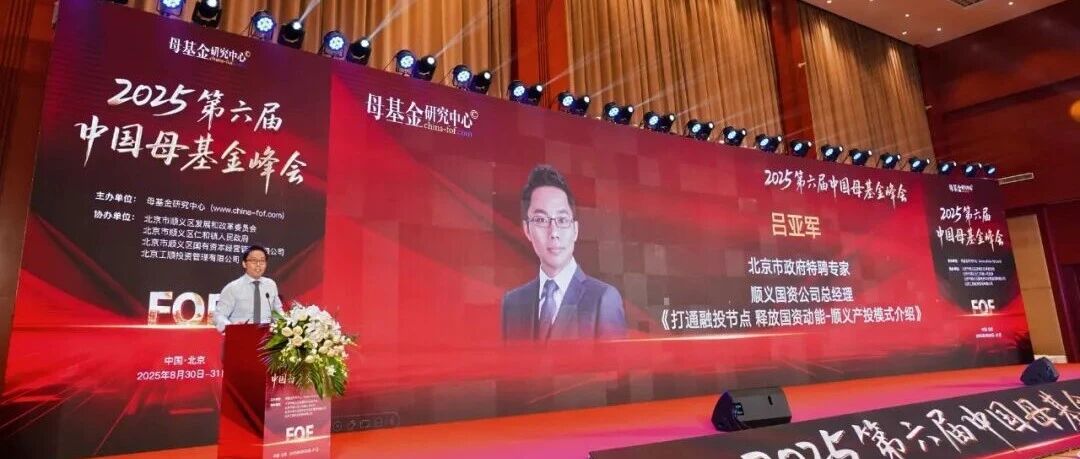
吕亚军:打造国资投资的“LGC”新模式
母基金研究中心· 2025-09-14 08:28
Core Viewpoint - The 2025 Sixth China Fund of Funds Summit highlighted the evolving landscape of the fund management industry, emphasizing the need for adaptation to market changes and the introduction of innovative investment structures to address current challenges [1][2][3]. Group 1: Market Environment and Challenges - The market sentiment has shifted from "embracing change" to "seeing the dawn" in 2025, indicating a gradual recovery and adaptation to new realities [2]. - Key challenges identified include difficulties in exit strategies, reduced fiscal resources impacting investment scale and capacity, and the need for effective error tolerance mechanisms [3][8]. - The fund management industry has seen a reduction of over 20% in management scale in the first half of 2025, primarily due to constrained exit channels and limited external funding [8]. Group 2: Investment Structure and Strategy - The "5+4" model in Shunyi integrates five major manufacturing sectors (new energy vehicles, aerospace, third-generation semiconductors, smart equipment, and healthcare) with four modern service sectors (aviation services, business exhibitions, industrial finance, and technology services) [3][4]. - Shunyi's investment framework employs a "direct investment + fund of funds" model, with a focus on significant projects exceeding 300 million RMB [6][9]. - The establishment of the "LGC structure" aims to unify limited and general partners to enhance capital supply and activate underperforming assets, thereby facilitating a supply-side reform in capital [9]. Group 3: Financial Performance and Capabilities - Shunyi's state-owned capital management company reported a consolidated revenue of approximately 10 billion RMB in Q1 2025, with a tax contribution of 970 million RMB [5]. - The financial institutions in Shunyi have grown to nearly 500, with an asset management scale of 4 trillion RMB, indicating a strengthening of the regional financial ecosystem [4]. - The company has achieved an upgrade in credit rating from "AA+" to "AAA," reflecting improved financing capabilities and market confidence [10]. Group 4: Future Directions and Innovations - The introduction of a "loan-equity linkage" mechanism aims to alleviate valuation discrepancies and support financing needs for private enterprises, enhancing the feasibility of investment projects [12]. - Shunyi is exploring the establishment of a "state-owned capital venture capital" model, leveraging its listed companies to create efficient resource allocation channels for strategic projects [13]. - The company is committed to continuous improvement and collaboration within the industry to foster a robust investment environment and achieve significant regional development [13].
顺义产业金融成果亮相服贸会 金融机构按年可获8000万元支持
Bei Ke Cai Jing· 2025-09-12 07:08
Core Insights - The 2025 China International Service Trade Fair is being held from September 10 to 14 in Beijing, showcasing the achievements of the Shunyi District's "Industry + Finance" model [1] Financial Performance - In 2024, the financial sector in Shunyi achieved an added value of 32.16 billion yuan, representing an 8% year-on-year growth, maintaining its position in the second tier of the city [1] - The total general public budget revenue increased from 4.06 billion yuan in 2016 to nearly 10 billion yuan in 2024, indicating sustained economic momentum [1] Financial Ecosystem Development - Shunyi District is accelerating the construction of a diversified financial ecosystem to support the growth of high-end manufacturing and other high-tech industries [2] - The district has introduced various supportive policies for financial institutions, including up to 50 million yuan in funding support for new financial institutions and 8 million yuan for stabilizing operations [2] Financial Institution Aggregation - Over 500 quality financial institutions have gathered in Shunyi, including Minsheng Bank, Huaxia Fund, Allianz Asset Management, and PayPal, creating a diverse financial ecosystem [3] - The district is focusing on the development of five high-end manufacturing sectors: new energy smart vehicles, aerospace, third-generation semiconductors, smart equipment, and healthcare, with increased support for these industries [3] Capital Market Support - Shunyi supports enterprises in capital market development with funding up to 10 million yuan for growth, 2.5 million yuan for New Third Board listings, and 5 million yuan for mergers and acquisitions [3] - A total of 134 listed companies in the district have raised nearly 240 billion yuan through direct financing [3] Policy Support for SMEs - The district has launched multiple policies to support the healthy development of unicorns, hidden champions, and specialized small and medium-sized enterprises, with funding support of up to 500,000 yuan for interest subsidies [4] - A risk compensation mechanism has been established to assist SMEs in overcoming financing challenges, with banks providing loan support and compensation for overdue loans [4] Investment Fund Landscape - Shunyi has over 200 funds with a total management scale of nearly 4 trillion yuan, focusing on intelligent manufacturing, biomedicine, and new energy smart vehicles [4] - The district's inclusive finance initiatives have resulted in a micro-loan balance exceeding 20 billion yuan, providing over 20 billion yuan in loan support to nearly 4,000 enterprises [4]
习近平总书记关切事丨蹚出一条转型发展的新路子
Xin Hua She· 2025-09-11 16:56
Group 1: Energy Transition - The transformation of resource-based regions is a significant issue for economic development, with a focus on energy transition, industrial upgrading, and moderate diversification [2] - The "Photovoltaic Great Wall" in the Kubuqi Desert is a vivid example of integrating energy transition with ecological governance, featuring solar panels that convert sunlight into clean energy [3][5] - Ordos, a traditional coal city, is actively pursuing a green and low-carbon energy structure under the "dual carbon" strategy, emphasizing the importance of upgrading traditional energy industries [4][7] Group 2: Industrial Upgrading - The China Pingmei Shenma Group in Pingdingshan is transforming its coal-based industry into a new materials industry, showcasing the potential of coal as a source for various products [8][9] - The merger of Pingmei Group and Shenma Group has created a unique coal-based nylon chemical industry chain, enhancing the region's industrial capabilities [11] - The group's revenue reached nearly 100 billion yuan last year, with over 200 enterprises in the "China Nylon City," reflecting significant industrial growth [12] Group 3: Moderate Diversification - The Shanxi Transformation Comprehensive Reform Demonstration Zone is fostering new industries, including third-generation semiconductors and new materials, to optimize the business environment and stimulate economic vitality [13][14] - The rapid development of Shanxi ShuoKe Crystal Co., Ltd. in the semiconductor sector exemplifies the successful cultivation of emerging industries in the region [16][17] - The demonstration zone has launched over 100 strategic emerging industry projects in the past three years, indicating a strong commitment to diversified economic development [17][18]