第六代移动通信

Search documents
奋楫“十五五”,资本与国策共创
Sou Hu Cai Jing· 2025-12-03 01:52
Core Insights - The focus of national development is shifting from "quantitative recovery" post-pandemic to "qualitative leap" in the "15th Five-Year Plan" [1] - The "15th Five-Year Plan" emphasizes "high-level technological self-reliance" and aims for a dual goal of "effective qualitative improvement and reasonable quantitative growth" [5][11] Group 1: Economic and Industrial Strategy - The national strategy is entering a new cycle centered on innovation efficiency, industrial structure, and regional collaboration, marking a shift from "policy following" to "system co-creation" [4] - The plan aims to build a modern industrial system with advanced manufacturing as the backbone, focusing on future industries like quantum technology, biomanufacturing, and hydrogen energy [11] - The transition from "incremental manufacturing" to "efficiency manufacturing" indicates a shift in focus from merely increasing production to optimizing resource allocation [12] Group 2: Investment Opportunities - Hard technology investment, including semiconductors and advanced materials, is positioned as a foundational logic for "systematic breakthroughs" [10] - Investment institutions are encouraged to engage in pre-financing and result transformation for national technology tasks, fostering capital co-creation [10] - The emphasis on "entrepreneurial investment + risk-sharing mechanisms" presents opportunities for investment firms to participate in national innovation initiatives [10] Group 3: Green Development - The "15th Five-Year Plan" elevates green development from a secondary goal to a structural institution, influencing all industrial allocations [17] - The integration of green issues into financial and market mechanisms signifies a shift in perspective, making green development a capital issue [17] - Sustainable investment opportunities in green infrastructure and carbon asset management are expected to grow [20] Group 4: Consumer and Market Dynamics - The plan positions consumption upgrade as a core driver of economic structural transformation, moving from recovery to quality enhancement [22] - The "silver economy" is recognized as a significant industrial opportunity, transforming aging issues into growth engines [22][25] - Investment opportunities in healthcare, elder care, and technology-assisted living are anticipated to rise due to demographic shifts [25] Group 5: Regional Development - The focus of regional policy is shifting from "development gradient" to "structural coordination," promoting a unified market and efficient resource allocation [27] - Investment institutions are encouraged to collaborate with local guiding funds to strengthen project foundations and facilitate new industry development in less developed regions [30] Group 6: Financial Market Reforms - The "15th Five-Year Plan" emphasizes structural improvements in capital markets, transitioning from a focus on financing to a comprehensive investment-funding-exit cycle [32] - Direct investment institutions are identified as key players in building a strong financial nation, with multiple exit pathways being developed [35] - The plan aims to enhance the inclusivity and adaptability of capital market systems, promoting direct financing methods [31] Strategic Summary - The "15th Five-Year Plan" outlines new engines for China's economic growth, including technological innovation and green transformation, while establishing a more inclusive capital market system [36] - Investment institutions are encouraged to align their strategies with national planning, leveraging professional judgment to identify promising sectors and companies for investment [36]

这6大未来产业,加快跑进现实(这些新提法,写入“十五五”规划建议④)
Ren Min Ri Bao Hai Wai Ban· 2025-12-02 22:46
Core Viewpoint - The article emphasizes the strategic importance of future industries in China's economy, highlighting the rapid development and application of technologies such as hydrogen energy, quantum technology, and embodied intelligence, which are expected to drive economic growth and innovation [4][5][7]. Group 1: Future Industries Overview - Future industries are a crucial part of China's "three new" economy, contributing over 18% to GDP last year [4]. - The "14th Five-Year Plan" identifies six key future industries, including quantum technology and biological manufacturing, which are at a critical stage of moving from laboratory to commercialization [5][6][10]. Group 2: Technological Advancements - China has achieved significant progress in hydrogen energy, with production capacity exceeding 50 million tons per year and over 600 renewable energy hydrogen production projects planned [8]. - In nuclear fusion, the EAST facility has set world records for plasma operation times, achieving 1 billion degrees Celsius for 1066 seconds [9][10]. - The development of the BEST facility aims for commercial nuclear fusion power generation by 2030, with a goal to light the first lamp by then [10]. Group 3: Market Potential and Applications - The market for brain-computer interfaces is expected to exceed 5.5 billion yuan, while the embodied intelligence market could surpass 400 billion yuan by 2030 [14]. - The application of embodied intelligence in various sectors, such as manufacturing and service industries, is being explored, with robots like NAVIAI demonstrating capabilities in tasks ranging from sewing to household chores [13][14]. Group 4: Policy and Support - The Chinese government is promoting the integration of technology and industry through policies aimed at fostering new application scenarios and supporting innovation [12][14]. - The focus on creating a supportive ecosystem for future industries includes investment in R&D and the establishment of platforms for biological manufacturing and brain-computer interfaces [14].
读懂中国“十五五”规划,中国式现代化彰显共享发展机遇承诺
2 1 Shi Ji Jing Ji Bao Dao· 2025-12-01 12:00
Core Insights - The "Understanding China" International Conference is being held for the 12th year, focusing on the theme of "New Layout, New Development, New Choices - Chinese-style Modernization and the New Global Governance Pattern" [1] - The conference aims to discuss the significance of the 14th Five-Year Plan and its implications for global governance, emphasizing China's role in providing new opportunities for developing countries [2][3] Group 1: Conference Themes and Objectives - The conference introduces two new topics: understanding the 14th Five-Year Plan and the four global initiatives, including the Global Governance Initiative [2] - The 14th Five-Year Plan is seen as a departure from the notion that modernization equals Westernization, offering new choices for developing countries [2][6] - The conference serves as a platform for global South countries to learn from China's modernization experience and to promote the concept of a community with a shared future for mankind [3][7] Group 2: International Cooperation and China's Role - Former Italian Prime Minister Romano Prodi highlights China's increasing importance in international cooperation, contrasting it with the past U.S.-led initiatives [2] - The conference emphasizes the need for collaboration among nations, particularly in the context of global challenges [2][4] - The participation of representatives from 72 countries, with a significant portion from the global South, indicates the growing influence of the conference [3] Group 3: Economic Strategies and Development Plans - The 14th Five-Year Plan focuses on domestic demand and international cooperation as core components of China's modernization strategy [3][6] - The plan aims to integrate economic growth with global cooperation, emphasizing shared opportunities and mutual development [6][7] - The plan includes innovative strategies for technology and industry, aiming to establish new economic growth points [8][9] Group 4: Regional Development and Innovation - The conference discusses the development experiences of the Guangdong-Hong Kong-Macao Greater Bay Area and Hainan Free Trade Port, highlighting their roles in China's modernization [12][13] - The Greater Bay Area is viewed as a vibrant region with significant potential for economic development and innovation [12] - The Hainan Free Trade Port is set to enhance international trade and cooperation, marking a new phase of China's high-level opening up [13]
专访中国社科院经济研究所原所长黄群慧:既要重视AI赋能千行百业,也要考量对就业的替代效应和带来的收入极化
Mei Ri Jing Ji Xin Wen· 2025-11-23 15:49
Core Viewpoint - The "15th Five-Year Plan" emphasizes the construction of a modern industrial system, reflecting a strategic shift in response to current domestic and international conditions, with a focus on both supply-side and demand-side policies [2][3][4]. Group 1: Modern Industrial System - The prioritization of "building a modern industrial system" signifies a need for new growth drivers, as traditional industries currently account for about 80% of the economy, with potential for significant market expansion through transformation [3][4]. - The modern industrial system is crucial for supporting the transformation of traditional industries and fostering new growth dynamics, highlighting the interdependence between technological innovation and industrial development [3][5]. Group 2: Policy Resource Allocation - The government should balance investments in traditional industries with those in strategic emerging and future industries, recognizing that traditional industries are essential for overall economic transformation [6][7]. - Different investment mechanisms are required for traditional, strategic emerging, and future industries, emphasizing the need for tailored policies to avoid pitfalls in resource allocation [8]. Group 3: Future Industries - The selection of six key future industries—quantum technology, biomanufacturing, hydrogen energy, nuclear fusion, brain-computer interfaces, and sixth-generation mobile communications—reflects a strategic focus on original innovation, market potential, and national security [9][10]. - The potential for these industries to achieve commercial viability within five years remains uncertain, with various factors influencing their market readiness and scalability [11][12]. Group 4: High-Tech Industry Growth - The goal of "doubling" the scale of high-tech industries over the next decade indicates a significant push for structural upgrades and the development of new high-tech sectors [14][15]. - Achieving breakthroughs in key areas like integrated circuits and industrial mother machines is critical for overcoming technological bottlenecks and enhancing national competitiveness [16]. Group 5: Artificial Intelligence Integration - The repeated emphasis on "artificial intelligence" in the plan indicates its role as a core driver for modern industrialization, aiming to empower various sectors of the economy [17][18]. - The social implications of AI, including its impact on employment and income distribution, must be considered in policy-making to ensure inclusive growth and address potential ethical concerns [18][19].
陕西“十四五”现代化产业体系建设成效显著
Shan Xi Ri Bao· 2025-11-22 00:28
Group 1: Modern Industrial System Development - Shaanxi has focused on building a modern industrial system as a strategic initiative during the 14th Five-Year Plan, leading to revitalization of traditional industries and rapid growth of emerging industries [1] - The province has implemented a plan for industrial structure adjustment in the Guanzhong area, promoting the transformation and upgrading of high-energy-consuming and high-polluting enterprises [1] - Strategic emerging industries and high-tech manufacturing have seen annual value-added growth rates of 8.7% and 10.3% respectively during the 14th Five-Year Plan, with new energy vehicle production growing at an annual rate of 112% [1] Group 2: Agricultural Modernization - The implementation of the rural industrial integration development demonstration park three-year action plan has resulted in the establishment of 9 national and 65 provincial demonstration parks, with a target of 3.356 billion yuan in central investment for 2025 [2] - In 2024, the total grain production is expected to reach 13.5229 million tons, with a historical high yield of 297.35 kg per mu [2] Group 3: Service Industry Development - By 2024, the service sector's value added is projected to reach 1.84 trillion yuan, accounting for 51.8% of the province's GDP, achieving the 14th Five-Year Plan target ahead of schedule [2] - The combined revenue of scientific research, technical services, and information technology services accounted for 51.3% of the profitable service industry in the first three quarters of this year [2] Group 4: Infrastructure Enhancement - The construction of the China-Europe Railway Express (Xi'an) has seen an increase in annual operations from 3,720 trains in 2020 to 4,985 in 2024, with an average annual growth of 34% [2] - The railway operating mileage has reached 6,030 kilometers, while the total road mileage has reached 190,000 kilometers, and urban rail transit operating mileage has reached 403 kilometers [2]
展望“十五五” | 专访黄群慧:既要重视AI赋能千行百业,也要考量其对就业的替代效应和带来的收入极化
Mei Ri Jing Ji Xin Wen· 2025-11-20 07:04
Core Viewpoint - The "15th Five-Year Plan" emphasizes the construction of a modern industrial system, reflecting a strategic shift in China's economic development focus, particularly in response to current domestic and international challenges [2][3][4]. Group 1: Modern Industrial System - The prioritization of "building a modern industrial system" signifies a shift towards strengthening the real economy, which is essential for sustainable growth and resilience against external shocks [4][7]. - The plan aims to transform traditional industries, which currently account for about 80% of the economy, into new growth drivers, potentially creating a market worth trillions [4][8]. - The integration of technological innovation with industrial development is crucial, as it ensures that breakthroughs in technology can be effectively applied within the industrial framework [3][8]. Group 2: Future Industries - The plan outlines six key future industries: quantum technology, biomanufacturing, hydrogen energy, nuclear fusion, brain-computer interfaces, and sixth-generation mobile communications, chosen for their potential to drive economic growth and strategic importance [11][19]. - These industries are expected to contribute significantly to China's high-tech sector, with the goal of achieving a "doubling" of high-tech industries over the next decade [18][19]. - The selection of these industries considers their original innovation potential, market prospects, and alignment with national security needs [11][19]. Group 3: Policy and Investment Strategies - The government is advised to adopt a differentiated approach to funding and policy support for traditional, strategic emerging, and future industries, ensuring that resources are allocated effectively without neglecting any sector [9][10]. - The establishment of a guiding fund for future industries is recommended to attract private investment while managing risks associated with high uncertainty in these sectors [22][23]. - The focus on nurturing "unicorn" and "gazelle" companies is essential for fostering innovation and ensuring a dynamic ecosystem that supports both large enterprises and startups [24][23]. Group 4: Technological Innovation and Social Impact - The plan highlights the importance of integrating social considerations into technological innovation, particularly regarding the impact of artificial intelligence on employment and income distribution [31][37]. - A balanced approach is necessary to ensure that technological advancements do not exacerbate social inequalities, aligning with the broader goals of shared prosperity and sustainable development [37][38]. - The governance of artificial intelligence must evolve through interdisciplinary collaboration to address its societal implications effectively [38].

2025中国未来产业前沿进展:量子科技迅猛、脑机接口落地、具身智能蓬勃发展
3 6 Ke· 2025-11-17 04:08
Core Insights - The article emphasizes the importance of future industries driven by cutting-edge technologies, which are in the early stages of development and have significant strategic, leading, disruptive, and uncertain characteristics [1]. Government Initiatives - The Chinese government has issued multiple guiding documents to promote the development of future industries, focusing on six key areas: future manufacturing, future information, future materials, future energy, future space, and future health [2]. - The 2024 and 2025 State Council work reports highlight the need to cultivate emerging and future industries, including quantum technology and life sciences, and to establish growth mechanisms for future industry investments [2]. - The 15th Five-Year Plan emphasizes the exploration of diverse technology routes and typical application scenarios to drive new economic growth points in various future industries [2]. Industry Developments Quantum Technology - Quantum technology integrates principles of quantum mechanics with various scientific fields, aiming to revolutionize information processing and transmission [5]. - Significant advancements include the development of the "Zuchongzhi III" superconducting quantum computing prototype, which set new global records in quantum computing capabilities [6]. - By 2025, China is expected to lead in quantum computing, transitioning from "catching up" to "leading" in the field [7]. Biomanufacturing - Biomanufacturing utilizes biological processes for material processing and conversion, with applications in pharmaceuticals, new materials, and renewable energy [8]. - China has become the largest exporter of key enzyme preparations and gene components, holding a 29% share of the global market [9]. - The industry is characterized by the integration of AI in research and production, accelerating innovation and improving production efficiency [10]. Hydrogen and Nuclear Fusion Energy - Hydrogen energy is recognized as a crucial component of global energy transition, with China being the largest hydrogen producer [11]. - Major projects include the world's largest green hydrogen base and advancements in nuclear fusion technology, with significant milestones achieved in plasma control and fusion energy development [12][13]. Brain-Computer Interfaces - Brain-computer interfaces (BCIs) are emerging as transformative technologies, with successful trials and clinical applications in various fields [14][15]. - The development of both invasive and non-invasive BCIs is progressing rapidly, with applications in medical rehabilitation and research [18]. Embodied Intelligence - The embodied intelligence sector is witnessing rapid growth, particularly in robotics, with advancements in AI and sensor technologies [19][20]. - 2025 is seen as a pivotal year for humanoid robots transitioning from prototypes to mass production, with applications in various industries [21]. Sixth Generation Mobile Communication - The sixth generation (6G) mobile communication technology is expected to enhance performance metrics significantly compared to 5G, with various breakthroughs achieved in key technologies [22][23]. - Standardization efforts for 6G are underway in China, with commercial deployment anticipated around 2030 [23][24].
【图解】权威解读|一图秒懂“十五五”规划建议核心热词
Zhong Guo Jing Ji Wang· 2025-11-14 03:26
Core Viewpoint - The article emphasizes the importance of achieving a moderate level of development for China by 2035, with a focus on enhancing GDP and fostering emerging industries to adapt to global economic changes [2][5][14]. Group 1: Economic Development Goals - The target is to exceed the threshold of $20,000 in per capita GDP by 2020 standards and to double the per capita GDP by 2035 compared to 2020 levels [2]. - Achieving a moderate level of development is seen as crucial for China's economic strategy moving forward [2]. Group 2: Emerging Industries - The "14th Five-Year Plan" aims to develop new pillar industries such as renewable energy, new materials, aerospace, and low-altitude economy [5]. - There is a call for a focus on key areas like quantum technology, biomanufacturing, hydrogen energy, and sixth-generation mobile communication to drive future industrial growth [6]. Group 3: Regional Innovation Systems - The establishment of regional innovation systems is essential, involving collaboration among government, enterprises, universities, and research institutions to enhance innovation capabilities [9]. - A tailored approach based on local resources and industrial foundations is recommended to prevent market bubbles and ensure sustainable development [6]. Group 4: Investment Strategies - Investment in physical assets (infrastructure, buildings, machinery) is crucial for solidifying the material and technical foundation for economic development [10]. - Investment in human capital (education, healthcare, skills training) is equally important for enhancing the capabilities and potential of the population [10]. Group 5: Digital Trade - Digital trade, characterized by data as a key production factor and digital services, is rapidly growing and is identified as a new trend in international trade and economic growth [12]. Group 6: Energy Strategy - Building an energy powerhouse is highlighted as a significant goal, with energy security being critical for national stability and development [13][14]. - The transition to green and low-carbon energy sources is emphasized as a timely and necessary step in the current global context [14].

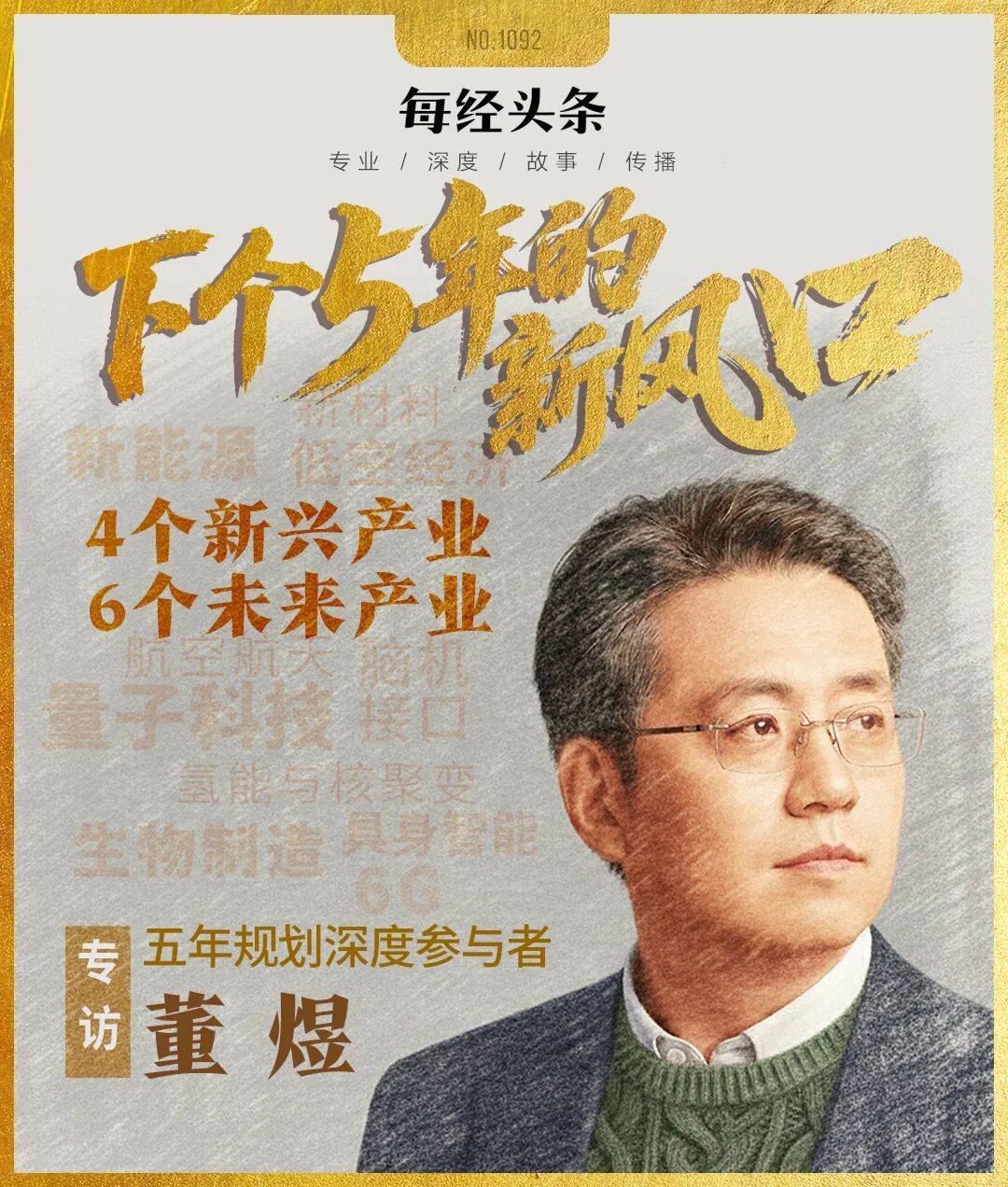
“十五五”新风口,专访五年规划深度参与者董煜:锚定4大新兴产业和6大未来产业
3 6 Ke· 2025-11-07 00:05
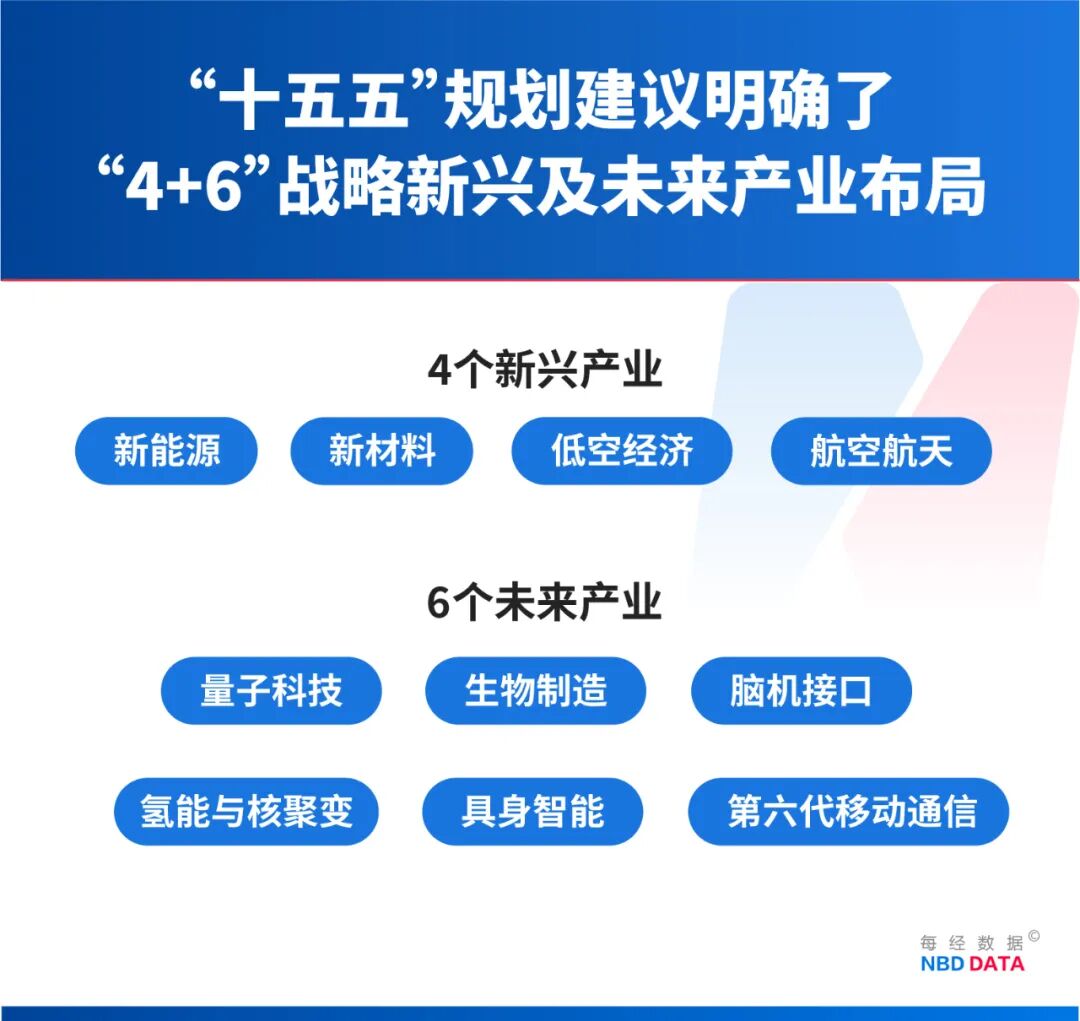
Group 1: Economic and Industrial Development - The "15th Five-Year Plan" emphasizes the construction of a modern industrial system as a foundation for economic modernization, highlighting the importance of strengthening the real economy and core competitiveness in response to external changes [2][4]. - The plan identifies "4+6" strategic emerging and future industries, with four emerging industries (new energy, new materials, low-altitude economy, and aerospace) expected to become pillar industries, while six future industries (quantum technology, biomanufacturing, brain-computer interfaces, hydrogen energy and nuclear fusion, embodied intelligence, and sixth-generation mobile communication) are recognized for their potential growth [7][4]. - The plan aims to enhance traditional industries and foster new and future industries, positioning new quality productivity as a priority for development [4][7]. Group 2: Social and Employment Policies - The plan places significant emphasis on improving people's livelihoods, focusing on three high-quality aspects: full employment, high-quality real estate development, and high-quality population development [11][12]. - It aims to address employment issues by ensuring sufficient job opportunities while enhancing job quality and sustainability, directly impacting household income [11]. - The plan proposes comprehensive support for family planning and child-rearing, aiming to create a family-friendly society and alleviate the burdens of child-rearing, thereby enhancing overall happiness [12]. Group 3: Market and Regulatory Framework - The plan stresses the need to eliminate barriers to building a unified national market, providing clear guidance for market participants and enhancing the efficiency of market operations [13][16]. - It emphasizes the establishment of six foundational market institutions, including property rights protection and market access, to reduce transaction costs and uncertainties in the market [13][16]. - The plan aims to create a favorable market environment by regulating competition and ensuring fair practices among market entities [16].
“十五五”新风口!专访五年规划深度参与者董煜:锚定4大新兴产业和6大未来产业
Sou Hu Cai Jing· 2025-11-06 12:11
Group 1 - The core idea of the article is the release of the "15th Five-Year Plan" which outlines the guiding principles for China's economic and social development for the next five years, emphasizing the modernization of the industrial system and the strengthening of the real economy [2][19]. - The "15th Five-Year Plan" prioritizes the construction of a modern industrial system as a crucial foundation for China's modernization, highlighting the need to enhance core competitiveness in the face of changing external environments [3][19]. - The plan identifies "4+6" strategic emerging and future industries, including four emerging industries (new energy, new materials, low-altitude economy, and aerospace) and six future industries (quantum technology, biomanufacturing, brain-computer interfaces, hydrogen energy and nuclear fusion, embodied intelligence, and sixth-generation mobile communication) as new growth points for the economy [8][9]. Group 2 - The plan emphasizes the importance of digital economy as a key driver for modern industrial systems, facilitating technological upgrades and structural optimization in the real economy [4]. - The "15th Five-Year Plan" outlines specific tasks to cultivate new productive forces, focusing on optimizing traditional industries and nurturing emerging and future industries, thereby establishing a clear direction for industrial development [5]. - The plan includes measures to support future industries, such as innovative regulatory approaches, venture capital development, and risk-sharing mechanisms to ensure effective funding and support for these high-risk sectors [9][12]. Group 3 - The plan places significant emphasis on improving people's livelihoods, with a focus on high-quality employment, real estate development, and population policies to address demographic challenges [12][13]. - It aims to enhance service consumption by expanding access and encouraging innovation in service sectors, thereby improving the quality of life for citizens [13]. - The plan stresses the need to eliminate barriers to building a unified national market, which is essential for fostering fair competition and enhancing market expectations [14][18].