
智能网联汽车

Search documents
首批L3级自动驾驶车型获批 车企明确:L2车辆暂无法直接升级
Mei Ri Jing Ji Xin Wen· 2025-12-19 00:50
Core Viewpoint - The approval of the first L3-level conditional autonomous driving models in China marks a significant milestone in the transition from "assisted driving" to "autonomous driving," fundamentally altering the responsibility chain in driving and paving the way for commercial applications in specific scenarios [2][5][9]. Group 1: Market Response - Following the announcement of L3-level model approvals, the capital market reacted swiftly, with several stocks in the intelligent driving sector experiencing significant gains, indicating strong investor interest [4]. - The approval is seen as a leap towards mass production and application of intelligent connected vehicles, reflecting a balance between regulatory oversight and technological advancement [4][17]. Group 2: Technical and Regulatory Developments - The L3-level models approved include Changan's "Deep Blue SL03" and BAIC's "Arcfox Alpha S6 (L3 version)," which will operate in designated areas in Chongqing and Beijing, respectively, under specific speed limits [6][8]. - The transition to L3-level driving involves a shift in responsibility from the driver to the system under certain conditions, a significant change from L2-level systems where the driver retains full responsibility [5][10]. Group 3: Future Projections - Industry experts predict that by 2026, the penetration rate of L3 and above autonomous vehicles could reach 10%, with L3-level vehicles expected to be commercially viable in specific applications such as airport shuttles and campus commuting [5][25]. - The market for Robotaxi services is projected to grow significantly, with estimates suggesting a market size exceeding 2.93 trillion yuan by 2030, driven by advancements in autonomous driving technology [12][24]. Group 4: Technological Innovations - The cost of key components for autonomous driving, such as lidar and AI chips, is decreasing, which is expected to stimulate the entire supply chain and create new business models in the automotive industry [21][24]. - The integration of advanced sensor technologies and AI models is crucial for the development of reliable L3-level autonomous driving systems, with a focus on multi-sensor fusion to handle complex driving environments [26][30]. Group 5: Regulatory Framework - The approval process for L3-level vehicles has been gradual, involving multiple stages of regulatory development and safety assessments, indicating a structured approach to integrating autonomous vehicles into the market [13][15]. - Local regulations, such as those in Beijing and Wuhan, are being established to support the commercialization of L3-level autonomous vehicles, providing a framework for future developments [16][30].



帮主郑重:三大消费赛道优质标的清单,中长线闭眼盯这几类!
Sou Hu Cai Jing· 2025-12-19 00:39
Group 1: Smart Connected Vehicles - Focus on three categories: 1) Companies producing core components for autonomous driving, such as lidar and in-vehicle cameras, with leading firms investing over 10% of revenue in R&D [3] [4] - 2) Intelligent cockpit service providers, with new vehicle penetration rates exceeding 60% and accelerating growth [4] - 3) Automotive-grade chip manufacturers, particularly those involved in domestic substitution, as domestic new energy vehicle installations account for over 50% of the global total, making chip localization a necessity [4] Group 2: AI Consumer Electronics - Emphasis on "AI+" upgrade targets: 1) New product categories empowered by AI, such as smart speakers with large models and AI translation devices, with sales growth rates exceeding 30% year-on-year [4] - 2) Leading companies in the consumer electronics supply chain, especially those producing AI modules and precision manufacturing for top brands, benefiting from industry upgrades and stable overseas orders [4] - 3) Companies related to AR/VR devices, supported by policies promoting digital consumption, with leading firms already in mass production [4] Group 3: Silver Economy - Focus on "essential needs + quality": 1) Companies in elderly health management, such as those producing smart blood glucose meters and blood pressure monitors, with over 280 million people aged 60 and above driving demand for health monitoring [4] - 2) Operators of elderly care services, particularly those with chain operations and integrated medical care, benefiting from policy incentives like venue and tax benefits, with leading institutions achieving over 85% bed utilization [4] - 3) Companies involved in elderly-friendly renovations, such as leading firms in elderly appliances and smart nursing equipment, with the market for elderly-friendly renovations growing over 25% annually [4] Group 4: Investment Strategy - Long-term investment targets should focus on R&D investment, market share, and policy alignment, as these companies are positioned at the forefront of national strategy and industrial upgrades [5]
市场最前沿|部分车型获准入许可 L3级自动驾驶大规模落地还有多远?
Xin Hua Wang· 2025-12-18 15:11
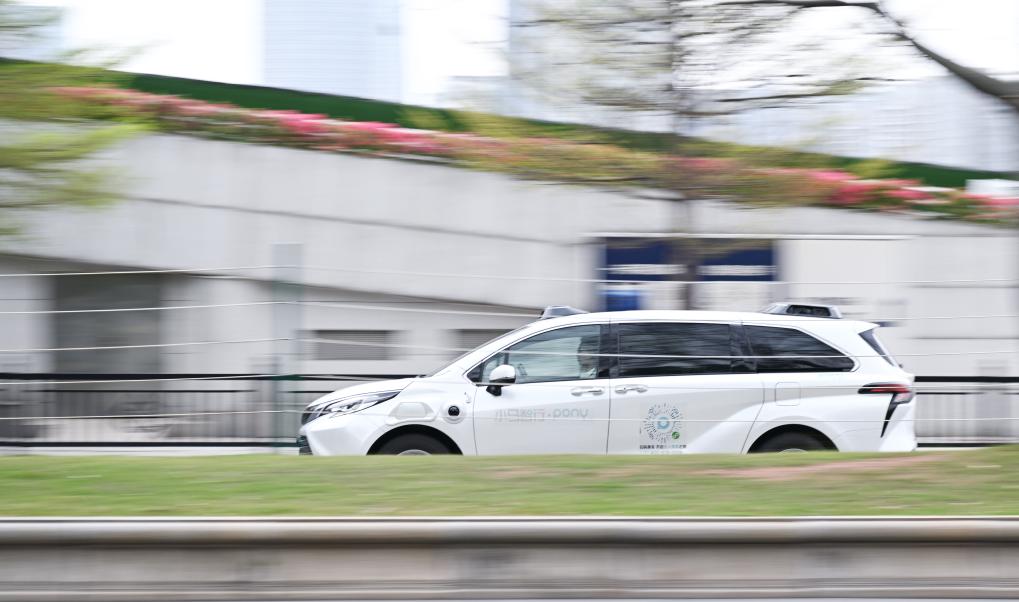
Core Viewpoint - The recent conditional approval of two L3 autonomous driving models in China marks a significant step in the automotive industry's development and international technological competition, but large-scale commercialization is still a long way off [1] Group 1: Approval and Commercialization - Obtaining product approval does not equate to imminent mass production of L3 vehicles; it indicates readiness for a trial phase under specific conditions [2] - The path to widespread L3 adoption involves a complex interplay of policy, technology, and industry ecosystem, requiring further advancements in legal frameworks, technical capabilities, and user acceptance [2] - The approval of these models will provide valuable practical experience for standard-setting, but significant challenges remain before large-scale commercialization can occur [2] Group 2: Testing and Pilot Programs - There is a clear distinction between testing demonstrations and pilot approvals; the former involves diverse entities and focuses on research and development, while the latter is a critical step towards transitioning from technical validation to mass application [3] - Pilot approvals are limited to automotive manufacturers and aim to explore and refine management systems, processes, regulations, and standards for future large-scale applications [3] Group 3: Safety and Operational Limits - The approved L3 models have specific operational boundaries, including limited road types, vehicle types, and a maximum speed of 50 km/h, reflecting a commitment to safety [6] - The decision to limit speed is based on the understanding that higher speeds increase safety risks and require more stringent performance and safety standards for autonomous systems [7] - The approach aims to start with small-scale, controlled testing environments to gradually optimize technology and accumulate industry experience for safe and orderly application [7] Group 4: Consumer Access - Currently, individual consumers cannot purchase or operate these autonomous vehicles; they are only available for trial use through designated channels like ride-hailing services [8] - The industry aims to conduct small-scale road tests in relatively low-risk areas, with plans to expand applications as safety and operational reliability are validated [8]
海南封关,和湖北有什么关系?
Sou Hu Cai Jing· 2025-12-18 13:09
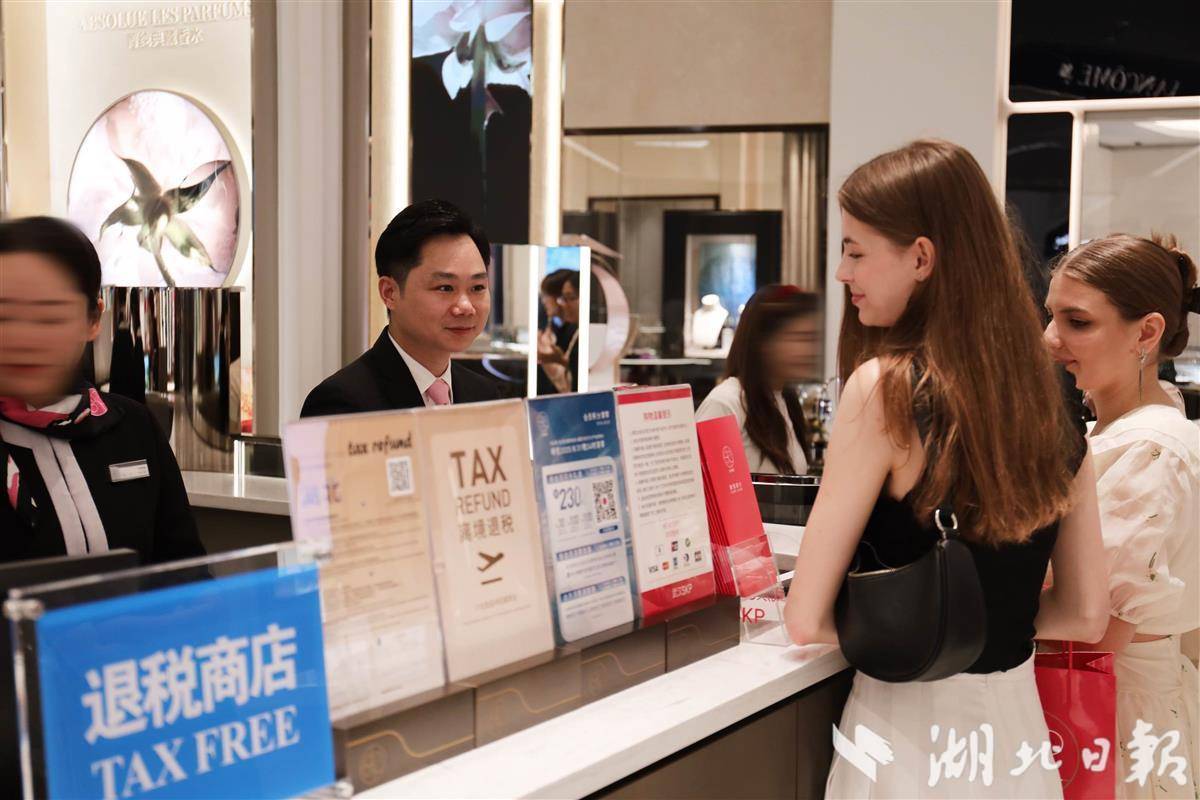
Core Viewpoint - The launch of the Hainan Free Trade Port's full island closure on December 18 marks a significant step towards creating a special customs regulatory area, enhancing openness while managing trade effectively [1][2]. Group 1: Trade and Customs - The "first line" refers to Hainan's access to the world, allowing most imported goods to enter without tariffs, VAT, or consumption tax, simplifying customs procedures [4]. - The "second line" is designed to prevent tax evasion by ensuring that goods entering the mainland from Hainan are subject to appropriate checks and taxes [4]. - Hainan aims to become a "super free trade transit hub," facilitating easier international trade while maintaining regulatory oversight on domestic transactions [4]. Group 2: Consumer Benefits - Tourists can continue to shop in Hainan without additional procedures, with an annual duty-free shopping limit of 100,000 yuan per person, and an expanded range of duty-free products available [8]. - The introduction of international resources in education and healthcare, such as access to over 520 innovative medical products in the Boao Lecheng International Medical Tourism Pilot Zone, enhances the attractiveness of Hainan for both residents and visitors [8]. Group 3: Opportunities for Hubei Enterprises - Hubei enterprises can benefit from a 30% value-added processing exemption from tariffs, presenting significant cost savings for industries like food processing and biomedicine [10]. - For example, processing Argentine beef in Hainan could save approximately 43,000 yuan in tariffs, enhancing profit margins for local businesses [10]. - Hubei's strengths in production can be leveraged with Hainan's favorable policies, creating competitive advantages in the market [10].
扩大新兴产业有效投资,前瞻布局未来产业项目,如何利好汽车业?
Zhong Guo Qi Che Bao Wang· 2025-12-18 07:20
Core Viewpoint - The article emphasizes the importance of expanding effective investment in emerging industries, particularly in the smart connected electric vehicle sector, as a significant driver for economic growth and technological innovation in China [3][4][9]. Group 1: Policy and Investment Direction - The National Development and Reform Commission's policy aims to optimize investment structure and expand investment space, particularly in emerging industries like smart connected electric vehicles [3]. - The policy framework outlines new industries such as renewable energy, new materials, and electric vehicles, which are seen as key areas for future investment [4]. - The focus on effective investment is expected to inject capital into technological innovation and facilitate the transition of the automotive industry towards smart, electric, and green solutions [4][5]. Group 2: Technological Advancements - Investment in emerging industries is expected to accelerate breakthroughs in key technologies for electric vehicles, such as solid-state batteries and high-power motors [4][7]. - The integration of new infrastructure for smart connected vehicles is creating a low-latency, high-reliability data transmission network essential for autonomous driving [5]. - Investments are also directed towards overcoming bottlenecks in critical areas like power systems, chip computing, and software algorithms, which are crucial for the automotive industry's technological competitiveness [7]. Group 3: Industry Transformation and Opportunities - The automotive industry is witnessing a shift towards cross-industry innovation, with companies exploring new avenues such as low-altitude travel and water-land-air mobility solutions [6]. - Hydrogen energy and electrification are emerging as dual engines driving the development of the automotive sector, with companies rapidly deploying comprehensive product matrices [6]. - The investment wave in emerging industries is enhancing regional industrial clusters, which are vital for establishing world-class automotive industry hubs [6]. Group 4: Globalization and Market Expansion - The investment in emerging industries is facilitating the globalization of China's automotive sector, transitioning from an "import" to an "export" model [8]. - Chinese automotive brands are increasingly gaining recognition in international markets, with a focus on expanding into Belt and Road Initiative regions where demand for electric vehicles is growing [8]. - The dual drive of capital and technology is reshaping the global automotive landscape, allowing Chinese companies to enhance their brand influence and competitiveness [8][9]. Group 5: Future Outlook - The convergence of effective investment and forward-looking strategies is expected to create a virtuous cycle in the automotive industry, enhancing research and development, practical applications, and global expansion [9]. - Key investment areas such as low-altitude travel, solid-state batteries, and smart connected core modules are identified as potential trillion-dollar growth sectors [9]. - The synergy between policy incentives and market dynamics is anticipated to optimize investment efficiency and focus resources on high-value segments within the smart connected electric vehicle industry [9].

深圳宝安:场景开放牵引产业变革
Jing Ji Ri Bao· 2025-12-18 04:50
Core Insights - The article highlights the rapid development of innovative industrial transformations in Bao'an District, Shenzhen, focusing on low-altitude logistics, smart manufacturing, and smart city applications [1][2][3] Group 1: Industrial Innovation and Scene Opening - Bao'an District has opened 158 drone routes, achieving 383,800 low-altitude flights and establishing China's first "air-ground collaborative" smart operation center [1] - The district has organized 641 government-enterprise scene matching activities over the past three years, attracting over 11,700 companies and facilitating transactions exceeding 20 billion yuan [1][2] - The "Baojing Chuangxiang" scene matching conference released over 500 scene opportunities, with more than 60 companies signing contracts, resulting in over 10 billion yuan in intended transaction amounts [2][3] Group 2: Technological and Product Development - Bao'an has become a hub for various innovative companies, including those focusing on perovskite solar technology, benefiting from the district's scene opening initiatives [3][4] - The district has established a development framework for technology-based SMEs, with 7,397 national high-tech enterprises, leading the country for eight consecutive years [4] Group 3: Ecosystem and Support Platforms - Bao'an aims to create a scene innovation ecosystem by leveraging policy innovation and smart manufacturing advantages, promoting a collaborative environment for enterprises [5][6] - The district has developed a supply-demand capability list and opportunity list to facilitate precise matching between enterprises and government-led public service needs [6] - The establishment of the Guangdong-Hong Kong-Macau Greater Bay Area Application Scene Innovation Center in Bao'an will focus on new technology testing and creating a platform for productivity enhancement [8][9]
杭州锻造智能网联汽车“世界级地标”
Hang Zhou Ri Bao· 2025-12-18 02:07
Core Insights - The article highlights the rapid development and implementation of the intelligent connected vehicle industry in Hangzhou, showcasing its transformation from manufacturing to a global technology leader in mobility solutions [4][10]. Group 1: Manufacturing Capabilities - The Geely Qiantang base produces several hundred vehicles daily, with a new car rolling off the line every two minutes [2][6]. - The facility features advanced automation, including a nearly 7,000-ton servo stamping line capable of producing nearly 1,000 stamped parts per hour [5]. - The production line supports mixed production of various powertrain models, including fuel, pure electric, plug-in hybrid, and battery swap vehicles [5][6]. Group 2: Technological Advancements - The vehicles produced, particularly the Galaxy series, are equipped with the Flyme Auto 2.0 intelligent cockpit system and Qualcomm Snapdragon high-performance chips, enhancing user interaction and driving assistance capabilities [6][7]. - A simulation testing environment allows for the generation of vast amounts of training data for autonomous driving systems, improving efficiency by 500 times and reducing the need for real-world testing by approximately 30% [7][11]. Group 3: Industry Ecosystem - Hangzhou has established a robust industrial ecosystem, connecting over 100 core component manufacturers with leading companies like Geely and Changan Ford, forming a billion-level industrial cluster [9][10]. - The city has implemented a "four-question model" to enhance collaboration between enterprises, government, educational institutions, and the market, facilitating the rapid transformation of research into production [8][9]. Group 4: Policy and Regulation - The introduction of the "Hangzhou Intelligent Connected Vehicle Testing and Application Promotion Regulations" positions Hangzhou as the first city in China to clarify the process for autonomous vehicle road testing [10][11]. - The city has issued 614 testing and application licenses, accumulating 5.92 million kilometers of testing mileage with a zero accident rate [10]. Group 5: Future Outlook - Hangzhou aims to leverage its advantages in "vehicle-road-cloud integration" to expand testing scenarios and promote the large-scale operation of Robotaxi services [12]. - The city is focused on developing high-value core areas such as vehicle-grade chips and advanced algorithms, fostering innovation through collaborative efforts [12][13].

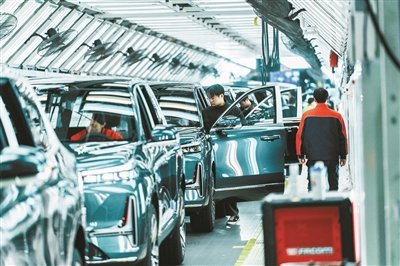
古都涌“新”潮
Ren Min Ri Bao· 2025-12-17 22:11
Core Insights - Xi'an is emerging as a significant hub for technological innovation, with 320 photonics companies generating a total output value of 35 billion yuan, showcasing the city's robust scientific capabilities and innovative ecosystem [1] - The city is actively implementing strategies to enhance its status as a national scientific center and innovation hub, focusing on key technological breakthroughs and the transformation of scientific achievements into industrial applications [1] Group 1: Technological Advancements - Xi'an is home to advanced scientific facilities, including the National Center for Molecular Medicine and the Advanced Attosecond Laser Facility, which are pivotal in enhancing the city's innovation capabilities during the 14th Five-Year Plan [3] - The city has achieved significant milestones in various fields, such as 3D bioprinting and bionic tissue engineering, with local universities and research institutes contributing to breakthroughs in core technologies [3][8] Group 2: Industry Development - The aviation industry in Xi'an has seen substantial growth, with the successful first flight of the "Jiu Tian" drone, marking a new breakthrough in large drone technology and contributing to an overall aviation cluster worth over 150 billion yuan [4] - Xi'an High-tech Zone is a key area for technological innovation, incorporating eight new sectors, including photonics and intelligent connected vehicles, into national development initiatives [5] Group 3: Policy and Ecosystem Support - The local government has introduced a series of supportive policies aimed at enhancing research platforms, improving the quality of technology enterprises, and optimizing the innovation ecosystem, thereby boosting overall innovation efficiency [6] - Xi'an is fostering a comprehensive innovation ecosystem that integrates basic research, technological breakthroughs, industrialization of achievements, and talent aggregation, enhancing the city's overall technological innovation capabilities [6] Group 4: Regional Collaboration - The city is promoting a collaborative innovation framework with surrounding areas, leveraging Xi'an's technological advantages for research and the industrial resources of nearby cities for rapid growth and development [9] - The strategic focus on regional collaboration aligns with national directives to build regional technology innovation centers and enhance new economic drivers, positioning Xi'an as a key player in China's modernization efforts [9]
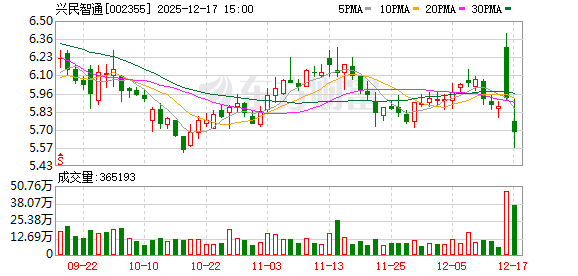
兴民智通:公司为无人驾驶开发了高网络可靠性的双5g智能网联终端产品—通信域控制器
Mei Ri Jing Ji Xin Wen· 2025-12-17 13:58
兴民智通(002355.SZ)12月17日在投资者互动平台表示,公司重视无人驾驶领域产品的布局开发,为 无人驾驶开发了高网络可靠性的双5g智能网联终端产品—通信域控制器(ICVBOX),目前已在L3L4 无人驾驶汽车Robotaxi、无人物流车上配套,服务客户涵盖百度萝卜快跑、Momenta以及国内主流车 企。 (文章来源:每日经济新闻) 每经AI快讯,有投资者在投资者互动平台提问:公司在L3 L4级无人驾驶方面有哪些布局? ...

L3级自动驾驶车型产品获准入许可 智能网联汽车迈入量产应用
Shang Hai Zheng Quan Bao· 2025-12-16 18:45
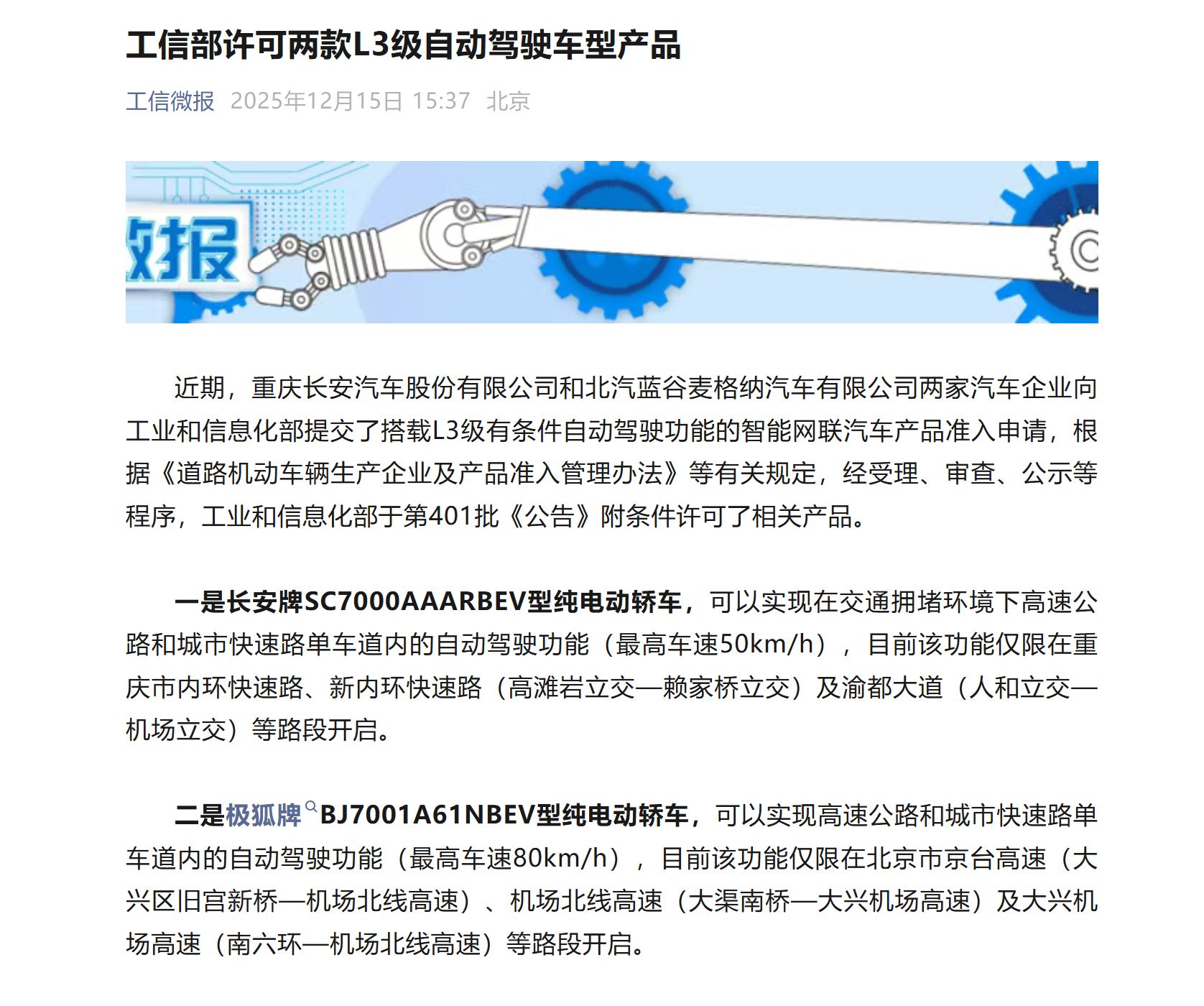
L3级自动驾驶正式"持证上路" 记者了解到,这次公布的两款车型,来自重庆长安汽车股份有限公司和北汽蓝谷麦格纳汽车有限公司。 一款长安牌纯电动轿车,可以实现在交通拥堵环境下高速公路和城市快速路单车道内最高时速50公里的 自动驾驶功能,目前该功能仅限在重庆市有关路段开启。一款北汽集团旗下极狐牌纯电动轿车,可以实 现高速公路和城市快速路单车道内最高时速80公里的自动驾驶功能,目前该功能仅限在北京市有关路段 开启。 据工业和信息化部信息,下一步,两款车型将由重庆长安车联科技有限公司、北京出行汽车服务有限公 司两家使用主体在上述区域内开展上路通行试点。相关部门将加强车辆运行监测和安全保障,不断健全 智能网联汽车准入管理和标准法规体系,推动我国智能网联新能源汽车产业高质量发展。 12月15日,工业和信息化部公布我国首批L3级有条件自动驾驶车型准入许可,两款分别适配城市拥 堵、高速路段的车型将在北京、重庆两地指定区域开展试点。 "我国自动驾驶在发展进程中迈出了重要一步,L3级自动驾驶从测试阶段开始迈入商业化应用阶段。"同 济大学汽车学院汽车产业与技术战略研究中心主任王宁告诉上海证券报记者,这表明L3级自动驾驶技 术成熟度得 ...