
外汇

Search documents
Gold News: Price Holds Key Support as 87% Fed Cut Odds Fuel Bullish Setup
FX Empire· 2025-12-03 12:38
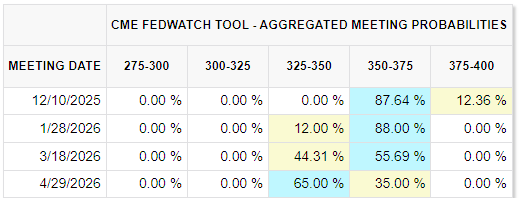
Group 1 - The market is currently pricing an 87% chance of a December rate cut by the Federal Reserve, a significant increase from 30% two weeks ago, influenced by weaker jobs data and dovish comments from Fed Governor Christopher Waller [2] - Treasury yields are declining, with the 10-year yield at 4.063% and the 2-year yield at 3.49%, which supports non-yielding assets like gold due to lower opportunity costs [3] - The upcoming economic data releases, including ADP employment, ISM Services, and delayed September PCE, will determine if the Fed's dovish stance is confirmed or challenged, impacting gold prices [4] Group 2 - The dollar is experiencing its ninth consecutive daily loss, down 0.15% to 99.10 on the index, marking a nearly 9% decline for the year, primarily due to changing rate expectations [5] - The decline in the dollar is further influenced by the euro gaining strength on potential Ukraine peace deal hopes and the yen firming due to discussions of a Bank of Japan rate hike [5]


美韩贸易协议刺激美元需求 韩国大幅提高2026年外汇稳定债券发行上限
智通财经网· 2025-12-03 06:25
Core Points - South Korea is increasing its annual foreign exchange stabilization bond issuance limit from $1.4 billion to $5 billion for 2026, more than doubling the original plan, in response to rising dollar demand due to a trade agreement with the U.S. [1] - The issuance of foreign exchange stabilization bonds aims to address currency fluctuations and capital outflow pressures, with a commitment to invest $350 billion in the U.S. and limit annual dollar outflows to $20 billion [1] - The South Korean government is taking measures to boost foreign exchange reserves, including issuing $1.7 billion in Samurai and U.S. dollar bonds and €1.4 billion (approximately $1.6 billion) in euro bonds [1] Financial Ratings and Currency Trends - Moody's, S&P Global, and Fitch have rated South Korea's sovereign debt at Aa2, AA, and AA- respectively, indicating strong creditworthiness [2] - The South Korean won has depreciated over 7% against the U.S. dollar in the second half of the year, reaching its lowest level in 16 years, making it the worst-performing Asian currency during this period [2] - The South Korean government is concerned about the increasing uncertainty in the foreign exchange market and is actively considering all available tools to address the depreciation of the won [2] Government Response and Measures - An emergency meeting was convened on November 24 by multiple government departments, led by the Ministry of Finance, to discuss specific measures to stabilize the foreign exchange market [2] - The meeting focused on effectively alleviating the depreciation pressure on the won and evaluating potential intervention strategies [2]
韩国大幅上调外汇平准化债券购买上限以应对美元需求预期
Xin Hua Cai Jing· 2025-12-03 05:49
根据周二晚些时候国会批准的年度预算计划,2026年的购买上限提高到50亿美元,而政府早先的提案为 14亿美元。2025年的上限设定为35亿美元。 此举是在韩国承诺根据其与美国的贸易协议提供3500亿美元的美国投资方案之后出台的。官员们表示, 所需的资金将通过海外发行政府担保债券以及管理国家外汇储备的收益来筹集。 新华财经北京12月3日电韩国已将其外汇平准化债券的年度购买上限提高至原计划的三倍以上,原因是 市场对韩美贸易和投资协议的担忧提高了对美元需求的预期。 (文章来源:新华财经) ...
今日期货市场重要快讯汇总|2025年12月3日
Xin Lang Cai Jing· 2025-12-03 00:51
Group 1: Precious Metals Futures - Spot gold prices experienced significant volatility, dropping to $4,180 per ounce on December 2, with a daily decline of 1.36% and further falling to $4,170 per ounce, resulting in a total daily drop of 1.52% [1][2] - Concurrently, New York futures gold also declined, falling below $4,210 per ounce with a daily drop of 1.55%, and further decreasing to below $4,200 per ounce, marking a daily decline of 1.76% [3][4] - However, on the morning of December 3, spot gold rebounded, surpassing $4,210 per ounce with a daily increase of 0.13% [5] - Silver's main contract showed strong performance, rising by 1% to 13,627.00 yuan on December 2, and further increasing by 2%, currently reported at 13,762.00 yuan [6][7] Group 2: Energy and Shipping Futures - U.S. crude oil inventories saw an increase, with the American Petroleum Institute (API) reporting a rise of 2.48 million barrels last week, compared to a decrease of 1.859 million barrels the previous week [8] Group 3: Macro and Market Impact - The European Central Bank's foreign exchange reserves saw a slight adjustment, increasing by 300 million euros to 328.4 billion euros [9] - The U.S. dollar index fluctuated due to policy expectations, with a 0.1% decline to 99.33 following comments from Trump regarding potential Federal Reserve chair candidates [10]
印度卢比跌至新低,印央行“走钢丝”
Huan Qiu Shi Bao· 2025-12-02 22:55
Core Insights - The Indian Rupee has depreciated to a historic low against the US Dollar, reaching 89.78 Rupees per Dollar, despite optimistic GDP growth data [2][3] - The depreciation is attributed to a combination of high tariffs imposed by the US on Indian exports and a lack of favorable trade agreements, leading to a significant outflow of foreign investment from the Indian market [3][5] Economic Performance - India recorded its strongest economic growth in six quarters, yet the Rupee continues to weaken, indicating a disconnect between economic performance and currency stability [1][2] - The Indian economy faces challenges due to high tariffs on exports, particularly in the context of US-India trade relations, which have worsened since July [3][5] Currency Trends - The Rupee has experienced its most severe monthly decline since 2022, driven by external pressures and domestic economic concerns [3] - The Reserve Bank of India has reportedly sold over $30 billion in foreign exchange assets to stabilize the Rupee, but the currency continues to face downward pressure [4] Foreign Investment - Foreign investors have withdrawn nearly $16.3 billion from the Indian stock market this year, approaching record outflow levels from 2022, exacerbating the Rupee's depreciation [3][5] - The lack of confidence in India's economic outlook and the high tariffs have led to a significant reduction in foreign investment, impacting the overall market sentiment [5] Trade Relations - The high tariffs imposed by the US on Indian goods have created a challenging environment for Indian exporters, particularly those reliant on the US market [3][5] - The ongoing trade tensions and lack of agreements with the US have raised concerns about India's international balance of payments and economic performance [5][6] Comparative Analysis - The Indian Rupee's performance is notably weaker compared to other emerging market currencies, as many Southeast Asian countries face less tariff pressure from the US [6] - The persistent current account deficit in India, where imports exceed exports, further diminishes demand for the Rupee compared to countries with current account surpluses [6]
【中金外汇 · 年度展望】宽松交易或回归
Sou Hu Cai Jing· 2025-12-02 07:01
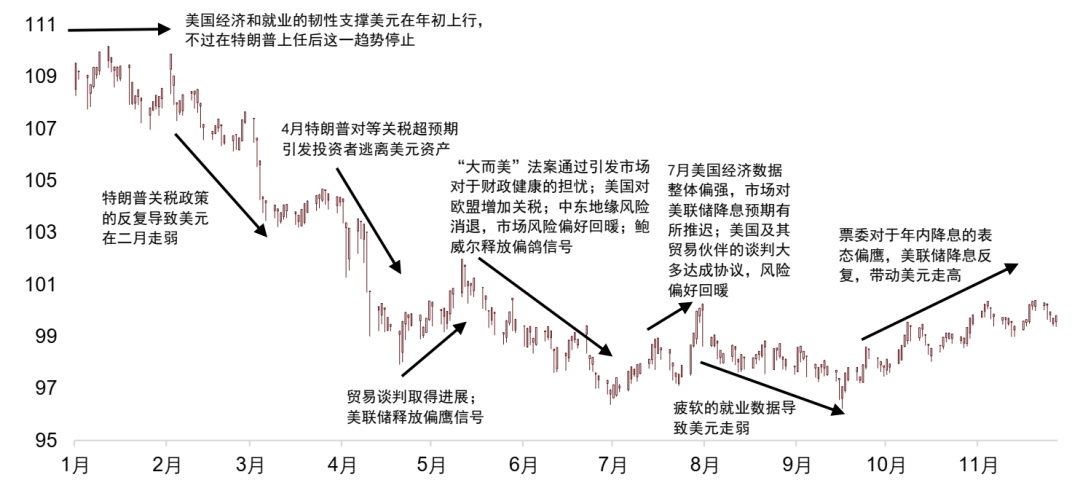
Summary of Key Points Core Viewpoint The global foreign exchange market has been significantly influenced by tariff expectations and fluctuations in the US dollar exchange rate since 2025. The dollar index experienced a notable decline in the first half of 2025, followed by stabilization in the latter half, with expectations of further movements in 2026 driven by interest rate differentials and changes in risk appetite. Group 1: 2025 Overview - The dollar index fell significantly in the first quarter of 2025 due to weaker-than-expected tariff policy advancements by the Trump administration, reversing the "Trump trade" [1] - In the second quarter, the dollar experienced a sharp decline driven by unexpected "reciprocal tariffs" and escalating US-China trade tensions, raising concerns about the US economic outlook and the stability of dollar assets [1][5] - The dollar stabilized in the third quarter as the US reached tariff agreements with major trading partners, alleviating market concerns about economic and financial stability [1][5] Group 2: 2026 Outlook - The narrowing of interest rate differentials and changes in risk appetite are expected to become the main themes in currency trading for 2026 [2][19] - The Federal Reserve's potential for more aggressive rate cuts compared to other non-US central banks may lead to a further decline in the dollar's volatility center [2][19] - The performance of different non-US currencies is likely to diverge, with the euro expected to lead due to improved economic growth dynamics in the Eurozone [3][19] Group 3: Renminbi (RMB) Dynamics - The RMB's exchange rate will be influenced by the dollar's performance and changes in US-China trade relations, with a stable exchange rate policy potentially impacting the RMB's trajectory [3][41] - The RMB is expected to appreciate moderately as the Fed's rate cuts narrow the interest rate differential between China and the US [3][41] - The resilience of the Chinese economy and financial markets under tariff pressures has reduced the impact of tariff risks on the RMB [3][41][64] Group 4: Currency Performance and Strategies - High-yield currencies from Latin America and Europe have performed relatively well, supported by favorable interest rate differentials and lower volatility [12][13] - The carry trade strategy has been the most profitable forex trading strategy in 2025, indicating a return to traditional trading logic based on interest rate differentials [13] - The euro is expected to benefit from reduced need for aggressive rate cuts by the European Central Bank, while the yen and pound may face relative weakness due to domestic policy pressures [3][38][39] Group 5: External Factors and Risks - The US government shutdown and tariff rate fluctuations pose risks to market stability and may increase volatility in the forex market [32][33] - Political uncertainties in France and Japan, as well as geopolitical factors like the Ukraine conflict, could also impact global risk sentiment and currency performance [32][36] - The overall environment is expected to favor a gradual appreciation of the RMB, supported by the internationalization of the currency and a stable economic outlook [62][76]
STARTRADER外汇:英镑/美元走低,预算争议与就业数据成焦点?
Sou Hu Cai Jing· 2025-12-02 03:34
美联储利率调整预期则是全球市场焦点,直接主导美元交易走向。受此前政府停摆影响,官方经济数据发布延迟,供给持续匮乏。12月10日利率决议临近, 决策层陷入困境——劳动力市场与通胀水平均缺乏最新数据支撑判断。 12月交易开启,英镑对美元周一开盘即下行,当日跌幅约0.25%,汇价重回关键技术面聚合区域。全球资金若持续流向美元,这一区域的技术特征或将进一 步作用于英镑交易情绪。 英镑走势当前深度绑定英国政治与财政动态。财政大臣蕾切尔·里夫斯因政府预算议题引发热议,外界质疑其对财政状况的表述存在偏差。 英国预算责任办公室(OBR)最新数据显示,工资增长、税收收入双双超预期,不仅抵消生产率下滑影响,更令政府财政从预估赤字转为盈余。即便如 此,蕾切尔·里夫斯仍坚持推进预算税负调整。 首相基尔·斯塔默领导的政府在议会举步维艰:民调支持率持续下滑,工党内部支持也在弱化。这种政治不确定性已成为影响英镑交易的关键变量,近期资 金流出特征明显,直接限制了英镑对美元的上行空间。 具体到英镑对美元价格表现,周一汇价在1.3250水平遇强阻,盘中买盘未能推动突破,最终回落至1.3200附近。 技术面显示,1.3250区域同时叠加50日与2 ...
特朗普称已确定下任美联储主席人选
Dong Zheng Qi Huo· 2025-12-01 01:29
1. Report Industry Investment Ratings No relevant content provided. 2. Core Views of the Report - Trump has determined the next Fed Chair nominee, likely Kevin Hassett, which is expected to increase market risk appetite and weaken the US dollar [2][13]. - After a sharp decline, the odds of the bond market have improved, but there is a risk of further adjustment as policy expectations rise [3][23]. - Due to floods in palm oil - producing areas, the supply pressure is expected to ease, and palm oil prices may rebound [4][25]. - CSPT's decision to cut copper production in 2026 and other factors are expected to drive copper prices to continue to rise [4][45]. - OPEC+ has decided to suspend production increases in Q1 2026, and short - term oil prices will maintain a volatile trend [5][67]. 3. Summary by Directory 3.1 Financial News and Comments 3.1.1 Macro Strategy (Gold) - A data center cooling system problem in Chicago led to a trading halt at CME, causing disruptions in multiple markets. Gold rose about 1.5% and silver soared 5% on Friday, driven by expectations of Fed rate cuts. The Shanghai and Shanghai Gold Exchange silver inventories are falling, and the CME trading halt has reduced market liquidity. It is recommended to reduce positions [10]. 3.1.2 Macro Strategy (Foreign Exchange Futures - US Dollar Index) - The Japanese Finance Minister said the rapid yen depreciation is not driven by fundamentals. Trump has determined the next Fed Chair nominee, and it is expected that Hassett will be elected, leading to increased market risk appetite and a weaker US dollar [11][13]. 3.1.3 Macro Strategy (US Stock Index Futures) - Ukraine's new negotiation representative went to the US to discuss ending the war. The CME system failure caused trading interruptions. The US rate - cut expectations are rising, and the market risk appetite has improved. The US stock index is expected to continue to repair and show a strong - biased volatile trend [15][16]. 3.1.4 Macro Strategy (Stock Index Futures) - China's November official manufacturing PMI was 49.2, slightly up from the previous value. The National Development and Reform Commission held a private enterprise symposium. The stock market trading volume has shrunk, and there may be no trend - based market in the short term. It is recommended to evenly allocate long positions in stock indices [18][19]. 3.1.5 Macro Strategy (Treasury Bond Futures) - China's November official manufacturing PMI was 49.2, in line with expectations. The central bank conducted a 3013 - billion - yuan 7 - day reverse repurchase operation, with a net withdrawal of 737 billion yuan on the day. The bond market has a risk of further adjustment as policy expectations rise. It is recommended to short long - term bond varieties on rebounds [21][23]. 3.2 Commodity News and Comments 3.2.1 Agricultural Products (Soybean Oil/Rapeseed Oil/Palm Oil) - Continuous heavy rain in Indonesia's Sumatra has caused floods and landslides. The supply pressure of palm oil is expected to ease, and prices may rebound. It is recommended to consider short - term long positions [25]. 3.2.2 Agricultural Products (Sugar) - As of the end of November, about 30 sugar mills in Guangxi and Yunnan have started production. The sugar production in Guangxi in November is expected to be 100,000 tons, far lower than last year. The Zhengzhou sugar 1 - month contract is expected to oscillate, and the main funds will gradually shift to the 5 - month contract [26][31]. 3.2.3 Agricultural Products (Cotton) - In October, China's cotton product exports decreased year - on - year but increased month - on - month. The EU's clothing imports from China increased in Q3. The US cotton export signing and shipment increased in the week ending October 16. The Zhengzhou cotton is expected to be strongly volatile in the short term and cautiously optimistic in the long term [32][35]. 3.2.4 Black Metals (Rebar/Hot - Rolled Coil) - Malaysia plans to add 48.4 million tons of steel production capacity from 2030 - 2035. China's November automobile dealer inventory warning index was 55.6%, up year - on - year and month - on - month. Steel prices are expected to oscillate with a slight rebound, and it is recommended to take an oscillatory approach [36][38]. 3.2.5 Agricultural Products (Soybean Meal) - Oil mills maintained a high operating rate. Argentina's soybean planting was 39% complete as of November 27. The US sold 312,000 tons of soybeans to China. International markets should focus on China's soybean purchases and South American weather, and domestic soybean meal is expected to oscillate [39][41]. 3.2.6 Agricultural Products (Corn Starch) - The price difference between corn starch and tapioca starch has widened. Corn starch is expected to be strong in the short term, and it is recommended to operate in the price - difference range in the medium - short term and expect it to strengthen in the long term [42][43]. 3.2.7 Agricultural Products (Corn) - As of November 27, the average grain - selling progress in Northeast China was 26%, and in North China was 25%, both faster than last year. Corn futures contracts are expected to have different trends, and it is not recommended to short against the trend in the short term [43][44]. 3.2.8 Non - ferrous Metals (Copper) - CSPT agreed to reduce copper production capacity by over 10% in 2026. Chile's October copper production decreased by 7% year - on - year. Copper prices are expected to rise, and it is recommended to buy on dips [45][48]. 3.2.9 Non - ferrous Metals (Polysilicon) - Hainan's new - energy power price was cleared at the upper limit. Polysilicon prices are under pressure, and it is recommended that investors operate with caution due to high volatility [49][51]. 3.2.10 Non - ferrous Metals (Industrial Silicon) - The operating rates of silicon enterprises in Sichuan and Yunnan are declining. The market is expected to oscillate between 8800 - 9500 yuan/ton, and it is recommended to focus on range - bound operations [52][54]. 3.2.11 Non - ferrous Metals (Lead) - On November 27, LME lead had a large - scale backwardation. The old - standard electric bicycle CCC certificates will be cancelled from December 1. The lead market is short of supply and strong in demand, and it is recommended to buy on dips [55][56]. 3.2.12 Non - ferrous Metals (Zinc) - On November 27, LME zinc had a large - scale contango. Antamina's zinc ore tender price was below $30/dry ton. Zinc prices are likely to rise, and it is recommended to observe buying opportunities on the right side and hold long - spread positions [57][58]. 3.2.13 Non - ferrous Metals (Lithium Carbonate) - Frontier Lithium released its mid - term report. The lithium carbonate market may face short - term callback pressure, and it is recommended to short on highs in the short term and buy on lows in the medium term [59][62]. 3.2.14 Non - ferrous Metals (Nickel) - Indonesia simplified the RKAB approval process. The nickel market is in surplus, and nickel prices are expected to oscillate at the current level [63][64]. 3.2.15 Energy Chemicals (Carbon Emissions) - On November 28, the EUA main contract closed at €83.26/ton. EU carbon prices are supported by auction suspension and reduced supply in 2026 but may be suppressed by warm weather [65]. 3.2.16 Energy Chemicals (Crude Oil) - OPEC+ decided to suspend production increases in Q1 2026. US crude oil production reached a record high in September. Short - term oil prices will maintain a volatile trend, and it is recommended to pay attention to the Russia - Ukraine negotiation progress [67][70]. 3.2.17 Shipping Index (Container Freight Rates) - The UK plans to cancel the small - package tariff exemption in 2029. The SCFI index rose. The container freight market is expected to oscillate, and it is recommended to consider light - position long positions in the 02 contract [71][72].
10月份中国外汇市场总计成交21.97万亿元
Jin Rong Shi Bao· 2025-12-01 01:09
2025年1至10月份,中国外汇市场累计成交252.07万亿元人民币(等值35.21万亿美元)。 责任编辑:袁浩 本报讯 记者马玲报道 国家外汇管理局11月28日发布的统计数据显示,2025年10月,中国外汇市场 (不含外币对市场,下同)总计成交21.97万亿元人民币(等值3.10万亿美元)。其中,银行对客户市场 成交3.57万亿元人民币(等值0.50万亿美元),银行间市场成交18.40万亿元人民币(等值2.59万亿美 元);即期市场累计成交8.26万亿元人民币(等值1.16万亿美元),衍生品市场累计成交13.71万亿元人 民币(等值1.93万亿美元)。 ...
韩元波动加剧 韩国政府加强外汇市场稳定和监管
Sou Hu Cai Jing· 2025-12-01 00:27
Core Viewpoint - The South Korean government has announced new measures to stabilize the foreign exchange market, aiming to address the long-standing imbalance in foreign exchange supply and demand, which has recently intensified the volatility of the Korean won [1] Group 1: Government Measures - The government will enhance regulation of foreign exchange transactions by export companies and will regularly monitor the flow of overseas investment funds [1] - Regulatory authorities will review the foreign exchange income and expenditure of export companies and seek policy tools to support their overseas investment activities [1] - Special inspections will be conducted to ensure adequate protection measures for overseas investments [1] Group 2: Central Bank Actions - The South Korean central bank is in discussions with pension funds to expand foreign exchange swap limits, which will help alleviate dollar liquidity pressure and enhance market resilience [1] - These measures are part of broader efforts to strengthen market operations and maintain stability [1]