
玩具

Search documents
每周一场促销活动,2026第一波广货福利来了
Sou Hu Cai Jing· 2026-01-14 06:22
Core Viewpoint - The "Guangdong Goods Go Global" Spring Action will officially launch on January 15, aiming to help enterprises expand their markets and boost sales through a series of promotional activities throughout the first quarter [1][4]. Group 1: Promotional Activities - The Spring Action will feature 12 online and offline promotional events throughout the first quarter, focusing on key categories such as home appliances, mobile phones, clothing, food, 3C digital products, beauty, home goods, toys, and daily chemicals [1][4]. - Each promotional event will showcase 30 to 50 high-quality enterprises, presenting Guangdong-made products that are high in technology content, cost-effective, and well-recognized in the market [1][4]. Group 2: Event Launch and Structure - The launch ceremony and home appliance promotional event will take place in Foshan, marking the beginning of the year's activities, followed by specialized events for mobile phones, clothing, food, 3C digital products, smart terminals, and automobiles in various cities and online platforms [4]. - The promotional strategy emphasizes online and offline collaboration, utilizing major e-commerce platforms such as Alibaba, JD.com, Douyin, Kuaishou, Pinduoduo, and Vipshop to create dedicated promotional sections and topics for Guangdong products [4]. Group 3: Marketing and Consumer Engagement - The Spring Action will include 18 diverse marketing activities aligned with key consumption periods such as the Spring Festival and Lantern Festival, featuring offline markets, live streaming from production sites, cross-border e-commerce events, and "Guangdong Brand Super Day" [4][8]. - The initiative aims to integrate product displays with local culture, traditional customs, and industry stories, enhancing consumer engagement with Guangdong manufacturing [4][8]. Group 4: Industry and Policy Support - The action will focus on "going into the industry front line," showcasing production management, quality control, and innovation through live factory visits and media coverage, thereby increasing consumer trust in Guangdong manufacturing [8]. - The Spring Action will align with policies promoting consumption, such as trade-in programs and "Guangdong Quality Purchase," to lower costs for enterprises participating in online promotions and live streaming sales [8].

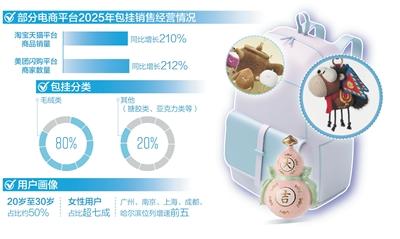
看中国好物七十二变丨玩具新潮催生“包挂经济”
Ren Min Ri Bao· 2026-01-14 04:58
Core Insights - The article discusses the emerging "bag-hanging economy," characterized by the popularity of small, portable accessories that serve as emotional expressions and social symbols among young consumers [4][5][6][8]. Group 1: Consumer Trends - Bag-hanging products are increasingly favored for their small size, low cost, and strong emotional value, catering to the psychological needs of young consumers who prioritize emotional satisfaction over mere utility [6][7][12]. - These accessories serve as "visual emotional expressions," helping consumers identify like-minded individuals and form new social circles [8][9]. - The trend reflects a shift in consumer behavior, where items are not just toys but also personal statements and reminders of experiences, often linked to local culture and personal memories [9][10]. Group 2: Industry Dynamics - Dongguan, known as the "Toy Capital of China," has become a manufacturing hub for bag-hanging products, housing over 4,000 toy manufacturers and 1,500 supporting companies, creating a complete industry chain from design to sales [10][11]. - The industry has shifted from mass production to flexible manufacturing, allowing for rapid design iterations and small batch production, which meets the fast-changing market demands [11][12]. - The integration of smart manufacturing and digital workshops has enabled lower production costs and quicker turnaround times, facilitating the production of unique items even in small quantities [11][12]. Group 3: Global Expansion - Chinese bag-hanging products are gaining international traction, with successful examples like the "Labubu" character and collaborations with popular media, enhancing their appeal in overseas markets [14][15]. - The rise of Chinese cultural products in global markets is supported by a growing acceptance of Chinese culture and aesthetics, with brands adapting their offerings to resonate with local consumers [15][16]. - The Chinese toy industry is leveraging its strong supply chain to enhance its global presence, with significant growth in regions like Southeast Asia, Europe, and the Americas projected for 2025 [15][16].
外贸展现强大韧性!2025年中国出口同比增长5.5%
Xin Lang Cai Jing· 2026-01-14 04:38
Core Viewpoint - China's export growth in December 2025 reached 6.6% year-on-year, while imports grew by 5.7%, indicating a positive trend despite external trade tensions [1][5]. Group 1: Export Performance - In 2025, China's total export growth was 5.5%, slightly down from 5.9% in the previous year, while imports remained flat compared to a 1.1% increase in 2024 [2][6]. - The strong export performance is attributed to three main factors: 1. A significant decline of nearly 20% in exports to the U.S. was offset by increased exports to the EU and Belt and Road Initiative countries [2][6]. 2. Upgrades in domestic manufacturing and a surge in global AI investments boosted exports of chips and automobiles, counterbalancing declines in traditional labor-intensive goods [2][6]. 3. Fluctuations in U.S. tariffs led to a "rush to export and import" phenomenon, with U.S. imports rising by 7.4% year-on-year from January to September 2025, supporting global trade growth [2][6]. Group 2: Future Export Outlook - For 2026, a potential decline in export growth is anticipated, with estimates around 1.0%, particularly due to high tariffs on U.S. goods [3][7]. - The U.S. trade representative indicated that a 25% decrease in U.S.-China trade is a step in the right direction, suggesting continued challenges in the U.S. market [3][7]. - Despite trade tensions, resilience in exports is expected due to new demands from emerging markets, global AI investments, and China's strong position in midstream and upstream sectors [3][7]. Group 3: Import Dynamics - Import momentum is likely to be affected by the slowdown in exports, but domestic policies aimed at boosting consumption and investment are expected to support demand for consumer goods and bulk commodities [3][7]. - The Central Economic Work Conference emphasized the importance of expanding domestic demand as a key focus for economic policy in 2026 [4][8]. Group 4: Investment Strategies - The Central Financial Office highlighted the need to stabilize investment, which has been declining, by leveraging government investments and optimizing project implementations [4][8]. - The focus for 2026 will be on real estate, infrastructure, and private investments to enhance overall investment contributions to the economy [4][8].
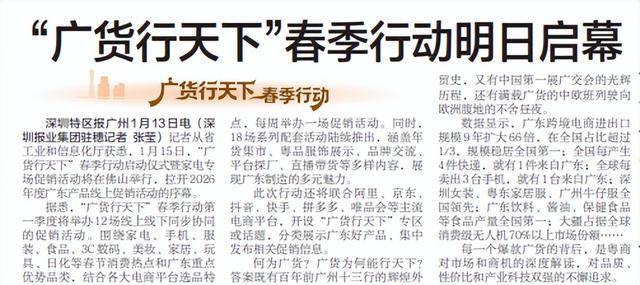
【深圳特区报】“广货行天下”春季行动明日启幕
Sou Hu Cai Jing· 2026-01-14 03:18
Group 1 - The "Guangdong Goods Going Global" spring campaign will kick off on January 15, 2026, in Foshan, marking the beginning of online promotional activities for Guangdong products [1] - The first quarter of the campaign will feature 12 promotional events, both online and offline, focusing on consumer hotspots such as home appliances, mobile phones, clothing, food, 3C digital products, beauty, home goods, toys, and daily chemicals [3] - The campaign will collaborate with major e-commerce platforms like Alibaba, JD.com, Douyin, Kuaishou, Pinduoduo, and Vipshop to create dedicated sections or topics for showcasing Guangdong products and promoting related information [3] Group 2 - Guangdong's cross-border e-commerce import and export scale has expanded 66 times over the past nine years, accounting for over one-third of the national total, maintaining the largest scale in the country [3] - Guangdong produces one out of every four express deliveries in China, and one out of every three smartphones sold globally comes from Guangdong [3] - The region leads the nation in the production of beverages, soy sauce, and health foods, with DJI holding over 70% of the global market share for consumer drones [3]
中国品牌浪潮:从世界工厂到全球心智占领
Sou Hu Cai Jing· 2026-01-14 02:49
Core Insights - The article discusses the transformation of Chinese brands from being known as "Made in China" to becoming global brand leaders through emotional connections and cultural exports, highlighting four key characteristics of this shift [1][10][14]. Group 1: Brand Globalization - The speed of brand globalization has significantly increased, with the time required to establish brand recognition in overseas markets reduced from ten years to just 3-5 years [14]. - Enhanced infrastructure, including cross-border e-commerce platforms and social media marketing, has facilitated this rapid expansion, shifting the approach from a "prolonged battle" to a "lightning war" [14][15]. Group 2: Evolution of Export Categories - The scope of exports has evolved from physical products to include cultural IP and services, with IP product exports growing at a rate of 8%, surpassing the average growth of consumer goods exports [15][19]. - This evolution signifies a transition for Chinese brands from being mere suppliers to becoming co-creators of value through deeper interactions with consumers [15][19]. Group 3: Deepening Export Models - The export model has shifted from simple trade to a comprehensive global supply chain layout, indicating that Chinese brands are moving from being participants in the global market to becoming network builders [16]. - Companies are now integrating R&D and production globally, enhancing their competitiveness and embedding themselves within local economic ecosystems [16]. Group 4: Consumer Connection Channels - Brands are moving away from reliance on third-party platforms like Amazon, adopting a multi-channel operation system that includes DTC (Direct-to-Consumer) models [17]. - This transition allows brands to directly reach consumers, gain insights into their needs, and accumulate user assets more effectively [17]. Group 5: Regional Market Opportunities - The Asia-Pacific market is experiencing rapid demand growth, particularly in beauty and fashion sectors, due to localized innovation and cost advantages [22]. - In contrast, the North American and European markets prioritize technology, design, and sustainability, making consumer electronics and high-end appliances more likely to gain acceptance [23]. - Latin America presents opportunities for high-cost performance products like smartphones and white goods, while the Middle East and Africa focus on basic needs, with daily necessities and communication devices achieving scale through cost optimization [24]. Group 6: Strategic Paths for Exporting Companies - Companies are forming three strategic paths based on their strengths: - A-class "Scale Guardians" like Haier focus on global supply chain integration and localized operations to enhance value in existing markets [21]. - B-class "Value Heights" brands like Miniso leverage IP collaborations and localized co-creation to build emotional connections with consumers [21]. - C-class "New Star Disruptors" like Huaxizi utilize "super products + cultural symbols" strategies to rapidly capture market attention and occupy niche segments [21]. Group 7: Case Studies - Haier has successfully established a localized operational system, achieving overseas revenue of 143.81 billion yuan in 2024, marking a 5.43% increase [33]. - Miniso's overseas revenue grew by 41.9% to 6.68 billion yuan in 2024, with a focus on flagship stores in prime locations to enhance brand experience [38]. - Huaxizi has entered over 110 countries, with significant sales in Japan, leveraging unique product designs and cultural narratives to build brand recognition [42][43].




布鲁可(00325):积木车及出海有望为26年增长亮点
HTSC· 2026-01-14 01:38
Investment Rating - The investment rating for the company is maintained as "Buy" with a target price of HKD 98.00 [1][5] Core Views - The company is expected to see growth in 2026 driven by its "all demographics + all price points + globalization" strategy, with new product lines such as building cars and international expansion contributing significantly [2][3] - Despite a weaker performance in traditional toy segments in 2025, new business lines like the 9.9 yuan Starry Edition and adult-oriented products are anticipated to boost revenue in the second half of 2025 and continue into 2026 [2] - The company has expanded its IP matrix, increasing the number of commercialized IPs from 14 in 2024 to 24 in 2025, with a total of approximately 63 IPs available for future development [2] - The introduction of new product categories, particularly building cars, is expected to contribute additional revenue in 2026, with the global vehicle toy market projected to reach RMB 102.8 billion [4] Summary by Sections Revenue and Profit Forecast - The adjusted profit forecast for 2025-2027 is projected at RMB 6.50 billion, RMB 8.71 billion, and RMB 11.60 billion respectively, with adjusted EPS of RMB 2.61, RMB 3.50, and RMB 4.65 [5][11] - Revenue is expected to grow significantly, with estimates of RMB 2.90 billion in 2025 and RMB 3.77 billion in 2026, reflecting year-on-year growth rates of 29.42% and 30.08% respectively [11][19] International Expansion - The company has made significant strides in its global strategy, achieving overseas revenue of RMB 1.11 billion in the first half of 2025, a year-on-year increase of 899%, with overseas revenue accounting for 8.3% of total revenue [3] - The company has showcased its products at international toy fairs in various countries, enhancing its global presence and brand recognition [3] Product Development - The company has accelerated its product launch schedule, with over 900 new SKUs introduced in 2025, particularly in the fourth quarter, which is expected to positively impact revenue in early 2026 [2] - The new building car products launched in November 2025 are expected to leverage high-density materials and innovative designs, enhancing user experience and driving sales growth [4]
爆款圈粉全球:“广货行天下”春季行动来了
21世纪经济报道· 2026-01-14 00:29
Core Viewpoint - Guangdong products, known as "广货," have been popular for over 40 years, driven by the region's deep understanding of consumer needs and a commitment to quality products that are functional, aesthetically pleasing, and marketable [2] Group 1: Spring Action Launch - The "广货行天下" spring action will officially kick off on January 15, 2026, with a series of promotional activities planned, including 10 offline and 2 online events in the first quarter [2][5] - A total of 18 supporting activities will be organized to showcase the diverse appeal of Guangdong manufacturing [2][10] Group 2: Promotional Activities - The promotional events will adopt a "one product per week" format, focusing on key categories such as home appliances, mobile phones, clothing, food, 3C digital products, beauty, home goods, toys, and daily chemicals [7] - Each week, a promotional theme will be introduced in collaboration with local cities and major e-commerce platforms [7] Group 3: Marketing Strategies - The activities will include factory visits to highlight outstanding brands and quality products, enhancing consumer trust through live broadcasts of management and production processes [13] - Live streaming sales will be integrated with local festivals and cultural activities to boost product visibility and influence [13] Group 4: E-commerce Platform Participation - Six major e-commerce platforms will establish "广货行天下" promotional sections, each focusing on specific product categories: - Taobao/Tmall will promote smart home appliances and food - JD.com will focus on mobile phones and digital electronics - Pinduoduo will emphasize clothing and daily necessities - Douyin will highlight 3C electronics, beauty, and home goods - Kuaishou will promote daily consumer goods and festive food - Vipshop will focus on clothing and mobile phones [16]

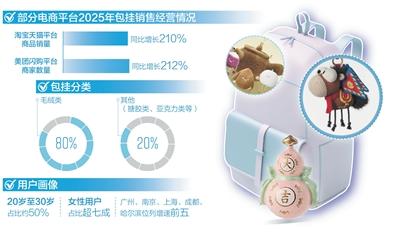
玩具新潮催生“包挂经济”
Xin Hua Wang· 2026-01-14 00:07
Core Insights - The rise of "bag-hanging economy" reflects a shift in consumer preferences towards portable, emotionally resonant products that serve as social symbols and personal expressions [3][4][5][6][7][8] Group 1: Consumer Trends - Bag-hanging products are increasingly popular among young consumers, characterized by small sizes and emotional value, fulfilling psychological needs beyond mere utility [5][6] - Consumers view bag-hanging items as "emotional companions" and social symbols, facilitating connections among individuals with similar values [7][8] - The trend is driven by a desire for personal expression and emotional connection, with products often reflecting local culture and personal experiences [8] Group 2: Industry Dynamics - Dongguan, known as the "capital of trendy toys," has become a manufacturing hub for bag-hanging products, housing over 4,000 toy manufacturers and 1,500 supporting companies [9][10] - The industry has shifted from mass production to flexible manufacturing, allowing for rapid design iterations and small-batch production to meet changing consumer demands [10][11] - The integration of smart manufacturing and digital workshops has enabled cost-effective production of small quantities, enhancing responsiveness to market trends [10] Group 3: Global Expansion - Chinese bag-hanging products are gaining international traction, with successful entries into markets in North America, Europe, and Southeast Asia, driven by unique cultural narratives and emotional resonance [12][13][14] - The rise of local brands and IP collaborations has enhanced the appeal of Chinese products abroad, showcasing a blend of traditional culture and modern design [14][15] - Future strategies include adapting products to local cultures while maintaining a connection to Chinese heritage, aiming to build emotional ties with global consumers [14][15]
“哭哭马”背后的 “情绪消费”蓝海
Mei Ri Shang Bao· 2026-01-13 22:20
Group 1 - The "Crying Horse" toy from Yiwu has unexpectedly become a bestseller, with daily orders nearing 20,000 and production lines increased from 2 to 15 to meet demand [1][2] - The rise of "emotional consumption" is highlighted, with various products and trends reflecting consumers' willingness to pay for emotional value, such as the popularity of the "Crying Horse" and other emotional products [1][2] - The emotional economy in China is projected to reach a market size of 2.3 trillion yuan by 2024, with expectations to exceed 4.5 trillion yuan by 2029, indicating significant growth potential in this sector [3] Group 2 - The "Crying Horse" resonates with consumers, particularly in the workplace, as it reflects the pressures and emotional struggles faced by workers, thus becoming a favored item among them [2] - The shift in consumer behavior from material needs to emotional fulfillment is evident, with consumers increasingly valuing the emotional resonance and satisfaction derived from their purchases [2][3] - The emergence of the "Z Generation" as a key consumer group emphasizes the trend towards emotional spending, as they prioritize experiences and emotional value in their consumption choices [2][3]
AI玩具赛道能否跑出下一个LABUBU?
Zheng Quan Ri Bao· 2026-01-13 16:49
Core Insights - The AI toy market is experiencing unprecedented growth, with sales in the first half of 2025 increasing by 600% quarter-on-quarter and over 200% year-on-year, driven by consumer demand and significant investment activity [1][2] - The industry is characterized by a diverse range of players, including tech startups, traditional toy manufacturers, and internet giants, all vying for a share of the AI toy market [2][4] - The pursuit of "realistic emotional interaction" has become a consensus among AI toy manufacturers, with competition shifting towards enhancing user experience [4][7] Market Dynamics - As of June 2025, there are 1,766 active companies in the AI toy sector, indicating a robust entry of various enterprises into this market [2] - The average return rate for AI toys is reported to be between 30% and 40%, significantly higher than the 15% for traditional toys, highlighting challenges in consumer acceptance [7] - AI toys generally have a higher profit margin compared to traditional toys, with prices ranging from 200 to 700 yuan, and some products priced significantly higher due to advanced features [5][6] Technological Integration - Companies are integrating advanced AI technologies into toys, enabling features such as memory retention and interactive dialogue, which enhance the emotional connection with users [2][3] - The development of multi-modal large models is a focus for traditional hardware companies, aiming to create more engaging AI toy experiences [3][4] - The industry is leveraging China's robust manufacturing capabilities, with domestic chips expected to account for 82% of AI toy components by 2025, providing a cost advantage [6] Commercial Strategies - AI toys are adopting a business model that combines one-time hardware sales with ongoing software subscription fees, extending product lifecycles [6] - Companies are exploring B2B solutions, offering comprehensive AI toy packages to small and medium enterprises, thereby creating additional revenue streams [6] - The industry is encouraged to maintain originality and avoid imitation, as suggested by industry leaders, to foster innovation and long-term growth [7] Regulatory Environment - The Ministry of Industry and Information Technology is working on revising national standards for toy safety, particularly concerning privacy and data security for AI toys that interact frequently with children [8] - The government aims to guide toy companies in applying AI technology to create new consumer demands, indicating a supportive regulatory framework for the industry [8]