
调味品

Search documents
恒顺醋业推出香醋可乐
Bei Jing Shang Bao· 2026-01-28 13:20
Core Viewpoint - Hengshun Vinegar Industry has launched a new product called "Fragrant Vinegar Cola," which incorporates six-year aged Hengshun vinegar, targeting various consumption scenarios such as beverage mixing, gifting, and sports [1]. Product Details - The new product features a sufficient amount of carbonation and a sweet and sour taste designed to refresh the palate [1]. - The packaging design of the product follows a retro style reminiscent of "Zhenjiang Vinegar" [1]. - The product is priced at 42 yuan for a pack of six 480ml bottles on Hengshun's official WeChat mini-program [1].

涪陵榨菜:公司存货主要包括原材料、库存商品、发出商品等
Zheng Quan Ri Bao Wang· 2026-01-28 10:40
Core Viewpoint - Fuling Zhacai (002507) is strategically increasing its inventory to take advantage of low raw material prices, aiming to mitigate future cost fluctuations while optimizing production and management to enhance performance [1] Group 1: Inventory Management - The company's inventory consists mainly of raw materials, finished goods, shipped products, and work-in-progress, with raw materials being the largest component [1] - The increase in inventory is a strategic move to stockpile raw materials at lower prices, which is intended to stabilize future costs [1] Group 2: Operational Efficiency - The company is committed to continuously optimizing its production and operational management to improve overall performance [1]

华宝国际发盈警 预期2025年度取得税前亏损2.63亿元至3.43亿元 同比减少约15%至35%
Zhi Tong Cai Jing· 2026-01-28 10:18
华宝国际(00336)发布公告,本集团预期于本年度(截至2025年12月31日止年度)将取得税前亏损介乎人民 币2.63亿元至人民币3.43亿元(包括商誉以及其他资产的减值计提及其他计提),与去年同期的税前亏损 约人民币4.02亿元相比,预期亏损减少约15%至35%。 嘉豪食品主要于中国从事调味品生産、销售、营销及分销。本集团考虑到未来中国餐饮业仍然低迷,以 及嘉豪食品于2025年的收入及营运盈利未如管理层于本公司2024年12月31日的预期,基于审慎及适用的 会计原则,本集团对嘉豪食品的未来销售采取审慎的预测,因而作出以上商誉减值估算。该商誉减值属 初步评估,且不排除会作出修改。 本年度税前亏损主要由于:本公司以及其附属公司层面的股份为基础的薪酬开支约人民币0.98亿元;及 本公司调味品板块旗下的嘉豪食品有限公司及其附属公司(嘉豪食品)所属现金产生单位的商誉减值亏 损,预计介乎人民币4.7亿元至人民币5.3亿元。 ...
华宝国际(00336)发盈警 预期2025年度取得税前亏损2.63亿元至3.43亿元 同比减少约15%至35%
智通财经网· 2026-01-28 10:17
智通财经APP讯,华宝国际(00336)发布公告,本集团预期于本年度(截至2025年12月31日止年度)将取得 税前亏损介乎人民币2.63亿元至人民币3.43亿元(包括商誉以及其他资产的减值计提及其他计提),与去 年同期的税前亏损约人民币4.02亿元相比,预期亏损减少约15%至35%。 嘉豪食品主要于中国从事调味品生産、销售、营销及分销。本集团考虑到未来中国餐饮业仍然低迷,以 及嘉豪食品于2025年的收入及营运盈利未如管理层于本公司2024年12月31日的预期,基于审慎及适用的 会计原则,本集团对嘉豪食品的未来销售采取审慎的预测,因而作出以上商誉减值估算。该商誉减值属 初步评估,且不排除会作出修改。 本年度税前亏损主要由于:本公司以及其附属公司层面的股份为基础的薪酬开支约人民币0.98亿元;及 本公司调味品板块旗下的嘉豪食品有限公司及其附属公司(嘉豪食品)所属现金产生单位的商誉减值亏 损,预计介乎人民币4.7亿元至人民币5.3亿元。 ...
调味品行业深度报告:BC端共振,期待改善
Dongguan Securities· 2026-01-28 09:33
Investment Rating - The report maintains an "Overweight" rating for the food and beverage industry, specifically focusing on the condiment sector [4][75]. Core Insights - The condiment industry in China is experiencing steady market expansion, with the market size projected to grow from 408.1 billion RMB in 2019 to 498.1 billion RMB by 2024, reflecting a compound annual growth rate (CAGR) of 4.07% [4][11]. - The competitive landscape of the condiment industry is characterized by a "one strong, many strong" structure, with Haitian Flavor Industry leading the market. The market concentration is expected to increase as the industry evolves towards more complex, convenient, and healthier products [4][24][29]. - The investment strategy emphasizes the potential for growth in the condiment sector driven by recovery in the restaurant industry, increased chain restaurant rates, and a growing demand for health-oriented products among consumers [4][75]. Summary by Sections Market Growth - The condiment market in China is projected to grow steadily, with a market size increase from 408.1 billion RMB in 2019 to 498.1 billion RMB by 2024, achieving a CAGR of 4.07% [4][11]. - The growth of compound condiments is outpacing that of the overall condiment industry, with a CAGR of 8.12% from 85.7 billion RMB in 2019 to 126.6 billion RMB in 2024 [4][17]. Competitive Landscape - The condiment industry is dominated by a few key players, with Haitian Flavor Industry being the largest, generating over 20 billion RMB in revenue, while the overall market remains relatively fragmented [4][24][25]. - The market concentration in China is lower than in the US and Japan, indicating potential for increased market share for leading companies as the industry evolves [4][26][29]. Demand Drivers - The consumption structure is primarily driven by the restaurant sector, which accounts for approximately 49% of the market, with household and food processing making up 34% and 17%, respectively [4][32]. - Factors such as the recovery of the restaurant sector, rising chain restaurant rates, and the growth of the takeout market are expected to boost demand for condiments [4][39][53]. Consumer Trends - There is a growing consumer preference for health-oriented products, with 90.8% of consumers expressing demand for zero-additive condiments and significant interest in low-sugar and low-salt options [4][56][59]. - Changes in population structure, including an increase in single-person households and an aging population, are driving the demand for smaller, more diverse condiment products [4][62][67]. Raw Material Analysis - The primary raw materials for condiment production include soybeans, sugar, and packaging materials, with soybeans accounting for approximately 17.6% of procurement costs [4][68]. - The report indicates that raw material prices are expected to remain manageable, with current prices for soybeans and other materials showing some fluctuations [4][71]. Investment Strategy - The report suggests maintaining an "Overweight" rating for the food and beverage sector, highlighting key companies such as Haitian Flavor Industry (603288), Zhongju High-tech (600872), and Qianhe Flavor Industry (603027) as potential investment targets [4][75].


涪陵榨菜:通过官方账号持续以图文、短视频等形式记录和展示田间砍收青菜头的实况
Zheng Quan Ri Bao Zhi Sheng· 2026-01-28 09:13
Group 1 - The company is currently in the peak harvesting period for its main ingredient, the green vegetable head, and has fully initiated its acquisition process [1] - The company is actively showcasing the harvesting process through various platforms such as Douyin and WeChat, using images and short videos to document the fieldwork [1] - The goal of these efforts is to enhance consumer awareness of the entire process from field to product, thereby increasing product exposure and strengthening brand image [1]
涪陵榨菜(002507.SZ):公司目前建有智能化脆口榨菜生产线
Ge Long Hui· 2026-01-28 07:35
Group 1 - The core viewpoint of the article is that Fuling Zhacai (002507.SZ) is enhancing its production capabilities through the establishment of an intelligent and green production base, which will improve the overall level of automation and ensure standardized product quality [1] Group 2 - The company currently has an intelligent production line for crispy pickled vegetables [1] - The future completion of the green intelligent production base will fully elevate the company's production automation level [1] - The initiative aims to guarantee the standardization of product quality [1]
食品饮料行业2025Q4基金持仓分析:食饮重仓比例持续下降,除酒类外的细分板块重仓比例回升
Wanlian Securities· 2026-01-28 00:24
Investment Rating - The industry investment rating is "stronger than the market," indicating an expected relative increase of over 10% in the industry index compared to the broader market within the next six months [29]. Core Insights - The food and beverage sector's heavy holding ratio continues to decline, dropping to 2.61% in Q4 2025, down 0.20 percentage points from the previous quarter, and significantly below the historical average of 6.77% since 2018 [1][10]. - Within the sector, the heavy holding ratio for sub-segments, excluding alcoholic beverages, has seen a rebound, with notable increases in categories such as seasoning and fermented products, dairy beverages, and snacks [2][13]. - The top ten heavy holdings in the food and beverage sector are dominated by liquor stocks, which occupy seven positions, with a total heavy holding ratio of 2.37% [3][19]. Summary by Sections 1. Heavy Holding Ratios - The food and beverage industry's heavy holding ratio has decreased to 2.61%, ranking sixth among 31 primary industries, down from fifth in the previous quarter [1][10]. - The liquor segment's heavy holding ratio has dropped to 2.26%, while other sub-segments like seasoning and fermented products, dairy beverages, snacks, and food processing have shown slight increases [2][13]. 2. Liquor Segment Analysis - The liquor segment remains a dominant force in the food and beverage industry, accounting for over 86% of the heavy holdings, although it has decreased by 1.76 percentage points [16]. - The top three liquor stocks by heavy holding ratio are Guizhou Moutai, Shanxi Fenjiu, and Wuliangye, with significant fluctuations in their rankings [19][20]. 3. Investment Recommendations - The report suggests that the liquor industry is in a bottoming phase, with low valuations and high dividends providing strong support for stock prices. The inventory destocking cycle is expected to continue until mid-2026, with potential investment opportunities emerging in the second half of 2026 [25]. - For the broader consumer goods sector, growth is anticipated from product upgrades, particularly in beer and dairy, while the seasoning industry is expected to benefit from low raw material costs and the rise of customized solutions [4][27].





创始人丁文军“离场”,腾讯、红杉“撤退”!“泡菜大王”吉香居找到新靠山,后续上市计划受关注
Sou Hu Cai Jing· 2026-01-27 16:21
Group 1 - The acquisition involves Chuanxiang Siyi (Shanghai) Food Co., Ltd. planning to acquire a controlling stake in Jixiangju Food Co., Ltd., with a signed share purchase agreement for 92% of Jixiangju's shares [1][2] - Jixiangju, known as the "King of Pickles in Meishan," has been in operation since 2000, focusing on the development, production, and sales of pickled vegetables and compound seasonings [2][4] - Prior to the acquisition, Jixiangju had been attempting to go public for several years, signing a listing guidance agreement with Huaxing Securities in 2020, but the IPO plans have not progressed significantly [5][6] Group 2 - FountainVest Capital Partners GP4 Ltd., the acquiring entity, is backed by FountainVest Capital, a private equity investment firm established in 2007, with partners having a strong international investment background [7] - The food industry analyst noted that Jixiangju has faced challenges due to its smaller scale and lower profit margins, which have limited its operational cost advantages [9] - The compound seasoning market is entering a phase of expansion, and with increased capital involvement, Jixiangju may benefit from improved channel development and product category operations [9]

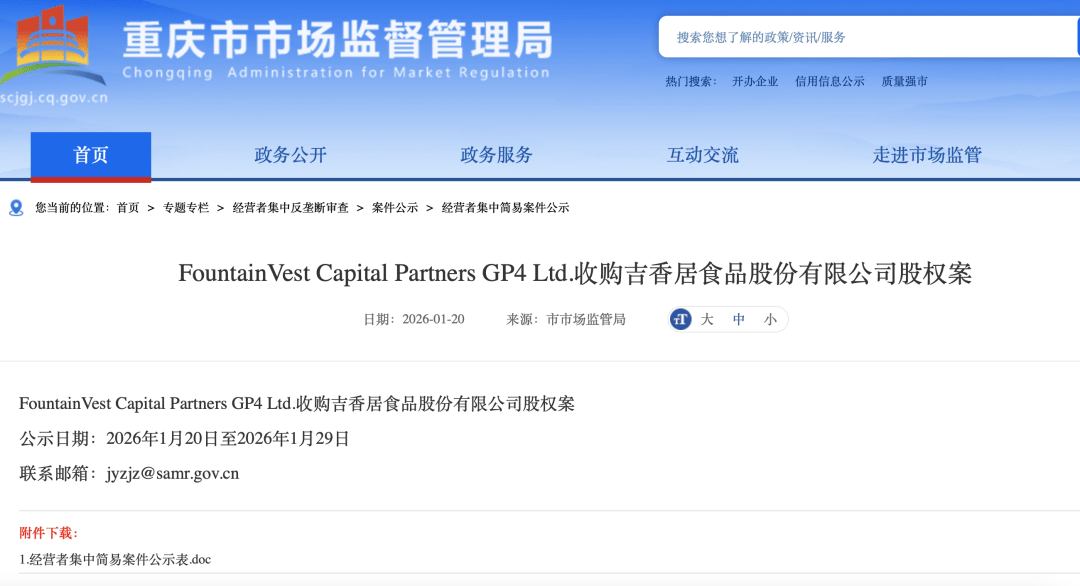
方源资本控股吉香居92%股权,酱腌菜龙头再易主
Bei Ke Cai Jing· 2026-01-27 14:17
Group 1 - Sichuan Jixiangju Food Co., Ltd. is undergoing a significant capital change as Fangyuan Capital has signed an agreement to acquire 92% of its shares, achieving control over the company [1][2] - The acquisition involves Fangyuan GP4 Company, which is indirectly controlled by Fangyuan Capital, and it will take over the shares held by existing shareholders, including the previous major shareholder Ding Wenjun [2] - Jixiangju specializes in the research, production, and sales of pickled vegetables and compound seasonings, and it has faced challenges in its attempts to go public, having previously engaged with multiple securities firms for IPO guidance without success [4] Group 2 - The pickled vegetable and seasoning industry, where Jixiangju operates, is currently experiencing a period of adjustment, with a reported 2.99% year-on-year decline in overall sales in the domestic seasoning market for 2024 [5] - The number of existing enterprises in the seasoning industry has been decreasing for three consecutive years, indicating a competitive environment that is increasingly challenging for small and medium-sized enterprises [5] - To achieve sustainable growth, Jixiangju needs to leverage external capital to overcome production capacity bottlenecks, upgrade its supply chain, and accelerate nationwide channel expansion [5]