军工制造

Search documents
币安接近达成协议 有望摆脱美国司法部施加的合规监督
Hua Er Jie Jian Wen· 2025-09-17 02:22
Group 1 - Binance is reportedly close to reaching an agreement with the U.S. Department of Justice (DOJ) to potentially eliminate a key regulatory requirement from a previous $4.3 billion settlement, specifically the need for external compliance monitoring [1] - The DOJ is evaluating whether to abandon the requirement for external monitors for certain companies, as some have complained that such oversight is costly and disrupts normal business operations [2] - Binance's founder, Zhao Changpeng, had previously pleaded guilty and served four months in prison, and is now seeking a pardon from Trump [1][3] Group 2 - The DOJ has already terminated external monitoring agreements for three companies under the Biden administration, indicating a shift in its approach to corporate oversight [2] - Binance originally agreed to two independent monitors as part of its plea agreement, one from the DOJ and another from the Financial Crimes Enforcement Network (FinCEN), but the latter's monitor is still in place [3] - The DOJ's decision to maintain external monitors for some companies, such as Toronto-Dominion Bank's U.S. subsidiary, highlights that not all companies are receiving leniency [3] Group 3 - The external monitoring requirement has been a contentious issue, as seen in the case of Boeing, where a judge rejected the agreement due to concerns over the selection criteria for the monitor [4] - The DOJ and Boeing reached a temporary agreement allowing Boeing to avoid criminal prosecution by working with a compliance consultant instead of an independent monitor [4]
孟晓苏谈特朗普的“美国版国有化”: 房地产商思维如何重塑美国经济
Feng Huang Wang Cai Jing· 2025-09-16 07:57
Group 1: Core Concept - The article discusses Trump's "American-style nationalization" policies, reflecting a significant shift in economic governance driven by his real estate developer mindset [3][4][13]. Group 2: Real Estate Developer Mindset - Trump's background as a real estate developer influences his governance approach, viewing everything as a negotiable asset and prioritizing immediate returns [4][7]. - The strategy includes converting subsidies into equity, treating key companies as "premium assets," and operating national strategies like business projects [4][7]. Group 3: National and Economic Security - The Trump administration emphasizes the importance of controlling strategic industries like semiconductors and rare earths to ensure national security [5]. - By acquiring stakes in companies like MP Materials, the government aims to reduce reliance on foreign sources, particularly China, and enhance supply chain security [5]. Group 4: Industrial Policy Reconstruction - Trump's approach represents a reaction against decades of neoliberal economic policies, seeking to bind companies more closely to government strategic goals through equity stakes rather than traditional subsidies [6][10]. - This shift marks a transition of the government from a "subsidizer" to a "strategic investor," emphasizing practical returns and national interests [7]. Group 5: Response to Chinese Competition - The administration's strategies include adopting elements of the "Chinese model" to maintain U.S. advantages in key technology sectors [8]. - By forming a "national team" and investing in critical companies, the government aims to consolidate resources for competitive advantage against China [8]. Group 6: Political Pragmatism - The policies are also driven by domestic political considerations, targeting key industries in swing states to secure voter support ahead of elections [9]. Group 7: Fiscal Pressures - The U.S. federal debt exceeding $37 trillion and increasing fiscal pressures motivate the shift towards equity-based funding, potentially transforming subsidies into assets [10]. Group 8: Controversies and Challenges - Trump's policies face criticism for undermining free market principles, creating conflicts of interest, and raising legal concerns regarding the use of subsidy funds [11][12]. - The approach may intensify global competition in industrial policy and national capitalism trends [12]. Group 9: Shift Towards National Capitalism - The combination of Trump's "America First" ideology and real estate mindset may lead the U.S. towards a "national capitalism" model, where the government plays a dominant role in the economy [13][14]. - This governance style raises questions about the future direction of the U.S. economic system, contrasting sharply with traditional free market ideals [14].


美国枪击惨剧的背后:军工复合体才是永不降半旗的赢家
Hu Xiu· 2025-09-14 12:03
Group 1 - The article highlights the irony of gun rights in the U.S., particularly focusing on the case of Charlie Kirk, who supports gun rights but was shot by an extreme right-wing individual [1] - It emphasizes the ongoing issue of gun violence in America, suggesting that the notion of gun freedom has become a dark joke in the current societal context [1] - The article reflects on the broader implications of gun culture in the U.S., questioning the effectiveness of gun rights advocacy in preventing violence [1]
我国稀有金属禁令重创美军工!98%全球镓产能成战略核弹,F-35生产线面临全面瘫痪?
Sou Hu Cai Jing· 2025-09-13 11:43
Group 1 - The article discusses the strategic importance of gallium (Ga) in the context of U.S.-China relations, highlighting that 98% of global gallium production is concentrated in China, which poses a significant risk to U.S. military supply chains [2][5] - Gallium nitride (GaN) technology is crucial for modern military applications, enabling significant advancements in radar, missile systems, and stealth aircraft [4][8] - The U.S. military's dependency on Chinese gallium is underscored by a report indicating that losing access to this supply could halve the production capacity of high-end weapons within 18 months [5] Group 2 - China's export control measures, including a licensing system implemented in July 2023, restrict the sale of gallium for military purposes, directly impacting U.S. military procurement [7] - A comprehensive ban on gallium exports to the U.S. is set to take effect in December 2024, which is expected to lead to a 77% drop in U.S. gallium imports and significant production delays for military contractors [10] - Collaborative efforts among China, Russia, and Mongolia to intercept gallium shipments have further tightened supply, leading to a 60-fold increase in black market prices with no available product [10] Group 3 - The U.S. government's attempts to mitigate the gallium supply crisis through domestic production, outsourcing to allied countries, and recycling efforts have largely failed due to technical and economic challenges [13][14][15] - Domestic production efforts are hindered by the need for high-purity gallium, which remains dependent on Chinese technology, creating a cycle of reliance [13] - Outsourcing to Canada and Australia has proven costly, with production costs exceeding those in China by 23 times due to patent monopolies held by Chinese companies [14] Group 4 - The gallium crisis illustrates a shift in global power dynamics, with China transitioning from a resource exporter to a key player in setting technological and regulatory standards [17][18] - The article emphasizes the importance of technological independence and resource management in the context of international competition, noting that China holds 81% of gallium extraction technology patents [18]


刚刚!突发警告:最大的泡沫!
券商中国· 2025-09-13 02:05
Core Viewpoint - The CEO of Rheinmetall, Armin Papperger, warns that the military drone manufacturing business may represent the largest bubble in the defense sector, marking the first public skepticism from a major industry leader regarding this market [2][4][5]. Group 1: Market Dynamics - Rheinmetall's stock price surged from €4.2 billion before the Ukraine conflict to €86 billion, reflecting a cumulative increase of 1948%, benefiting from a new arms race in Europe [2][5]. - The company anticipates its order backlog could reach €120 billion by mid-next year, driven by increasing defense budgets in Europe, particularly Germany [8]. Group 2: Industry Challenges - Papperger highlights that insufficient government orders for drones make it unlikely for companies to achieve sales targets of €1 billion by 2030 [6]. - The prices of short-range military drones have dropped to around €1,000, while long-range drones are priced at approximately €2,500, complicating profitability [6]. Group 3: Strategic Goals - Rheinmetall aims to increase its sales from €9.75 billion last year to between €40 billion and €50 billion by 2030, with a target profit margin of 20% [7]. - The company plans to divest its civilian business by Q1 or Q2 of 2026, transitioning to a pure military manufacturer and expanding into aerospace and naval sectors [9]. Group 4: European Defense Spending Trends - The European Defense Agency reports that EU member states' defense spending may exceed 2.1% of GDP by 2025, reaching €392 billion, reflecting a commitment to enhance military capabilities [9]. - A report indicates that defense spending among EU countries is projected to increase by 19% in 2024, amounting to €343 billion, which is 1.9% of GDP [9]. Group 5: Investment Opportunities - Investment analysts suggest that approximately 23% of the projected $2.9 trillion increase in core defense spending will be allocated to equipment purchases, benefiting both European and U.S.-Korean defense contractors [10]. - Additionally, about 54% of the broader security spending increase is expected to be directed towards energy and infrastructure, potentially boosting demand for critical materials and energy equipment in Europe [10].

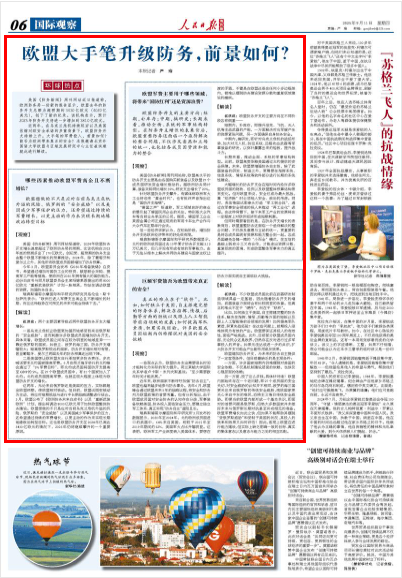
欧盟大手笔升级防务,前景如何?(环球热点)
Ren Min Ri Bao Hai Wai Ban· 2025-09-10 22:49
Core Insights - The European Union's defense spending reached a record €343 billion ($402 billion) in the previous year, exceeding expectations, with projections to rise to €381 billion by 2025 [1][2][3] - The increase in defense spending is driven by the ongoing Ukraine crisis, perceived security threats from Russia, and reduced military commitments from the United States [2][3][4] Group 1: Factors Driving Increased Defense Spending - The EU aims to address not only the immediate risks from the Ukraine crisis and Russian threats but also to achieve long-term geopolitical transformation through sustained military spending [2][3] - In 2024, defense spending growth surpassed the European Defense Agency's expectations by €17 billion, with all EU member states, except Portugal and Ireland, increasing their defense budgets [2][3] - The EU's "Ready for 2030" white paper emphasizes investment in defense industries and joint procurement to enhance military capabilities by 2030 [2][3] Group 2: Allocation of Defense Spending - The primary focus of EU defense spending includes short-term stock replenishment, mid-term research and development, and long-term military structural transformation [4][6] - Equipment procurement increased by 39% year-on-year, while research and development spending grew by 20% [5][6] - The EU's military spending is expected to stimulate the defense industry, although some economists caution that initial benefits to the economy may be limited [5][6] Group 3: Challenges and Integration Issues - The EU faces significant integration challenges in defense restructuring, requiring unified intentions and the consolidation of resources and capabilities among member states [7][8] - The reliance on the U.S. for military support complicates the EU's goal of achieving defense autonomy, with 64% of weapons imported by NATO European members coming from the U.S. [9][11] - The lack of a cohesive understanding of security threats among EU member states hinders the establishment of a unified defense strategy [11][12]
安徽长城军工股份有限公司股票交易异常波动公告
Shang Hai Zheng Quan Bao· 2025-09-05 21:58
Core Viewpoint - The stock of Anhui Changcheng Military Industry Co., Ltd. experienced an abnormal trading fluctuation, with a cumulative decline exceeding 20% over three consecutive trading days from September 3 to September 5, 2025 [2][4][8] Group 1: Stock Trading Abnormality - The company's stock price fell significantly, with a cumulative deviation of over 20% during the specified trading days, qualifying as an abnormal trading situation according to the Shanghai Stock Exchange rules [2][4][8] - The company confirmed that there were no undisclosed significant matters affecting the stock's trading fluctuations, following inquiries with its controlling shareholders and actual controllers [5][6] Group 2: Company Operations and Major Events - The company reported that its production and operational activities remain normal, with no significant changes impacting the stock's trading [5] - There are no undisclosed major events such as asset restructuring, share issuance, or significant business collaborations that could influence the stock price [5][6] Group 3: Media and Market Rumors - The company did not identify any media reports or market rumors that could have a significant impact on its stock price during the trading fluctuation period [6][7] Group 4: Board of Directors' Statement - The board confirmed that there are no undisclosed matters that should have been reported according to the Shanghai Stock Exchange regulations, and previous disclosures do not require corrections or supplements [9]

航天智造:2025年上半年,公司军品收入673.38万元
Zheng Quan Ri Bao Wang· 2025-09-04 11:45
Core Viewpoint - Aerospace Intelligence (航天智造) reported a military product revenue of 6.7338 million yuan in the first half of 2025, representing a year-on-year increase of 6.96% [1] Company Summary - Aerospace Intelligence's military product revenue for the first half of 2025 is 6.7338 million yuan [1] - The revenue growth of 6.96% compared to the same period last year indicates a positive trend in the company's military product segment [1]

美国大米成日本“红线”!日方在最后关头取消访美,特朗普步步紧逼,关税谈判要谈崩?
Sou Hu Cai Jing· 2025-09-04 07:30
Core Points - The recent high-level trade talks between the US and Japan were unexpectedly canceled, highlighting a significant diplomatic tension over sensitive agricultural issues, particularly regarding rice imports [1][3] - The US government's push for Japan to purchase American rice has been perceived as an infringement on Japan's domestic policies and cultural values, leading to a strong backlash from Japanese officials [3][4] - Japan's decision to cancel the visit signals a shift towards a more assertive stance in defending its national interests against perceived US unilateralism [4][6] Trade Negotiations - The breakdown of the trade talks is rooted in Japan's sensitivity to rice, which is not just an agricultural product but also a cultural and political symbol [3] - The US has employed aggressive negotiation tactics, including the introduction of a "reciprocal tariff" policy, which has left Japan in a defensive position [3][6] - Despite the cancellation of high-level talks, working-level discussions between the two countries will continue, indicating Japan's desire to maintain bilateral relations while reassessing its strategy [4][7] Geopolitical Context - The US's military deployment plans in Japan, including the introduction of the "Aegis" missile system, have raised concerns about Japan's geopolitical positioning and its implications for regional stability [6] - The US's actions reflect a broader "America First" strategy, prioritizing its own interests over those of its allies, which complicates Japan's efforts to assert its own national interests [6][7] - The ongoing trade dispute over rice has become a litmus test for the strength and dynamics of the US-Japan alliance, with potential for further unexpected developments in future negotiations [7]

金十数据全球财经早餐 | 2025年9月4日
Jin Shi Shu Ju· 2025-09-03 23:09
Group 1: Economic Indicators - The Federal Reserve officials are paving the way for interest rate cuts, with the Beige Book indicating that economic activity is largely flat [3][10] - The number of job openings in the U.S. unexpectedly fell to its lowest level in nearly a year, dropping to 7.18 million from a revised 7.36 million in June [10] - The U.S. Treasury yields fell across the board, with the 10-year Treasury yield closing at 4.221% and the 2-year yield at 3.625% [3] Group 2: Commodity Markets - Spot gold prices rose for seven consecutive days, reaching a record high of $3,580 per ounce before closing at $3,559.13, up 0.73% [3][7] - Spot silver prices surpassed $41 per ounce, marking a new high since 2011, closing at $41.22, up 0.81% [3][7] - International crude oil prices fell sharply, with WTI crude dropping 2.78% to $63.55 per barrel and Brent crude down 2.49% to $67.28 per barrel [3][7] Group 3: Stock Market Performance - U.S. stock indices showed mixed results, with the Dow Jones down 0.05%, S&P 500 down 0.5%, and Nasdaq up 1% [4] - The Hang Seng Index in Hong Kong fell 0.6% to 25,343.43 points, with significant declines in technology and military stocks [5] - A-share indices also displayed divergence, with the Shanghai Composite Index down 1.16% and the ChiNext Index up 0.95% [6] Group 4: Corporate Developments - The FTSE China A50 Index will include four new stocks: BeiGene, WuXi AppTec, NewEase Technology, and Zhongji Xuchuang [10][15] - American Bitcoin, a cryptocurrency mining company linked to the Trump family, saw its stock rise by 16% after listing on Nasdaq [10]