
可再生能源

Search documents
印度放风考虑取消中企竞标限制,专家:中企对于有关消息应保持高度谨慎
Huan Qiu Shi Bao· 2026-01-09 22:37
Group 1 - The Indian government plans to lift restrictions on Chinese companies participating in government contract bidding, which have been in place for five years, indicating a shift towards balancing security concerns with economic pragmatism [1][2] - Following the 2020 India-China border conflict, restrictions led to a significant decrease in contract amounts awarded to Chinese firms, causing shortages of related materials and delays in project timelines in India [1] - The lifting of restrictions aims to restore competition in the government contract sector and accelerate the execution of public projects, reflecting a gradual warming of India-China relations [2] Group 2 - Indian officials believe that easing restrictions is a pragmatic move to support domestic economic priorities, although limitations on Chinese investments in sensitive sectors are likely to remain [2] - Experts suggest that for India to genuinely enhance cooperation with China, it must open its market and adopt a fair and friendly attitude towards Chinese capital and enterprises, providing a secure investment environment [2]
CCER累计成交额6.5亿元,林业碳汇、新能源受青睐
2 1 Shi Ji Jing Ji Bao Dao· 2026-01-09 13:25
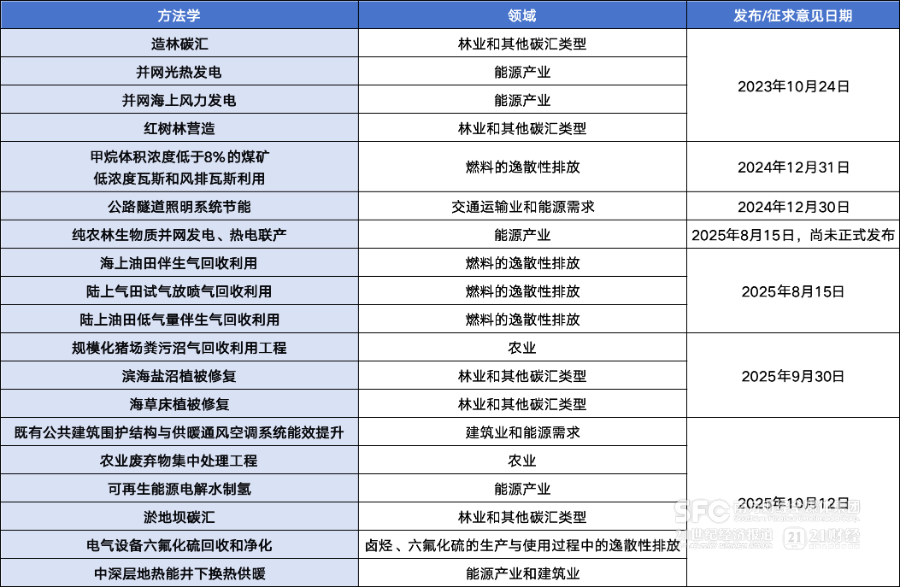
Core Viewpoint - The CCER methodology is undergoing significant expansion, with a total of 18 methodologies expected by the beginning of 2026, aimed at addressing key gaps in China's Nationally Determined Contributions (NDC) for greenhouse gas emissions reduction [1][4]. Group 1: Methodology Expansion - The Ministry of Ecology and Environment has introduced 12 new CCER methodologies in 2025, focusing on renewable energy utilization, energy efficiency improvements, agricultural waste resource utilization, ecosystem carbon sinks, and non-CO2 greenhouse gas reductions [1][4]. - The highest number of methodologies pertains to forestry carbon sinks (5), followed by the energy sector (4) and fugitive emissions [1]. Group 2: Market Development - Since its launch in January 2024, the voluntary greenhouse gas reduction trading market has seen over 5,700 accounts opened by various stakeholders, with a cumulative transaction volume of 921.94 million tons and a transaction value of 650 million yuan, averaging about 70 yuan per ton [3][7]. - The market is expected to facilitate the registration of projects that will achieve approximately 125 million tons of voluntary greenhouse gas reductions [3][7]. Group 3: New Fields and Incentives - The new methodologies incorporate six new fields into the voluntary reduction trading market, including oil and gas field recovery, ecosystem carbon sinks, agricultural waste resource utilization, renewable energy utilization, energy efficiency improvements, and sulfur hexafluoride reductions [4][5]. - The methodologies are designed to support green technologies and new business models, providing clear revenue expectations and reducing initial application costs for green technologies [5]. Group 4: Data Quality and Management - A comprehensive data quality management system is being established, ensuring reliable data acquisition, storage, and calculation, with mechanisms for cross-verification and internal management by project owners [6]. - The methodologies aim to focus on economically feasible projects, simplifying the development process and allowing for the bundling of smaller projects to reduce costs [6]. Group 5: Future Directions - The Ministry of Ecology and Environment aims to create a transparent, unified, and widely participatory voluntary greenhouse gas reduction trading market that aligns with international standards, contributing to carbon neutrality goals and the development of a green economy [8].

中企承建的阿塞拜疆风电项目竣工仪式在巴库举行
Xin Hua She· 2026-01-09 09:45
Core Viewpoint - The completion of the Hizi-Apsheron wind power project, constructed by a Chinese company, is significant for Azerbaijan's national development and energy transition [1] Group 1: Project Overview - The Hizi-Apsheron wind power project is located in eastern Azerbaijan and has a total installed capacity of 240 megawatts, making it the largest single wind power project in the country [1] - The project consists of 37 wind turbines and is expected to generate an annual electricity output of 1 billion kilowatt-hours, sufficient to meet the daily electricity needs of over 300,000 households [1] Group 2: Government and Diplomatic Support - Azerbaijani President Aliyev praised the project's completion and the professional capabilities of Chinese companies, expressing a welcome for more Chinese investments in Azerbaijan [1] - The Chinese Ambassador to Azerbaijan emphasized the importance of cooperation in green development and the shared opportunities for development between China and Azerbaijan [1] Group 3: Future Prospects - The Azerbaijani government is prioritizing the modernization and development of its energy sector, focusing on both traditional and renewable energy sources [1] - The project is expected to enhance Azerbaijan's energy potential and contribute to the country's overall development [1]
工信部: 工业企业和园区新建太阳能、风能等可再生能源发电每年就近就地自消纳比例原则上不低于60%
Mei Ri Jing Ji Xin Wen· 2026-01-09 08:52
Core Viewpoint - The Ministry of Industry and Information Technology (MIIT) has released the "Guidelines for the Construction and Application of Industrial Green Microgrids (2026-2030)", emphasizing the integration of renewable energy and advanced technologies in industrial settings [1] Group 1: Industrial Green Microgrid Components - Industrial green microgrids will include renewable energy generation, utilization of industrial waste energy, clean low-carbon hydrogen production and utilization, new energy storage applications, power conversion and flexible interconnection, and digital energy-carbon management systems [1] Group 2: Renewable Energy Utilization Requirements - New industrial enterprises and parks are required to ensure that the self-consumption ratio of locally generated renewable energy, such as solar and wind power, is not less than 60% annually [1] Group 3: Market Participation and Regulations - In regions with continuous operation of the electricity spot market, distributed photovoltaic systems can connect to user-side grids or engage in dedicated supply to users, with a self-consumption surplus electricity feed-in model allowed, where the feed-in electricity does not exceed 20% of the total available generation [1] Group 4: Grid Integration and Control - There is a focus on continuously enhancing the grid's capacity to accommodate renewable energy generation facilities and improving control capabilities to achieve "observable, measurable, adjustable, and controllable" standards [1]

工信部、国家发改委、国家能源局等5部门重要通知!
中国能源报· 2026-01-09 04:13
Core Viewpoint - The article discusses the issuance of the "Guidelines for the Construction and Application of Industrial Green Microgrids (2026-2030)" by five government departments, aiming to promote energy conservation and carbon reduction in key industrial sectors [3][4]. Summary by Sections 1. Introduction - The guidelines are part of the implementation of the "Green and Low-Carbon Development Action Plan for Manufacturing (2025-2027)" and aim to facilitate the low-carbon transformation of industrial energy use [3]. 2. Construction Principles - Promote efficient multi-energy complementary utilization by integrating local solar, wind, hydrogen, and waste heat resources to meet diverse energy needs [4]. - Encourage high local consumption of renewable energy by analyzing industrial load and planning the scale and mix of renewable energy and storage [4]. 3. Main Content of Construction - Industrial green microgrids include renewable energy generation, industrial waste energy utilization, clean hydrogen production and utilization, new energy storage applications, and digital energy management systems [6][9]. - Renewable energy generation should have a self-consumption ratio of at least 60% for new solar and wind projects [6]. 4. Construction Models - Two main construction models are identified: self-built by industrial enterprises or parks, and third-party co-built with qualified service providers [15][16]. - The self-built model focuses on increasing green electricity usage and ensuring safe electricity supply, while the third-party model involves collaboration for project planning, investment, and operation [15][16]. 5. Application Scenarios - High energy-consuming industries such as steel, petrochemicals, and non-ferrous metals can utilize waste heat and pressure resources to improve energy efficiency [17]. - Flexible application scenarios for industries like machinery and textiles can adjust energy use based on production schedules, enhancing renewable energy consumption [18]. - Scalable adjustable applications in sectors like electrolytic aluminum and polysilicon can leverage real-time load adjustments to participate in demand response [19]. 6. Construction Requirements - Strict adherence to existing standards and regulations for microgrid construction and operation is emphasized, ensuring safety and economic responsibility [20]. - Accelerate the application of advanced technologies in clean energy generation and storage systems [20].

朝阳少侠:中国产能不是“过剩”,而是太少
Xin Lang Cai Jing· 2026-01-09 00:42
Group 1 - China's trade surplus reached over $1 trillion for the first time in 2025, highlighting its manufacturing strength and efficiency in responding to global market demands [1][4][21] - The surplus is a result of China's evolution from labor-intensive industries to capital-intensive and intelligent manufacturing, now accounting for approximately 30% of global industrial production [3][21] - Western countries' trade policies and restrictions on China's high-tech industries have inadvertently contributed to this surplus, as they expect China to remain a low-end supplier [4][21] Group 2 - The notion of "overcapacity" in China is challenged by data showing that the production and sales of electric vehicles are closely aligned, with 14.9 million units produced and 14.78 million sold in 2025 [9][27] - China's electric vehicle exports have surged by 90.4% year-on-year, indicating strong international demand, particularly from developing countries [12][29] - The global demand for electric vehicles is projected to exceed supply, with estimates suggesting a need for 45 million units by 2030, far surpassing current production capabilities [12][29] Group 3 - China's economic strategy focuses on self-reliance and domestic circulation, with a significant contribution from domestic demand to economic growth, averaging 86.4% from 2021 to 2024 [14][31] - The government aims to enhance consumer spending and increase household income, positioning domestic demand as a priority for future economic policies [31] - China's commitment to reducing tariffs and expanding imports reflects its intention to foster mutual benefits in international trade [31][32] Group 4 - The establishment of the Hainan Free Trade Port and the ongoing China International Import Expo signify China's openness to global trade and its role as a key player in the global supply chain [32][35] - The cumulative intended transaction amount from the Import Expo has reached nearly $600 billion, showcasing China's attractiveness as a market for international goods [35] - China's manufacturing capabilities are recognized globally, with a focus on providing affordable and sustainable products, contributing to a positive perception of its role in the global economy [30][35]

【管窥天下】2025年全球能源变革:范式跃迁与路线分化的交响曲
Xin Lang Cai Jing· 2026-01-08 19:02
Core Insights - By 2025, the global clean energy sector will transition from policy-driven growth to market-driven dynamics, establishing clean energy as a primary power source [1] - The geopolitical landscape surrounding energy transition is intensifying, with major countries adopting divergent energy strategies [3] Group 1: Market and Structural Turning Points - The International Energy Agency states that to meet the Paris Agreement's 1.5°C target, global renewable energy capacity must triple by 2030 compared to 2022 levels, with an average energy efficiency growth rate doubling [2] - In 2025, global renewable energy installations will exceed 700 GW, marking a 20% increase from 2024, approaching the 2030 target [2] - The growth of renewable energy is now primarily driven by the absolute cost advantage of clean energy technologies rather than fiscal subsidies, with wind and solar power generation surpassing coal for the first time [2] Group 2: Geopolitical Dynamics and Differentiated Paths - The Trump administration's "America First Energy Policy" has led to a systematic retreat from global green governance, impacting clean energy investments and imposing tariffs on solar components and electric vehicle parts [3] - China is transitioning from being a "super supplier" of clean energy equipment to a "model definitor" of new energy systems, actively promoting carbon peak and carbon neutrality initiatives [3] - The EU, traditionally a leader in green development, faces challenges in its clean energy transition speed due to geopolitical tensions and internal competitiveness issues [4] Group 3: System Reconstruction and Transition Challenges - The global energy landscape is shifting from "fuel supply anxiety" to "electricity system and industrial chain competition," emphasizing complex system governance over mere electricity expansion [6] - Digital technologies are enabling the rise of virtual power plants (VPPs), with China aiming for over 20 million kW of adjustment capacity by 2027 [6] - Global low-carbon transition investments surpassed $2 trillion for the first time in 2025, with a growing ratio of clean energy to fossil fuel investments at 2.5:1, highlighting the need to address quality risks and financial challenges [7]
深海之下,国运之上:解码巴西石油公司的崛起之路与南美能源新秩序
Sou Hu Cai Jing· 2026-01-08 09:26
Core Insights - The article emphasizes the transformative impact of Brazil's offshore oil discoveries on the country's energy independence and geopolitical standing, particularly through the advancements made by Petrobras in deepwater oil exploration and production [1][3]. Group 1: Petrobras' Strategic Developments - Petrobras has shifted its focus from merely upstream exploration to a comprehensive energy value chain, aiming to reduce reliance on primary resource exports and enhance the production of high-value products [3]. - The company plans to achieve near self-sufficiency in diesel by 2029, currently importing 20%-25% of its diesel, primarily from Russia [3]. - Key projects like the Abreu e Lima Refinery and the Boaventura Energy Complex are central to Petrobras' strategy to increase refining capacity by millions of barrels per day [3]. Group 2: Renewable Energy Initiatives - Petrobras is actively promoting energy transition by increasing its renewable energy share to 8%-11% by 2050, leveraging Brazil's strong hydropower, wind, and solar resources [4]. - The company is enhancing its biofuel production, with ethanol already comprising about 40% of transportation fuel in Brazil, and is integrating agricultural advantages into energy production [4]. Group 3: Financial Resilience - In a volatile global energy market, Petrobras demonstrated financial resilience with a net profit of $4.1 billion in Q2 2025, despite Brent crude prices dropping from $75.7 to $60.7 per barrel [5]. - The company reported a net income of $5.2 billion in Q3 2025, a 28% quarter-on-quarter increase, with operating cash flow reaching $9.9 billion [5]. - Petrobras maintains strict capital discipline, focusing 90% of capital expenditures on exploration and production, with a total debt ceiling of $75 billion to manage financial risks [5]. Group 4: Dual Strategy for Future Growth - Petrobras is pursuing a dual strategy of optimizing its core oil and gas business while aggressively entering the renewable energy sector [6]. - The company plans to invest over $110 billion from 2025 to 2029, primarily to strengthen its deepwater oil and gas position, with an expected increase of 3.2 million barrels of oil equivalent per day [7]. Group 5: Global Ambitions and Partnerships - Brazil's energy strategy aligns with Petrobras' global ambitions, as the country joins the OPEC+ cooperation mechanism and hosts COP30, signaling its intent to play a significant role in global energy governance [7]. - The establishment of the China-Brazil Technology Innovation Center highlights the collaborative efforts between Chinese and Brazilian entities in addressing global energy challenges [8]. Group 6: Market Entry Considerations for Chinese Enterprises - The rise of Petrobras offers valuable lessons for Chinese companies looking to expand globally, particularly in energy and technology sectors [8]. - Successful market entry in Brazil requires understanding local regulations, cultural nuances, and establishing strong relationships with Petrobras and its partners [9].


特朗普宣布退出多个联合国机构 美国“气候退缩”立场再升级
Xin Lang Cai Jing· 2026-01-08 09:01
Core Viewpoint - The announcement by President Donald Trump to withdraw from multiple key international organizations focused on climate issues, including the IPCC and UNFCCC, exacerbates the U.S. retreat from global climate cooperation, potentially diminishing its influence on greenhouse gas reduction and limiting the global impact of these institutions [1][4]. Group 1: Withdrawal Implications - The U.S. plans to exit 66 organizations, which includes significant climate-related bodies, indicating a shift in climate policy that may weaken U.S. authority on emissions reduction [1][4]. - The withdrawal from the UNFCCC means the U.S. will no longer participate in the annual COP meetings, which are crucial for global low-carbon transition and climate financing [2][5]. - This move is seen as a severe challenge to international climate cooperation since the signing of the Paris Agreement, particularly affecting competition in clean energy technology [6]. Group 2: Domestic Policy Context - Trump's actions align with his domestic policy adjustments aimed at loosening regulations on polluting industries and fossil fuels, marking a continuation of his administration's stance against climate change initiatives [1][5]. - The withdrawal from the Paris Agreement process was initiated in January 2025, reflecting Trump's consistent dismissal of climate change as a significant issue [1][5]. Group 3: Future Participation Challenges - Future U.S. administrations seeking to re-engage in global climate governance will face complex procedures, as rejoining the UNFCCC may require Senate approval [2][6]. - Conservative proponents of the withdrawal argue that it frees the U.S. from policies perceived as detrimental to energy costs, signaling a rejection of global actions that dictate domestic energy practices [3][6]. Group 4: Impact on Scientific Assessment - The U.S. withdrawal from the IPCC will hinder its ability to participate in critical scientific assessments that inform global climate policy, although individual American scientists may still engage in research [7]. - The next major assessment report, originally scheduled for 2029, may see reduced U.S. involvement due to previous cuts in funding and staffing at federal climate agencies [8]. - The absence of U.S. expertise and data contributions could significantly affect the operations of the IPCC, which has historically relied on American support [8].
甘肃敦煌实现全年全域用绿电
Ren Min Ri Bao· 2026-01-08 02:52
Group 1 - The core viewpoint is that Dunhuang City in Gansu Province will achieve full-year, all-region utilization of green electricity by 2025 [1] - Dunhuang City is located in the Gobi Desert of the Hexi Corridor, with abundant wind and solar resources, capable of developing 28 million kilowatts of wind power and 86 million kilowatts of solar power [1] Group 2 - Currently, the total installed capacity of power sources in Dunhuang City is 4.34 million kilowatts, all of which are renewable energy [2]