
汽车制造

Search documents
重汽暴涨1.5倍夺冠!三一紧追 东风猛涨329% 前2月新能源自卸车实销增五成 | 头条
第一商用车网· 2026-03-24 02:06
Core Viewpoint - In February 2026, the overall sales of new energy heavy trucks declined by 9% year-on-year, ending a long streak of growth that began in February 2023, although some segments, such as new energy dump trucks, continued to show growth [1][2]. Sales Performance - In February 2026, domestic sales of new energy heavy trucks reached 7,435 units, a month-on-month decrease of 54% and a year-on-year decrease of 9%. New energy dump trucks sold 1,208 units, with a month-on-month decline of 49% but a year-on-year increase of 25% [2]. - The market share of new energy dump trucks in the new energy heavy truck segment was 16.25% in February 2026, up from 14.67% in January 2026 [4]. - The penetration rate of new energy dump trucks reached 45.26% in February 2026, maintaining a level above 45% for eight consecutive months [8][5]. Market Trends - The new energy dump truck market has seen a continuous growth streak, achieving 26 consecutive months of growth from January 2024 to February 2026 [6]. - The overall heavy truck market experienced a decline in demand, with total sales of only 28,400 units in February 2026, down 41% year-on-year [8]. Competitive Landscape - In the new energy dump truck market, major players include China National Heavy Duty Truck Group (重汽), SANY, and XCMG, with 重汽 winning the sales championship for four consecutive months [15]. - In February 2026, 重汽 sold 892 units, holding a market share of 25.0%, while SANY and XCMG sold 696 and 454 units, respectively [20]. - The market saw significant growth from several companies, with 比亚迪 and 远程 achieving year-on-year increases of 320% and 216%, respectively [17][21]. Regional Distribution - In the first two months of 2026, new energy dump trucks were registered in 29 provincial-level regions, with the top six regions (Yunnan, Sichuan, Shandong, Guangdong, Shanxi, and Zhejiang) accounting for nearly half of the total sales [11]. Conclusion - The new energy dump truck segment remains one of the few areas in the new energy heavy truck market that continues to grow, raising questions about its sustainability moving forward [24].



西部证券晨会纪要-20260324
Western Securities· 2026-03-24 00:43
Group 1: Zijin Mining (601899.SH) - The core conclusion highlights the advancement of the three-wheel drive of gold, copper, and lithium, strengthening both anti-cyclical attributes and growth potential [1] - In 2025, Zijin Mining achieved a revenue of 349.08 billion yuan, a year-on-year increase of 14.96%, and a net profit attributable to shareholders of 51.78 billion yuan, up 61.55% [6] - Gold production reached 90 tons, a 22.8% increase, contributing 40.89% to the group's gross profit, with significant growth driven by acquisitions and project improvements [6][7] - Copper production was 1.09 million tons, a 1.56% increase, contributing 34.49% to gross profit, with a target of 1.5-1.6 million tons by 2028 [7] - Lithium carbonate production reached 25,500 tons, with a projected increase to 120,000 tons in 2026, representing a 370% growth [7] - Earnings per share (EPS) for 2026-2028 are projected at 3.12, 3.65, and 4.06 yuan, with price-to-earnings (PE) ratios of 10, 8, and 8 times respectively [6] Group 2: Li Auto (2015.HK) - The report indicates that Li Auto's revenue for 2025 was 112.3 billion yuan, a decrease of 22% year-on-year, with a net profit of 1.14 billion yuan, down 86% [9] - In Q4 2025, the company achieved a revenue of 28.8 billion yuan, with a vehicle gross margin of 16.8%, slightly above expectations due to supplier rebates [9][10] - The launch of the new L9 model and advancements in embodied intelligence products are expected to drive a new growth cycle for the company [10] - The company plans to deliver 85,000 to 90,000 vehicles in Q1 2026, with a revenue forecast of 20.4 to 21.6 billion yuan [10] - Revenue projections for 2026-2028 are 131.2 billion, 169.2 billion, and 195.7 billion yuan, with net profits of 1.2 billion, 5.1 billion, and 9.1 billion yuan respectively [11] Group 3: China Hongqiao (01378.HK) - China Hongqiao reported a revenue of 162.35 billion yuan in 2025, a year-on-year increase of 3.96%, with a net profit of 22.64 billion yuan, up 1.18% [14][15] - The company’s operating cash flow was particularly strong, with a growth of 14.75%, indicating improved financial health [15] - The aluminum alloy segment maintained sales of 5.824 million tons, with a revenue of 106.1 billion yuan, while alumina sales increased by 22.7% to 13.397 million tons [16] - EPS for 2026-2028 is expected to be 3.24, 3.50, and 3.78 yuan, with PE ratios of 9, 9, and 8 times respectively [16] Group 4: North Exchange Market - The North Exchange market is currently under pressure, with a significant decline in the core index, reaching a 10-month low, and liquidity continues to shrink [4][20] - The report notes that the market is at a dual bottom in terms of sentiment and liquidity, with a need to be cautious about ongoing liquidity issues and external geopolitical disturbances [4] - Long-term investment value is expected to gradually emerge as the market expands and institutional improvements continue, particularly for specialized and innovative enterprises [4][20]

于东来回应40亿资产利润分配争议;千问上线AI打车;小鹏汽车成立Robotaxi业务部;扎克伯格打造AI智能体,助力自己履行CEO职责丨邦早报
创业邦· 2026-03-24 00:09
Core Viewpoint - The article discusses various developments in technology and business, highlighting significant events such as lawsuits, company strategies, and market trends in the AI and automotive sectors. Group 1: Legal and Corporate Responses - DJI has filed a lawsuit against YingShi Innovation over six patent disputes, claiming that the patents in question are related to inventions made by former employees during their tenure at DJI [3] - YingShi Innovation's CEO Liu Jingkang responded, asserting that the patents were developed independently within YingShi and not related to DJI's work [3] - Fat Donglai's founder Yu Donglai clarified that the distribution of 4 billion yuan in profits is shared among employees and management, emphasizing that he only holds a 5% stake [4] Group 2: Technological Advancements and Business Strategies - Xiaopeng Motors has established a Robotaxi division to oversee product development and operations, aiming to launch passenger services in the second half of the year [4] - Xiaomi's CEO Lei Jun stated that the company has been involved in robotics for six years, despite current losses, and remains optimistic about the industry's future [5] - Meta's CEO Mark Zuckerberg is developing an AI assistant to enhance his efficiency in information retrieval and decision-making [6] Group 3: Market Trends and Performance - Domestic AI models have surpassed U.S. models in usage for three consecutive weeks, with a significant increase in total calls from 4.69 trillion to 7.359 trillion, marking a 56.9% growth [7] - The wireless earphone market in China is projected to reach 121.37 million units by 2025, with a year-on-year growth of 6.9%, indicating a shift towards structural optimization and value reconfiguration [19] Group 4: Investment and Financing Activities - Elliott Investment Management has invested billions in Synopsys, aiming to enhance profitability from software and services [11] - Lightyear Technology has completed a $100 million Series D funding round to advance AI technology and talent acquisition [11] - Earendil Labs has raised $787 million, setting a new record for biotechnology financing in 2026 [11]



60万一张车牌?新加坡车市到底多疯狂
汽车商业评论· 2026-03-23 23:06
Group 1 - The core point of the article highlights the high costs associated with car ownership in Singapore, particularly the Certificate of Entitlement (COE) prices, which are significant barriers to entry for consumers, yet the demand for cars remains strong [3][4][14]. - In the latest COE bidding, the prices for small and large cars were reported at 111,890 SGD (approximately 601,000 RMB) and 115,568 SGD (approximately 621,000 RMB) respectively, indicating the high financial commitment required for car ownership [3][9]. - Despite the high costs, the new car registration in Singapore is projected to reach 52,678 units by 2025, with electric vehicles (EVs) making up about 45% of this figure, reflecting a shift in consumer preferences towards electric options [3][17]. Group 2 - The COE system in Singapore is unique, requiring all vehicles to secure a COE before registration, which grants a ten-year ownership and road usage right [8][9]. - The government has frozen the annual growth rate of cars and motorcycles since February 2018, which will continue until early 2028, leading to increased competition for existing vehicle quotas and influencing COE prices [9][11]. - The government is also adjusting policies to accommodate electric vehicles, including raising the power threshold for EVs eligible for the A group COE and providing incentives for early adoption [12][11]. Group 3 - The article notes that the automotive market in Singapore is not just about selling cars but also about creating experiences, as evidenced by luxury brands like Porsche investing in experience centers [25][27]. - Porsche's new experience center in Singapore, set to open in 2027, will feature a 2-kilometer track and is aimed at enhancing brand engagement in the region [25][26]. - Despite high prices, luxury brands continue to invest in Singapore, indicating a belief in the market's potential and the importance of customer experience over mere sales figures [22][21]. Group 4 - The article emphasizes the growing acceptance of electric vehicles among Singaporean consumers, with brands like BYD rapidly increasing their market share, selling 3,002 vehicles in the first four months of 2025, surpassing Toyota [29][30]. - The local distribution network for BYD is expanding quickly, with multiple sales points established, indicating a strategic approach to cater to a diverse consumer base in a high-cost market [31][32]. - Overall, the article suggests that despite the high costs of car ownership, Singapore remains a viable market for investment in the automotive sector, driven by evolving consumer preferences and strategic brand positioning [32].


【2025年年报点评/小鹏汽车-W】Q4业绩符合预期,物理AI转型可期
东吴汽车黄细里团队· 2026-03-23 15:41
Core Viewpoint - Xiaopeng Motors' 2025 annual report shows performance in line with expectations, with significant growth in revenue and a milestone of achieving quarterly profitability for the first time in Q4 2025 [3][4]. Financial Performance - Q4 2025 revenue reached 22.25 billion yuan, a year-on-year increase of 38.2% and a quarter-on-quarter increase of 9.2% [3]. - Automotive sales revenue was 19.07 billion yuan, up 30.0% year-on-year and 5.6% quarter-on-quarter, driven by the growth in new model deliveries [3]. - Service and other income surged to 3.18 billion yuan, marking a 121.9% year-on-year increase [3]. - The company achieved a net profit of 380 million yuan in Q4 2025, with a non-GAAP net profit of 510 million yuan [3]. Profitability Metrics - The overall gross margin for Q4 2025 was 21.3%, an increase of 6.9 percentage points year-on-year and 1.2 percentage points quarter-on-quarter, primarily due to the growth in service and other income [4]. - The automotive gross margin stood at 13.0% [4]. - R&D expense ratio for Q4 was 12.9%, reflecting a year-on-year increase of 0.5 percentage points [4]. Sales and Production - The wholesale volume for Q4 was 116,000 vehicles, representing a year-on-year increase of 27.0% [4]. - The average selling price (ASP) per vehicle was 164,000 yuan [4]. Strategic Initiatives - In 2026, the company plans to launch four new models, including a flagship SUV, the GX, set to debut in Q2 2026 [5]. - The target for the shipment of the Turing AI chip in 2026 is 1 million units [5]. - The second-generation VLA is expected to achieve full OTA coverage by Q2 2026, expanding navigation capabilities [5]. - The humanoid robot IRON is planned for mass production by the end of 2026, with a monthly production target of over a thousand units [5]. Revenue and Profit Forecast - Revenue forecasts for 2026 and 2027 have been adjusted to 96.2 billion yuan and 126.5 billion yuan, respectively, reflecting year-on-year growth of 25% and 32% [6]. - Net profit forecasts for 2026 and 2027 have been revised down to -1.4 billion yuan and 2.1 billion yuan, respectively [6]. - EPS estimates for 2026, 2027, and 2028 are projected at -0.71 yuan, 1.12 yuan, and 3.38 yuan, with corresponding PE ratios of 56 and 19 for 2027 and 2028 [6].

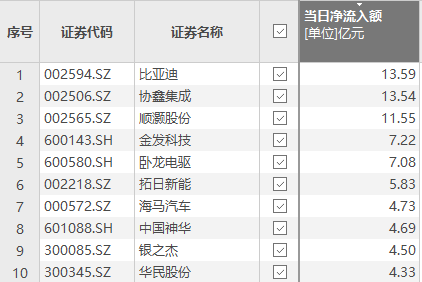
资金风向标 | 比亚迪获资金净流入13.59亿元
Shang Hai Zheng Quan Bao· 2026-03-23 12:51
Core Viewpoint - The article highlights the top ten stocks with the highest net inflow of funds on March 23, with BYD leading the list with a net inflow of 1.359 billion yuan [1]. Group 1: Top Stocks by Net Inflow - BYD (002594.SZ) received a net inflow of 1.359 billion yuan [2]. - Xiexin Integrated (002506.SZ) followed closely with a net inflow of 1.354 billion yuan [2]. - Shunhao Co., Ltd. (002565.SZ) had a net inflow of 1.155 billion yuan [2]. - Jinfat Technology (600143.SH) recorded a net inflow of 722 million yuan [2]. - Wolong Electric Drive (600580.SH) saw a net inflow of 708 million yuan [2]. - Tuojin New Energy (002218.SZ) had a net inflow of 583 million yuan [2]. - Haima Automobile (000572.SZ) experienced a net inflow of 473 million yuan [2]. - China Shenhua (601088.SH) recorded a net inflow of 469 million yuan [2]. - Yinzhi Jie (300085.SZ) had a net inflow of 450 million yuan [2]. - Huamin Co., Ltd. (300345.SZ) saw a net inflow of 433 million yuan [2].
小鹏汽车-W(09868):2025年年报点评:Q4业绩符合预期,物理AI转型可期
Soochow Securities· 2026-03-23 12:02
Investment Rating - The investment rating for the company is "Buy" (maintained) [1] Core Insights - The company reported Q4 revenue of 22.25 billion yuan, a year-on-year increase of 38.2% and a quarter-on-quarter increase of 9.2%. The automotive sales revenue was 19.07 billion yuan, up 30.0% year-on-year and 5.6% quarter-on-quarter, primarily due to the growth in new model deliveries. Service and other income reached 3.18 billion yuan, a year-on-year increase of 121.9% [7] - The company achieved its first quarterly profit in Q4 2025, with a net profit of 380 million yuan and a non-GAAP net profit of 510 million yuan [7] - The overall gross margin continued to grow, with a comprehensive gross margin of 21.3% in Q4 2025, an increase of 6.9 percentage points year-on-year and 1.2 percentage points quarter-on-quarter [7] - The company is committed to its AI transformation, planning to increase R&D investment in physical AI to 7 billion yuan in 2026. It aims to launch four new models in 2026, including a flagship SUV [7] - The company has set a target of 1 million units for the shipment of its Turing AI chips in 2026 and plans to achieve full-scenario OTA coverage with its second-generation VLA by Q2 2026 [7] - The earnings forecast has been adjusted, with expected revenues for 2026 and 2027 revised to 96.2 billion yuan and 126.5 billion yuan, respectively, reflecting year-on-year growth of 25% and 31.6% [7] - The projected EPS for 2026, 2027, and 2028 are -0.71 yuan, 1.12 yuan, and 3.38 yuan, respectively, with corresponding P/E ratios of 88.44 and 56 for 2027 and 2028 [7] Financial Summary - Total revenue forecast for 2024 is 40.87 billion yuan, with a year-on-year growth of 33.22% [1] - The company expects to achieve a net profit of 2.13 billion yuan in 2027 and 6.46 billion yuan in 2028 [1] - The projected comprehensive gross margin for 2026 is 17.96%, with a net profit margin of 1.69% in 2027 [8]
2026/3/16-2026/3/22汽车周报:油价上涨将撬动新能源Beta,宇树IPO有望催化机器人板块-20260323
Shenwan Hongyuan Securities· 2026-03-23 11:48
Investment Rating - The report maintains a positive outlook on the automotive industry, particularly focusing on hybrid and fast-charging solutions, recommending companies like Geely and BYD, as well as the new energy supply chain [2][3]. Core Insights - The recent rise in oil prices is expected to enhance the penetration rate of new energy vehicles globally, with a focus on hybrid and fast-charging solutions [2]. - The IPO application of Yushu has been accepted, and the production release of Tesla's Optimus V3 is anticipated to catalyze the robotics sector [2]. - The report suggests continued attention to blue-chip companies with strong performance support, especially those within major indices, such as Yutong Bus and Minth Group [2]. Industry Situation Update - According to the China Passenger Car Association, the average daily retail sales of passenger cars in the second week of March were 45,000 units, a 19% decrease year-on-year but a 42% increase compared to the previous month [2]. - The price index for traditional raw materials and new energy raw materials has decreased recently, with traditional vehicle raw material prices down by 1.1% week-on-week and up by 6.1% month-on-month, while new energy vehicle raw material prices decreased by 2.7% week-on-week and increased by 2.4% month-on-month [2]. - The total transaction amount in the automotive industry this week was 349.939 billion yuan, a decrease of 8.81% compared to the previous week [2]. Market Situation Update - The automotive industry index closed at 7488.87 points this week, down 4.40%, which is a greater decline than the 2.19% drop in the CSI 300 index [12]. - Among industry stocks, 14 rose while 257 fell, with the largest gainers being Shentong Technology, Meili Technology, and Jintuo Co., which rose by 11.3%, 5.0%, and 4.9% respectively [16]. - The report highlights the importance of focusing on companies with strong performance support and potential for valuation growth, particularly in the context of AI and new energy trends [2][3]. Investment Analysis Opinions - The report emphasizes the importance of AI spillover and demand recovery, recommending a focus on intelligent and high-end directions in the automotive sector, particularly for new energy vehicle companies like Xpeng, NIO, and Li Auto [2]. - It also suggests that companies with overseas business support, such as BYD and Geely, should be monitored closely [2]. - The report identifies key trends in the robotics and data center cooling sectors, recommending companies with strong performance support and potential for valuation growth [2]. Key Events - The report reviews the "2026 Spring Automotive Industry Investment Strategy," which indicates limited impact from policy changes on automotive demand, with an optimistic view on the recovery of mid-to-high-end demand [3]. - The report notes that the penetration rate of new energy vehicles is expected to continue increasing, with a projected overseas sales volume of nearly 10 million units in five years [3]. - The report highlights the significance of robotics, low-altitude economy, and AIDC as new industry directions driven by technology [3].

周观点 | 油价上行 坚定看好整车出海大趋势【国联民生汽车 崔琰团队】
汽车琰究· 2026-03-23 11:43
Market Performance - The automotive sector underperformed the market this week, with A-share automotive stocks declining by 4.40%, ranking 16th among Shenwan sub-industries, compared to the CSI 300's decline of 2.21% [2]. Export Trends - The rise in international oil prices has enhanced the competitive advantage of new energy vehicles (NEVs) in overseas markets. In January-February 2026, China's passenger car exports reached 1.136 million units, a year-on-year increase of 54.6%. Leading companies like Geely and BYD saw exports rise by 129% and 51% respectively [3][9]. - The export of NEVs is expected to continue its upward trend, with a significant increase in sales anticipated for March [3][9]. Domestic Demand - Domestic demand for passenger vehicles showed signs of recovery as cities like Shanghai initiated multiple rounds of vehicle replacement subsidies. The weak demand in January-February was attributed to delayed policy implementation and a lack of new model launches. However, improvements in these areas are expected to stabilize demand in March [4][10]. - The government has allocated 62.5 billion yuan for national subsidies to support vehicle purchases, which is expected to stimulate demand [12]. Robotics and Automation - Yushun Technology's IPO application was accepted by the Shanghai Stock Exchange, aiming to fund the development of intelligent robots and manufacturing bases, positioning the company as a leader in the general robotics industry [5][10]. - NVIDIA announced partnerships with leading automakers like BYD and Geely to develop L4 autonomous vehicles based on the NVIDIA DRIVE Hyperion platform [6][11]. Investment Recommendations - The automotive sector is recommended for investment due to the expected recovery in domestic demand and the growth in NEV exports. Key companies to watch include Geely, BYD, and Xpeng Motors [15]. - In the parts sector, companies like Bertley and Horizon Robotics are recommended for their roles in the smart vehicle supply chain [20]. Commercial Vehicles - The heavy truck market is expected to benefit from vehicle replacement policies and stable export growth. Recommendations include Weichai Power and China National Heavy Duty Truck Group [7][27]. - The bus sector is also projected to recover, with strong export capabilities for companies like Yutong Bus [27]. Motorcycle Market - The motorcycle market is experiencing pressure in the mid-to-large displacement segment, with sales declining in February. However, the demand for larger displacement models is expected to grow, with companies like Spring Wind Power and Longxin General being recommended [31][35].
汽车行业月报:淡季产销阶段性承压,车企陆续披露年报
Zhongyuan Securities· 2026-03-23 10:24
Investment Rating - The report maintains an investment rating of "Outperform the Market" for the automotive industry [4][6]. Core Insights - The automotive industry index has underperformed the Shanghai Composite Index by 5.08 percentage points, ranking 17th among 30 primary industries [4][11]. - The automotive production and sales in February 2026 were significantly impacted by seasonal factors and the Spring Festival, with production and sales down 31.7% and 23.1% month-on-month, and down 20.5% and 15.2% year-on-year, respectively [6][30]. - The market share of domestic brands in the passenger car segment has increased to 70.2%, reflecting a 3.33 percentage point rise [6][50]. - The report highlights a stable performance in the commercial vehicle market, with production and sales showing positive growth in the first two months of 2026 [6][56]. - The penetration rate of new energy vehicles reached 42.37% in February 2026, with production and sales down 21.8% and 14.2% year-on-year, respectively [6][63]. Industry Performance Review - As of March 20, 2026, the automotive industry index has decreased by 8.13%, underperforming the Shanghai Composite Index [11][20]. - The automotive sector has seen a decline in individual stock performance, with only 7% of stocks rising in March 2026 [16][17]. - The industry valuation has decreased, with a PE ratio of 31.51, ranking 15th among 30 primary industries [20][21]. Key Data Tracking - In February 2026, the automotive production and sales figures were 1.672 million and 1.805 million units, respectively, reflecting a significant decline due to various factors [6][30]. - The passenger car market faced challenges, with production and sales of 1.4 million and 1.536 million units, respectively, showing a year-on-year decline [44][50]. - The commercial vehicle market showed resilience, with production and sales of 273,000 and 270,000 units, respectively, maintaining positive growth in the first two months of 2026 [56][57]. - New energy vehicle production and sales in February 2026 were 695,000 and 765,000 units, respectively, with a year-on-year decline [63][67]. Important Company News - The report notes that NIO achieved its first quarterly profit in Q4 2025, with a significant improvement in financial health [83]. - Geely's revenue for 2025 reached 345.2 billion, with a net profit increase of 36%, driven by strong performance in its new energy brand [84]. - Chery reported a revenue of 300.3 billion for 2025, with a net profit growth of 34.6%, indicating a positive trend in its financial performance [84].