
投资银行

Search documents
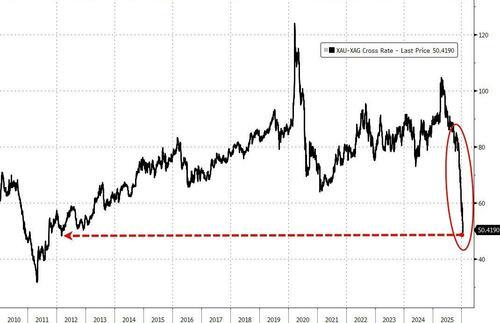
金银比14年来首度跌破50,高盛疾呼:反手做多的时候到了
Feng Huang Wang· 2026-01-16 07:04
Core Viewpoint - The silver market is experiencing unprecedented interest and activity, driven by geopolitical tensions, record inflows from retail investors, and expectations of U.S. tariffs on silver, leading to significant price volatility and a historic drop in the gold-silver ratio [1][3][8]. Group 1: Market Dynamics - The gold-silver ratio has fallen below 50 for the first time in 14 years, indicating a shift in market dynamics favoring silver [1]. - Silver is at the center of trade tensions, with the U.S. listing it as a critical mineral and China imposing stricter export controls, which has heightened investor interest [3]. - Retail trading activity in silver is currently 2.1 times its three-month average, surpassing both gold and cryptocurrencies, suggesting a structural increase in demand rather than just short-term speculation [5]. Group 2: Investment Trends - Retail investors have injected a record $921.8 million into silver-related ETFs over the past 30 days, marking the largest buying spree in history [6]. - The iShares Silver Trust (SLV) has seen an unprecedented 169 consecutive days of net inflows from retail investors, indicating a fundamental shift in asset allocation strategies [6]. - The expectation of potential U.S. tariffs of up to 50% on silver has led to a concentration of silver in the U.S., causing liquidity pressures in the London market and amplifying price volatility [8]. Group 3: Comparative Analysis with Gold - Goldman Sachs notes that despite the current enthusiasm for silver, gold remains a preferred alternative investment for those seeking to diversify away from dollar risk, with a projected 67% performance increase by 2025 [10]. - Gold ETFs currently represent only 0.17% of the U.S. non-cash financial investment portfolio, indicating significant room for growth compared to the peak in 2012 [11]. - The ongoing demand for gold from central banks is expected to continue, with average monthly purchases projected to reach 70 tons by 2026, significantly higher than the 17 tons average in 2022 [11]. Group 4: Future Outlook - Goldman Sachs suggests that the current speculative behavior in silver, driven by physical market tightness, may not be sustainable, and once the excitement fades, the support for silver prices could weaken [14]. - The historical volatility of silver compared to gold suggests that while silver may outperform in certain conditions, the long-term outlook for gold remains strong due to continued central bank purchases and investor diversification [14].

高盛观点 | 2026年中国宏观经济展望
高盛GoldmanSachs· 2026-01-16 05:05
Economic Outlook - Goldman Sachs projects China's real GDP growth to reach 4.8% in 2026, surpassing the market consensus of 4.5% [1] - Structural challenges such as weak consumer spending and a sluggish labor market persist, although the drag from the declining real estate market is expected to lessen [1] - The firm anticipates that increased exports and a reduction in the negative impact of the real estate sector will lead to a faster-than-expected economic growth this year [1] Trade and Inflation - The forecast for Producer Price Index (PPI) inflation is -0.7%, slightly better than the consensus expectation of -1.0% [2] - The PPI has been in deflation for over three years, prompting the government to implement "anti-involution" policies to curb price competition among manufacturers [2] - Goldman Sachs expects the current account surplus to rise from 3.6% of GDP in 2025 to 4.2% in 2026, contrary to the consensus prediction of a decline to 2.5% [2] Export Dynamics - The resilience of Chinese exports is attributed to three factors: rapid expansion of exports to emerging markets, limited ability of other countries to impose trade barriers against China in key mineral sectors, and greater growth potential in high-tech exports [5] - The firm predicts that export prices, measured in USD, will turn positive in 2026, increasing from -2.7% last year to 0.7% [6] Consumer and Labor Market - The labor market in China has been weak, with employment indices at their lowest levels in a decade, and nominal wage growth expected to slow to 3.8% year-on-year by Q3 2025 [7] - Targeted government policies are anticipated in 2026 to alleviate labor market pressures and support income growth, including subsidies for labor-intensive services and increased minimum wages [7] - Despite a forecasted slowdown in household consumption growth, government consumption is expected to accelerate, balancing the overall contribution of consumption to GDP growth [7] Real Estate Market - The Chinese real estate sector is in its fifth year of decline, with most activity indicators down by 50%-80% from peak levels in 2020-2021 [8] - There are no signs of stabilization in the real estate market, with high housing inventory and severe financing conditions for major developers [11] - Goldman Sachs predicts that the drag from the real estate sector on GDP growth will decrease by 0.5 percentage points annually, although it will still negatively impact growth in the coming years [11] Risks to Growth Outlook - The growth forecast faces slight downward risks due to weaker-than-expected momentum and a lack of urgency for significant policy easing from decision-makers [12] - Potential risks include renewed tensions in US-China relations, increased trade barriers from major trading partners, and intensified financial pressures on local governments and banks [12]

中美AI竞争或于2030年迎来转折
Zhong Guo Dian Li Bao· 2026-01-16 03:09
据高盛此前发布的报告,当前,美国数据中心容量占全球的44%,已消耗美国约6%的电力,预计到 2030年,这一比例将上升至11%,而衡量电网可靠性的有效备用电力容量指标却从5年前的26%降至 19%。在全美13个区域电网中,8个已达到或低于该临界值,弗吉尼亚州等数据中心密集地区均出现电 价飙升现象。 据彭博社报道,当地时间1月7日,全球知名投行高盛表示,在数据中心用电需求迅猛增长的背景下,到 2030年,美国几乎所有电力电网都将面临备用容量不足的问题,或为中国在人工智能竞争中取得先发优 势提供机遇。 "如果电力约束持续存在,中国有可能在AI竞赛中实现反超。"高盛全球大宗商品研究联席主管Samantha Dart直言,美国的新增发电能力跟不上需求增长。按行业惯例,电网需要保持至少15%的备用裕度,才 能在峰值负荷与可用发电能力间形成安全空间。但目前,美国部分电网已低于这一水平,随着数据中心 持续拉动用电需求,备用不足的问题在未来几年只会进一步恶化。 与此形成鲜明对比的是,中国电力供应展现出强大韧性。高盛报告指出,预计到2030年,中国将拥有约 400吉瓦的备用电力容量,达到全球数据中心预期总需求的3倍以上。 ...
高盛交易所-2026年展望第一集-宏观全景
Goldman Sachs· 2026-01-16 02:53
Investment Rating - The report indicates a positive outlook for the U.S. economy with a projected GDP growth rate of 2.5% for Q4 2026, suggesting an investment rating that leans towards optimism for the U.S. market [1][3]. Core Insights - Goldman Sachs predicts that the U.S. economy will benefit from reduced tariff impacts, tax cuts, corporate fiscal support, and potential further interest rate cuts by the Federal Reserve, leading to a GDP growth forecast that exceeds market consensus [1][2][3]. - For China, the economic growth forecast for 2026 is also above market consensus, driven by export growth that offsets negative impacts from the real estate sector, with an expected current account surplus reaching about 1% of global GDP [1][6]. - The report anticipates a continued weakening of the U.S. dollar in 2026, primarily due to the Federal Reserve's potential for larger rate cuts compared to other developed markets [1][8]. Summary by Sections U.S. Economic Outlook - The U.S. GDP growth is expected to be 2.5% in Q4 2026, supported by factors such as reduced tariffs, tax relief for consumers, and corporate fiscal support [1][3]. - The labor market is projected to remain stable with an unemployment rate around 4.5%, despite rising productivity levels [4]. China Economic Forecast - China's economic growth is anticipated to surpass market expectations, with export growth compensating for real estate sector weaknesses [1][6]. - The current account surplus is expected to expand, reflecting strong performance in export-oriented industries [6]. Currency and Inflation Trends - The report forecasts a continued decline in the U.S. dollar, influenced by the Federal Reserve's monetary policy [1][8]. - Inflation in developed countries is cooling, with expectations that it will approach central bank targets by the end of the year [11][12]. Market Dynamics - The report suggests that the stock market may continue to perform well, although at a diminishing rate, due to a favorable macro environment [13]. - Credit markets are viewed as less favorable compared to equity markets, with narrowing spreads limiting upside potential [14].
高盛:铜价上涨主要由投机推动,精炼铜关税或于年中宣布
Wen Hua Cai Jing· 2026-01-16 02:04
Group 1 - Goldman Sachs reports that LME copper prices have surged 23% since November, exceeding $13,000, driven primarily by speculative capital inflows rather than fundamental factors [2] - The recent price increase is not attributed to the strengthening dollar, expectations of Chinese economic growth, or supply tightness outside the U.S., despite rising inventories in the U.S. and abroad [2] - Goldman Sachs correctly predicted that copper tariffs would not be announced alongside the critical minerals order signed on January 14 under Section 232, which retains the possibility of future tariffs [2] Group 2 - Goldman Sachs maintains its baseline forecast that refined copper tariffs will be announced mid-year and implemented by January 2027, indicating a shift away from relying solely on tariffs for metal supply security [3] - China's copper industry faces three major challenges: increasing dependence on foreign resources, overcapacity in the midstream processing sector, and suppressed downstream demand due to high copper prices [4]

高盛重返华尔街股票资本市场之巅! “预测市场”或成下一个创收利器
Zhi Tong Cai Jing· 2026-01-16 01:17
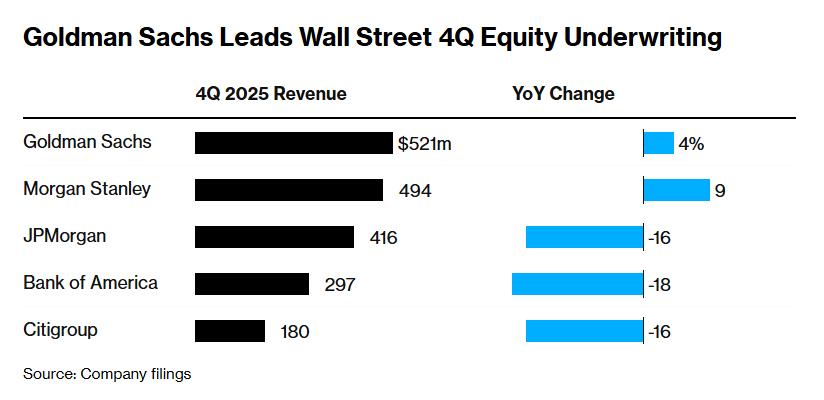
华尔街金融巨头高盛集团(GS.US)在去年最后一个季度重新回到了华尔街股票资本市场(即ECM市场)营收排行榜的榜 首位置,高盛夺魁之际正值华尔街各大银行业巨头们争夺有望于2026年在美股市场进行首次公开募股(IPO)大型项目 (包括OpenAI、Anthropic以及SpaceX等)的承销角色。此外,高盛集团正在密切关注预测市场(Prediction Markets)领域 的重大投资机遇,希望借此在这一快速增长的且围绕现实世界事件下注的平台中获益,力争成为类似Polymarket这样 的预测市场平台。 这家总部位于纽约的金融巨头报告称,2025年最后三个月,其股票承销性质的营收约为5.21亿美元,超越了摩根士丹 利的4.94亿美元和摩根大通的4.16亿美元同项业务营收规模。 短期内难以逾越 高盛首席执行官大卫.所罗门表示,这一数字(2025年最后三个月的股票承销类营收数据)在短期内不太可能被超越。 如上图所示,高盛领跑华尔街第四季度股票承销业务。 "我猜测,股票资本市场的整体水平在2026年仍会明显低于2021年的峰值,但会稍微高于今年的水平,至于季度水平 则难以精准预测。"所罗门在周四的银行财报电话会议上告 ...
高盛CEO称该银行正在探索预测市场的机会
Xin Lang Cai Jing· 2026-01-15 18:12
来源:环球市场播报 华尔街主流公司进军预测市场可能会提升这个监管宽松但蓬勃发展的金融领域的合法性和交易量。一些 做市商公司已经加入混战。 高盛已经与预测市场存在关联。领英资料显示,该行业最大的公司之一Kalshi的首席执行官兼联合创始 人Tarek Mansour曾在大学期间在高盛担任过几个月的分析师。 所罗门表示:"我当然能预见这与我们业务的交汇点。"他指的是受美国商品期货交易委员会监管的预测 市场合约。不过,他也提醒称其接纳速度可能不会像一些观察人士预测的那样快。 该公司首席执行官大卫·所罗门称预测市场"极为有趣",并表示在过去两周内,他亲自会见了两家最大 预测市场公司的领导人。 所罗门周四在该银行公布第四季度财报后与分析师的通话中说:"我们这有一个团队会花时间与他们沟 通并研究此事。" 高盛集团正在关注预测市场的机会,这将使这家投资银行能够从快速增长的、针对现实世界事件进行投 注的领域中获益。 ...
擎旗金融强国路 赋能实体新篇章 | 中信证券投行的2025
Xin Lang Cai Jing· 2026-01-15 16:39
Core Viewpoint - The company aims to play a pivotal role in the realization of China's financial power strategy by enhancing its investment banking capabilities and supporting the real economy through innovative financial services and resource allocation. Group 1: Service to the Real Economy - The company is committed to supporting technological innovation by integrating into the national innovation-driven development strategy, enhancing capital flow to tech sectors, and providing tailored services for high-quality development of tech enterprises [1][2]. - In 2025, the company led equity underwriting in the STAR Market, Growth Enterprise Market, and Beijing Stock Exchange with a total of 55.1 billion yuan, maintaining industry leadership [2]. - The company has actively facilitated mergers and acquisitions in the tech sector, exemplified by its support for significant asset restructuring and financing for companies like AVIC Chengfei [3]. Group 2: Green and Low-Carbon Transition - The company has implemented the "dual carbon" strategy, establishing a green service ecosystem and supporting energy structure transformation with a green bond underwriting scale of 77.6 billion yuan in 2025, leading the industry [4]. - It assisted in the issuance of the first offshore green bond by a central enterprise, raising 6 billion yuan for sustainable financing [4]. - The company has supported significant transactions in the renewable energy sector, including the privatization of environmental companies and the IPO of leading photovoltaic manufacturers [4]. Group 3: Inclusive Finance and Pension Finance - The company has innovated inclusive finance services to support rural revitalization and the pension industry, with a total underwriting scale of 19.3 billion yuan for rural revitalization bonds in 2025 [5]. - It facilitated the issuance of the first pension-themed corporate bond in China, raising funds for various elder care projects [5]. Group 4: Direct Financing Services - The company has strengthened its domestic and offshore equity financing services, achieving an A-share underwriting scale of 272.1 billion yuan in 2025, with a market share of 24.5% [6]. - In the Hong Kong market, it sponsored 33 IPOs, accounting for 28.4% of the market, including significant IPOs for major companies [7]. Group 5: Bond Market Leadership - The company achieved a record bond underwriting scale of 2.2 trillion yuan in the domestic market in 2025, with a market share of 6.9% [8]. - It led offshore bond underwriting with a scale of 5.3 billion USD, supporting major companies in their international financing efforts [8]. Group 6: Capital Market Oversight - The company has maintained high standards in risk management and compliance, achieving an A-class rating in all major business evaluations for four consecutive years [9]. Group 7: Innovation in Financial Services - The company has actively participated in capital market reforms and product innovations, supporting the listing of several tech companies under new regulatory frameworks [10]. - It has been a leader in the REITs market, participating in 29 public REITs with a total issuance scale of 68.9 billion yuan [11]. Group 8: Internationalization Efforts - The company has enhanced its international service capabilities, supporting Chinese enterprises in their global expansion and participating in significant IPOs across various countries [14][15]. - It has facilitated the issuance of offshore RMB bonds, contributing to the internationalization of the RMB [18].

Goldman Sachs(GS) - 2025 Q4 - Earnings Call Transcript
2026-01-15 15:30
Financial Data and Key Metrics Changes - In Q4 2025, the company generated earnings per share (EPS) of $14.01, with a return on equity (ROE) of 16% and a return on tangible equity (ROTE) of 17.1% [21] - For the full year, EPS was $51.32, representing a 27% increase compared to the previous year, with an ROE of 15% and an ROTE of 16%, improving by 230 and 250 basis points respectively from 2024 [21] - The company reported total revenues of $13.5 billion for Q4 and $51.5 billion for the full year, with a significant increase in total assets under supervision reaching a record $3.6 trillion [21][24] Business Line Data and Key Metrics Changes - Global Banking and Markets (GBM) produced record revenues of $41.5 billion for the year, up 18% year-over-year, with investment banking fees rising 25% to $2.6 billion in Q4 [22] - FICC net revenues were $3.1 billion in Q4, up 12% year-over-year, while equities net revenues reached $4.3 billion, with equities financing results hitting a quarterly record of $2.1 billion, up 42% year-over-year [23][24] - Asset and Wealth Management (AWM) revenues were $16.7 billion for 2025, with a pre-tax margin of 25% and record management fees of $3.1 billion in Q4, up 10% year-over-year [24] Market Data and Key Metrics Changes - The investment banking backlog rose for the seventh consecutive quarter to a four-year high, primarily driven by advisory activities [23] - The company maintained its number one position in M&A advisory and ranked first in leverage lending, with a strong outlook for investment banking activity in 2026 [22][23] Company Strategy and Development Direction - The company is focused on narrowing its strategic focus and enhancing its client offerings, including the transition of the Apple Card portfolio and the completion of the General Motors credit card program [5][21] - The firm aims to grow its more durable financing revenues, which comprise 37% of total FICC and equity revenues, and has set a target of achieving a pre-tax margin of 30% in AWM [9][11] - The introduction of One Goldman Sachs 3.0, an operating model propelled by AI, aims to improve efficiency and accountability across the organization [18] Management's Comments on Operating Environment and Future Outlook - Management expressed optimism about the investment banking outlook for 2026, citing catalysts such as corporate strategic repositioning and increased sponsor activity [7][20] - The company is confident in its ability to deliver strong returns for shareholders, supported by a robust capital position and diversified funding mix [28][29] - Management acknowledged potential challenges from economic growth, policy uncertainty, and market volatility but remains focused on disciplined risk management [28][29] Other Important Information - The company announced a $0.50 increase in its quarterly dividend to $4.50, representing a 50% increase from the previous year, and has $32 billion of remaining buyback capacity [16][28] - Total operating expenses for the year were $37.5 billion, with compensation expenses of $18.9 billion, reflecting a compensation ratio of 31.8% [27] Q&A Session Summary Question: How does the company plan to scale wealth management? - Management highlighted the strength of its ultra-high net worth franchise and plans to expand through third-party wealth channels, including partnerships with RIAs [30][31] Question: What is the level of confidence in maintaining mid-teens returns? - Management believes they have significantly raised the floor for returns, supported by the growth of durable revenues, and expects to operate in the mid-teens through the cycle [34][35] Question: Is there potential for transformational M&A? - Management stated that while they are open to opportunities, the bar for significant transformational M&A remains high due to cultural integration considerations [42] Question: What is the current state of the capital markets cycle? - Management indicated that the environment is set up to be constructive for M&A and capital markets activity in 2026, with expectations of exceeding 2021 activity levels [44][45]
高盛首席执行官:预计2026年投资银行业务势头将加速。
Jin Rong Jie· 2026-01-15 14:56
本文源自:金融界AI电报 高盛首席执行官:预计2026年投资银行业务势头将加速。 ...