
金融衍生品

Search documents
南华国债周报:1.7%可能是新中枢-20250803
Nan Hua Qi Huo· 2025-08-03 13:46
Group 1: Futures Data - The Friday settlement price of the 10 - year Treasury bond futures T2509.CFE is 108.450 with a weekly increase of 0.24%, and T2512.CFE is 108.425 with a 0.20% increase [7]. - The Friday settlement price of the 5 - year Treasury bond futures TF2509.CFE is 105.730 with a 0.14% increase, and TF2512.CFE is 105.785 with a 0.13% increase [7]. - The Friday settlement price of the 2 - year Treasury bond futures TS2509.CFE is 102.352 with a 0.03% increase, and TS2512.CFE is 102.394 with a - 0.01% change [7]. - The Friday settlement price of the 30 - year Treasury bond futures TL2509.CFE is 119.090 with a 0.82% increase, and TL2512.CFE is 118.820 with a 0.78% increase [7]. Group 2: Spread Data - The spread of T2509 - T2512 is 0.025 with a weekly increase of 4.000; TF2509 - TF2512 is - 0.055 with no weekly change; TS2509 - TS2512 is - 0.042 with a - 0.432 weekly change [7]. - The spread of 2TS - T is 300.958 with a - 0.151 weekly change; 2TF - T is 103.010 with a 0.035 weekly change; TS - TF is 98.974 with a - 0.093 weekly change [7]. Group 3: Bond Yield Data - The Friday closing yield of the 1 - year Treasury bond is 1.37% with a - 1.49 BP weekly change; 2 - year is 1.42% with - 1.11 BP; 3 - year is 1.45% with - 2.39 BP; 5 - year is 1.57% with - 2.15 BP; 7 - year is 1.67% with - 2.21 BP; 10 - year is 1.71% with - 2.75 BP; 30 - year is 1.95% with - 2.70 BP [7]. - The Friday closing yield of the 1 - year CDB bond is 1.50% with a - 2.70 BP weekly change; 3 - year is 1.64% with - 2.25 BP; 5 - year is 1.67% with - 3.40 BP; 7 - year is 1.79% with - 3.20 BP; 10 - year is 1.76% with - 4.54 BP; 30 - year is 2.05% with - 2.70 BP [7]. Group 4: Funding Rate Data - The latest price of the inter - bank pledged repo rate DR001 is 1.31% with a - 20.35 BP weekly change; DR007 is 1.42% with - 22.81 BP; DR014 is 1.53% with - 13.51 BP [7]. - The latest price of the SHIBOR1M is 1.55% with a 0.40 BP weekly change; SHIBOR3M is 1.56% with a 0.40 BP weekly change [7].
上交所期权周报-20250803
Xiangcai Securities· 2025-08-03 11:58
1. Report Industry Investment Rating No relevant content provided. 2. Core Viewpoints of the Report - The weekly market declined to varying degrees, with all three option underlying assets dropping by over 1%. The changes in the position PCR ratios showed divergence, with the position PCR of 50ETF and 300ETF continuing to fall, while the put contract position ratio of 500ETF increased. Considering the changes in the implied volatility curve structure, with the curve of 500ETF shifting to the left, indicating some cautious sentiment, it is believed that the current market risk preference level has decreased, and a cautious attitude towards small-cap growth stocks is recommended. This is relatively favorable for large-cap blue-chip underlying assets such as 50ETF and 300ETF [5][43]. 3. Summary by Relevant Catalogs 3.1 Periodic and Spot Market Review 3.1.1 Underlying Asset Market - From July 28 to August 1, the Shanghai Composite Index fluctuated during the week, closing at 3559.95, with lower trading volume compared to the previous week. The Shenzhen Component Index fluctuated and declined during the week, with a decline of 1.58% compared to the previous week, closing at 10991.32, and lower trading volume compared to the previous week [2][8]. - 50ETF opened at 2.917 at the beginning of the week and closed at 2.876 at the end of the week, down 0.040 or 1.37% from the previous week, with a trading volume of 10.865 billion yuan. Huatai-PineBridge CSI 300ETF opened at 4.203 at the beginning of the week and closed at 4.133 at the end of the week, down 0.070 or 1.67% from the previous week, with a trading volume of 17.173 billion yuan. Southern CSI 500ETF opened at 6.365 at the beginning of the week and closed at 6.287 at the end of the week, down 0.078 or 1.23% from the previous week, with a trading volume of 6.109 billion yuan [3][8]. 3.1.2 Futures Index Market - From July 28 to August 1, all contracts of the stock index futures IH closed down. Among them, contract IH2508 declined by -1.42%. All contracts of the stock index futures IF closed down. Among them, contract IF2508 declined by -1.93%. All contracts of the stock index futures IC closed down. Among them, contract IC2508 declined by -1.43% [9]. 3.2 Option Market Review 3.2.1 Trading and Position Holding Situation - From July 28 to August 1, the average daily trading volume of 50ETF options decreased compared to the previous week, while the total position increased. The average daily trading volume of 50ETF options for the week was 1,249,242 contracts, a decrease of 123,739 contracts from the previous week's average daily trading volume. The total position was 1,443,444 contracts, an increase of 202,752 contracts from the end of the previous week. The total position PCR was 0.84, a decrease of 0.14 from the end of the previous week [13]. - The average daily trading volume of Huatai-PineBridge CSI 300ETF options decreased compared to the previous week, while the total position increased. The average daily trading volume of Huatai-PineBridge CSI 300ETF options for the week was 1,165,780 contracts, a decrease of 219,482 contracts from the previous week's average daily trading volume. The total position was 1,284,104 contracts, an increase of 107,929 contracts from the end of the previous week. The total position PCR was 0.89, a decrease of 0.14 from the end of the previous week [15]. - The average daily trading volume of Southern CSI 500ETF options decreased compared to the previous week, while the total position increased. The average daily trading volume of Southern CSI 500ETF options for the week was 1,352,948 contracts, a decrease of 102,102 contracts from the previous week's average daily trading volume. The total position was 1,249,009 contracts, an increase of 165,492 contracts from the end of the previous week. The total position PCR was 1.07, an increase of 0.06 from the end of the previous week [19]. 3.2.2 Volatility Situation - **Historical Volatility**: As of August 1, the 5-day historical rolling volatility of 50ETF rose to 13.05%, near the 50th percentile of the five-year historical level. Currently, the 5-day, 10-day, 20-day, and 40-day historical volatilities are 13.05%, 10.97%, 9.09%, and 9.07% respectively [22]. - The 5-day historical rolling volatility of Huatai-PineBridge CSI 300ETF rose to 14.26%, near the 50th percentile of the five-year historical level. Currently, the 5-day, 10-day, 20-day, and 40-day historical volatilities are 14.26%, 12.76%, 10.26%, and 9.74% respectively [25]. - The 5-day historical rolling volatility of Southern CSI 500ETF rose to 12.99%, near the 25th percentile of the five-year historical level. Currently, the 5-day, 10-day, 20-day, and 40-day historical volatilities are 12.99%, 13.83%, 11.63%, and 11.80% respectively [26]. - **Implied Volatility**: On August 1, the implied volatility near the at-the-money level decreased, and the overall implied volatility level declined. For 50ETF and 300ETF, the slopes on both sides of the curve increased, indicating an increased market expectation of future volatility. For 500ETF, the curve shifted to the left, showing some cautious sentiment [29]. - **Comparison of Historical Volatility and Implied Volatility Trends**: In terms of volatility, short-term volatility increased slightly, and monthly volatility followed suit. Implied volatility declined continuously during the week, and the volatility difference narrowed significantly. It is expected that historical volatility will continue to rise in the future, and the volatility difference will further narrow [36]. 3.3 Investment Recommendations - Given the market decline, the divergence in position PCR ratios, and the changes in the implied volatility curve structure, a cautious attitude towards small-cap growth stocks is recommended, and large-cap blue-chip underlying assets such as 50ETF and 300ETF are relatively favored [5][43].
市场恐慌阴霾再起,美股对冲成本飙升预警下行风险
智通财经网· 2025-08-02 07:00
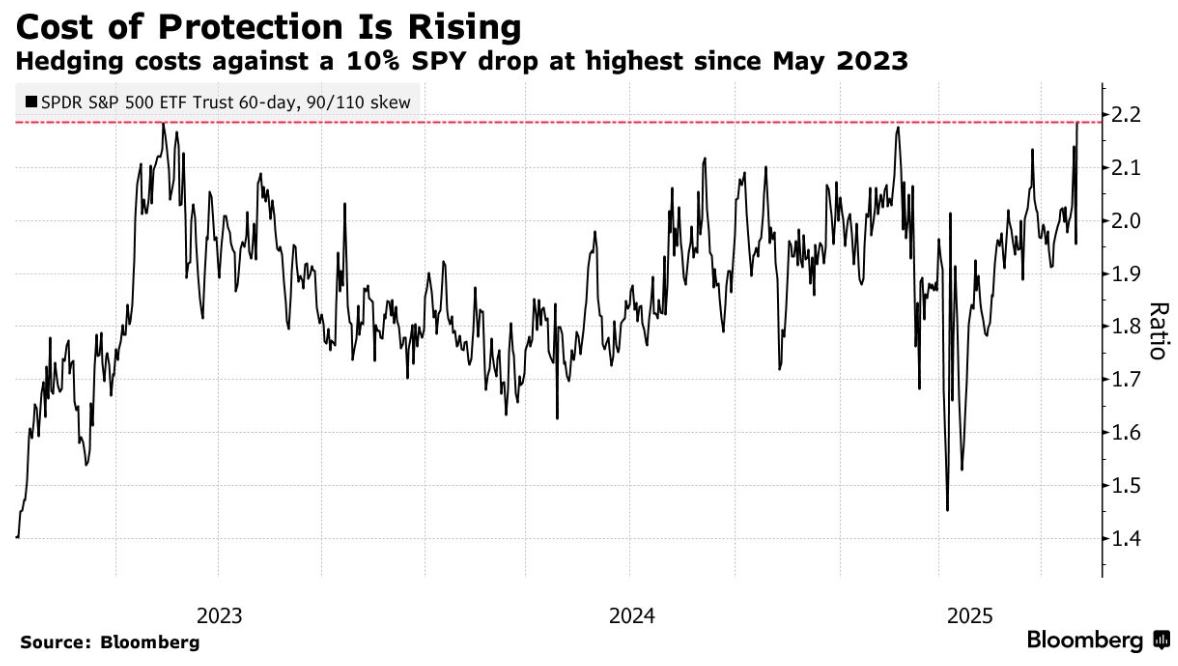
Group 1 - The S&P 500 index experienced a significant drop of 1.8%, marking its worst single-day performance since April, driven by fears of economic downturn due to tariff policies and disappointing job growth [1] - The Cboe Volatility Index (VIX), known as the "Wall Street Fear Index," surged to nearly 20, indicating increasing market pressure [1] - The cost of hedging against a potential 10% decline in the S&P 500 index ETF has reached its highest level since the regional banking crisis in May 2023, reflecting heightened concerns among investors [1] Group 2 - Following a 25% rise in the S&P 500 index since early April due to tariff impacts, investors are now seeking risk protection for the upcoming two months, particularly as the historically poor-performing months of August and September approach [3] - Data from Deutsche Bank indicates that Commodity Trading Advisors (CTAs) are holding stock long positions at the 94th percentile, the highest level since January 2020, suggesting confidence in the market but also potential for sharp reversals if conditions change [3] - Investor anxiety remains primarily focused on the short term, with the skewness indicator for S&P 500 options rising but still below levels seen before the April downturn [3]

事件落地,资?拥挤度释放
Zhong Xin Qi Huo· 2025-08-01 04:45
投资咨询业务资格:证监许可【2012】669号 中信期货研究|⾦融衍⽣品策略⽇报 2025-08-01 事件落地,资⾦拥挤度释放 股指期货:事件落地,资⾦拥挤度释放 股指期权:领⼝策略强化波动率结构 国债期货:市场继续消化政治局会议信息 股指期货方面,周四沪指低开低走,两市放量至1.96万亿元,前期主 线全面回落,仅有科技成长补涨。展望后市,中报季、阅兵前时点值得关 注,仍有事件交易机会,短期靴子落地式资金释放,我们建议看长做短, 配置型投资者继续持有IM多单,回撤反而成为加仓良机。 股指期权方面,尽管昨日升波下跌,但期权市场流动性并无显著提 升,成交量提升10%,而成交金额仅增加2.4%。波动率方面,IO、MO昨日 小幅抬升,但变化逻辑相异,MO的波动率微笑结构反映领口策略的强化, 即认沽波动率升,而认购波动率降;而IO波动率微笑结构相反,或反映市 场短期对成长风格更加谨慎,而对价值风格相对积极。综上,短线仍是双 卖为主,把握波动率回落,中期备兑思路不变。 国债期货方面,昨日国债期货主力合约继续上涨。昨日,国债期货高 开后震荡上行,市场继续消化政治局会议信息,债市情绪延续好转; 另外,7月PMI数据公布,制 ...
思看科技: 关于开展外汇衍生品交易业务的可行性分析报告
Zheng Quan Zhi Xing· 2025-07-31 16:38
Group 1 - The company plans to engage in foreign exchange derivative trading to mitigate risks associated with currency fluctuations and enhance financial stability [1][2] - The maximum contract value held on any trading day will not exceed 15 million USD (or equivalent in RMB), with a trading period of 12 months from board approval [1][2] - The funding for these transactions will come from the company's own funds, without involving raised funds or bank credit [1][2] Group 2 - The necessity for engaging in foreign exchange derivatives arises from the increasing foreign currency payment amounts, which expose the company to foreign exchange risks [2] - The company has established a management system for foreign exchange derivative trading, outlining principles, approval authority, and internal control measures, which comply with regulatory requirements [2][5] - The company aims to conduct these transactions prudently, avoiding speculative activities, and will continuously monitor market conditions to adjust strategies accordingly [4][5] Group 3 - Risks associated with foreign exchange derivative trading include exchange rate fluctuation risks, internal control risks, customer default risks, and liquidity risks [3][4] - The company has implemented risk control measures, including careful selection of trading partners and adherence to legal regulations, to mitigate potential risks [4][5] - The conclusion is that engaging in foreign exchange derivative trading is both necessary and feasible, as it aligns with the company's operational needs and risk management strategies [6]
思看科技: 外汇衍生品交易业务管理制度
Zheng Quan Zhi Xing· 2025-07-31 16:38
Core Points - The article outlines the foreign exchange derivatives trading management system of SiKan Technology (Hangzhou) Co., Ltd, aiming to standardize trading practices and enhance risk management [1][2] - The system is established in accordance with relevant laws and regulations, including the Company Law and Securities Law of the People's Republic of China, and is designed to ensure the safety of the company's assets [1][2] Group 1: General Principles - The foreign exchange derivatives trading business includes various products such as forward foreign exchange, swaps, options, and interest rate derivatives, aimed at mitigating exchange rate and interest rate risks [2][3] - The system applies to the company and its consolidated subsidiaries, requiring unified management and operation of foreign exchange derivatives trading by the company [2][3] Group 2: Basic Principles of Trading - The company must adhere to principles of legality, prudence, safety, and effectiveness in foreign exchange derivatives trading, focusing on normal business operations and avoiding speculative activities [2][3] - Transactions are only permitted with qualified financial institutions approved by the State Administration of Foreign Exchange and the People's Bank of China [3] Group 3: Approval Authority - The company's shareholders' meeting or board of directors serves as the decision-making and approval body for foreign exchange derivatives trading, with specific thresholds for approval based on transaction size and impact on net profit [4][5] - The board of directors can authorize the chairman to make investment decisions within approved limits [4][5] Group 4: Management and Operational Procedures - The management layer proposes trading limits based on estimated business scale and market analysis, which must be approved by the board of directors or shareholders' meeting [12] - The financial department is responsible for the specific operation and management of foreign exchange derivatives trading [12][13] Group 5: Risk Management Procedures - The financial department must monitor and report any significant abnormal situations in trading that may pose risks, ensuring timely communication with the board of directors [18][19] - Losses exceeding 10% of the company's most recent audited net profit must be disclosed promptly [19] Group 6: Confidentiality and Compliance - All personnel involved in foreign exchange derivatives trading must adhere to confidentiality protocols, ensuring that sensitive information is not disclosed without authorization [15][16] - The internal audit institution is responsible for supervising compliance with risk control policies and procedures [16]
瑞丰新材: 证券投资及衍生品交易管理制度(2025年7月修订)
Zheng Quan Zhi Xing· 2025-07-30 16:36
General Principles - The company establishes a system for managing securities investment and derivative trading to prevent investment risks and ensure the safety and effective appreciation of investment funds, in accordance with relevant laws and regulations [1][2] - The system applies to the company's securities investment and derivative trading activities, which include various forms of investments such as new stock subscriptions, stock repurchases, and bond investments [1][2] Investment and Trading Principles - The company must adhere to national laws and regulations, ensuring that all investment activities are legal, prudent, safe, and effective [2] - Investments must align with the company's asset structure and should not affect the normal operation of its main business [2] - The company is prohibited from engaging in high-risk investments within twelve months after using raised funds to supplement working capital [2] Decision-Making Authority - Securities investment exceeding 50% of the company's latest audited net assets and over 50 million RMB requires shareholder approval [3] - Investments over 10% of the latest audited net assets and exceeding 10 million RMB require board approval [4] - Derivative trading requires a feasibility analysis report submitted to the board for approval [4] Management and Oversight - The company must conduct securities investments through its own accounts and cannot use others' accounts for trading [6] - The finance department is responsible for managing funds and accounting for securities investments and derivative trading [6] - The audit and supervision department is tasked with auditing and monitoring investment activities, ensuring compliance with risk control measures [8] Risk Control Measures - The company must separate trading, finance, audit, and risk control personnel to ensure accountability [7] - Appropriate stop-loss limits must be established for various derivatives, and the company must track market price changes to assess risk exposure [8] Information Disclosure - The company is required to disclose information regarding its securities investments and derivative trading in accordance with regulations from the China Securities Regulatory Commission and the Shenzhen Stock Exchange [9] - Any significant losses or unusual situations must be reported immediately to the board [9]

股票股指期权:隐波回落,隐波溢价仍较多,可考虑备兑策略
Guo Tai Jun An Qi Huo· 2025-07-30 14:11
Report Date - The report is dated July 30, 2025 [1] Core Viewpoint - Stock index options: Implied volatility has declined, and there is still a significant implied volatility premium. A covered call strategy can be considered [2] Market Data Summary Underlying Market Statistics - **Indices**: The Shanghai Composite 50 Index closed at 2819.35, up 10.76; the CSI 300 Index closed at 4151.24, down 0.79; the CSI 1000 Index closed at 6718.48, down 55.40 [3] - **ETFs**: The Shanghai Composite 50 ETF closed at 2.943, up 0.009; the Huatai-PineBridge CSI 300 ETF closed at 4.232, down 0.003; etc [3] Option Market Statistics - **Volume and Open Interest**: For example, the trading volume of Shanghai Composite 50 index options was 56,146, an increase of 29,906; the open interest was 68,176, a decrease of 2,286 [3] - **PCR**: The VL-PCR and OI-PCR of different options vary, such as the VL-PCR of Shanghai Composite 50 index options was 51.35%, and the OI-PCR was 58.89% [3] Option Volatility Statistics - **ATM-IV and HV**: The ATM-IV of Shanghai Composite 50 index options (near - month) was 14.82%, down 1.32%; the same - term HV was 6.37%, up 0.05% [6] - **Skew and VIX**: The Skew of Shanghai Composite 50 index options was 9.62%, down 3.24%; the VIX was 18.64, down 0.976 [6]
胜宏科技: 外汇套期保值管理制度(2025年7月修订)
Zheng Quan Zhi Xing· 2025-07-29 16:43
Core Viewpoint - The document outlines the foreign exchange hedging management system of Shenghong Technology (Huizhou) Co., Ltd, aiming to standardize hedging operations, mitigate foreign exchange risks, and ensure compliance with relevant laws and regulations [1][2][3]. Group 1: General Principles - The purpose of the hedging management system is to regulate foreign exchange hedging activities and effectively control foreign currency exchange rate risks [1]. - The hedging activities include various financial instruments such as forward foreign exchange contracts, foreign exchange swaps, currency swaps, foreign exchange options, interest rate swaps, and other foreign exchange derivatives [1][2]. - The system applies to both the company and its subsidiaries, treating subsidiary hedging activities as those of the listed company [1]. Group 2: Operational Regulations - The company must conduct hedging activities based on legitimate, prudent, safe, and effective principles, ensuring that these activities align with normal business operations and do not involve speculative trading [2]. - Hedging transactions are only permitted with financial institutions approved by the State Administration of Foreign Exchange and the People's Bank of China, and the hedging limits must not exceed those approved by the board or shareholders [2]. - The foreign exchange hedging contracts must not exceed the company's predicted foreign exchange receipts and payments, and the delivery period must match the actual execution period of the business [2]. Group 3: Approval Authority - A feasibility analysis report must be prepared and submitted to the board for approval before conducting hedging activities [3]. - Certain transactions require submission to the shareholders' meeting if they exceed specified thresholds related to net profit and net assets [3]. - The board of directors and the shareholders' meeting serve as the decision-making bodies for hedging activities [4]. Group 4: Management Process - The financial center is responsible for planning, funding, executing, and managing hedging activities, while the internal audit department oversees the actual operations and risk management [4][5]. - The financial center must analyze foreign exchange market trends and propose hedging plans, which require approval from the financial head and the company president [5]. - Each hedging transaction must be documented, and the internal audit department must regularly review the operations and report findings to the board's audit committee [5][6]. Group 5: Risk Management and Information Disclosure - All personnel involved in hedging must adhere to confidentiality protocols regarding transaction details and financial status [6]. - The financial center must ensure timely settlement with financial institutions based on actual foreign exchange receipts and payments [6][7]. - The company is required to disclose information related to hedging activities in accordance with regulations from the China Securities Regulatory Commission and the Shenzhen Stock Exchange [7].

股票股指期权:盘中隐波与标的呈现正相关上行,隐波溢价扩大
Guo Tai Jun An Qi Huo· 2025-07-29 12:51
Report Summary 1. Market Conditions - On July 29, 2025, in the stock index option market, the intraday implied volatility showed a positive correlation with the underlying assets and increased, and the implied volatility premium expanded [1]. 2. Market Data 2.1 Underlying Market Statistics - **Indices**: The closing prices of the Shanghai - Shenzhen 300 Index, the CSI 1000 Index, and the Shanghai Composite 50 Index were 4152.02, 6773.88, and 2808.59 respectively, with increases of 16.20, 43.91, and 5.82. Their trading volumes were 230.81 billion, 259.26 billion, and 47.05 billion shares, with changes of 8.05 billion, 6.52 billion, and - 2.69 billion shares [1]. - **ETFs**: The closing prices of the Huatai - Bairui 300 ETF, the Southern 500 ETF, and the ChinaAMC Science - Innovation 50 ETF were 4.235, 6.431, and 1.125 respectively, with increases of 0.021, 0.040, and 0.015. Their trading volumes were 8.06 billion, 2.13 billion, and 37.52 billion shares, with changes of 2.03 billion, 0.11 billion, and - 0.73 billion shares [1]. 2.2 Option Market Statistics - **Trading Volume and Open Interest**: The trading volumes of the Shanghai - Shenzhen 300 Index Option, the CSI 1000 Index Option, and the Shanghai Composite 50 Index Option were 71146, 181506, and 26240 respectively, with changes of - 5069, 476, and - 5095. Their open interests were 191714, 253286, and 70462 respectively, with changes of 3662, 7762, and 1265 [1]. - **PCR Indicators**: The VL - PCR of the Shanghai - Shenzhen 300 Index Option, the CSI 1000 Index Option, and the Shanghai Composite 50 Index Option were 58.24%, 81.44%, and 44.26% respectively, and the OI - PCR were 72.66%, 96.82%, and 55.62% respectively [1]. 2.3 Option Volatility Statistics - **ATM - IV and HV**: For the Shanghai - Shenzhen 300 Index Option, the near - month ATM - IV was 15.72% with a change of - 0.07%, and the same - term HV was 6.49% with a change of - 0.04%. For the CSI 1000 Index Option, the near - month ATM - IV was 19.03% with a change of - 0.36%, and the same - term HV was 8.53% with a change of 0.04% [4]. - **Skew and VIX**: The skew of the Shanghai - Shenzhen 300 Index Option was 9.81% with a change of - 2.44%, and the VIX was 19.76 with a change of 0.059. The skew of the CSI 1000 Index Option was 1.81% with a change of - 1.18%, and the VIX was 23.21 with a change of - 0.002 [4]. 3. Option - Specific Charts - For each type of option (such as the Shanghai Composite 50 Index Option, the Shanghai - Shenzhen 300 Index Option, etc.), there are charts showing the full - contract PCR, the main - contract volatility, the main - contract skew, the volatility cone, and the volatility term structure [8][12][15].