
锂电

Search documents
47条举措全力冲刺“开门红”
Xin Lang Cai Jing· 2026-02-08 18:30
Core Viewpoint - The Xining Economic and Technological Development Zone has issued a plan for the first quarter of 2026, focusing on 13 key areas and proposing 47 specific measures to ensure a strong start for industrial economic growth and lay a foundation for high-quality development throughout the year [1][2] Group 1: Environmental and Industrial Focus - The plan emphasizes ecological priority and green development, with measures for pollution prevention and control, enhancing environmental supervision in air, water, and solid waste sectors, and improving emergency management systems [1] - The development zone aims to promote green upgrades in traditional industries, implement energy-saving and carbon-reduction technological transformations, and accelerate the construction of the South River National Zero Carbon Park [1] - Key industries targeted include non-ferrous metals, crystalline silicon, and lithium batteries, with tailored strategies to ensure production and market supply meet demand [1] Group 2: Investment and Project Management - The development zone aims for fixed asset investment to exceed 2.36 billion yuan in the first quarter and is accelerating the progress of over 70 ongoing projects [2] - A spring investment promotion campaign will focus on strengthening and supplementing industrial chains and quickly attracting and constructing projects [2] - The zone is optimizing land resource allocation and enhancing financial management efficiency while ensuring safety in production and emergency response to extreme weather [2] Group 3: Implementation and Coordination - To ensure effective implementation of measures, the development zone will enhance collaborative efforts and process management, optimize the business environment, and establish tracking and supervision mechanisms [2] - Responsibilities will be enforced through weekly scheduling, monthly reporting, and quarterly assessments to ensure that all initiatives are effectively executed [2]
华泰证券:风险偏好下降驱动的调整波段或接近尾声
Xin Lang Cai Jing· 2026-02-08 15:06
Core Viewpoint - The report from Huatai Securities indicates that the A-share market experienced a decline this week, driven primarily by a decrease in risk appetite, with a notable shift between high and low-performing stocks [1] Summary by Categories Market Overview - The overall external macro risks have been initially priced in, with a cooling of financing funds and a narrowing of net outflows from ETFs, while both domestic and foreign institutional investors have shown a net inflow against the trend [1] Structural Analysis - The report suggests that segments with floating profits, crowded trading, and significant performance verification pressures have largely completed their initial pricing, indicating that the adjustment phase may be nearing its end [1] Calendar Effect - The report notes that the calendar effect for February in the A-share market is relatively positive, recommending a gradual increase in portfolio flexibility [1] Investment Strategy - The focus should be on selecting high-beta and relatively high valuation-cost performance segments within industries experiencing a reversal in prosperity or a continuation of improvement trends, particularly in lithium battery chains, communication equipment, semiconductors, certain building materials, and chemicals [1] - For low-beta segments, attention should be given to agriculture [1] - From a mid-term perspective, it is advised to overweight the upstream sectors of the power chain, insurance, and the aerospace industry chain [1]

南华期货碳酸锂产业周报:春节长假,关注卖波动率机会-20260208
Nan Hua Qi Huo· 2026-02-08 14:29
1. Report Industry Investment Rating No information provided in the report. 2. Core Views of the Report - In the short - term, before the Spring Festival, the downstream restocking is over, and there are many uncertainties during the long holiday. It is recommended to gradually reduce positions and hold light or no positions to avoid risks. The current volatility of the lithium carbonate futures market is at a historical high, and there is limited room for further upward volatility, so it is advisable to focus on the layout opportunities of the short - volatility strategy. In the long - term, the growth logic of demand in the three downstream application fields of energy storage, new - energy vehicles (passenger and commercial) remains unchanged, and the industry fundamentals still strongly support the long - term value of lithium carbonate. It is advisable to grasp market correction opportunities and adopt a strategy of buying on dips [2]. - The driving logic of lithium carbonate futures prices before the Spring Festival will be absent, mainly focusing on reducing volatility. After the festival, factors such as the release progress of lithium resources at home and abroad, the maintenance and production scheduling of supply and demand sides, and the production and sales of new - energy vehicles will jointly dominate the subsequent market price trends [1]. 3. Summary by Relevant Catalogs Chapter 1: Core Contradictions and Strategy Recommendations 1.1 Core Contradictions - The lithium carbonate futures price showed a significant decline with reduced positions this week. Before the Spring Festival, the driving logic is absent, and after the festival, factors such as lithium resource release, supply - demand maintenance and production scheduling, and new - energy vehicle production and sales will affect prices. The domestic lithium concentrate inventory is currently stable. Some lithium salt plants are scheduled for maintenance around the Spring Festival, and attention should be paid to their resumption of production after the festival. The downstream restocking before the Spring Festival is over, and the focus is on new - energy vehicle production and sales [1]. - Technically, the historical volatility of lithium carbonate futures has reached a new high, and the implied volatility is declining. There is a high possibility that the volatility will drop significantly, and the support level around 120,000 yuan should be noted [1]. 1.2 Industry Customer Strategy Recommendations - The support level of the lithium carbonate main contract is 120,000 yuan, the current 20 - day rolling volatility is 117.4%, and the historical percentile of the 3 - year volatility is 96.6% [7]. - Different hedging strategies are recommended for lithium - battery enterprises in aspects such as procurement management, sales management, and inventory management. For example, in procurement management, when the product price is not correlated, a combination of long - term futures contracts and options is recommended; when the product price is correlated, a combination of main futures contracts and options is used. The recommended hedging ratios vary from 5% to 50% [7]. Chapter 2: Market Information - This week, important events in the lithium - battery industry include: on February 1st, the 5000t/d beneficiation project of Jinxin Mining, a subsidiary of Guocheng Mining, successfully carried out a feed test; on February 2nd, CATL signed a cooperation agreement for a new - energy battery production base in Quanzhou; on February 4th, Shengxin Lithium Energy's subsidiary planned to acquire a 13.93% stake in Yajiang Huirong Mining; on February 5th, Fengyuan Co., Ltd. reported its production capacity and utilization rate; on February 6th, Guoxuan High - tech planned a private placement to raise up to 5 billion yuan for battery projects [9][10][11]. Chapter 3: Futures and Price Data 3.1 Price - Volume and Capital Interpretation - This week, the lithium carbonate futures price dropped significantly. The closing price of the weighted index contract was 132,971 yuan/ton, a week - on - week decrease of 10.35%. The trading volume was about 753,990 lots, a week - on - week decrease of 0.95%, and the open interest was about 636,575 lots, a week - on - week decrease of 86,426 lots. The LC2605 - LC2607 spread showed a Contango structure, and the number of warehouse receipts increased by 3,146 lots week - on - week [13][16]. - From a technical analysis perspective, the price dropped to the 60 - day moving average, and the open interest decreased to a six - month low. The price broke through the first support level of 140,000 yuan, and the second support level of 130,000 yuan needs further observation. The medium - to - long - term upward trend of the lithium carbonate futures price has not been broken [16]. - Regarding options, the 20 - day historical volatility and the implied volatility of at - the - money options of lithium carbonate futures are both at historical highs. The PCR of option open interest fluctuates. It is recommended to focus on the short - volatility strategy due to the limited upward space of volatility and the rapid decline of option time value approaching the Spring Festival [18]. - In terms of capital trends, the short - position scale remained stable this week. The near - month contracts are under pressure as downstream restocking is over. The 05 contract, as the main contract, was affected by profit - taking and pre - holiday risk - aversion sentiment, showing a significant decline [21][23]. - The CME and LME lithium hydroxide futures prices and trading volume data are provided. The significant decline in the lithium carbonate main - contract price has led to a significant strengthening of the near - term basis, and it is recommended to seize the opportunity to buy on the futures market [30][34]. 3.2 Spot Price Data - The report provides the weekly price data of the lithium - battery industry chain, including lithium ore, lithium salt, cathode materials, electrolyte, and battery cells. Most product prices showed a downward trend this week, such as industrial - grade lithium carbonate with a week - on - week decrease of 16.56% and battery - grade lithium carbonate with a week - on - week decrease of 16.20% [40]. Chapter 4: Valuation and Profit Analysis 4.1 Industry Chain Upstream and Downstream Profit Tracking - Due to the significant decline in futures prices, the profits of lithium carbonate production lines using externally - purchased lithium ore as raw materials have weakened significantly, and the tightness of ore - end inventory has been relieved. The overall profit of the recycling end remains negative, and the profits of lithium hydroxide production lines have also declined [43]. - Among cathode materials, the profits of lithium iron phosphate and ternary materials have a marginal strengthening trend, cobalt - acid lithium is in a volatile range, and manganese - acid lithium shows marginal strengthening. The profit of the lithium hexafluorophosphate link, the core raw material of the electrolyte, has a marginal weakening trend, while the profit of the electrolyte has a marginal strengthening trend [46]. 4.2 Import and Export Profits No specific data analysis on import and export profits is provided in the text, but relevant charts are presented. Chapter 5: Fundamental Situation 5.1 Lithium Ore Supply - The report shows the import volume of lithium concentrate by country and provides the weekly inventory data of domestic lithium ore. The total weekly salable inventory of lithium ore is 238,000 tons, a week - on - week decrease of 12.18%. The port inventory is 253,000 tons, a week - on - week decrease of 14.53% [64][65]. 5.2 Upstream Lithium Salt Supply - For lithium carbonate supply, the total operating rate of sample enterprises is 47.29%, a week - on - week decrease of 4.46%. The total output is 20,744 tons, a week - on - week decrease of 3.82%. The operating rates and outputs of different production lines (lithium - spodumene, lithium - mica, salt - lake, and recycling) vary [67]. - The net export of lithium carbonate and inventory data are presented. The total weekly inventory of lithium carbonate is 105,463 tons, a week - on - week decrease of 1.88%. The inventory days are 30 days, a week - on - week increase of 5.26% [80][82]. - Regarding lithium hydroxide supply, the monthly production data by process are provided, including the total production, production at the smelting end, and production at the causticizing end [88]. 5.3 Mid - Stream Material Factory Supply - The weekly production data of battery material factories are provided, including lithium iron phosphate, ternary materials, cobalt - acid lithium, manganese - acid lithium, and lithium hexafluorophosphate. Most products' production and operating rates showed a downward or slightly fluctuating trend this week [94]. - The inventory data of material factories, such as the weekly total inventory of ternary materials and lithium iron phosphate, are also presented [107]. 5.4 Downstream Battery Cell Supply - The weekly production data of Chinese power battery cells are provided. The total production of power battery cells is 26.70 GWh, a week - on - week increase of 1.14%. The production of iron - lithium - type and ternary - type power battery cells shows different trends [113]. - The monthly production data of power, energy - storage, and consumer - type battery cells and the lithium - battery installation volume data are presented [115][118]. 5.5 New - Energy Vehicles - The production and sales data of new - energy vehicles are provided, including the weekly production and sales data of new - energy passenger and commercial vehicles, the penetration rate of new - energy vehicles, and the sales data of major new - energy vehicle enterprises [120][121]. - The inventory data of new - energy vehicles, such as the inventory warning index of domestic automobile dealers, are also presented [130]. 5.6 Energy Storage - The total scale data of energy - storage winning bid power and capacity are provided, including the total scale of winning bid power and capacity and the seasonal data of the total scale of winning bid capacity [132].


周观点0208:太空光伏催化不断,CSP大厂资本开支超预期-20260208
Changjiang Securities· 2026-02-08 14:21
Investment Rating - The report maintains a "Positive" investment rating for the industry [3] Core Insights - The space photovoltaic industry is progressing, with significant capital expenditures from major CSP manufacturers exceeding expectations [1] - The demand for energy storage is driven by ongoing electricity shortages in the U.S., highlighting the cost-effectiveness of leading companies [14] - The report emphasizes the importance of new directions such as space photovoltaics, AIDC, and robotics, which are catalyzing investment opportunities [14] Summary by Sections Photovoltaics - The space photovoltaic sector is gaining traction, with SpaceX's application for 1 million satellites accepted by the FCC, indicating a robust future for space-based data centers [20] - The China Photovoltaic Industry Association released cost analysis, indicating that the average full cost of mainstream photovoltaic products is expected to stabilize, providing support for price recovery [21] - The report highlights the potential for significant growth in global photovoltaic installations, with annual additions projected between 725-870 GW during the 14th Five-Year Plan [22] Energy Storage - Sunshine Power announced plans to establish a production base in Poland, aiming for 20 GW of inverter capacity and 12.5 GWh of energy storage systems [39] - The report notes a 45% year-on-year increase in EU battery storage capacity, with large-scale storage systems becoming the main growth driver [39] - January saw a significant increase in independent storage projects, with a total of 12.3 GW/36 GWh of bids, despite a year-on-year decline due to procurement timing [40] Lithium Batteries - The demand for lithium batteries continues to strengthen, with all segments showing a willingness to maintain prices, indicating ongoing profitability improvements [14] - The report recommends focusing on battery segments, particularly companies like CATL and EVE Energy, which are expected to perform well in the medium term [14] Wind Power - The report emphasizes the start of a new wind power cycle during the 14th Five-Year Plan, with significant opportunities in commercial aerospace and offshore wind projects [14] - Companies involved in wind turbine manufacturing and components are highlighted as key investment opportunities [14] Power Equipment - The domestic power grid's investment plan is projected at 5 trillion yuan, with significant improvements in pricing and demand driven by electricity shortages in the U.S. [14] - The report suggests focusing on opportunities in AI for power management and virtual power plants [14] New Directions - The report highlights the importance of developments in humanoid robotics and AIDC technology, with specific companies recommended for investment based on their potential in these sectors [14]





电力设备行业周报:国内储能景气持续,太空光伏需求进一步强化-20260208
Guohai Securities· 2026-02-08 14:08
Investment Rating - The industry investment rating is "Recommended" (maintained) [1] Core Views - The domestic energy storage market continues to thrive, and the demand for space photovoltaic is further strengthened. The recent acquisition of xAI by SpaceX and the approval of a million-satellite application by the FCC are expected to drive rapid growth in space energy, particularly solar wing demand [4][5] - The report highlights the positive changes and potential catalysts across various sectors within the power equipment industry, maintaining an overall "Recommended" rating for the sector [6] Summary by Sections Recent Performance - The power equipment sector has shown a performance increase of 3.0% over the last month, with a 54.2% increase over the past year, outperforming the CSI 300 index, which has decreased by 3.1% in the last month and increased by 20.8% over the past year [3] Key Events and Insights - In the photovoltaic sector, the approval of SpaceX's satellite application is expected to significantly boost demand for solar energy solutions. The report suggests focusing on companies involved in photovoltaic battery equipment and components, such as Maiwei Co., Jiejia Weichuang, and others [4] - The wind power sector is expected to accelerate following the signing of the "Hamburg Declaration," which commits nine countries to develop 100GW of offshore wind power, potentially benefiting domestic manufacturers [5] - The energy storage market saw a total order volume of 36.3GWh in January 2026, with significant contributions from regions like Ningxia and Hebei. The average price for a 4-hour system has increased by 42% compared to the lowest point in July 2025 [6] - The lithium battery sector is witnessing accelerated industrialization of dry electrode equipment, with companies like Xianzhong Intelligent and others leading the way [6] Recommendations - The report recommends focusing on key players in the photovoltaic sector, such as Longi Green Energy and Aiko Solar, as well as companies in the wind power sector like Goldwind Technology and Mingyang Smart Energy [5][6] - In the energy storage space, companies like Sungrow Power Supply and EVE Energy are highlighted as potential investment opportunities [6]
两股宣布并购重整,双双提前涨停
2 1 Shi Ji Jing Ji Bao Dao· 2026-02-08 13:39
Group 1: Mergers and Acquisitions Activity - The A-share lithium battery sector is experiencing significant capital operations, with Yongtai Technology planning to acquire a 25% stake in Yongtai High-tech from CATL through a share issuance, leading to a stock suspension starting February 9 [2] - The stock of Yongtai Technology reached a market cap of 26.6 billion yuan after hitting the daily limit up on February 6, marking its first limit up since 2026 [2][6] - Another company, Ruili Kemi, announced plans to acquire the remaining 16% stake in its subsidiary, Wuhan Kedes, which will make it a wholly-owned subsidiary, also resulting in a stock suspension from February 9 [2] Group 2: Ongoing Mergers and Acquisitions Announcements - At least 18 companies in the A-share market disclosed merger and acquisition progress this week, indicating a robust trend in corporate restructuring [3] - Specific companies involved include Longyun Co., which plans to acquire 58% of Xuanheng Film Industry, and Yiwang Yichuang, which intends to purchase 100% of Lianshi Legend for cash and shares [4] Group 3: Changes in Company Control - Shanshan Co. announced a potential change in control, with its major shareholder set to change to Anhui Weiqi Group, and the actual controller to the Anhui State-owned Assets Supervision and Administration Commission, following a restructuring process [5] - The company is currently in a state of no effective control after the death of its founder, leading to a significant power struggle within the family [5]


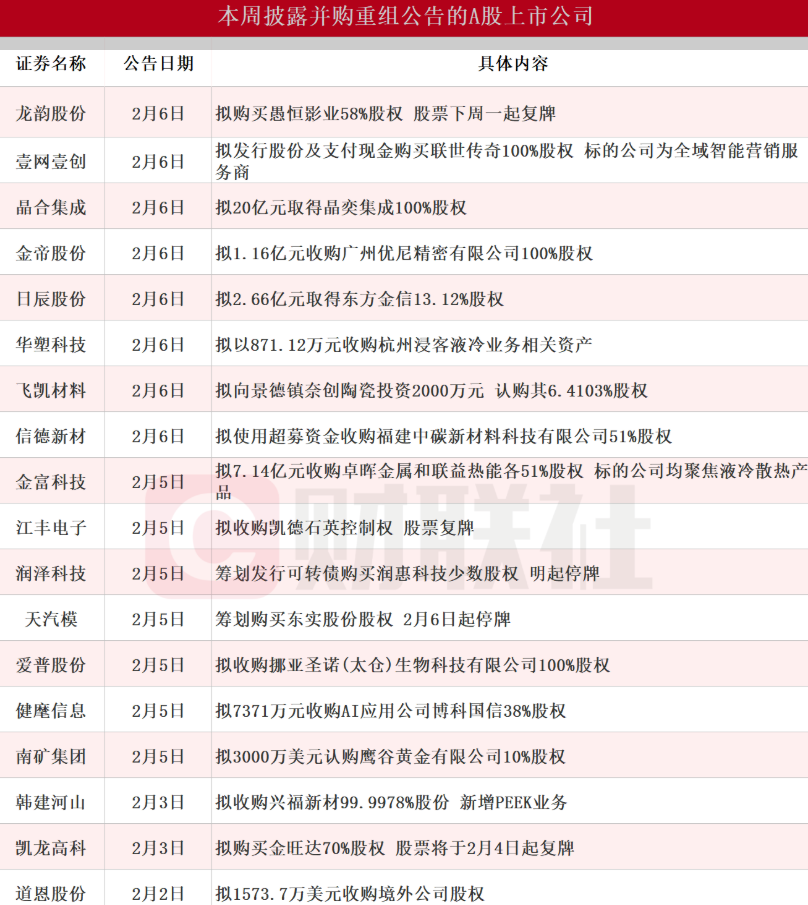
春节前最后一个交易周!持币观望,还是持股过节?券商发声
证券时报· 2026-02-08 12:56
Core Viewpoint - The article discusses the strategies for investors in the last trading week before the Spring Festival, highlighting the mainstream recommendation of "holding stocks over the holiday" based on historical "Spring Festival effect" analysis and current economic expectations [1][5]. Market Trends and Historical Analysis - A-shares typically exhibit a "calendar effect" around the Spring Festival, characterized by "volume contraction before the festival and expansion afterward" [2][3]. - Historical data indicates that market volume usually starts to decline from T-8 days (T being the day of the festival), with significant volume drop observed around February 4, 2026, where trading amounts fell below 2.5 trillion yuan [2]. - The market tends to rebound in the last five trading days before the festival, with a clear upward trend often continuing until about T+6 days after the festival [2]. Fund Behavior and Market Dynamics - The "down then up" pattern of the index is attributed to risk-averse behavior of funds during the holiday, leading to a temporary market decline before a rebound as investors anticipate the "Spring Festival effect" [3]. - The rotation of large-cap and small-cap stocks is notable, with large-cap stocks performing better before the festival and small-cap stocks gaining an advantage afterward [3][4]. Investment Strategies and Recommendations - Multiple brokerage firms suggest a balanced approach to investment, emphasizing "stable allocation" before the festival and a focus on growth and industry trends afterward [8]. - Specific sectors such as low-volatility, high-dividend stocks in banking and consumer sectors are expected to attract funds during the pre-festival period [8]. - The technology sector remains a long-term consensus for investment, with a focus on AI applications, high-end manufacturing, and new energy post-festival [8]. Sector Focus and Future Outlook - Analysts recommend monitoring sectors that may experience marginal changes during the festival, including humanoid robots, AI industry chains, and gaming [9]. - The overall sentiment suggests that the market may see renewed upward momentum post-festival, driven by improved economic and profit expectations, as well as a favorable liquidity environment [6][7].

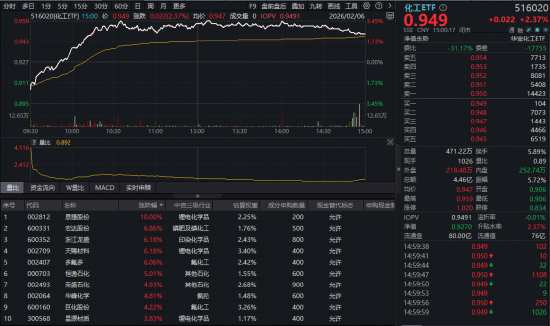
化工板块单日吸金近200亿元!锂电、磷化工强势领涨,化工ETF(516020)逆市上探3.45%!景气周期启动?
Xin Lang Cai Jing· 2026-02-08 12:15
Core Viewpoint - The chemical sector experienced a significant rally on February 6, with the chemical ETF (516020) showing a maximum intraday increase of 3.45% before closing up 2.37% despite market conditions [1][7]. Market Performance - The chemical ETF opened lower but quickly rebounded, maintaining high levels before a slight pullback at the close [1][7]. - Key stocks in the lithium battery, phosphate chemical, and petrochemical sectors saw substantial gains, with Enjie Technology hitting the daily limit, and other stocks like Hongda shares, Zhejiang Longsheng, and Tianci Materials rising over 6% [1][7]. Capital Inflow - The basic chemical sector attracted significant capital, with a net inflow of 19.918 billion yuan, the highest among 30 sectors tracked by Citic [3][9]. - This capital influx indicates strong investor interest and confidence in the sector's growth potential [3][9]. Industry Trends - The lithium battery sector is entering a growth phase characterized by rising prices and demand for key chemical materials such as lithium iron phosphate and hexafluorophosphate [3][9]. - Analysts suggest that policy directions are optimizing supply-side dynamics, enhancing the competitive advantages of leading companies in the chemical industry [3][9]. Future Outlook - Zhongyuan Securities anticipates that ongoing regulatory measures will strengthen supply-side constraints, benefiting certain sub-industries like chlorine-alkali, pesticides, and polyester filament in February [3][9]. - Guojin Securities remains optimistic about investment opportunities in the chemical sector, recommending a focus on leading companies and products experiencing price increases [3][9]. Investment Strategy - Investors are encouraged to consider the chemical ETF (516020) for efficient exposure to the sector, as it tracks the CSI sub-industry index covering various themes including AI computing and new energy [3][9].
用好“关键一招”,探索县域经济高质量发展“射洪路径”
Xin Lang Cai Jing· 2026-02-07 20:46
Core Insights - The article emphasizes the importance of developing distinctive county economies as highlighted by the 20th National Congress and provincial government reports, showcasing a commitment to enhancing county-level economic growth [3] Group 1: Economic Development - The city of Shehong has adopted a "3+2" integrated approach to local economic work, focusing on industrial strength and establishing itself as a core area for lithium battery production and a national hub for high-quality liquor [3] - Over the past five years, Shehong's GDP increased from 41.4 billion to 68.5 billion, with its share of the total GDP in Suining rising from 29.5% to 34.2% [3] - General public budget revenue doubled from 1.51 billion to 3.45 billion, indicating significant fiscal growth [3] Group 2: Strategic Goals - The city aims to become a "billion-level county" in the western region by strengthening key industries, particularly in lithium and food and beverage sectors, while exploring new development models [4] - Plans include advancing urban integration with surrounding towns and expanding urban development boundaries to 50 square kilometers by 2030 [4] - Key transportation projects are prioritized to enhance connectivity with Suining and the Chengdu-Chongqing economic circle [4] Group 3: Urban and Social Development - The city is committed to exploring new paths for urban-rural integration, implementing initiatives to attract visitors, and optimizing public services in employment, education, healthcare, and elder care [5] - The goal is to increase the urban population to over 500,000 by 2030, transforming Shehong into a well-functioning, comfortable, and happy city [5]
开足马力!
Xin Lang Cai Jing· 2026-02-06 17:54
Core Insights - The Xining Economic and Technological Development Zone aims to achieve an industrial output value of 29.15 billion yuan and a 5% growth in industrial added value in the first quarter of 2026 [1] Group 1: Industrial Performance - Currently, 157 large-scale industrial enterprises in Xining Development Zone are operating at full capacity, while over 100 small and medium-sized enterprises are improving quality and efficiency [1] - More than 70 ongoing projects are being expedited to meet construction deadlines, with a focus on the spring construction peak [2] Group 2: Key Industries and Projects - The development zone is concentrating on three main industries: non-ferrous metals, crystalline silicon, and lithium batteries, with dedicated teams conducting in-depth research to identify potential and bottlenecks in capacity release and supply chain collaboration [1] - Significant projects include the Green Balance's 100,000-ton high-value resource utilization, Yellow River Xinye's phosphorous pig iron casting and graphitization technology upgrades, and the production of high-efficiency lithium battery electrodes by Times New Energy [2] Group 3: Policy and Support Measures - A service coordination leadership group for investment attraction has been established to address pain points in enterprise development and project construction [2] - A one-stop service platform for enterprise policies has been created to facilitate tax reductions, interest subsidies, and regular bank-enterprise matchmaking meetings to alleviate financing difficulties [2]