商业银行

Search documents
每日报告精选-20251222
GUOTAI HAITONG SECURITIES· 2025-12-22 11:31
Macroeconomic Insights - The US inflation rate for November was 2.7%, down 0.3 percentage points from September, significantly below the market expectation of 3.1%[11] - The unemployment rate in the US has unexpectedly risen, indicating a slowdown in the job market[7] - The European Central Bank has maintained interest rates for the fourth consecutive meeting, suggesting the end of the rate-cutting cycle is near[7] Market Performance - Emerging market stocks underperformed compared to developed markets, with the Nikkei 225 down 2.6% and the Hang Seng Index down 1.1%[6] - The 10-year US Treasury yield fell by 3 basis points to 4.16%, while the domestic 10Y government bond futures price decreased by 0.1%[6] Commodity and Currency Trends - COMEX silver prices increased by 9.4% in the week, with a year-to-date increase exceeding 120%[13] - The US dollar index rose by 0.3%, while the Japanese yen depreciated by 1.2% against the dollar[17] Investment Strategies - The report suggests a focus on AI applications and commercial aerospace as key investment themes, with significant growth expected in these sectors[19][21] - The domestic consumption sector is anticipated to benefit from government policies aimed at boosting consumer spending, with new consumption scenarios emerging[23] Industry-Specific Insights - In the automotive sector, Tesla's Robotaxi has begun unmanned testing, indicating potential growth in the autonomous driving supply chain[34] - The steel industry is facing a demand decline, with iron ore inventories reaching a four-year high, while production rates are expected to stabilize[39][41]
今日期货市场重要快讯汇总|2025年12月19日
Sou Hu Cai Jing· 2025-12-19 00:11
Precious Metals Futures - Goldman Sachs predicts that gold prices will rise by 14% to $4,900 per ounce by December 2026, with potential upside risks [1] - On December 19, New York futures gold prices rose, breaking through $4,380 per ounce (up 0.14%), $4,390 per ounce (up 0.37%), and ultimately surpassing $4,400 per ounce, with a daily increase of 0.60% [2][3][4] - Spot gold also increased, breaking through $4,350 per ounce (up 0.29%), $4,360 per ounce (up 0.55%), and further rising to $4,370 per ounce, with a daily increase of 0.74% [5][6][7] - However, on December 18, precious metal prices experienced a pullback, with New York futures gold falling below $4,340 per ounce (down 0.78%) and spot gold below $4,310 per ounce (down 0.65%) [8][9] - Silver showed weaker performance, with New York futures silver falling below $65 per ounce (down 2.85%) and spot silver also below $65 per ounce (down 1.84%) [10][11] Base Metals Futures - Goldman Sachs reaffirms that copper prices will reach $15,000 per ton by 2035 and continues to recommend a long position in copper and a short position in aluminum for contracts expiring in December 2027 [12] Energy and Shipping Futures - In the energy market, U.S. natural gas futures prices fell over 3.00% on December 19, currently reported at $3.233 per million British thermal units, with the decline expanding to 4.00%, now at $3.199 per million British thermal units [14][15] - The EIA natural gas report shows that as of the week ending December 12, U.S. natural gas inventories totaled 35,790 billion cubic feet, a decrease of 1,670 billion cubic feet from the previous week and down 610 billion cubic feet year-on-year (a 1.7% decline), while being 320 billion cubic feet above the 5-year average (a 0.9% increase) [16] - Goldman Sachs predicts that by 2026, the average price of Brent crude oil and West Texas Intermediate crude oil will drop to $56 and $52 per barrel, respectively [17] Macroeconomic and Market Impact - The European Central Bank's policy direction is under scrutiny, with several officials indicating that the rate-cutting cycle is likely over, maintaining deposit rates at around 2% unless a significant shock occurs; however, discussions on rate hikes are considered "premature" [18][19] - The ECB also forecasts that inflation rates will be below 2% in the first quarter of 2026 and from the third quarter of 2026 to the fourth quarter of 2027 [20] - In the U.S., concerns about premature significant rate cuts were expressed, while the White House's National Economic Council director believes there is substantial room for rate cuts by the Federal Reserve [21][23] - Several banks have recently lowered U.S. dollar deposit rates, with one bank reporting a decrease of 0.05 percentage points in its latest dollar time deposit rates [24]

上证50VS道琼斯:中美传统行业差距抹平,未来分野唯在科技
3 6 Ke· 2025-12-17 00:31
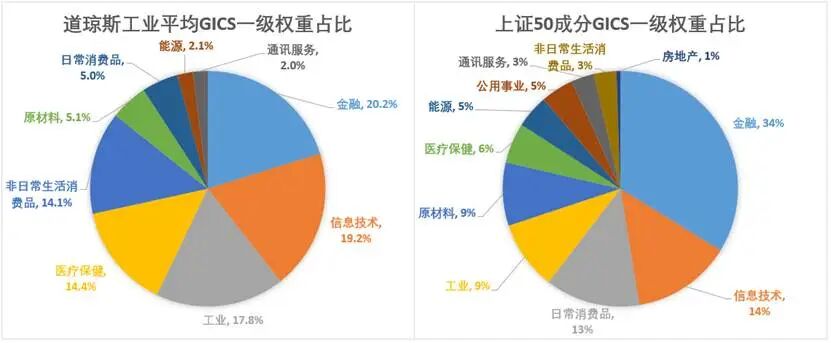
Group 1 - The article compares the valuation and fundamental changes between the Nasdaq and the Hong Kong stock market's Chinese internet companies over the past three years, highlighting the differences in pricing logic and relative performance of the Dow Jones Industrial Average and the Shanghai Stock Exchange 50 Index [1] - The Dow Jones Industrial Average consists of 30 stocks across 27 GICS sectors, with only three companies in the same sub-industry, while the Shanghai Stock Exchange 50 Index has 50 stocks across 26 GICS sectors, with nearly half not being the only representative in their respective industries [2] - The financial sector holds a higher weight in the Shanghai Stock Exchange 50 Index at 34%, compared to 20.2% in the Dow Jones Industrial Average, indicating a higher concentration in the former [2][5] Group 2 - The average PE valuation of the Dow Jones Industrial Average is approximately three times that of the Shanghai Stock Exchange 50 Index, indicating a less rational composition in the latter [5] - The total market capitalization of the Dow Jones increased from $2.9 trillion to $7.9 trillion, with a compound annual growth rate (CAGR) of 64.4%, while the Shanghai Stock Exchange 50 Index's CAGR was only 23.4% [8] - After excluding Nvidia and Cambrian, the market capitalization growth of the Shanghai Stock Exchange 50 Index outpaced that of the Dow Jones in traditional industries, with a CAGR of 20.5% compared to 15.1% for the Dow Jones [9][11] Group 3 - The valuation levels of the Shanghai Stock Exchange 50 Index and the Dow Jones Industrial Average are similar, with PE ratios of approximately 19.9x and 19.3x, respectively, indicating a convergence in valuation logic [11] - The historical percentile averages for the Dow Jones and the Shanghai Stock Exchange 50 Index are 31.4% and 37.8%, respectively, suggesting that both indices are below median levels [13] - The traditional industries represented by both indices show minimal differences in valuation levels, with the Shanghai Stock Exchange 50 Index slightly outperforming the Dow Jones in certain aspects [15] Group 4 - The revenue growth rates for both indices are similar, with the Dow Jones showing a quarterly revenue increase from $313 billion to $408 billion, while the Shanghai Stock Exchange 50 Index experienced a slight decline before rebounding to a 10.5% growth [16][18] - The profit margins between the two indices are comparable, with the Shanghai Stock Exchange 50 Index benefiting from resource concentration, leading to higher net profit margins than the Dow Jones [20][22] Group 5 - The cost structures of both indices are nearly identical, with the Shanghai Stock Exchange 50 Index's sales and management fee rate at approximately 10.5% and the Dow Jones at 10.3% [23] - The debt structure shows that the Dow Jones has a higher overall debt ratio of 68%, while the Shanghai Stock Exchange 50 Index maintains a more conservative debt ratio of 45% [27] - The competition level in the Shanghai Stock Exchange 50 Index is higher than in the Dow Jones, with a lower free cash flow to revenue ratio, indicating ongoing capital expenditures [31][33] Group 6 - The article concludes that there are no significant differences between the traditional industries of the Dow Jones and the Shanghai Stock Exchange 50 Index, with both showing similar market scales, valuation logic, and revenue growth rates [37] - The capital structure differences highlight that the Dow Jones firms are more leveraged and focused on shareholder returns, while the Shanghai Stock Exchange 50 Index firms are more conservative and maintain a higher safety margin [39]

国家市监总局:涉直播电商、网络交易平台等多项新规将出台
2 1 Shi Ji Jing Ji Bao Dao· 2025-12-16 14:28
Group 1 - The National Market Regulation Administration (NMR) introduced the "Credit Repair Management Measures" to establish a more scientific and complete credit repair mechanism [1] - The NMR released the "Enforcement Guidelines for Commercial Bank Charging Behavior" to standardize bank charging practices and reduce corporate financing costs [1] - New regulations on "Live E-commerce Supervision Management Measures" and "Network Trading Platform Rules Supervision Management Measures" are expected to be introduced soon to ensure orderly development [1] Group 2 - The NMR is working on the "Antitrust Compliance Guidelines for Internet Platforms" and has completed public consultation, focusing on three key areas: policy delivery, listening to enterprises, and strict enforcement against monopolistic behaviors [2] - The NMR plans to introduce a second batch of penalty exemption lists, adding three categories of first violations and four categories of minor violations that will not incur penalties [3] - The criteria for "first violation" and "minor violation" are clearly defined, emphasizing that "no penalty" does not equate to "no oversight" [3] Group 3 - Starting from October 1, the NMR launched a cross-provincial enterprise migration data transmission system, which simplifies the migration process through three main reductions: reducing the need for physical travel, reducing required documentation from 32 to 8 items (a 75% reduction), and reducing the number of processing steps [4] - The new system allows for seamless data sharing and processing, enabling businesses to complete migration in a more efficient manner [4]
今日期货市场重要快讯汇总|2025年12月16日
Xin Lang Cai Jing· 2025-12-16 00:07
Group 1: Precious Metals Futures - New York gold futures surpassed $4,340 per ounce, with a daily increase of 0.09% [1][9] - Spot gold also rose, breaking through $4,310 per ounce, with a daily gain of 0.10% [2][10] Group 2: Energy and Shipping Futures - International crude oil prices faced downward pressure, with WTI crude futures closing down 1.08% at $56.82 per barrel, and Brent crude futures down 0.92% at $60.56 per barrel [3][11] - During the trading session, WTI crude briefly exceeded $57 per barrel but ultimately fell 0.27% [4][12] - Progress in Russia-Ukraine peace talks further pressured oil prices, with U.S. crude futures dropping by $1 during the day [5][13] Group 3: Base Metals Futures - Goldman Sachs raised its 2026 copper price forecast from $10,650 per ton to $11,400 per ton, maintaining the 2027 forecast at $10,750 per ton, noting that copper prices are susceptible to pullbacks related to artificial intelligence [6][14] - Bank of America anticipates a supply shortage for aluminum next year, with prices expected to exceed $3,000 per ton [7][15] Group 4: Macro and Market Impact - U.S. stock indices collectively declined, with the Dow Jones down 0.09%, Nasdaq down 0.59%, and S&P 500 down 0.16%; the Nasdaq Golden Dragon China Index fell 2.17%, with several Chinese concept stocks, including Furlong Group and Neng Chain Smart Electric, dropping over 6% [8][16] - In terms of Federal Reserve policy, Williams expressed support for last week's rate cut decision but indicated that January's actions would require further observation; meanwhile, Fed chair candidate Hassett faces internal opposition due to close ties with Trump [8][16] - Geopolitically, positive developments in the U.S.-Ukraine negotiations were reported, with both sides nearing consensus on security guarantees, and Trump stated that a conflict resolution agreement is closer than ever [8][16]

交通银行(601328):业绩增速逐季改善,息差管控颇有成效
GUOTAI HAITONG SECURITIES· 2025-12-10 09:05
Investment Rating - The report maintains a "Buy" rating for the company with a target price raised to 8.58 CNY from the current price of 7.45 CNY [2][6]. Core Insights - The company's revenue and net profit growth rates have been improving quarter by quarter, indicating effective control over interest margins and stable asset quality [2][12]. - The report highlights a focus on high-quality development, prioritizing stable interest margins over mere scale expansion, with core indicators showing continuous improvement after a three-year effort to enhance asset quality [12]. Financial Summary - Revenue for 2023 is projected at 257,595 million CNY, with a slight increase of 0.3% year-on-year. The net profit attributable to shareholders is expected to be 92,728 million CNY, reflecting a 0.7% increase [4]. - For 2025, revenue is estimated to reach 263,638 million CNY, with a growth rate of 1.5%, while net profit is projected at 95,696 million CNY, marking a 2.3% increase [4][13]. - The net interest margin is expected to decrease by 8 basis points to 1.20% year-on-year, with pressures on further declines anticipated but limited downward space [12][13]. Asset Quality - As of Q3 2025, the non-performing loan (NPL) ratio is reported at 1.26%, down 2 basis points from Q2, indicating an improvement in asset quality [12]. - The report notes that the corporate NPL ratio has improved to 1.24%, while the retail NPL ratio has slightly increased to 1.42%, suggesting ongoing challenges in consumer repayment capabilities [12].

每日报告精选-20251209
GUOTAI HAITONG SECURITIES· 2025-12-09 08:48
Group 1: Macroeconomic Insights - The central government emphasizes "domestic demand as the main driver" for economic growth, aligning with the "14th Five-Year Plan" to promote a consumption-driven economic model[5] - The fiscal deficit rate for 2026 is expected to be around 4%, with new local special bonds projected to be issued at approximately 4.6 trillion yuan[6] - The focus on improving people's livelihoods remains high, with policies aimed at resolving overdue payments to businesses and wages for migrant workers[6] Group 2: Export Performance - In November 2025, dollar-denominated exports grew by 5.9% year-on-year, while imports increased by 1.9%[8] - The trade surplus rebounded, with exports in November showing a month-on-month growth of 8.2%, significantly higher than the 1.0% growth in October[8] - Exports to non-U.S. markets, particularly the EU and ASEAN, showed positive growth, with ASEAN exports up by 8.2% and Latin America by 14.9%[9] Group 3: Financial Market Trends - The average daily trading volume in the A-share market decreased to 1.7 trillion yuan, with the proportion of stocks rising falling to 42.66%[16] - New issuance of equity funds dropped to 12.16 billion yuan, indicating a slowdown in public fund activity[17] - Foreign capital saw a net outflow of 3.8 million USD, with the proportion of northbound trading declining to 29.0%[17] Group 4: Company Performance and Projections - China Tianying's revenue for the first three quarters of 2025 was 3.942 billion yuan, a year-on-year decrease of 8%[34] - Didi's adjusted EBITA for 2025 is projected at 46.0 billion yuan, with a target market value of 234.7 billion yuan based on a 15x EV/EBITA valuation[38] - COFCO Technology's net profit for the first three quarters of 2025 grew by 2.3%, with revenue reaching 1.72 billion yuan, a year-on-year increase of 28.8%[44]


2025长三角百强企业榜单揭晓
Xin Hua Ri Bao· 2025-12-09 01:32
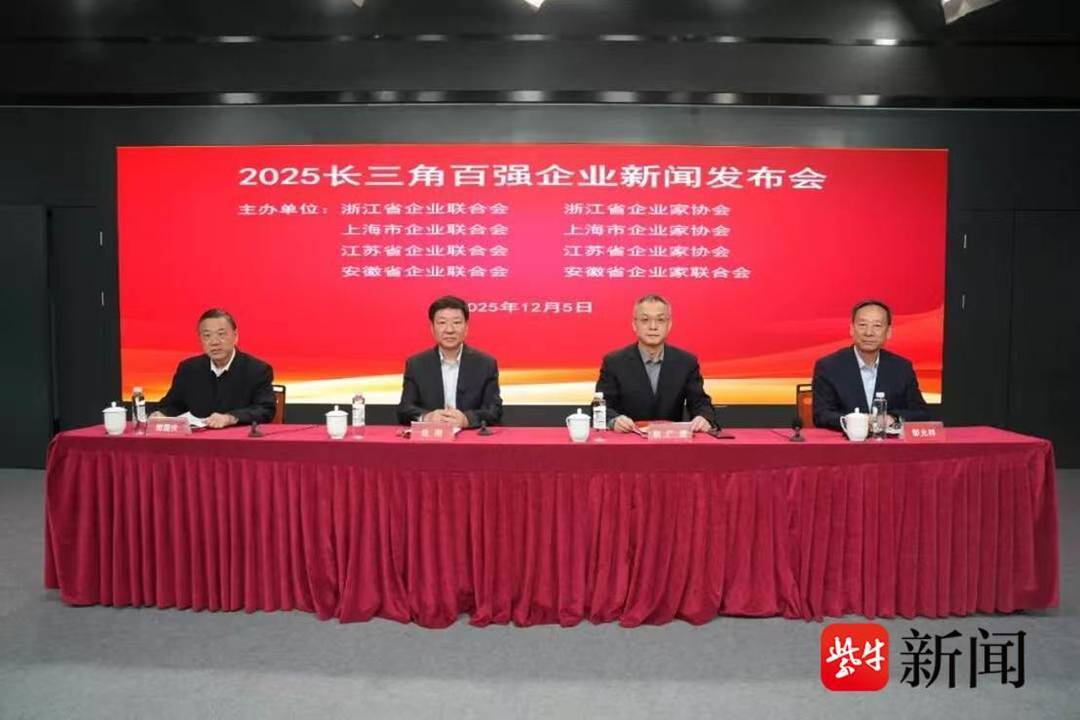
Group 1 - The 2025 Yangtze River Delta Top 100 Enterprises conference was held in Shanghai, where rankings for the top 100 enterprises and private enterprises were released along with development reports [1] - In 2024, the total revenue of the top 100 enterprises in the Yangtze River Delta reached 21.4 trillion yuan, an increase of 6.7647 billion yuan, representing a growth of 3.27% year-on-year [1] - The average revenue per enterprise reached 2.1373 billion yuan, with the entry threshold set at 767.3 million yuan [1] - Net profit for the top 100 enterprises exceeded 1 trillion yuan, reaching 1.02435 trillion yuan, an increase of 134.15 billion yuan, or 15.07% year-on-year [1] - The total tax payment reached 795.87 billion yuan, an increase of 8.6 billion yuan, or 1.09% year-on-year [1] - Private enterprises made a significant showing, with 54 making the list, an increase of 5 from the previous year, and their revenue reached 12.1 trillion yuan, accounting for 56.61% of the total [1] Group 2 - Jiangsu province had 24 enterprises listed among the top 100, an increase of 1 from the previous year, with Hengli Group Co., Ltd. ranked 3rd and Shenghong Holding Group Co., Ltd. ranked 7th [2] - The listed enterprises from Jiangsu primarily operate in industries such as petrochemicals, metallurgy, commercial banking, new energy, apparel, and construction machinery [2] - The 24 listed enterprises in Jiangsu achieved a combined revenue of 4.3 trillion yuan in 2024, a year-on-year growth of 2.92% [2] - The total assets of these enterprises reached 10.3 trillion yuan, reflecting a year-on-year increase of 12.19% [2] - Research and development expenses amounted to 58.2 billion yuan, representing a year-on-year growth of 4.8% [2]
2025长三角百强企业榜单揭晓江苏24家企业上榜
Xin Hua Ri Bao· 2025-12-08 23:10
Group 1 - The 2025 Yangtze River Delta Top 100 Enterprises conference was held in Shanghai, where rankings for the top 100 enterprises and top 100 private enterprises were released along with development reports [1] - In 2024, the total revenue of the top 100 enterprises in the Yangtze River Delta reached a record high of 21.4 trillion yuan, an increase of 676.47 billion yuan, or 3.27% year-on-year [1] - The average revenue per enterprise reached 2.1373 billion yuan, with the entry threshold set at 767.3 million yuan [1] - Net profit for the top 100 enterprises exceeded 1 trillion yuan, reaching 1.02435 trillion yuan, an increase of 134.15 billion yuan, or 15.07% year-on-year [1] - The total tax paid by these enterprises reached 795.87 billion yuan, an increase of 8.6 billion yuan, or 1.09% year-on-year [1] - Private enterprises showed strong performance, with 54 making the list, an increase of 5 from the previous year, and their revenue reached 12.1 trillion yuan, accounting for 56.61% of the total [1] Group 2 - Jiangsu province had 24 enterprises on the list, an increase of 1 from the previous year, with Hengli Group Co., Ltd. ranked 3rd and Shenghong Holding Group Co., Ltd. ranked 7th [2] - The 24 enterprises from Jiangsu achieved a total revenue of 4.3 trillion yuan in 2024, a year-on-year increase of 2.92% [2] - The total assets of these enterprises reached 10.3 trillion yuan, a year-on-year increase of 12.19% [2] - Research and development expenses amounted to 58.2 billion yuan, reflecting a year-on-year increase of 4.8% [2]
江苏24家企业上榜2025长三角百强
Yang Zi Wan Bao Wang· 2025-12-08 15:38
Core Insights - The 2025 Yangtze River Delta Top 100 Enterprises list was released, highlighting the growth and performance of companies in the region [1][3] Group 1: Overview of the 2025 Yangtze River Delta Top 100 - The list includes 24 companies from Jiangsu, an increase of 1 from the previous year [3] - Key companies in the top 10 include Hengli Group (ranked 3rd) and Shenghong Holding Group (ranked 7th) [3] Group 2: Financial Performance of Top Enterprises - The 24 listed companies are projected to achieve a total revenue of 4.3 trillion yuan in 2024, reflecting a year-on-year growth of 2.92% [3] - Total assets of these companies amount to 10.3 trillion yuan, with a year-on-year increase of 12.19% [3] - Owner's equity stands at 1.9 trillion yuan, up by 9.34% year-on-year [3] - Research and development expenses are expected to reach 582.1 billion yuan, marking a growth of 4.80% [3] - The total number of employees across these companies is 704,000, which is a 4.80% increase [3] Group 3: Performance of Private Enterprises - The number of private enterprises in the Top 100 has surpassed half, reaching 54, an increase of 5 from the previous year [4] - Private enterprises generated 12.1 trillion yuan in revenue, accounting for 56.61% of the total, marking a significant milestone [4] - The revenue growth rate for private enterprises was 9.51%, exceeding the average growth rate of the Top 100 by 6.24 percentage points [4] - Net profit for private enterprises grew by 23.65%, outpacing the average growth rate of the Top 100 by 8.58 percentage points [4] Group 4: Sector-Specific Insights - The manufacturing sector, particularly in integrated circuits and computers, has shown rapid growth [4] - The service sector also demonstrated revenue growth, with significant profit increases in internet services, water transportation, and insurance [4] - The strong performance of internet service companies has been a key driver of the overall growth in the Yangtze River Delta Top 100 [4]